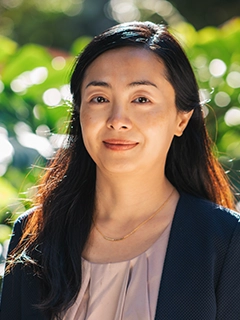
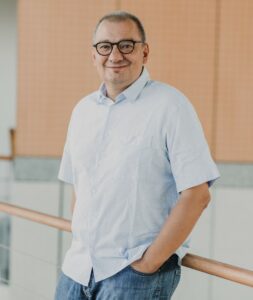
Feng Yao is a Professor and Department Chair in Economics at West Virginia University. He specializes in theoretical and applied econometrics, focusing on nonparametric and semiparametric methods, production frontier and efficiency analysis, risk management, and regression structure testing. His secondary research area is Industrial Organization. Ph.D. in Economics from Oregon State University (2004) B.A. in Economics from Renmin University of China (1999) Contact: 304-293-7867 | Feng.Yao@mail.wvu.edu | 4129 Reynolds Hall
Yongyi Guo serves as an Assistant Professor in the Department of Statistics at the University of Wisconsin-Madison, following a postdoctoral fellowship at Harvard University under Susan A. Murphy. Her academic foundation includes a Ph.D. in Statistics from Princeton University (2022) advised by Jianqing Fan and a B.S. in Mathematical Sciences from Peking University (2016). Dr. Guo's research integrates statistical learning with digital health applications, specializing in reinforcement learning for personalized mobile interventions and causal inference methodologies. Her work demonstrates particular expertise in micro-randomized trials for cannabis use reduction, where she developed the MiWaves and reBandit algorithms to optimize just-in-time adaptive interventions through online decision-making frameworks. Analysis of her publication trends reveals consistent focus on bridging theoretical statistics with health implementation challenges, featuring innovations in anytime-valid inference for N-of-1 trials, communication-efficient distributed estimation, and robust regression techniques for dependent data structures.
Chinthaka Kuruwita is an Associate Professor of Statistics at Hamilton College, affiliated with the Department of Mathematics and Statistics. His research focuses on developing advanced regression models and statistical methodologies for diverse applications including public health and network security. Ph.D. in Mathematical Sciences, Clemson University M.S. in Mathematical Sciences, Clemson University B.Sc. in Statistics, University of Colombo Kuruwita's work spans nonparametric and semiparametric statistical techniques, with notable contributions to quantile regression, censored data analysis, and anomaly detection. His research has been applied to adolescent suicide risk modeling and speaker recognition systems. His publications demonstrate expertise in asymmetric kernel density estimation, varying coefficient models, and robust statistical approaches for complex datasets. Key journals include Biometrika, Journal of Statistical Planning and Inference, and IEEE Symposium on Circuits & Systems. Scientific Awards Clayton V. Auconi Outstanding Master's Student Award (2005-06) Sri Lanka Association for the Advancement of Science Best Undergraduate Research (2004) University of Colombo Statistics Gold Medal (2003) V.W. Samaranayake Memorial Gold Medal (2003) Kuruwita teaches courses in mathematical statistics and statistics seminar topics, contributing to data science education at Hamilton College.
Jiang Xuejun is an Associate Professor in the Department of Statistics and Data Science at Southern University of Science and Technology (SUSTech). He has been with SUSTech since 2013, initially as a Tenure-Track Assistant Professor and promoted to Associate Professor in 2019. Prior to joining SUSTech, he served at Zhongnan University of Economics and Law. His educational background includes: Ph.D. in Statistics from The Chinese University of Hong Kong (2009) M.Sc. from Yunnan University B.Sc. from National University of Defense Technology Jiang Xuejun's research focuses on advanced statistical methodologies with applications in various domains. His work spans statistical theory development and practical applications in finance, economics, and risk assessment. He has made significant contributions to quantile regression, variable selection, survival analysis, and nonparametric regression methods. His research publications demonstrate a strong trend toward developing innovative statistical methods for high-dimensional data analysis, Bayesian modeling approaches, and applications in financial econometrics and disaster risk assessment. Many of his recent papers focus on quantile regression techniques, dimension reduction methods, and robust statistical testing procedures. Jiang Xuejun has received several prestigious awards: Shenzhen Outstanding Teacher (2018) Southern University of Science and Technology "Outstanding Teaching Award" (2018) "Excellent Mentor Award" from Southern University of Science and Technology (2016) Selected for Shenzhen's "Peacock Plan" for overseas high-level talents He has successfully secured multiple research grants as Principal Investigator, including projects funded by the National Natural Science Foundation of China (both General and Youth programs), Guangdong Provincial Natural Science Foundation, and Shenzhen Science and Technology Innovation Commission. His research portfolio includes work on likelihood inference for high-dimensional models, statistical methods for epidemic disease control, and quantitative trading systems using machine learning. Jiang maintains an active research group focusing on statistical methodology development and applications, with particular emphasis on financial statistics and econometrics. His team collaborates with researchers across multiple disciplines to address complex data analysis challenges in economics, finance, and public health.
Bingkai Wang is an Assistant Professor in the Department of Biostatistics at the University of Michigan School of Public Health. His research focuses on causal inference, clinical trials, and statistical methods for complex data. PhD in Biostatistics from Johns Hopkins University (2021) BS in Mathematics from Fudan University (2016) His work spans causal inference , machine learning , and test-negative designs in infectious disease research, with methodological contributions to semiparametric efficiency theory and cluster-randomized trials . Recent articles highlight advancements in model-robust inference , stepped-wedge trial designs , and handling incomplete outcomes in clinical trials. He has received multiple awards, including the 2024 IMS New Researcher Travel Award and the Margaret Merrell Award . Contact: bingkai@umich.edu
Christopher Frank Parmeter is an Associate Professor in the Economics department at the Miami Herbert Business School, University of Miami. His research focuses on econometric methodology and applied economic analysis. Role: Assoc. Professor Email: c.parmeter@miami.edu ORCID: 0000-0001-6123-0107 His research spans econometrics, stochastic frontier analysis, and measurement error correction. Recent work explores robotics' economic impact, bank efficiency under exchange rate volatility, and robust nonparametric techniques. Key publication trends include Bayesian stochastic frontier models, nonparametric inference, and empirical applications in tourism and finance. While specific awards are not detailed, his work contributes significantly to econometric theory and applied economics.
Lan Wang is a Centennial endowed chair professor and Department Chair of the Department of Management Science at the Miami Herbert Business School, University of Miami. She holds secondary appointments as Professor in the Department of Health Management and Policy within the Miami Herbert Business School and as Professor in the Department of Public Health Sciences at the Miller School of Medicine. Dr. Wang earned her Ph.D. in Statistics from Pennsylvania State University and her Bachelor's degree in Applied Mathematics from Tsinghua University, China. Prior to joining the University of Miami, she was a Professor of Statistics at the School of Statistics, University of Minnesota. Dr. Wang's research spans several interrelated areas including high-dimensional statistical learning, quantile regression, reinforcement learning, optimal personalized decision recommendation, survival analysis, and business analytics. Her work is characterized by strong methodological development with applications in business, economics, healthcare, and other domains. She is particularly interested in interdisciplinary collaboration that addresses real-world problems through innovative statistical approaches. Her research has significant implications for precision medicine, where she develops methods to identify optimal individualized decision rules to improve patient outcomes. Dr. Wang's recent publications demonstrate a consistent focus on advancing statistical methodology for high-dimensional data analysis and personalized decision making. Her work bridges theoretical statistics with practical applications, particularly in healthcare analytics. She has made significant contributions to quantile regression theory, high-dimensional regression techniques, optimal treatment rules, and statistical learning frameworks. A notable theme across her publications is the development of robust methods that maintain performance even with heavy-tailed error distributions. Fellow of the American Statistical Association Fellow of the Institute of Mathematical Statistics Member of the International Statistical Institute Dr. Wang has served as Co-Editor for Annals of Statistics (2022-2024) and as associate editor for several leading statistical journals including Journal of the American Statistical Association, Annals of Statistics, Journal of the Royal Statistics Society, and Biometrics. Her editorial leadership reflects her standing in the statistical community and her commitment to advancing methodological research. While specific grant details aren't provided, her extensive publication record in top-tier journals suggests substantial research funding supporting her work.
Ganggang Xu is an Associate Professor (with tenure) in the Department of Management Science at the Miami Herbert Business School , University of Miami . He specializes in advanced statistical methodologies, particularly in nonparametric and semiparametric modeling, spatial statistics, and point process theory. Education: Ph.D. in Statistics, Texas A&M University (2011) B.S. in Statistics, Zhejiang University (2006) Research Interests: His research spans several key areas in modern statistics and data science. He has made significant contributions to nonparametric and semiparametric regression , particularly in the context of functional data analysis and spatial-temporal modeling . His work on point processes includes marked, multivariate, and clustered point processes, with applications ranging from neuroscience to social media behavior. He also explores Bayesian hierarchical models and model selection techniques, often integrating computational efficiency with theoretical rigor. Publications Overview: His recent publications (2023–2025) reflect a strong focus on machine learning-enhanced statistical modeling , including tree-based estimation of intensity functions, network autoregressive models, and quantized inference. He has also contributed to applied domains such as medical imaging and inventory control , demonstrating the broad applicability of his methodological work. Grants & Collaborations: While specific grants are not listed in the provided text, his extensive publication record with multiple co-authors across institutions suggests active collaboration and possible funding from NSF or NIH-equivalent bodies in statistics and data science. Labs & Teams: Though no specific lab is mentioned, his affiliations and co-authorships imply involvement in interdisciplinary research teams at the University of Miami, especially within the business analytics and statistical modeling domains.
Massimo Costabile is a Full Professor of Mathematical Methods for Economics, Actuarial and Financial Sciences at the Department of Economics, Statistics and Finance 'Giovanni Anania' (DESF) of Università della Calabria, where he also serves as Department Director. He teaches Quantitative Models in Finance in the Master's degree course in Finance and Insurance and Financial Mathematics in the Mathematics degree program. Laurea in Economic and Social Sciences, Università della Calabria (1993) PhD in Actuarial Science, Sapienza Università di Roma (1996) Research Interests: His work focuses on computational finance, life insurance policy valuation, and analytical methods for complex financial instruments. Key areas include: Numerical methods for derivative securities and insurance products Stochastic volatility modeling in financial and actuarial contexts Regime-switching and jump-diffusion option pricing frameworks Guaranteed minimum withdrawal benefits (GMWB) in variable annuities Risk capital requirements under CVaR constraints Discrete-time lattice approaches for financial modeling Recent Research Trends: Recent publications examine stochastic correlation in life insurance pricing, mixed fractional Brownian motion applications, and semiparametric models for non-life insurance capital allocation. His work combines binomial lattice techniques with advanced volatility models to address insurance risk and financial derivative valuation challenges. Administration & Collaborations: As Department Director, he oversees academic operations while collaborating with national and international researchers. He serves on editorial boards and peer-review panels for journals like Decisions in Economics and Finance and Insurance: Mathematics and Economics. Laboratories: Co-manages the Multimedia Teaching Lab (Laboratorio di Didattica Multimediale) and Informatica 3 Lab at DESF, focusing on didactic applications of computational methods in economics and finance education.
Alessandro Staino is an Associate Professor in the Department of Economics, Statistics and Finance at the University of Calabria, where he teaches Mathematical Methods for Economics and Mathematics for Finance and Actuarial Science across multiple degree programs including Statistics for Data Science, Finance and Insurance, and Business Administration. His educational background includes: Degree in Statistical and Actuarial Science from the University of Calabria MPhil from Brunel University PhD from the University of Bergamo Postdoctoral fellowship at the University of Palermo Staino's research centers on mathematical finance and actuarial science, with core expertise in contingent claims pricing, risk management, and portfolio optimization. He develops advanced lattice-based models to address complex financial and insurance problems under stochastic correlation and volatility frameworks, contributing significantly to life insurance pricing and derivative valuation methodologies. His recent publications (2023-2025) reveal a consistent focus on lattice-based approaches for pricing insurance products and financial derivatives under multiple risk factors. These works integrate stochastic correlation, fractional Brownian motions, and robust covariance estimation to solve problems in life insurance, mortality bonds, and variable annuities, demonstrating strong interdisciplinary connections between actuarial science, quantitative finance, and computational mathematics. No scientific awards were mentioned in the provided information. While specific advising details and grant information were not documented in the scraped text, his collaborative research patterns indicate active engagement with international scholars across finance and actuarial domains. Staino is an integral member of the Quantitative Methods for Economics, Finance and Management research group at DESF, which develops mathematical programming models, econometric techniques, and statistical tools for decision-making in finance, actuarial science, industrial economics, transport, and logistics.
Valentin Patilea is a Full Professor of Statistics at the National School of Statistics and Information Analysis (ENSAI) in France and serves as Head of the PhD program. He is a Permanent Member of CREST (Center for Research in Economics and Statistics), a prominent research center in economics and statistics. His academic career spans institutions across Europe, with significant contributions to statistical methodology and applications. Professor Patilea's educational background includes a Habilitation à diriger des recherches in Mathematics from the University of Rennes 1 (2006), a PhD in Statistics from Université catholique de Louvain (1997), an MSc in Mathematical Economics and Econometrics from Université Toulouse I (1993), and an MSc in Mathematics from the University of Bucharest (1989). His research focuses on advanced statistical methodologies, particularly in semi and nonparametric statistics, survival analysis, time series analysis, econometrics, and functional data analysis. Patilea's work bridges theoretical statistics with practical applications across various domains, developing innovative methods for complex data structures and dependencies. His research has significantly advanced methodologies for functional data, cure models, and weakly dependent time series. Analysis of Patilea's recent publications reveals a strong emphasis on functional data analysis, with particular attention to adaptive estimation methods, irregular data structures, and computational efficiency. His work spans theoretical developments in statistical methodology while maintaining connections to practical applications in economics and other fields. The publications demonstrate increasing sophistication in handling complex data structures, particularly multivariate functional data and dependent observations. Professor Patilea actively contributes to the academic community through editorial service, currently serving as Associate Editor for Bernoulli Journal (since 2022) and Statistical Methods and Applications (since 2025). Previously, he served on the editorial boards of the Journal of the Royal Statistical Society: Series B and the Journal of the American Statistical Association. He has supervised numerous PhD students, including current candidates Omar Kassi, Hassan Maissoro, and Daphne Aurouet, and has previously guided successful dissertations by Sunny Wang, Guillaume Flament, Edouard Genetay, and others. His supervision spans theoretical statistics, functional data analysis, and econometric applications. Professor Patilea leads the FunStatMath research initiative focused on Functional Data Analysis, which addresses mathematical challenges posed by data that naturally occur as curves or surfaces rather than vectors. This network connects researchers working on theoretical developments and applications across neuroscience, environmental sciences, and biology.
François Portier is an Associate Professor at CREST-ENSAI (École Nationale de la Statistique et de l'Analyse de l'Information) and Head of the Master for Smart Data Science program. He serves as Associate Editor for both the Electronic Journal of Statistics and Computational Statistics & Data Analysis . His research spans Monte Carlo Methods , Statistical Learning , and Semiparametric/Nonparametric Statistics , with focus areas including stochastic optimization, probability measure approximation, and local-averaging estimators. Recent work demonstrates strong computational statistics emphasis in adaptive sampling techniques and model validation frameworks. His publication trends reveal concentrated contributions to Stochastic optimization algorithms (2025) Dimension reduction in classification (2025) Covariate shift adaptation (2025) Density model diagnostics (2025) showcasing methodological innovation in high-dimensional statistical inference. Portier maintains active academic service through editorial roles and leads ENSAI's Smart Data Science program, bridging theoretical statistics with data science applications.
Professor Georgios Iliopoulos is a distinguished academic serving as Professor and Department Chair of the Department of Statistics and Actuarial Science at the University of Piraeus. With an extensive academic career spanning over two decades, Professor Iliopoulos has established himself as a leading expert in statistical theory and methodology. His leadership as Department Chair demonstrates his significant contribution to the academic community and his commitment to advancing statistical education and research. Professor Iliopoulos completed his educational journey at the University of Patras, earning his B.A. in Mathematics in 1993 followed by a PhD in Statistics in 1999. His academic career progressed through various institutions before he settled at the University of Piraeus, where he has held positions from Assistant Professor (2003-2010) to Associate Professor (2010-2015) and ultimately to Professor (2015-present). Professor Iliopoulos's research focuses on several key areas of statistical theory, with particular emphasis on Markov chain Monte Carlo methods, Statistical Decision Theory, Scale parameter estimation, Accurate inference under censorship, and Constrained inference arrangement. His work bridges theoretical statistics with practical applications, demonstrating how sophisticated statistical methods can solve real-world problems across various domains. His research has consistently addressed challenging theoretical questions while maintaining relevance to practical statistical challenges faced by researchers and practitioners. Analysis of Professor Iliopoulos's publication record reveals a strong focus on theoretical statistics with applications in reliability analysis, Bayesian inference, and censoring methodologies. His work demonstrates a consistent pattern of advancing statistical theory while maintaining practical relevance, particularly in the areas of parameter estimation, confidence interval construction, and inference with censored data. The interdisciplinary nature of his research is evident in publications spanning journals in statistics, biostatistics, and computational statistics. Professor Iliopoulos is actively involved in teaching both undergraduate and postgraduate courses. At the undergraduate level, he teaches Linear Algebra, Statistics II: Hypothesis Testing, and Special Topics in Statistics (Bayesian Statistics). For postgraduate students, he offers Computational Statistical Techniques as part of the Master of Science in Applied Statistics program. His teaching reflects his research expertise, providing students with both theoretical foundations and practical applications of advanced statistical methods.
Panagiotis Lorentziadis serves as faculty at the Department of Business Organization and Administration within the School of Business Administration at Athens University of Economics and Business, where he teaches Quantitative Methods courses. His research focuses on quantitative methodologies for business decision-making , with particular expertise in statistical modeling for financial forecasting and operations research applications. His work bridges theoretical statistics with practical business administration challenges, emphasizing semiparametric approaches to complex evaluation problems. Key recognitions include: Distinction award from the Hellenic Mathematical Society Certificate of Outstanding Contribution from the US Department of Defense His publication record spans prestigious journals including the European Journal of Operational Research , Omega , and Operational Research , demonstrating consistent contributions to quantitative business methodologies. Professional experience includes prior academic appointments at the University of California, Berkeley and University of La Verne.
Dr. Wanzhu Tu is a faculty member at Indiana University with multiple roles: Professor of Biostatistics & Health Data Science Executive Vice Chair of the Department of Biostatistics & Health Data Sciences Adjunct Professor in the School of Public Health Scientist at the Indiana University Center for Aging Research Dr. Tu is an applied statistician specializing in nonparametric and semiparametric models. His research focuses on modeling biological processes in diseases like hypertension, and he develops methods for longitudinal data analysis and survival analysis. Applications include aging, chronic kidney disease, and public health. His recent publications highlight methodological innovations in clustering, causal inference, and semiparametric modeling. Applied work addresses hypertension, chronic kidney disease, aging, and public health using large health datasets, including electronic health records and longitudinal studies. Dr. Tu's advising of students and grant funding activities are not detailed in the provided information. He is affiliated with the Indiana University Center for Aging Research, contributing to interdisciplinary aging research.

_meitu_1.jpg)