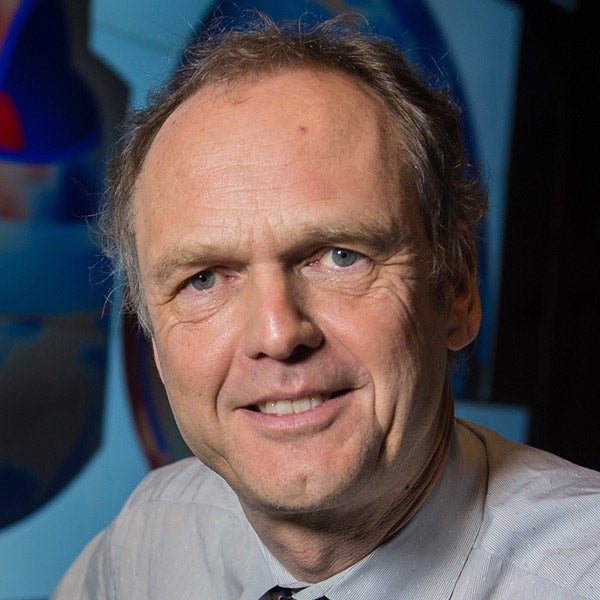
Maarten de Hoop is the Simons Chair and Professor of Computational and Applied Mathematics at Rice University, part of the George R. Brown School of Engineering. He holds visiting roles at MIT and the Chinese Academy of Sciences. His research spans seismic wave analysis, inverse problems, deep learning, and planetary seismology. He earned his Ph.D. in Technical Sciences from Delft University of Technology (1992), and earlier degrees from Utrecht University. Notable awards include the 1996 J. Clarence Karcher Award and 2001 Fellowship from the Institute of Physics. His work integrates computational mathematics with geophysics, focusing on extracting signal information from large datasets, developing novel inverse scattering methods, and applying deep learning to geoscience challenges. Recent studies include transformer models for in-context learning, semialgebraic neural networks, and seismic waveform foundation models like SeisLM. He leads the Geo-Mathematical Imaging Group, fostering interdisciplinary projects in planetary missions and data-driven discovery.
Damek Davis serves as an Associate Professor of Statistics and Data Science and Co-Academic Director of the Dual Master's Degree in Statistics at the Wharton School, University of Pennsylvania. His academic base is the Department of Statistics and Data Science within the Wharton School, with his office located at the Academic Research Building in Philadelphia, PA. His research expertise centers on optimization theory for data science, with deep specialization in nonsmooth and stochastic optimization problems. Key focus areas include convergence analysis of first-order methods, variance reduction techniques, and theoretical guarantees for algorithms in nonconvex settings. His work bridges mathematical rigor with practical applications in machine learning and statistical inference, particularly in developing efficient computational frameworks for large-scale data analysis. Analysis of his 2022-2024 publications reveals dominant themes in optimization for modern data challenges: nonsmooth stochastic approximation, linear convergence under sharpness conditions, and global optimality in mixture models. His research consistently appears in premier venues across optimization (Mathematical Programming, SIAM Journal), statistics (The Annals of Statistics), and machine learning (IEEE Transactions), demonstrating cross-disciplinary impact in both theoretical foundations and computational methodologies.
Mahir Can is a Professor of Mathematics at Tulane University, affiliated with the School of Science & Engineering. His research focuses on Algebraic Combinatorics and Geometry, with particular emphasis on algebraic structures, monoid theory, and geometric representation theory. He holds a Ph.D. in Mathematics from the University of Pennsylvania (2006) and a B.S. in Mathematics from Middle East Technical University (2001). His work explores intersections between combinatorics, algebraic geometry, and coding theory, including studies on Schubert varieties, toric varieties, and error-correcting codes derived from algebraic structures. Recent research highlights include investigations into irreducible numerical monoids, spherical varieties, and the geometry of flag manifolds. Publications span topics such as metric space constructions via directed graphs, applications of homogeneous fiber bundles, and generalized conjectures in combinatorial monoid theory. No scientific awards or grants are explicitly listed in the provided text. Dr. Can’s advising record and lab affiliations are not detailed here, though his academic profile reflects active engagement in advanced mathematical research and education.
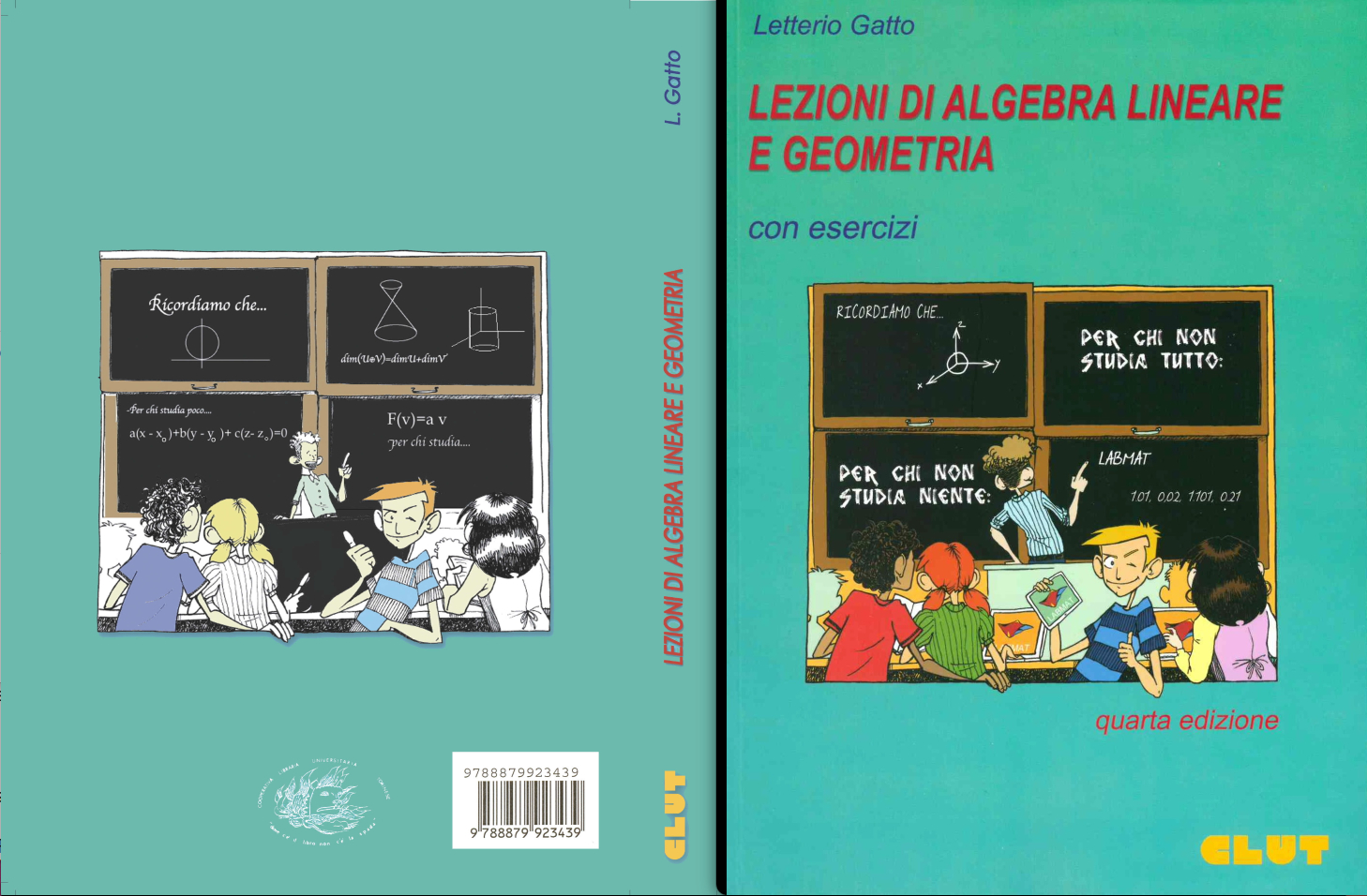
Letterio Gatto is a Tenured Associate Professor in the Department of Mathematical Sciences (DISMA) at Politecnico di Torino, Italy. His research focuses on algebraic geometry, commutative algebra, and their connections to mathematical physics. He has held visiting positions at Brazilian institutions including Fundação de Amparo à Pesquisa do Estado de São Paulo (FAPESP) and Conselho Nacional de Desenvolvimento Científico e Tecnológico. Gatto has been actively involved in international collaborations, particularly between Italy and Brazil, and has received several research awards including the Collectanea Mathematica's Distinguished Paper Award. His educational background includes a Laurea in Matematica from Università di Torino (1987, 110/110 e Lode), a Dottorato di Ricerca in Matematica from Consorzio Universitario Torino-Genova (1988-1992), a Visiting Ph.D. student position at Boston University (January-June 1990), and a Postdoc at Rijkuniversiteit te Utrecht (1994-1995) with a NATO fellowship. Gatto's research spans several interconnected areas in mathematics. His primary focus is on the application of Hasse-Schmidt derivations on exterior algebras to symmetric polynomials and Schubert calculus. He investigates vertex operators in Heisenberg's vertex algebra and their connections to bosonic and fermionic representations of infinite-dimensional Lie algebras. His work also extends to Wronskians and ordinary differential equations with indeterminate coefficients, as well as families of special Weierstrass points on complex algebraic curves. These research threads converge in his development of the theory of Hasse-Schmidt Derivations on Exterior Algebras (HiDEAs). Gatto's recent publications demonstrate a consistent focus on algebraic structures related to exterior algebras and their applications. His work bridges commutative algebra, representation theory, and algebraic geometry. A notable trend is the exploration of connections between Grassmann algebras, Clifford algebras, and Lie algebra representations. His research has increasingly incorporated vertex operator techniques and their applications to Schubert calculus. The collaborative nature of his work is evident through partnerships with mathematicians across Europe and the Americas. His major awards include: Collectanea Mathematica's Distinguished Paper Award (2022) MARM AWARD (Mentoring African Research in Mathematics) by London Mathematical Society Cientista Visitante fellowship from FAPESP (multiple periods) Gatto has served on PhD committees at Università degli Studi di Torino for multiple cycles (32nd-34th). He has been a scientific responsible for the MARM Partnership project (2024-2025) between Politecnico di Torino and University of Lubumbashi. His grant activities include the MARM program (2020-2022) mentoring mathematics research at the University of Namibia. He has organized several international meetings including 'Mathematics Building Partnership with Africa' (2023) and 'A Fall Meeting in Algebraic Geometry and Related Topics' (2017). Gatto is part of the 'Algebraic, Computational and Differential Geometry' research group at DISMA and has been an active peer reviewer for numerous mathematical journals.
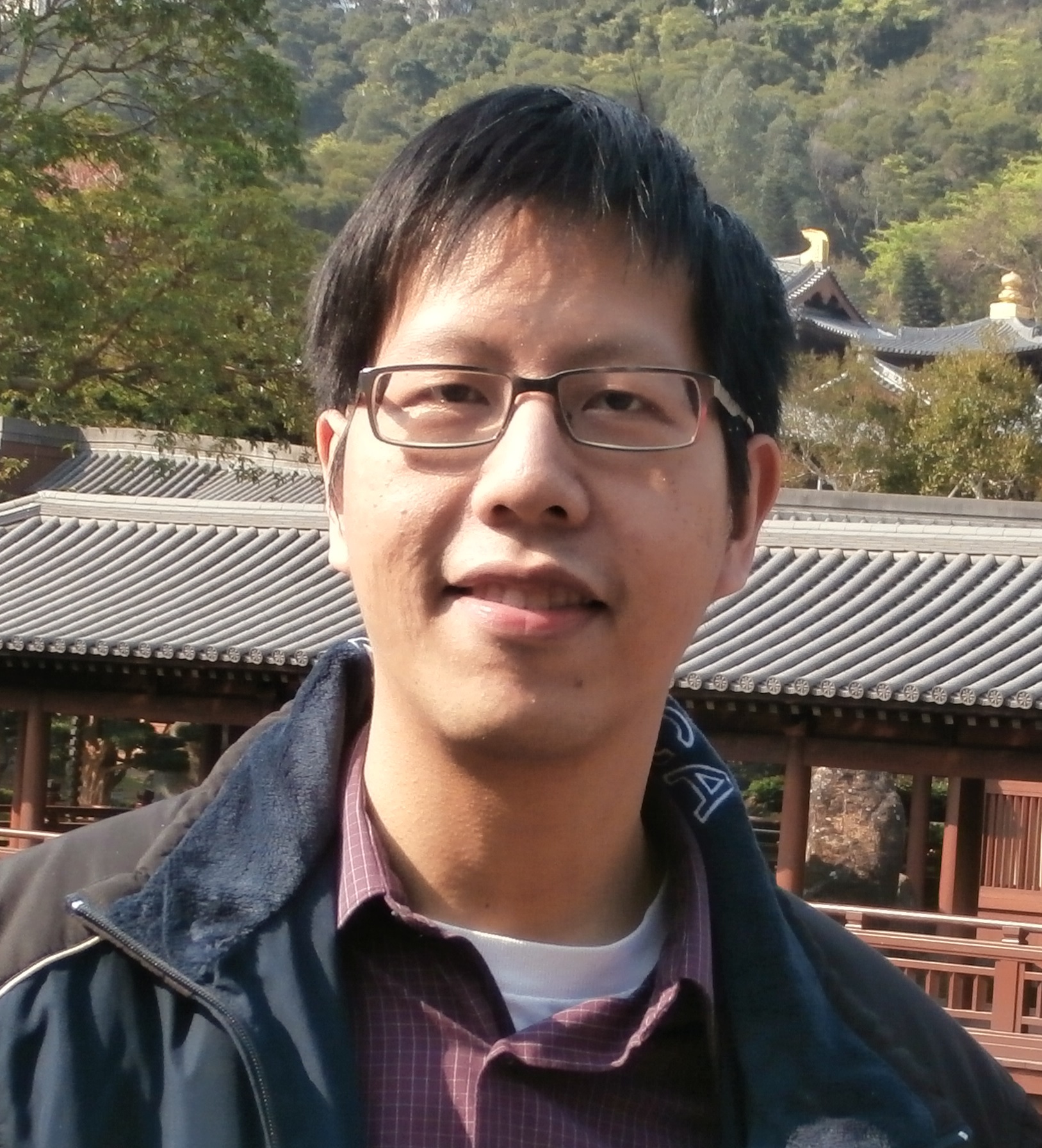
Timothy Moon-Yew Chan is a Founder Professor in Computer Science at the Siebel School of Computing and Data Science, University of Illinois at Urbana-Champaign. Previously, he taught at the Cheriton School of Computer Science, University of Waterloo from 1999 to 2016. His distinguished career in theoretical computer science has earned him the prestigious Founder Professorship at UIUC. Chan's research focuses on algorithms and computational geometry, with particular expertise in geometric data structures, fine-grained complexity, and geometric optimization problems. His work bridges theoretical foundations with practical applications, exploring the limits of efficient computation for geometric problems. He has made significant contributions to problems involving convex polygons, geometric set cover, shortest paths in geometric graphs, and computational geometry in moderate dimensions. His extensive publication record demonstrates a consistent research trajectory in computational geometry, with recent work advancing techniques like the shrink-and-bifurcate method, improving algorithms for geometric problems, and exploring connections between fine-grained complexity and geometric computation. His publications appear regularly in top venues including SoCG, SODA, STOC, and FOCS, as well as leading journals like Discrete and Computational Geometry and SIAM Journal on Computing. Chan serves on editorial boards for Algorithmica, Discrete and Computational Geometry, and Computational Geometry: Theory and Applications. He has been active in program committees for major conferences including STOC'25 (as chair for ESA'24), SODA'24, STOC'23, SoCG'22, and many others across the theoretical computer science landscape. He teaches advanced courses in algorithms, computational geometry, and data structures at UIUC, including CS 374 (Algorithms and Models of Computation), CS 473 (Algorithms), and specialized 498/598 courses on computational geometry, advanced data structures, and fine-grained algorithms. His teaching has been recognized with multiple honors, including being named on the CITL List of Teachers Ranked as Excellent By Their Students.
Nathanaël Fijalkow is a Researcher at CNRS in LaBRI (Bordeaux) and a Research Fellow at The Alan Turing Institute in London. His primary research fields include games , machine learning , automata theory , and dynamical systems , with a focus on synthesizing programs from logical specifications and probabilistic models. Research Interests span program synthesis (programming by example), controller synthesis (temporal logic specifications), games on graphs (parity/mean payoff games), probabilistic automata (bounded ambiguity), and invariants for linear dynamical systems. He bridges formal methods with machine learning through projects like DeepSynth . Scientific Contributions include: Undecidability results for probabilistic automata Advances in parity game algorithms (quasi-polynomial lower bounds) Foundations of probabilistic modal logics Efficient synthesis techniques using SMT solvers and distributional learning Supervision involves guiding postdocs and PhD students such as Guillaume Lagarde, Antonio Casares, and Pierre Ohlmann. He has secured grants like the Momentum DeepSynth project (2019-2021) , aiming to merge formal methods with ML for program synthesis.
Felix Gotti is an NSF Postdoctoral Fellow and Instructor in Applied Mathematics at the Massachusetts Institute of Technology (MIT), Department of Mathematics within the School of Science. He earned his PhD in Mathematics from UC Berkeley in 2019 under the supervision of Prof. Lauren Williams. Prior to his position at MIT, he was an Exchange Graduate Scholar at Harvard University and a Postdoctoral Researcher at the University of Graz (Austria) and the University of Florida. His educational background includes: PhD in Mathematics, UC Berkeley (2019) Gotti's research centers on Algebra and Combinatorics, with a primary focus on the phenomenon of non-uniqueness of factorizations into irreducibles in integral domains and atomic monoids. He employs techniques from combinatorics, linear algebra, and number theory to investigate these structures. His combinatorial research focuses on posets and matroids, while he also maintains interests in polyhedral geometry and cluster algebras. His work bridges abstract algebraic theory with concrete combinatorial applications, creating connections between seemingly disparate mathematical domains. Analysis of Gotti's publication record reveals a consistent focus on factorization theory across algebraic structures. His research spans semigroup rings, Puiseux monoids, semirings, and polynomial rings, examining properties like atomicity, elasticity, and length-factoriality. The interdisciplinary nature of his work connects commutative algebra, combinatorics, and geometry, with applications in understanding the structural properties of various algebraic objects. His scientific recognition includes the prestigious NSF Postdoctoral Fellowship, which supports his research at MIT. NSF Postdoctoral Fellow Gotti is deeply committed to mentoring and advising students. He serves as the Group Research Coordinator of MIT PRIMES, a program introducing high school students to research in mathematics, computer science, and computational biology. He has supervised numerous students including Cecilia Aguilera, Khalid Ajran, Sofia Albizu-Campos, and others who have produced significant research papers. His mentees have received notable awards including the Spirit of Ramanujan Fellowship, Regeneron Science Talent Search recognition, and awards from the American Mathematical Society. Gotti also serves as the Lead Mentor of CrowdMath, a free year-long online research program open to high-schoolers and undergraduates worldwide. He has taught multiple courses at MIT including Combinatorial Analysis (18.211), Multivariable Calculus (18.02), and specialized topics like Ideal Theory and Prüfer Domains. As a member of the editorial board of Communications in Algebra, Gotti contributes to the scholarly community by reviewing mathematical research. His leadership in educational programs demonstrates his commitment to nurturing the next generation of mathematicians through structured research opportunities and mentorship.
Serge Randriambololona is a permanent Researcher at the French National Centre for Scientific Research (CNRS), specializing in the intersection of mathematical logic and geometry. His work bridges model theory with real algebraic and analytic geometry, focusing on structural properties of o-minimal systems and geometric tameness. His academic foundation includes a 2005 PhD from Université de Savoie (now Université Savoie Mont Blanc), supervised by Krzysztof Kurdyka and Patrick Speissegger. The doctoral thesis, Structures o-minimales, corps de Hardy et ensembles de petite arité , established his research trajectory in low-arity structures and Hardy fields. Randriambololona's research centers on tameness phenomena in geometric structures, with three core pillars: (1) O-minimal structures and their generation from low-arity relations, (2) Model-theoretic properties of real analytic and semialgebraic sets, particularly regarding complex dimension and holomorphic closures, and (3) Reducts of valued fields and polynomially bounded analytic structures. His work demonstrates how logical tameness constraints manifest in geometric regularity. His publication timeline from 2005-2016 reveals evolving depth in geometric model theory, starting with foundational o-minimality results, progressing through elimination theory for curves, and culminating in sophisticated analyses of tameness in complex-analytic contexts. Collaborations with Adamus, Shafikov, Starchenko, and Kowalski highlight interdisciplinary connections between logic, algebraic geometry, and complex analysis. As a CNRS researcher, he operates within France's national research infrastructure without university departmental affiliation. His email ( Serge.Randriambololona@math.cnrs.fr ) confirms his position in CNRS's mathematics division, though specific laboratory details aren't provided in available sources.
Tong Chen is a Postdoc in the Machine Learning section at the Department of Computer Science, University of Copenhagen, focusing on theoretical and applied machine learning with applications in information retrieval, medical data analysis, remote sensing, sustainability, and biological data modeling. His research spans adversarial machine learning, neural network compression, and robustness verification using polynomial and semialgebraic optimization techniques. Chen develops mathematically rigorous frameworks to enhance deep learning model efficiency, security, and reliability while addressing real-world implementation challenges. Chen's publication trajectory reveals increasing emphasis on formal verification methods and compression-robustness trade-offs, with recent work integrating semialgebraic geometry for neural network certification. This demonstrates a clear trend toward foundational approaches that bridge theoretical optimization and practical AI safety requirements. As part of the Machine Learning section, Chen contributes to the SCIENCE AI Centre and TreeSense initiative, utilizing the department's dedicated compute cluster for resource-intensive remote sensing and deep learning experiments in global environmental monitoring.
Prof. Dr. Peter Bürgisser is a Professor at the Technical University of Berlin, affiliated with the Institute of Mathematics and the Algorithmic Algebra research group within Faculty II - Mathematics and Natural Sciences. His research focuses on algebraic complexity theory, computational algebra, and geometric methods in computer science. Bürgisser has made significant contributions to topics including invariant theory, numerical analysis of algorithms, and the computational complexity of algebraic problems. He has authored influential books such as *Algebraic Complexity Theory* and has published extensively in top-tier journals like the Journal of the ACM and SIAM Journal on Computing. His work includes developing polynomial-time algorithms for problems in invariant theory, analyzing the condition numbers of algebraic varieties, and studying the computational aspects of semialgebraic sets. Bürgisser's research also intersects with probability theory, particularly in understanding the statistical properties of zeros of random polynomials and the geometry of random algebraic varieties. Recent trends in his publications emphasize geometric complexity theory, non-commutative optimization, and the application of numerical methods to algebraic problems. He has collaborated with researchers such as Felipe Cucker, Michael Walter, and Avi Wigderson on foundational topics in computational mathematics and theoretical computer science. Bürgisser's office is located in room EB 116, and his contact information includes the email pbuerg@math.tu-berlin.de. His research has been supported through grants and collaborations, though specific grant details are not explicitly mentioned in the provided texts.
James Worrell is a Professor of Computer Science at the University of Oxford, affiliated with Green Templeton College. He holds a prestigious UKRI Fellowship (equivalent to an ERC Advanced Grant) and an EPSRC Established-Career Fellowship. His research focuses on logic in computer science, linear dynamical systems, and automated verification, with applications to formal methods and decision procedures. He has held leadership roles on program committees for major conferences including POPL, CONCUR, FoSSaCS, and ICALP. Notable invited talks include the CRM Workshop on Fluid Dynamics and the MOD23 Summer School in Formal Verification. He currently advises PhD students like Julian D’Costa and collaborates with postdocs Bertrand Teguia and Jakub Konieczny. His research investigates decidability questions in linear systems, recurrence sequences, and matrix semigroups. He has pioneered techniques combining o-minimal geometry, automata theory, and model checking to analyze dynamical systems. Recent work addresses transcendence properties of numerical sequences and robustness in machine learning models. Awards include ERC and UKRI funding recognitions. He teaches advanced courses on logic and proof, automata theory, and computational learning theory at Oxford, with lecture materials available online. His work bridges theoretical computer science with applications in safety-critical systems and formal verification.
Themistoklis Melissourgos is a Lecturer (Assistant Professor) in the School of Computer Science and Electronic Engineering at the University of Essex. He is a member of the Artificial Intelligence research group and the Centre for Computational Finance and Economic Agents. Prior to joining Essex, he held postdoctoral positions at TU Munich in the Operations Research group under Prof. Andreas S. Schulz, and at the University of Liverpool. PhD in Computer Science, University of Liverpool (supervised by Prof. Paul Spirakis) BSc in Electrical and Computer Engineering, University of Patras His research lies at the intersection of Theoretical Computer Science and Economics , with a primary focus on Algorithmic Game Theory and Computational Social Choice . He investigates the computational complexity of problems in these domains and develops exact and approximation algorithms. His work often addresses fundamental questions in market equilibria, fair division, and strategic computation. The recent publications of Dr. Melissourgos span top-tier conferences such as FOCS , STOC , ICALP , AAAI , and AAMAS . A clear trend in his work is the establishment of strong inapproximability results for problems in computational economics and game theory, particularly within complexity classes like PPAD and PPA. His research on the Pure-Circuit problem and consensus halving has provided foundational hardness results. He also explores applications in computational finance, such as optimizing trading strategies with genetic algorithms. Scientific Service: Program Committees: AAMAS 2025, ECAI 2024/2025, SAGT 2022/2023/2025, IJCAI 2021-2024, AAAI 2020/2023-2025 Reviewer: For numerous top conferences (STOC, FOCS, SODA, etc.) and journals (JACM, SICOMP, etc.) Organizing: SAGT 2016, MFCS 2018; Co-organized seminars on Complexity of Total Search Problems and Fair Division at TU Munich Dr. Melissourgos has an active teaching record, having served as a Teaching Assistant and Instructor at the University of Liverpool for courses in algorithms, AI, and computational game theory. At the University of Essex, he is a Module Supervisor for courses in quantitative finance and financial engineering. He has not been awarded any specific scientific prizes mentioned in the text, and there is no information about research grants. He has not published a list of advisees, suggesting he may be early in his faculty career. He is actively involved in his research community and contributes significantly to the academic service of his field.
Peyman Afshani is an Associate Professor in the Department of Computer Science at Aarhus University, Denmark. His research focuses on geometric algorithms, data structures, and algorithms for hierarchical memory systems. He maintains an active research profile with consistent publications since 2009, including 61 research outputs as documented. His primary research interests include: Geometric algorithms and data structures Algorithmics Algorithms for hierarchical memory Range Query optimization Computational Geometry Analysis of his publication trends since 2009 shows sustained output with 3-5 publications annually, peaking at 5 in multiple years (2011, 2012, 2014, 2017, 2019, 2021, 2023, 2024). His recent work (2023-2025) demonstrates continued focus on computational geometry problems including simplex range reporting, semialgebraic range reporting, and convexity in 3D search algorithms. His research shows strong theoretical foundations with practical applications in data structure design and query optimization. Collaboration networks indicate significant engagement with international researchers, particularly in computational geometry and data structure research domains. Professor Afshani supervises PhD students (at least one documented case) and maintains an active research program with consistent output across two decades.
Janusz Adamus is a Professor in the Department of Mathematics at The University of Western Ontario. He holds a Ph.D. from the University of Toronto (2003) and a Habilitation from Jagiellonian University (2013). His research focuses on analytic geometry, semialgebraic/subanalytic geometry, and discrete mathematics, with notable contributions to arc-analytic functions and cycle structure in bipartite graphs. He has supervised multiple graduate students and holds an NSERC Discovery Grant for his work on analytic mappings. Education: Ph.D., University of Toronto, 2003 Habilitation, Jagiellonian University, 2013 Research Interests include algebraic aspects of analytic mappings, subanalytic set properties, and extremal graph theory. His work bridges algebraic, topological, and transcendental methods in geometry. Recent publications explore arc-symmetric sets, Hamiltonian cycles in bipartite digraphs, and flatness criteria in algebraic geometry. He has received awards including the Malcolm S. Robertson Prize and NSERC Fellowships. Advising and grants include mentoring over a dozen graduate students and securing NSERC funding. His teaching includes advanced courses like Real Analysis I and Complex Analytic Geometry.
María Pilar Vélez Melón is a Professor at the Higher Polytechnic School of Nebrija University , specializing in applied mathematics and automated reasoning. She earned her PhD in 1995 from Universidad Complutense de Madrid with the thesis La geometría de los abanicos en dimensión 2 , supervised by Dr. Jesús María Ruiz Sancho. Her research focuses on automated geometry theorem proving , algebraic geometry , and symbolic computation , particularly through her involvement with the MA Nebrija Research Group on Mathematics and its Applications . Her work emphasizes the integration of GeoGebra Discovery for educational purposes, including automated reasoning tools to detect geometric truths and handle degeneracies. She has co-authored studies with Tomas Recio, Zoltán Kovács, and others, spanning topics like real singularities in space curves, convexity algorithms, and computational geometry applications.