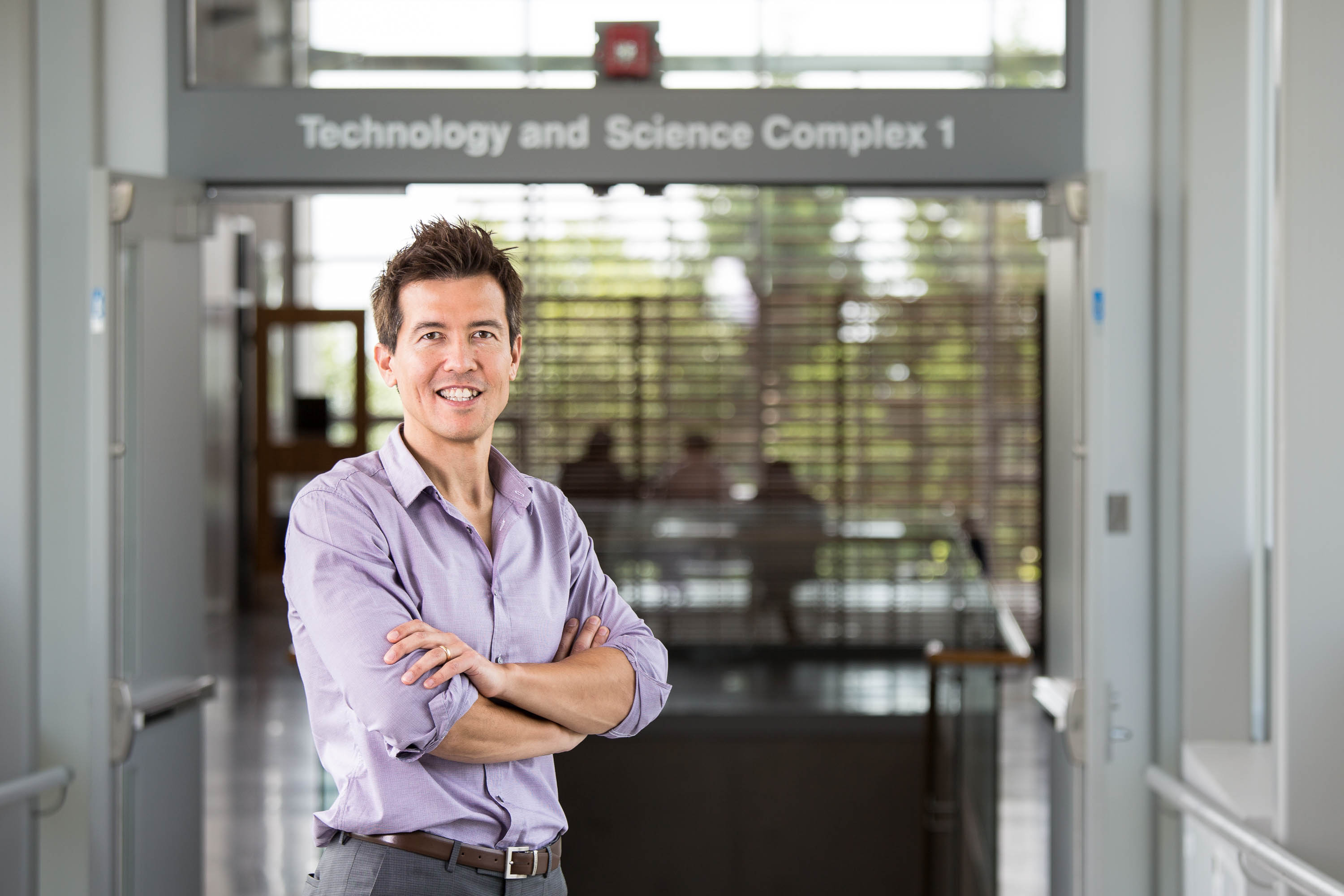
Monica Soمشاهده پروفایل
دانشیار
Monica So is an Associate Professor of Chemistry and Biochemistry and Lantis University Chair at California State University, Chico, within the College of Natural Sciences. Her research integrates chemical intuition with physics to address sustainability challenges through nanomaterials engineering. Education : B.S. in Organic Materials Chemistry from UCLA; Ph.D. in Inorganic Solid-State Chemistry from Northwestern University Her research focuses on three core areas: energy transfer pathways, charge transport mechanisms, and interfacial phenomena in metal-organic frameworks (MOFs). These programmable nanosponges enable applications in water decontamination, solar energy conversion, and petroleum separation. Her lab develops conductive MOFs for batteries, adsorbent materials for removing heavy metals from water, and semi-transparent agrivoltaic systems that co-locate solar panels with crop production. Analysis of her 15 most recent publications reveals dominant themes in sustainable materials design, with 73% focused on MOF applications for environmental remediation and energy systems. Key trends include the development of tunable nanosponges for water purification (27% of works), charge transport optimization in electronic materials (33%), and agrivoltaic integration for land productivity (13%). Lantis University Chair Gates Millennium Scholar National Defense Science & Engineering Graduate (NDSEG) Fellow CSU STEM-NET Faculty Fellow (3 terms) As a mentor, she has trained over 1,000 undergraduates since 2015, with 63% of research alumni entering Ph.D. or M.D. programs. Her $3.3 million in active funding includes major grants from NSF, DOE, and ACS Petroleum Research Fund supporting projects like Raman spectrometer acquisition ($225k), agrivoltaics crop studies ($250k), and the $2.25M BATTERIES energy storage initiative. She co-founded Women in STEM at Chico State, creating mentorship programs and coding workshops for Girl Scouts. The So Lab operates as a collaborative hub for chemists, physicists, and materials scientists developing nanostructured solutions for sustainability. Current projects include the DOE-funded BATTERIES initiative for emerging energy researchers and NSF-supported agrivoltaics research optimizing light transmission for crop growth beneath solar panels.