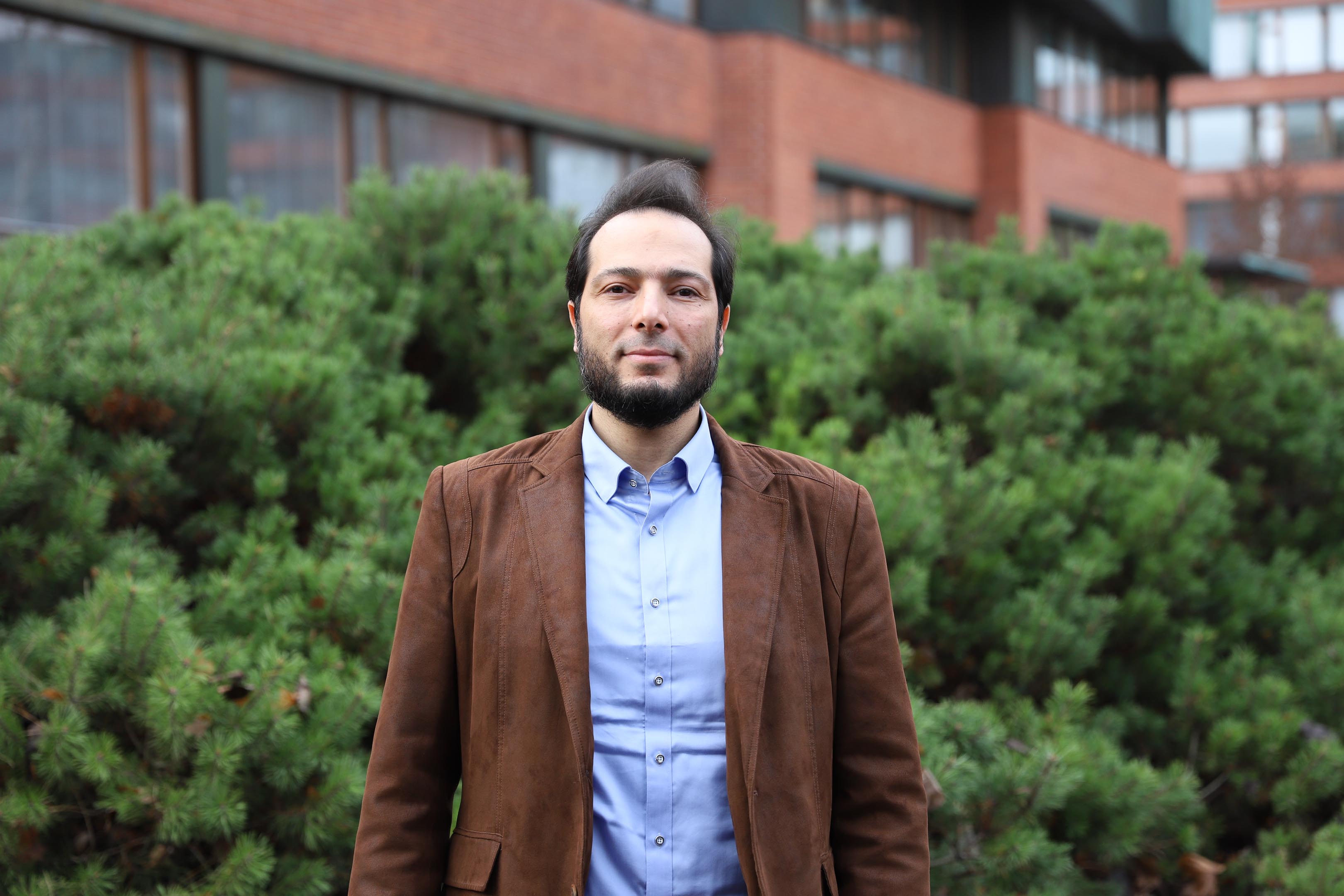
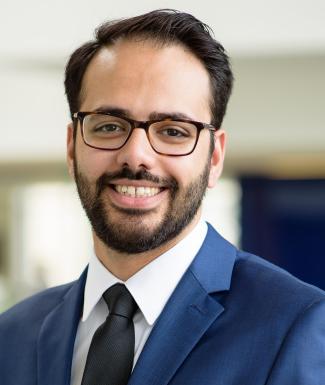
Hadi Meidani is a Clinical Associate Professor at the Carle Illinois College of Medicine , specifically within the Department of Biomedical and Translational Sciences at the University of Illinois at Urbana-Champaign . He teaches courses in Civil and Environmental Engineering, including topics like Systems Engineering & Economics , Machine Learning in CEE , and Uncertainty Quantification . Ph.D., Civil Engineering, University of Southern California (2012) M.S., Electrical Engineering, University of Southern California (2012) M.S., Structural Engineering, Sharif University of Technology (2005) B.S., Civil Engineering, K.N. Toosi University of Technology (2002) Dr. Meidani's research focuses on uncertainty quantification , scientific machine learning , and optimization under uncertainty for engineering systems. His work spans stochastic multiscale analysis , physics-informed machine learning , and model reduction techniques. His recent publications emphasize machine learning for infrastructure systems , graph neural networks , physics-informed models , and traffic assignment . Key trends include deep learning , multi-fidelity modeling , and neural operator transformers applied to metamaterial design , seismic reliability , and autonomous freight delivery .
Vesna Terzic is a Professor in the Department of Civil Engineering and Construction Engineering Management at California State University Long Beach's College of Engineering. Her research specializes in seismic performance assessment, infrastructure resilience, and probabilistic risk analysis of structures. Education includes a PhD in Structural Engineering from UC Berkeley, MS in Earthquake Engineering from Ss. Cyril and Methodius University, and BS in Structural Engineering from University of Belgrade. Research focuses on developing advanced computational frameworks for evaluating post-earthquake functionality of buildings and bridges. Her work integrates performance-based engineering with resilience quantification, emphasizing practical applications for seismic design and retrofitting. Recent publications demonstrate consistent focus on functional recovery modeling, structural health monitoring, and optimization of protective systems. Research trends show progression from component-level analysis to regional recovery simulation frameworks. Major awards: ACI Chester Paul Siess Award for Excellence in Structural Research (2017) Popert Fellowship, UC Berkeley (2009) Professional service includes membership on FEMA P-58 project committees and contributions to OpenSees development. Current projects investigate soil-structure interaction effects on tall buildings and recovery-based design methodologies.
Prof. Eleni Chatzi is a Full Professor and Chair of Structural Mechanics at ETH Zurich's Department of Civil, Environmental and Geomatic Engineering. She holds a PhD from Columbia University (2010) and has held roles from Assistant to Full Professor at ETH since 2010. Her research focuses on intelligent structural monitoring and data-driven asset management, emphasizing nonlinear dynamics and sensor integration. Affiliations : Institute of Structural Engineering, European Academy of Wind Energy (EAWE President), Swiss Community for Computational Methods (SWICCOMAS Chair) Research interests include Structural Health Monitoring (SHM), system identification, and advanced simulation tools. She pioneered work on data-driven diagnostics and self-aware infrastructure, supported by grants like the ERC Starting Grant (2015). Awards include the 2020 Walter L. Huber Prize and 2024 SHM Person of the Year Award. Her work spans wind energy infrastructure, metamaterials for vibration control, and AI-driven structural analytics. Over 600 publications and 200k+ citations highlight her impact. She teaches computational science and structural dynamics in ETH's programs and collaborates globally on sustainable infrastructure projects.
Professor Emily So serves as Deputy Head of the School of Arts and Humanities at the University of Cambridge and directs the Cambridge University Centre for Risk in the Built Environment (CURBE). A chartered civil engineer with extensive field experience, she holds leadership roles in the Open-Oxford-Cambridge AHRC Doctoral Training Partnership and chairs the Faculty EDI Committee. Her research focuses on urban risk and resilience , particularly in earthquake-prone regions. Combining structural engineering with epidemiological approaches, she develops innovative casualty estimation models and engages directly with affected communities worldwide. Her work spans seismic safety, disaster epidemiology, and remote sensing applications for rapid damage assessment. Professor So's publication trends reveal strong emphasis on machine learning for disaster risk modeling , with recent work featuring graph neural networks, deep clustering for urban morphology, and LSTM-based population forecasting. Her research bridges engineering, social sciences, and data science to address resilience in developing nations. 2010 Shah Family Innovation Prize (Earthquake Engineering Research Institute) Fellow of the Institution of Civil Engineers (FICE) Scientific Advisory Group for Emergencies (SAGE) member advising UK government As Director of CURBE, she leads interdisciplinary collaborations with EEFIT, Global Earthquake Model (GEM), World Bank, and USGS. Her field investigations following major earthquakes inform practical solutions for vulnerable communities, notably contributing to the 2017 World Building of the Year design in China. Current work includes sabbatical research for 2025-2026 focused on decolonizing architectural approaches to disaster resilience. Professor So maintains active roles in professional organizations and international disaster response frameworks, with her CURBE team developing methodologies now implemented globally for seismic safety improvements.
Mohamed Noureldin is an Assistant Professor at the Department of Civil Engineering, Aalto University , Finland, with prior academic roles at Sungkyunkwan University, South Korea (2015–2022). His expertise lies in integrating Artificial Intelligence (AI) with Structural Health Monitoring (SHM) , Structural Digital Twin , Predictive Maintenance , and Seismic Retrofitting . Research Focus : AI-powered sustainable structural design, smart retrofitting, predictive maintenance, structural material innovation, and next-generation performance-based seismic/wind design. Industrial Experience : 20+ years in offshore/onshore structural engineering (Hyundai Heavy Industries, Samsung Engineering, Arab-Swiss Engineering Company, Zuhair Fayez Partnership). Teaching : Courses in structural analysis, seismic design, dynamics, and reinforced concrete at Aalto and Sungkyunkwan Universities. Laboratory : Leads the Structural Design AI Lab (SDAI), focusing on AI-driven resilient infrastructure. Contact : mohamed.noureldin@aalto.fi , +358504544861. His publications explore cutting-edge applications of AI, ML, and DL in seismic retrofitting, structural durability, soil stabilization, and hybrid damping systems. Collaborative work emphasizes life-cycle cost assessment and augmented reality for predictive maintenance.
Paolo Gardoni is the Alfredo H. Ang Family Professor and an Excellence Faculty Scholar in the Department of Civil and Environmental Engineering at the University of Illinois Urbana-Champaign, with additional professorial appointments in Industrial & Enterprise Systems Engineering and Biomedical & Translational Sciences. He also serves as Director of the MAE Center and Editor-in-Chief of Reliability Engineering & System Safety. Education Ph.D. in Civil Engineering, University of California, Berkeley (2002) M.A. in Statistics, University of California, Berkeley (2001) M.Eng. in Structural Engineering, University of Tokyo (1997) Laurea (BS+MS equivalent) in Structural Engineering, Politecnico di Milano (1997) Research Interests Gardoni’s scholarship integrates probabilistic methods with large-scale infrastructure systems to advance reliability, risk, and life-cycle analysis. His work quantifies the performance of deteriorating systems under natural and anthropogenic hazards, models societal impacts of disasters, and develops decision frameworks for sustainable and resilient infrastructure. He also examines ethical, social, and legal dimensions of risk, and investigates optimal strategies for hazard mitigation, disaster recovery, and climate adaptation. Across more than 250 refereed journal papers, he has advanced sub-fields ranging from probabilistic mechanics and earthquake engineering to catastrophe bond pricing and engineering ethics, leveraging tools such as stochastic differential equations, Bayesian networks, and physics-informed machine learning. Awards & Honors Alfredo Ang Award on Risk Analysis and Management of Civil Infrastructure (ASCE, 2021) Best Paper Awards in ASCE Journal of Sustainable Water in the Built Environment (2019) and Geotechnical Research (2018 Telford Premium Prize) Fellowships and named professorships: Alfredo H. Ang Family Professor, Excellence Faculty Scholar, and courtesy or honorary professorships at Tsinghua, IIT Guwahati, Tongji, Jianghan, and Loughborough universities. Research Leadership & Funding Gardoni has secured over $58 million in research funding from NSF, DHS, NIST, USAID, Qatar National Research Fund, and other agencies. He directs the MAE Center—formerly an NSF Engineering Research Center—focused on multi-hazard engineering approaches, and is Editor-in-Chief of Reliability Engineering & System Safety (Elsevier, IF 9.4). He founded and formerly led the journal Sustainable and Resilient Infrastructure (Taylor & Francis) and serves on editorial boards of nine additional journals. Advising & Mentorship He has graduated 27 PhD and 35 Master’s students, many of whom now hold faculty positions worldwide. His group maintains an active pipeline of doctoral and post-doctoral researchers working on resilience analytics, infrastructure monitoring, and risk-informed decision-making. Laboratories & Collaborations He leads the MAE Center and is affiliated with the Critical Infrastructure Resilience Institute (CIRI) and the Biomedical and Translational Sciences group. International collaborations span the UK (Loughborough), India (IIT Guwahati), and China (Tsinghua, Tongji, Jianghan), fostering cross-disciplinary research in reliability and resilience engineering.
Professor Hong Hao is a John Curtin Distinguished Professor at Curtin University, affiliated with the School of Civil and Mechanical Engineering and the Curtin Research Centre for Infrastructural Monitoring & Protection. His expertise spans Structural Dynamics, Earthquake Engineering, Blast and Impact Engineering, and Structural Health Monitoring. He holds prestigious roles like Fellow of ATSE, ISEAM, and ASCE, and has led organizations such as the International Association of Protective Structures and the Australian Earthquake Engineering Society. Education: BE (Tianjin University, 1982), MSc (UC Berkeley, 1985), PhD (UC Berkeley, 1989). Awards include the Tan Chin Tuan Fellowship and multiple Ko Medals. He has authored over 200 journal articles, with recent work focusing on blast-resistant materials, seismic fragility, and AI-driven structural health monitoring. His research emphasizes resilient infrastructure, including metaconcrete structures, corrosion-resistant materials, and sensor-based damage detection. Ongoing projects involve smart tunnel safety under BLEVE explosions and modular building systems.
Dr. John Francis Clinton is the Director of Seismic Networks and Head of the Earthquake Monitoring Section at the Swiss Seismological Service (SED), ETH Zurich. He leads the Marsquake Service for NASA's InSight mission and oversees Switzerland's broadband and strong-motion seismic networks. His expertise spans earthquake early warning systems, seismic instrumentation, and glacial seismology. Clinton is also a Co-Investigator on the Mars InSight mission and involved in international projects like EPOS and RAMSIS. Education PhD in Civil Engineering (Minor in Geophysics), California Institute of Technology (2004) MSc in Civil Engineering, California Institute of Technology (1998) BEng in Civil Engineering, University College Dublin (1997) Research Interests Dr. Clinton focuses on real-time seismology, seismic instrument design, structural health monitoring, and glacial seismology. His work bridges engineering applications with geophysical data analysis, particularly in earthquake early warning systems and induced seismicity studies. He collaborates internationally on projects such as the Valais Near Fault Observatory and Nicaragua’s Earthquake Early Warning development. Publications Overview His 15 most recent papers (2011–2015) highlight advancements in seismic network optimization, Marsquake detection algorithms, and glacial icequake mechanisms. Key themes include improving early warning accuracy, understanding subglacial dynamics, and validating high-rate GPS for structural monitoring. Awards & Memberships Member, Swiss Academy of Sciences (since 2008) Member, IRIS Quality Assurance Advisory Committee (since 2013) Chair, European Integrated Data Archives (EIDA) (2013–2015) Labs & Teams Clinton directs the SED’s Earthquake Monitoring team and collaborates with ETH Zurich’s Geophysics Masters Program. His group manages Switzerland’s seismic networks and leads the Marsquake Service, which analyzes InSight lander data for Martian seismic events.
Christopher D.P. Baxter is a Professor and Department Chair of Civil and Environmental Engineering at the College of Engineering, University of Rhode Island , with expertise in geotechnical engineering, offshore wind energy, and coastal resilience. He holds a Ph.D. in Civil Engineering from Virginia Tech (1999), an M.S. from Purdue University (1994), and a B.S. from Tufts University (1990). Research Focus: Geotechnical characterization of marine sediments, liquefaction resistance analysis, fiber-optic sensing for infrastructure monitoring, and coastal protection systems. Recent Publications: 15+ articles (2011–2025) covering topics like shear wave velocity, offshore wind foundation dynamics, and tsunami hazard modeling. Grants: Led projects on offshore wind monitoring (2019–2024) and fiber-optic seismic sensing (2021–2023). Key Collaborations: Work with teams on submarine landslide analysis, coastal dune reinforcement, and Rhode Island infrastructure resilience. His work bridges experimental geomechanics with practical coastal engineering solutions.
Giuseppe Carlo Marano is a Full Professor at the Department of Structural, Building and Geotechnical Engineering at Politecnico di Torino. He is also a component of the SISCON Interdepartmental Center for Infrastructure Safety. With expertise in civil and structural engineering, his work focuses on machine learning applications, seismic risk reduction, and sustainable structural optimization. Education Graduated cum laude in Structural Engineering from Polytechnic University of Bari PhD in Structural Engineering from University of Florence (2000) Research Interests Marano's research spans structural optimization, seismic engineering, and machine learning applications in civil infrastructure. He develops advanced computational models for: Seismic retrofitting of existing structures Optimization of steel and masonry structures Recycled materials in concrete production AI-driven structural health monitoring Multiobjective design methodologies Publication Trends His recent work emphasizes: Machine learning for concrete mix design and damage assessment Optimization of gridshells and arch structures Seismic isolation systems and vibration control Sustainable construction practices with recycled materials Multiobjective genetic algorithms for structural design Scientific Recognitions National Scientific Qualification - First Band (2013, MIUR Italy) Certificate of Appreciation for Outstanding Lecture (2012, China) Academic Contributions As an educator, he teaches: Consolidamento Strutturale (Structural Consolidation) Dinamica delle Vibrazioni Random (Random Vibration Dynamics) Progettazione Generativa (Generative Design) He also leads Challenge@PoliTo initiatives and contributes to national infrastructure safety regulations. Research Projects ADAPT4CE - Adaptive Digital Systems for Circular Economy (2025-2028) AI-ENVISERS - AI for Seismic Retrofit Environmental Impact (2023-2025) ADDOPTML - Additive Manufacturing Optimization (2021-2025)
Farhad Pourkamali Anaraki is an Assistant Professor in the Department of Mathematical and Statistical Sciences at the University of Colorado Denver, part of the College of Liberal Arts and Sciences. His research focuses on Machine Learning, Data Science, and Computational Mathematics, with interdisciplinary applications in engineering, materials science, and uncertainty quantification. He specializes in developing data-driven methodologies for complex systems, including composite materials, seismic response prediction, and additive manufacturing. Key research themes include probabilistic neural networks, adaptive machine learning for sparse data, and computational techniques for engineering challenges. His work integrates advanced algorithms with domain-specific problems, such as optimizing material properties and enhancing predictive models in civil and mechanical engineering contexts. Despite his prolific publication record, no specific scientific awards or grants are explicitly listed in the provided information. He maintains an active profile in teaching and mentoring, though formal advisee details are not documented here.
Youssef M. A. Hashash is the Grainger Distinguished Chair in Engineering and a Professor in the Department of Civil and Environmental Engineering at the University of Illinois at Urbana-Champaign (UIUC). He holds a B.S., M.S., and Ph.D. in Civil Engineering from MIT (1987–1992). His expertise spans geotechnical engineering, earthquake engineering, and computational geomechanics, with a focus on deep excavations, tunneling, and soil-structure interaction. He co-developed DEEPSOIL, widely used for seismic soil response analysis. Education: B.S. Civil Engineering, MIT (1987) M.S. Civil (Geotechnical) Engineering, MIT (1988) Ph.D. Civil (Geotechnical) Engineering, MIT (1992) Research Interests: Dr. Hashash's work integrates geotechnical engineering with advanced technologies like AI, visualization, and discrete element modeling. Key areas include: Seismic site response and amplification models for Central/Eastern North America Tunneling and underground infrastructure resilience Geotechnical applications of machine learning and augmented reality Soil-structure interaction and liquefaction analysis Professional Roles: Geotechnical co-leader, NIST investigation of the Champlain Towers South collapse (2022–present) Chair, National Academies' Committee on Geological and Geotechnical Engineering (2024–present) Past President, Geo-Institute of ASCE Awards: Presidential Early Career Award for Scientists and Engineers ASCE 2014 Peck Medal Elected to National Academy of Engineering (2022) Labs/Teams: Leads research groups at UIUC focused on computational geomechanics and geotechnical earthquake engineering. Collaborates with federal agencies like NIST and NSF on large-scale projects.
Richard Simon is an Associate Professor in the Department of Civil, Geological and Mining Engineering at Polytechnique Montréal. He holds leadership roles as Publications Director of his department and Administrative Director of the Institute for Research in Mining and Environment (IRME) UQAT-Polytechnique. His educational background includes a B.Eng. and M.Sc.A. from Polytechnique Montréal and a Ph.D. from McGill University. Dr. Simon teaches courses including Introduction to Mine Operations, Underground Mining, and Rock Mechanics I. His research focuses on rock mechanics, numerical modeling, mining engineering, and geotechnical applications in mining environments. His extensive publication record demonstrates consistent focus on numerical modeling of rock behavior, mine stability analysis, and backfill mechanics. Recent work emphasizes computational geomechanics applications in mining operations, including stress analysis in backfilled stopes, slope stability in open pits, and optimization of mining layouts. Environmental aspects of mining, particularly contaminant transport in fractured rock, also feature prominently. Dr. Simon has supervised 6 doctoral and 8 master's students working on topics ranging from numerical seismic assessment in mines to rock fracture mechanics. He secured significant research funding including $900,000 (2017) for a metals circular economy project and led three new IRME research initiatives (2015). He directs research activities at IRME UQAT-Polytechnique and collaborates extensively within the mining geomechanics research community. His expertise is regularly featured in media outlets including La Presse+ and Les Affaires.
Ahmed Elbanna is an Associate Professor at the University of Illinois Urbana-Champaign (UIUC), affiliated with the Grainger College of Engineering and the Department of Civil and Environmental Engineering. He holds a Ph.D. from Caltech (2011) and has been on UIUC faculty since 2013. His research focuses on mechanics of complex systems, including earthquake dynamics, metamaterials, and biomaterials. He has received prestigious awards such as the NSF CAREER Award (2018) and the Donald Biggar Willett Faculty Fellowship (2020). Education: Ph.D. Civil Engineering, California Institute of Technology (2011) M.S. Applied Mechanics, California Institute of Technology (2006) M.S. Structural Engineering, Cairo University (2005) B.S. Civil Engineering, Cairo University (2003) Research Interests: Elbanna’s work spans theoretical and applied mechanics, with emphasis on fracture, wave propagation, and critical phenomena in geophysical and biological systems. Key areas include: Earthquake mechanics and granular matter dynamics Mechanical metamaterials for wave control Networked biological materials (e.g., bone, hydrogels) Modeling epidemic dynamics during the COVID-19 pandemic Awards & Recognition: National Science Foundation CAREER Award (2018) Donald Biggar Willett Faculty Fellow (2020) Journal of Applied Mechanics Award (2019) UIUC Teaching Excellence Awards (2018–2024) Service & Leadership: Member of the UIUC Faculty Senate (2020–present) Co-Chair, Computational Mechanics Committee (ASCE EMI, 2024–present) Leader, Computational Science Group at Southern California Earthquake Center (2019–present) Labs & Groups: Leads the Mechanics of Complex Systems Lab at UIUC, focusing on interdisciplinary research in geophysics, materials science, and computational modeling.
Associate Professor Bambang Trigunarsyah holds a position at RMIT University since 2018, affiliated with the School of Property, Construction and Project Management (PCPM). He earned his BSc in Civil Engineering from Colorado School of Mines, a Master's in Civil Engineering (Construction Management) from the University of Indonesia, and a PhD in Engineering Project Management from the University of Melbourne. His career spans industry roles, including project engineering in Indonesia's oil and gas sector, academic leadership at the University of Indonesia, and international teaching/research appointments at Queensland University of Technology (QUT) and King Fahd University of Petroleum and Minerals in Saudi Arabia. Research interests focus on post-disaster reconstruction, infrastructure project governance, constructability of infrastructure, and project management in developing countries. Notable projects include risk management frameworks using blockchain, circular economy in Saudi construction, and BIPV energy solutions. He actively supervises HDR students in areas like public-sector project success determinants and thermal environment studies. Bambang serves as Higher Degree Research Delegate Authority (HDR DA) for the School of PCPM and teaches postgraduate project management programs. Professional memberships include AIPM, PMI, and ASCE. His industry advisory roles include Indonesia's National Construction Service Development Board (2002-2007) and Australia-Indonesia Centre's Infrastructure Cluster (2016-2018). Recent research emphasizes BIM applications in infrastructure preservation, risk assessment methodologies, and climate-resilient construction. His work bridges theory and practice, addressing challenges in emerging economies and complex project environments.