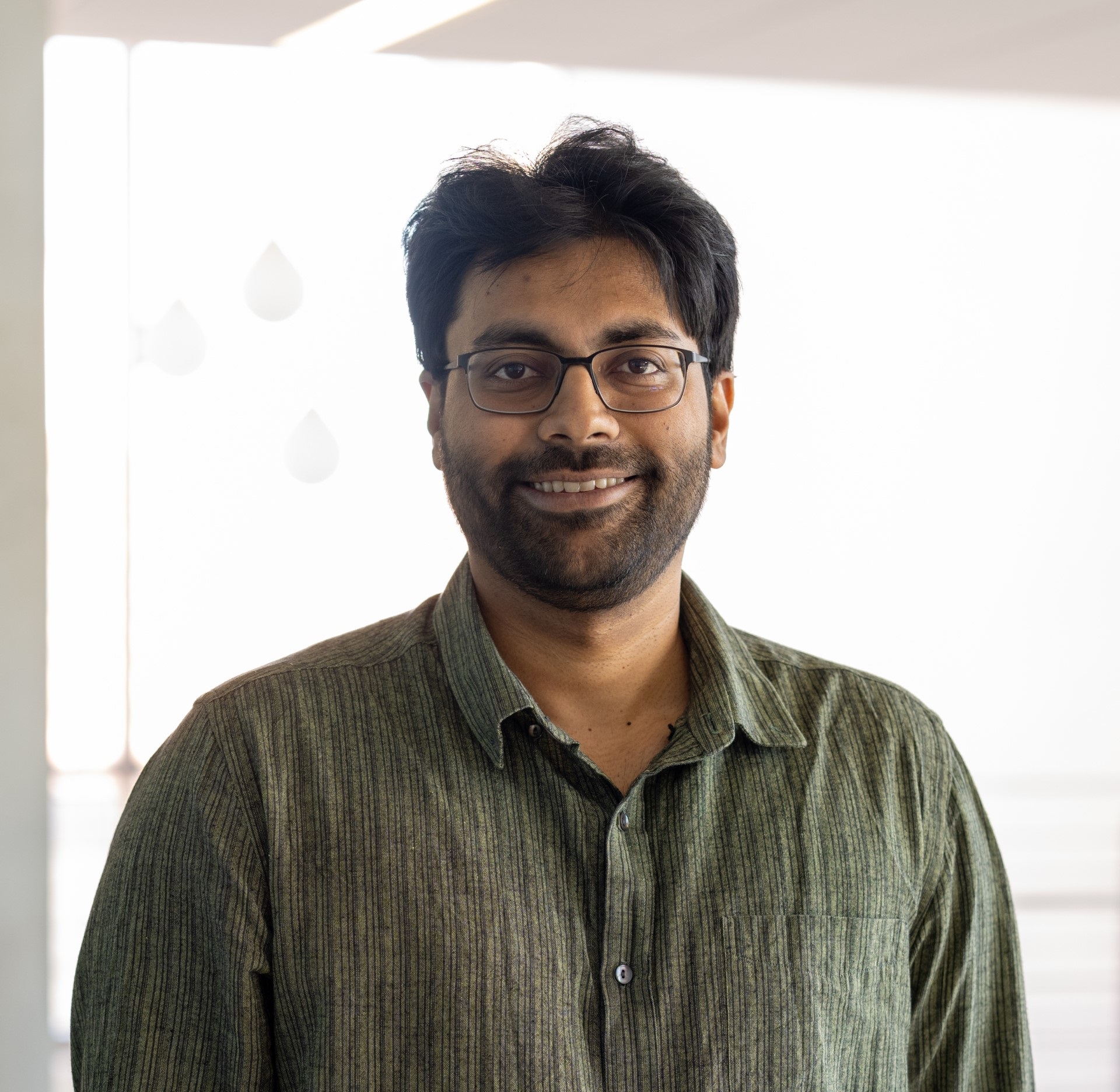
Dr. Manoj Karkee is the Norman R. and Sharon R. Scott Professor of Agriculture and Life Sciences at Cornell University's Department of Biological and Environmental Engineering. He leads the #AgRobotics Lab, focusing on AI, machine vision, and robotics for smart farming. Previously, he directed the Washington State University Center for Precision and Automated Agricultural Systems. His expertise spans sensing systems, autonomous robotics, and agricultural automation. He holds a PhD in Agricultural Engineering and Human Computer Interaction from Iowa State University. Education: PhD (2009, Iowa State), MSc (2005, Asian Institute of Technology), B.Sc. (2002, Tribhuvan University). Research interests include precision agriculture, robotic harvesting, and AI-driven crop management. He has published widely in journals like Computers and Electronics in Agriculture and serves as Editor-in-Chief of that journal. Awards include the 2020 Rainbird Engineering Concept Award and recognition as a 2019 AI Pioneer. Lab work focuses on multi-purpose orchard robots, soft robotics for fruit harvesting, and AI-enhanced crop monitoring. Collaborations span global institutions and industry partners to develop scalable farming solutions. His research aims to enhance resource efficiency, crop yields, and sustainability in agriculture.
Vaibhav Garg is a Collegiate Assistant Professor of Computer Science at the Virginia Tech Innovation Campus. Previously, he worked as a teaching and coding instructor at Outco Company in California. His research focuses on applying computational methods to societal challenges such as detecting inciting speech on social media and auditing rogue mobile apps for misuse. He holds a Ph.D. in Computer Science from North Carolina State University (2024), an M.S. from Indraprastha Institute of Information Technology, Delhi (2019), and a B.S. from The LNM Institute of Information Technology (2017). Research Interests: Applied Natural Language Processing Social Media Analytics Cybersecurity AI for Social Good Responsible Computing Educational Technology His recent work includes publications on inciting speech detection, trauma narratives analysis, and mobile app misuse audits. These studies emphasize ethical AI applications in addressing societal issues like online harassment and privacy violations. Awards & Honors: Carla Savage Award (2023) for outstanding Ph.D. research at NC State Grants & Funding: National Security Agency (NSA) research grants during Ph.D. National Science Foundation (NSF) research grants during Ph.D. His current work explores interdisciplinary solutions at the intersection of NLP and social responsibility, with a focus on developing technologies that promote ethical online environments.
Zhijing Jin is an Assistant Professor at the University of Toronto and a postdoc at the Max Planck Institute for Intelligent Systems, working with Bernhard Schölkopf. She is also a faculty member at the Vector Institute and an ELLIS advisor. Her research focuses on Causal Reasoning with LLMs , Moral Reasoning in LLMs , and AI Safety , with contributions to AI for Science and NLP for Social Good. She leads the Jinesis AI Lab , which explores causal LLMs, multi-agent systems, and ethical AI applications. Education: PhD in Computer Science from Max Planck Institute (Germany) and ETH Zurich (Switzerland) Bachelor’s degree from University of Hong Kong, with visiting semesters at MIT and National Taiwan University Research Interests: Her work bridges causal inference and NLP, addressing robustness, interpretability, and ethical alignment of LLMs. Key projects include Corr2Cause (causal reasoning), GovSim / MoralSim (multi-agent LLMs), and frameworks like NLP4SG for social impact. She advocates for causal mechanisms to tackle AI safety and societal challenges. Recent Articles: Recent work explores political bias in LLMs, ethical dilemmas in multi-agent systems, and causal foundations for trustworthy AI. These studies emphasize real-world applications, such as healthcare NLP and policy analysis. Awards & Recognition: 3 Rising Star Awards 2 Best Paper Awards at NeurIPS 2024 Workshops Fellowships from Open Philanthropy and Future of Life Institute Grants & Mentorship: Funded by NSERC, Schmidt Sciences, and the Cooperative AI Foundation. She mentors ~20 students globally, including PhD candidates in multi-agent LLMs, causal LLMs, and AI safety. The Jinesis Lab offers remote mentorship across institutions like UofT, ETH Zurich, and University of Michigan. Labs & Collaborations: Active collaborations include MPI-IS, Vector Institute, and ETH Zurich’s AI Center. Her lab emphasizes open science, with tools like MoralLens and RouterAttack released publicly.
Aleksandar Jevremović is a Full Professor at the Faculty of Informatics and Computing, Singidunum University (Belgrade, Serbia), and holds multiple academic and professional roles. He is the Serbian representative at the UNESCO IFIP Technical Committee on Human-Computer Interaction since 2018. He has served as Vice-Dean of his faculty (2015–2018) and held visiting professorships at institutions like Ss. Cyril and Methodius University (North Macedonia) and Tallinn University (Estonia). His research focuses on cybersecurity, IoT, AI, and e-learning innovation. Education and Affiliations: External Researcher at the Mathematical Institute of the Serbian Academy of Sciences and Arts Visiting Scholar at Cyprus Interaction Lab (Cyprus University of Technology) Alumni/Postdoc Researcher at Tallinn University's HCI Group Member of IEEE and the Informatics Association of Serbia Research Interests: Jevremović’s work spans cybersecurity (e.g., intrusion detection, secure IoT protocols), human-computer interaction (HCI), AI-driven education tools, and neurotechnological applications like EEG-based assessment systems. He emphasizes practical solutions for digital safety, such as children’s online protection and cryptographic key generation from biometric data. Grants and Projects: Member of the External Advisory Committee for the EU-funded ONTOCHAIN project (2022–2023) Mentor for training schools like AAPELE Training School and NET4Age-Friendly initiatives Trainer in IoT, cybersecurity, and health promotion programs across Europe Labs and Teams: He collaborates with interdisciplinary teams on projects like CASPER (Children Agents for Secure and Privacy Enhanced Reaction) and led the development of WIDE, a collaborative web development education platform.
Eugene Chan is an Associate Professor in the Department of Marketing Management at the Ted Rogers School of Management, Toronto Metropolitan University. He holds a PhD in Marketing from the University of Toronto, a MA in Social Psychology from the University of Chicago, and an AB in Honors Psychology from the University of Michigan, along with an ARCT (Hons) in Piano Performance from the Royal Conservatory of Music, reflecting a multidisciplinary background. His research lies at the intersection of consumer psychology, political ideology, health communication, and sustainability. He employs experimental and survey methods grounded in social science theories to understand how individuals make judgments and decisions in marketplaces and society. Key themes include the influence of political ideology on consumer behavior, strategies for effective marketing and health communication, and promoting environmentally sustainable choices. His work often explores how emotional, moral, and cognitive factors shape consumer decisions. His recent publications span top journals such as Journal of Consumer Psychology , Global Environmental Change , Computers in Human Behavior , and Personality and Social Psychology Bulletin . These studies reveal consistent focus on behavioral interventions, ideological divides, health compliance, and environmental sustainability. Trends indicate a strong emphasis on moral psychology, emotional triggers, and real-world applications in public policy and marketing strategy. Scientific Awards: Emerging Researcher Award, Australian and New Zealand Marketing Academy (2018) Dean’s Award for Excellence in Research by an Early Career Researcher, Monash Business School (2018) He has secured research funding from diverse sources including the National Natural Science Foundation of China, ACR Transformative Consumer Research Grant, IHS Hayek Fund, and the Indiana Commission for Higher Education, supporting projects on fake news mitigation, brand revitalization, moral foundations, and pandemic behavior. He has taught at institutions worldwide, including the University of Toronto, Monash University, and Purdue University, demonstrating international academic engagement. Eugene Chan serves in editorial roles for several journals, including as Associate Editor for Australasian Marketing Journal and International Journal of Consumer Studies , and as Special Issue Editor for Frontiers in Psychology . He also co-authored the 2nd Asia-Pacific edition of the textbook Consumer Behavior , contributing to marketing education. He advises students in consumer behavior and marketing research, though specific advisees are not listed.
Joseph Darowski is an Assistant Professor in the Department of English at Brigham Young University, affiliated with the College of Humanities. His academic work bridges literary analysis and cultural studies, with a focus on American popular media. Research Interests: Dr. Darowski specializes in American popular culture, particularly comic books, television, and film. His scholarship explores how media reflects and shapes societal issues such as race, gender, identity, and class. He has made significant contributions to the study of superhero narratives, situating them within broader historical and cultural contexts. Publication Trends: His body of work reveals a sustained engagement with cultural history through long-running television series and superhero comics. He examines how shows like Cheers , Frasier , and Survivor , as well as franchises like X-Men and Superman , serve as mirrors to American values across decades. His edited essay collections, particularly the Ages of Superheroes series, demonstrate interdisciplinary rigor and thematic breadth. Teaching and Service: He teaches courses in English, likely covering topics in media, literature, and cultural studies. While no formal advising or grant information is provided, his extensive publication record suggests active scholarly engagement.
Brent Lagesse is an Associate Professor at the University of Washington - Bothell , affiliated with the Division of Computing & Software Systems under the School of Science, Technology, Engineering & Mathematics . His research focuses on security in emerging environments , particularly secure machine learning and privacy in sensor-rich systems . Ph.D. in Computer Science from the University of Texas at Arlington (2009) Research Interests include: Detecting and locating hidden webcams Scalable AI/ML defense mechanisms Privacy-preserving video sharing AI systems for air quality prediction Automated yeast cell analysis CRISPR/CAS9 guide-donor libraries Article Trends : Recent publications emphasize secure machine learning for smart city applications, privacy-preserving technologies , and resource-constrained security in crowdsensing environments . Collaborative work spans cybersecurity education , environmental monitoring , and context-aware systems . Scientific Awards : Cybersecurity Fulbright Scholar (University of Cambridge, 2018) Johann-von-Spix International Guest Professorship (University of Bamberg, 2019-20) Advising & Grants : Advises current research students Neil Prakasam and Nicholas Handaja NSA grant ($96k) for GenCyber curriculum development (2022) NSF grant ($300k) for AI-enhanced cybersecurity workforce studies (2021) T-Mobile grants for ML security metrics and dataset anonymization (2020-2022) Laboratory : Leads the Security of Emerging Environments (SEE) Lab , developing practical and theoretical frameworks for smart city security and privacy-preserving technologies .
Jonathan S. Skinner is a Professor at Dartmouth College, Department of Economics, and a professor at the Dartmouth Institute for Health Policy and Clinical Practice within the Geisel School of Medicine. He serves as the Aging Program Director at the National Bureau of Economic Research (NBER) and has contributed extensively to understanding healthcare productivity, technology adoption, and policy implications for aging populations. Key research areas: Health Economics, Economics of Aging, Public Policy Current projects focus on Medicare/Medicaid spending, geographic healthcare disparities, and pandemic impacts on vulnerable populations. Publications (2023–2010) reveal trends in healthcare fraud networks , racial segregation in hospital admissions , and end-of-life expenditures . His work often integrates Medicare claims data and network analysis to assess systemic inefficiencies. Recent scientific collaborations include partnerships with institutions such as the NBER and JAMA Network Open. He has analyzed regional mortality disparities and technology diffusion in clinical settings, with implications for public health strategy.
Stephanie Forrest is a Professor of Computer Science at Arizona State University and serves as Director of the Biodesign Center for Biocomputation, Security and Society . She holds affiliations with the School of Computing and Augmented Intelligence , Global Futures Laboratory , and Santa Fe Institute External Faculty . Education: B.A. from St. John's College M.S. and Ph.D. in Computer Science from the University of Michigan Research Interests: Forrest specializes in the intersection of biology and computation , with key contributions to cybersecurity (anomaly detection, instruction-set randomization), automated software repair (evolutionary methods), and biological modeling (immune systems, SARS-CoV-2 spread). Her work bridges complex adaptive systems , AI/ML , and defense applications . Scientific Contributions: 2020 IEEE S&P Test of Time Award 2019 ICSE Most Influential Paper Award 2011 ACM/AAAI Allen Newell Award NSF Presidential Young Investigator (1991) IEEE Fellow Evolutionary Computation Pioneer award Publications & Grants: Her research appears in top venues (ICSE, IEEE S&P, PNAS) and is funded by the National Science Foundation , DARPA , Air Force Research Lab , and Santa Fe Institute . Key projects include Crispy (CRISPR-inspired DoS defense), GenProg (automated bug correction), and SIMCoV-GPU (agent-based pandemic modeling).
Laura Horak is Professor of Film Studies at Carleton University and director of the Transgender Media Lab and Transgender Media Portal. Her research investigates transgender and queer film history across the United States, Canada, and Sweden, establishing her as a pioneer in trans cinema and media studies. A white cis queer settler scholar, she leverages institutional resources for social justice through public-facing scholarship and community collaboration. Her educational background includes: BA from Yale University MA and Ph.D. from UC-Berkeley Horak's research centers on how cinema shapes gender and sexuality from early 20th-century silent films to contemporary trans YouTube content, with emphasis on cross-dressing women, trans filmmaking practices, and feminist/queer media historiography. She bridges transgender studies, film history, and digital humanities to recover marginalized narratives and challenge heteronormative film canons. Her recent publications (2018-2024) demonstrate three key trends: 1) Development of trans digital humanities through special issues on queer/trans DH and cinematic bodies; 2) Feminist film archiving focused on silent cinema's 'nasty women' and cross-dressing histories; 3) Trans media activism via film festivals, erotic curation, and community-centered platforms like the Transgender Media Portal. This work consistently prioritizes intersectionality, international collaboration, and public accessibility. Horak's scholarly impact has been recognized with: Huffington Post Best Film Books of 2016 for Girls Will Be Boys Choice Outstanding Academic Title (2016) Richard Wall Memorial Award Finalist (2016) Kraszna-Krausz Best Moving Image Book Longlist (2016) She mentors emerging scholars in film studies and digital humanities while securing major research funding, including an SSHRC Insight Grant (2020-2025), Ontario Early Researcher Award (2019-2024), and SSHRC Partnership Development Grant for Cinema’s First Nasty Women . Her work integrates academic rigor with public engagement through film programming and digital tool development. Horak founded the Transgender Media Lab as a physical and virtual hub for trans media scholarship and created the Transgender Media Portal to democratize access to trans film history. She collaborates with international film archives, festivals, and scholars to preserve trans cinematic heritage and foster community connections through projects like the 99-film Cinema’s First Nasty Women collection praised by The New York Times as a 'mind-expanding endeavour'.
Dr. Shravan Ravi Narayan is an Assistant Professor in the Computer Science department at The University of Texas at Austin. His research focuses on secure systems, program verification, and hardware-based security, with groundbreaking work in Software Fault Isolation (SFI), WebAssembly security, and Spectre attack mitigation. He teaches courses like CS361S (Network Security and Privacy) and CS380S (Theory and Practice of Secure Systems). 2023 - Distinguished paper award at ASPLOS 2022 - Mozilla research award 2022 - IEEE Cybersecurity Award for Practice 2022 - NSA Best Scientific Cybersecurity Paper Honorable Mention 2021 - Google V8 research award His publications highlight innovations in hardware-assisted isolation (HFI), sandboxing runtime design (WaVe), and browser security frameworks like RLBox. His work bridges systems security, programming languages, and hardware architecture to create practical, verifiable security solutions. He actively recruits exceptional PhD candidates with expertise in security, programming languages, or computer architecture and collaborates with industry leaders like Firefox and Fastly.
Marsha Chechik is a Professor in the Department of Computer Science at the Faculty of Arts and Science, University of Toronto. She previously served as Department Chair from 2019-2022 and as Acting Dean in the Faculty of Information from July-December 2022. Her academic career spans numerous research contributions and leadership roles within the software engineering community. Professor Chechik's primary research interests focus on software engineering with emphasis on formal methods to enhance software quality. Her work encompasses scalable automated verification techniques including model-checking and theorem-proving, formal specification languages, verification of protocols, non-classical logics, and reasoning under inconsistency. She has made significant contributions to model management, software product lines, safety and security assurance, and automotive safety systems. Her research bridges theoretical foundations with practical applications, particularly in managing uncertainty in software models and developing techniques for automotive safety verification. Her recent publications demonstrate a strong focus on model management and transformations, software product lines and variability analysis, safety and security assurance cases, and semantic analysis of software evolution. The integration of formal methods with practical software engineering challenges, especially in safety-critical domains like automotive systems, represents a consistent theme throughout her work. Professor Chechik has been recognized with multiple prestigious awards including a Best Paper Award at RE'12, a SIGSOFT Distinguished Paper Award at ICSE'12, a Best Student Paper Award at CASCON'07, and a Distinguished Paper Award at ICSE'07, highlighting the impact and quality of her research contributions. She actively supervises graduate students and has successfully guided numerous Ph.D. candidates to completion. Her group has produced graduates who predominantly pursue research careers in both academic institutions and industrial research labs. She currently leads several funded projects including the Automotive Safety project (in collaboration with General Motors) and the Software Evolution project, focusing on practical applications of her research interests. Professor Chechik leads the Software Engineering Lab at the University of Toronto, where innovative projects like Matchmakers (a serious game for software engineering) are developed. Her collaborative network extends across institutions, with notable partnerships including Julia Rubin at the University of British Columbia, demonstrating her commitment to interdisciplinary research and academic collaboration.
Dr. Christoph Müller is a leading scientist at the Potsdam Institute for Climate Impact Research (PIK), Germany, where he has served as working-group leader of the Land Biosphere Dynamics group since 2012. He also co-leads the Global Biosphere and Water Modeling team and acts as the scientist-in-charge for the internationally renowned LPJmL global vegetation and crop model. Additionally, he is Co-lead of the Ag-GRID initiative within the Agricultural Model Intercomparison and Improvement Project (AgMIP) and serves as Topical Editor for Geoscientific Model Development . Education Diploma in Geoecology, University of Potsdam (2002) PhD in Geoecology, University of Potsdam & International Max Planck Research School (IMPRS) (2007) Research Interests Dr. Müller’s research centres on understanding and modelling the interactions between climate, land use, and the biosphere to support sustainable food-system transformations. His work integrates global-scale vegetation and crop models with climate projections, socio-economic scenarios, and observational data to assess: Impacts of climate change and extreme events on crop yields and food security Carbon, nitrogen, and water cycles in managed and natural ecosystems Land-based climate-mitigation strategies and their co-benefits or trade-offs Adaptation options for agriculture under global change He promotes open science and reproducible modelling workflows, exemplified by the LPJmL open-source ecosystem model and associated toolkits. Publication Profile & Trends Since 2014 he has authored or co-authored more than 200 peer-reviewed articles. Recent work (2024-2025) highlights three dominant themes: (1) quantifying underestimated negative impacts of climate extremes on crop yields, (2) assessing the sustainability of large-scale land-based mitigation measures, and (3) advancing model intercomparison frameworks (e.g., AgMIP, ISIMIP) to reduce uncertainty in global yield projections. His studies increasingly integrate economic and health perspectives, examining how dietary shifts and food-system transformations can achieve climate, environmental, and social co-benefits. Scientific Awards & Recognition While no formal awards are explicitly listed, several publications have received notable recognition: “Soil quality both increases crop production and improves resilience to climate change” (Nature Climate Change, 2022) – listed among China’s top ten major advances in agricultural science in 2023. “Large potential for crop production adaptation depends on available future varieties” (Global Change Biology, 2021) – top-downloaded article. “Climate change impacts on global agriculture emerge earlier in new generation of climate and crop models” (Nature Food, 2021) – widely cited in IPCC AR6. Leadership, Grants & Collaboration Dr. Müller leads or co-leads multiple international projects and working groups: Working Group Leader – Land Biosphere Dynamics, PIK Research Department 2 Co-Lead – Ag-GRID, Agricultural Model Intercomparison and Improvement Project (AgMIP) Scientist-in-Charge – LPJmL model development and application Topical Editor – Geoscientific Model Development journal These roles involve coordinating multi-institutional consortia, securing competitive grants, and mentoring early-career researchers. Laboratory & Data Resources Dr. Müller’s “team” is essentially the LPJmL modelling group at PIK, comprising post-docs, doctoral researchers, and software engineers who maintain and extend the LPJmL code-base, develop satellite-data fusion products, and provide model-driven policy support to governments and international organisations such as the IPCC, FAO, and World Bank.
Luis Castedo Ribas is a Professor at the Faculty of Informatics , University of A Coruña (UDC) , Spain, since 2001. Previously held research positions at the University of Southern California (USC) and École supérieure d'électricité (SUPELEC). PhD in Telecommunications Engineering (1993), Technical University of Madrid Department of Computer Engineering Research Group: Electronic and Communications Technology Group Research Interests: Specializing in Signal Processing and Information Theory for Wireless Communications Engineering , with focus on MIMO Communication Systems , 5G Radio Interfaces , Joint Source-Channel Coding , and High-Speed Wireless Communications . His work bridges theoretical advancements with practical prototyping of digital communication systems. Recent Article Trends: Publications span Massive MIMO , Beamforming , AI/ML for Wireless , and Quantum-Inspired Coding , reflecting his leadership in evolving telecom standards (5G→6G). Collaborative work with institutions like IEEE and European consortia. Scientific Awards: Best Student Paper (2007, 2013, 2017) General Co-Chair, IEEE Sensor Array Workshop (2014) General Co-Chair, European Signal Processing Conference (2019) Grants & Collaborations: Principal Investigator in over 50 projects funded by Spanish Ministry of Science, EU programs, and companies like Atos Origin. Key roles in national and international research consortia.
Vasileios P. Kemerlis is an Associate Professor of Computer Science at Brown University, where he conducts research in systems and software security. He serves as the director of the Secure Systems Lab (SSL) and is a recipient of the prestigious NSF CAREER Award. His work focuses on practical security solutions for real-world systems. Dr. Kemerlis specializes in software, hardware, and systems security with particular emphasis on OS kernel protection, software hardening, fuzz testing, and information flow tracking. His research bridges theoretical security concepts with practical implementations that can be deployed in commodity systems. His work often leverages hardware features to build more robust security mechanisms while maintaining system performance. His recent publications demonstrate a consistent focus on memory safety, control flow integrity, and practical security mechanisms that can be deployed in real-world systems. His work spans multiple security domains including kernel security, network security, and application security, with a strong emphasis on developing solutions that balance security guarantees with practical performance considerations. Scientific Awards: NSF CAREER Award Dr. Kemerlis teaches advanced security courses at Brown University including CSCI 1650: Software Security and Exploitation (offered Fall 2016-2024) and CSCI 2951U: Topics in Software Security (offered Spring 2016-2018, 2020, 2021, 2024). As director of the Secure Systems Lab, he leads research efforts that have resulted in numerous publications at top security venues including IEEE Symposium on Security and Privacy, ACM CCS, and USENIX Security. The Secure Systems Lab under his direction focuses on developing practical security solutions that can be deployed in real-world systems, with recent work exploring hardware-assisted security mechanisms, binary hardening techniques, and novel approaches to memory safety.