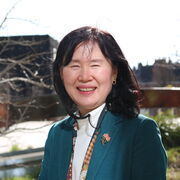
Busi Makoni is an Associate Professor at Pennsylvania State University, affiliated with the Department of Applied Linguistics and the Program of African Studies. She earned her MA from the School of Oriental and African Studies (University of London) and her PhD from the University of Edinburgh. Research areas include language rights, courtroom discourse, and language policy in African contexts. Her work intersects applied linguistics, legal studies, and sociolinguistics. She has published in journals such as International Journal of the Sociology of Language and Language Policy Journal , focusing on African languages, discourse analysis, and translanguaging strategies.
Helga Wagenleiter is a Term Assistant Professor of German at the University of Alaska Fairbanks, where she has taught since 2008. A native German speaker with four decades of Alaskan residence, she directs the university’s German-language program, offering courses up to the 300-level both face-to-face and online to reach learners statewide. Education MA in Languages and Literacy, University of Alaska Fairbanks (2023) Graduate studies in Social Pedagogy/Education, Universität Tübingen (1978) Fachhochschule für Sozialwesen, Reutlingen (1975) Fachschule für Sozialpädagogik (1971) Research & Teaching Focus Her pedagogical philosophy centers on communicative, learner-centered instruction that meets students wherever they are—geographically and linguistically. By leveraging technology and flexible modalities, she ensures equitable access to German-language education across Alaska’s vast and diverse communities. Her work emphasizes interactive curricula, culturally responsive materials, and the integration of Alaskan contexts into language learning. Articles & Publications No specific scholarly publications are listed in the supplied materials. Advising & Grants While no formal advisees or funded grants are cited, her long-standing commitment to expanding German instruction suggests ongoing curricular development and outreach initiatives. Contact & Office Office: Gruening 609A Phone: 907-460-5600 Email: hwagenleiter@alaska.edu Office Hours: Mondays 4–5 p.m. (Online)
Craig Chambers is a Professor and Department Chair in the University of Toronto Department of Psychology. His research focuses on human communication , cognitive science , and psycholinguistics , particularly language processing across the lifespan and communication with social robots . Education: B.A. in Linguistics, York University M.A. in Linguistics, University of Toronto M.A. in Brain & Cognitive Sciences, University of Rochester Ph.D. in Brain & Cognitive Sciences and Linguistics, University of Rochester His lab investigates how speakers balance verbal and non-verbal information (gestures, intonation, environmental context) to convey meaning, and how listeners integrate these cues during comprehension. Recent studies explore pragmatic inferences , lexical competition , age-related differences in language processing, and social robotics applications . Key article trends include child language acquisition , speech perception in aging populations, multimodal communication , and language prediction mechanisms . Lab activities blend rigorous scientific inquiry with playful experimentation, including initiatives like "The PAL LAB PLAYS!"
Douglas Lightfoot serves as Associate Professor of German and Linguistics at the University of Alabama's Department of Modern Languages & Classics, where he directs the German Program and advises German Linguistics graduate students. His academic leadership spans both linguistic theory and language pedagogy. His educational background includes: PhD in Germanic Linguistics, University of California, Los Angeles (2000) MA in Germanic Linguistics, University of California, Los Angeles (1995) Dual BA in Germanic/Oriental/Slavic Languages & Linguistics, University of California, Santa Barbara (1991) Studies at Georg-August Universität, Göttingen, Germany (1988-1989) Lightfoot's research centers on Historical Germanic linguistics , specializing in word-formation processes, affixoid development, grammaticalization, and lexicalization . His work uniquely bridges theoretical linguistics with foreign language pedagogy , examining how historical language evolution informs contemporary teaching practices. He investigates phonological phenomena in spoken German and advocates for integrating language history into curriculum design to enhance student comprehension of linguistic structures. His publication trajectory reveals a consistent focus on German morphological evolution, particularly suffix development and compound formation, while increasingly emphasizing practical applications for language educators. Recent works highlight scholarly writing practices and collaborative research methodologies, reflecting his commitment to advancing academic communication within the linguistic community. Recognition includes: Article of the Year Award (2007) from Die Unterrichtspraxis: Teaching German Freeman Award nomination (2006) by the Northeast Conference on Language Teaching Interdisciplinary Award for Alabama foreign language instruction 2011 Southern Conference on Language Teaching Excellence nomination As German Linguistics Graduate Advisor, Lightfoot mentors emerging scholars while securing institutional research support through multiple University of Alabama Research Advisory Committee grants. His advocacy for writing groups demonstrates commitment to scholarly productivity, and his leadership in professional organizations like the American Association of Teachers of German shapes pedagogical standards across the discipline. Though no formal laboratory is mentioned, his collaborative writing initiatives function as intellectual incubators for academic development.
Sandra Wilson Smith is an Associate Professor in the Department of English at Temple University’s College of Liberal Arts. Her expertise spans writing pedagogy, English as a Second Language (ESL), and American literary studies, with a focus on marginalized voices and interdisciplinary teaching methods. Education: Ph.D. in English, The Graduate Center, City University of New York (CUNY), 2008 Research Interests: Writing pedagogy and developmental writing, particularly in ESL contexts Young-adult and African-American literature Historical analysis of 18th–19th century American female adventure narratives Publications & Teaching Trends: Her work bridges literary analysis with pedagogical innovation, integrating video game theory into composition instruction and exploring transnational communication through technology. Key publications include studies on frontier literature, dystopian themes in African-American fiction, and comparative pedagogy using Homer and Sherman Alexie. Office: Mazur Hall, Temple University.
Gisela Ernst-Slavit is a Professor at Washington State University's College of Education, Sport, and Human Sciences, specializing in English Language Learners (ELL) education. Based at the Vancouver campus, she focuses on sociolinguistics, literacy, biliteracy, and critical issues in Latinx student education, with a career spanning scholarship, instruction, and service. Educational Background: Ph.D. in Bilingual/Multicultural Education, University of Florida M.S. in Multicultural/Multilingual Education, Florida State University B.S. in Clinical Psychology, Pontificia Universidad Católica del Perú Her research emphasizes bilingual education , academic language integration , and equity in diverse classrooms . She advocates for culturally responsive pedagogy and has led projects like the $2.2 million DOE-funded ELL IMPACT initiative to train bilingual paraeducators. Her recent publications analyze language policy tensions in dual language programs, refugee student integration , and mathematics instruction for ELLs . Collaborative works highlight interdisciplinary approaches to academic language across K-12 curricula. Scientific Awards: WSU Faculty Diversity Award (2020) "Real Hero" Award (2019) As past president of WAESOL and a keynote speaker on oral language importance in education, she bridges research and practice through grants, publications, and community engagement, ensuring marginalized voices shape educational policies and practices.
Natalia Norte Fernández-Pacheco is an Associate Professor at the University of Alicante (UA) and an English teacher at the Official School of Languages (EOI). She holds a PhD in English Philology from UA (2016) and a Diploma of Advanced Studies (DEA) in 2007. Her academic work spans teaching and research, with a focus on multimodal approaches to EFL instruction. Current affiliations: Department of English Studies (UA), Official School of Languages (EOI) Research Interests Her research explores the intersection of multimodal discourse analysis, English-medium instruction (EMI), and educational technology. Key areas include: Impact of multimodal ensembles on EFL audio-visual comprehension Role of digital tools like vodcasts in language learning Strategies for enhancing student engagement through multimodal presentations Integration of visual, auditory, and textual modes in university lectures Publications & Trends Natalia's scholarly output (2016-2020) centers on multimodal EFL pedagogy. Her work analyzes vodcast-based instruction, EMI implementation, and the cognitive effects of combining visual, auditory, and textual modes in language learning. These publications highlight interdisciplinary links between applied linguistics, educational technology, and discourse analysis. Collaboration & Institutions She is affiliated with the ACQUA research group (Second and Foreign Language Acquisition) at UA and teaches in the Department of English Studies. Her professional roles include: Teaching English at EOI for diverse CEFR levels Lecturing in UA's Tourism and English Studies degrees Her office is located at the Higher Polytechnic School II, University of Alicante.
Stephen D. Looney is a Teaching Professor in Applied Linguistics at Pennsylvania State University and Director of the ITA Program. His research focuses on classroom interaction and second language assessment through conversation analysis. Education: Ph.D. in Linguistics from the University of Georgia M.A. in TESOL from Carson-Newman University Dr. Looney specializes in multimodal classroom discourse as morally ordered social practice, examining how teachers and students navigate epistemics, deontics, and emotion in situ. His work includes mixed-methods research on L2 interactional competence assessment to inform test rating criteria. He teaches courses in classroom discourse analysis, conversation analysis, pronunciation pedagogy, and second language acquisition. His recent publications demonstrate consistent focus on conversation analysis in educational settings, particularly exploring multimodal resources like laughter, teasing, and embodiment in managing classroom interactions. Key trends include third-turn repetitions in foreign language classrooms, translingual practices in workplace contexts, and Rasch modeling for assessment validity.
Jeffrey Steele is a Professor in French Studies at the University of Toronto. His research focuses on second language acquisition, laboratory phonology, and bilingual literacy. He explores how phonological and phonetic factors influence language learning, particularly the acquisition of French and Spanish segmental and prosodic features by Mandarin, Japanese, and English speakers. Steele also investigates the role of phonological awareness in bilingual children's literacy development. PhD in Linguistics, McGill University MA in French Linguistics, Queen’s University BA Hons in French, University of Manitoba Steele’s work employs electropalatography (EPG) to analyze articulatory timing, assimilation, and cluster simplification in native and non-native speech. His publications address topics like cross-linguistic influence on coda voicing, syllable position effects, and the impact of phonetic input variability on L2 learning. Recent studies highlight gradient and categorical effects in bilingual phonology, phonological licensing asymmetries, and prosodic prominence acquisition. He co-developed the University of Toronto Test of French and maintains the Romance Phonetics Database (2004–Present). SSHRC Insight Development Grant (2022–2027) on Reading Comprehension in French Immersion Learners Steele teaches courses in French language skills, linguistic analysis, and individual differences in language acquisition. His collaborations with researchers like Colantoni and Kochetov bridge theoretical linguistics and applied pedagogy.
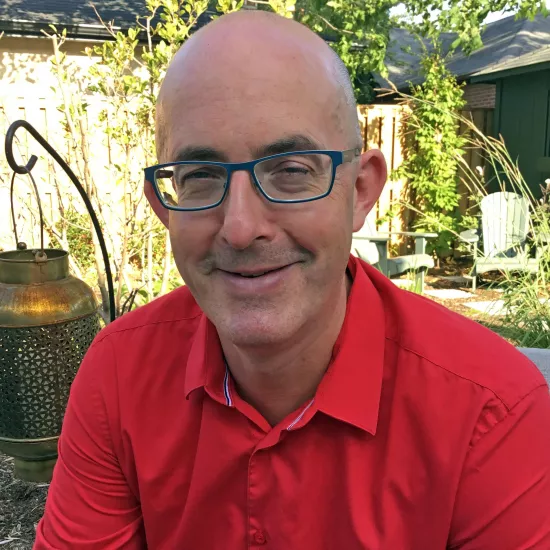
Christopher J Hall is Professor of Applied Linguistics at the York St John University , School of Education, Language and Psychology. With a PhD in Linguistics from the University of Southern California, he has made significant contributions to the fields of Global Englishes, Second Language Acquisition, and cross-linguistic influence. His research explores the social and cognitive dimensions of English as an international language, notably through the co-developed Parasitic Model of vocabulary learning with Peter Ecke. A Fellow of the Higher Education Academy (FHEA), he has taught at undergraduate and postgraduate TESOL courses while supervising postgraduate researchers. His book Ontologies of English (CUP, 2020) was shortlisted for the 2021 BAAL Book Prize. Recent collaborative work with colleagues in Germany and China focused on reconceptualizing English in teacher education, supported by the British Association for Applied Linguistics' Applying Linguistics fund. He has served in editorial and committee roles for major academic organizations like BAAL and QAA Linguistics Review Group.
Sukyeon Cho is a Senior Lecturer in Korean Language at the School of Languages, Arts and Societies, University of Sheffield . She joined the school in 2005 and took a full-time role as Director of the Korean Language Programme in 2008. Her teaching focuses on interactive and culturally immersive methods to enhance Korean language learning. Qualifications: BA (Korea Air & Correspondence University), MBA (Sogang University) Her work emphasizes the use of games, songs, and language exchange programs to improve speaking skills. She has contributed to the Sheffield Korean Society and Korean School, holding leadership roles between 2003–2008. In 2020, she received the South Korean President’s Award for her dedication to Korean language education. Mrs. Cho has been featured in media interviews, including MBC Korea (2011) and BBC Radio Sheffield/eFM Seoul (2019), discussing Korean Studies and cultural engagement.
Dr. Petra Poelmans is a Lecturer in Motivational Learning Environments at Rotterdam University of Applied Sciences, affiliated with the Teacher Training Institute. Her work bridges education, research, and professional practice, focusing on secondary education in Zeeland and Rotterdam. Research interests include: Designing motivating learning environments using motivation theories Hybrid learning environments in vocational (MBO) and higher professional education (HBO) Professional identity development of students and teachers Integrated reading instruction across subject areas Collaborative tools for assessing practical issue complexity Key projects include the MOZAIC initiative for self-regulated learning and a study on reading skills in all subjects. She collaborates with Zeeland school boards and Fontys University of Applied Sciences, where she previously worked. Her public lecture in 2023 emphasized teacher-student collaboration in motivation and context-dependent educational mechanisms.
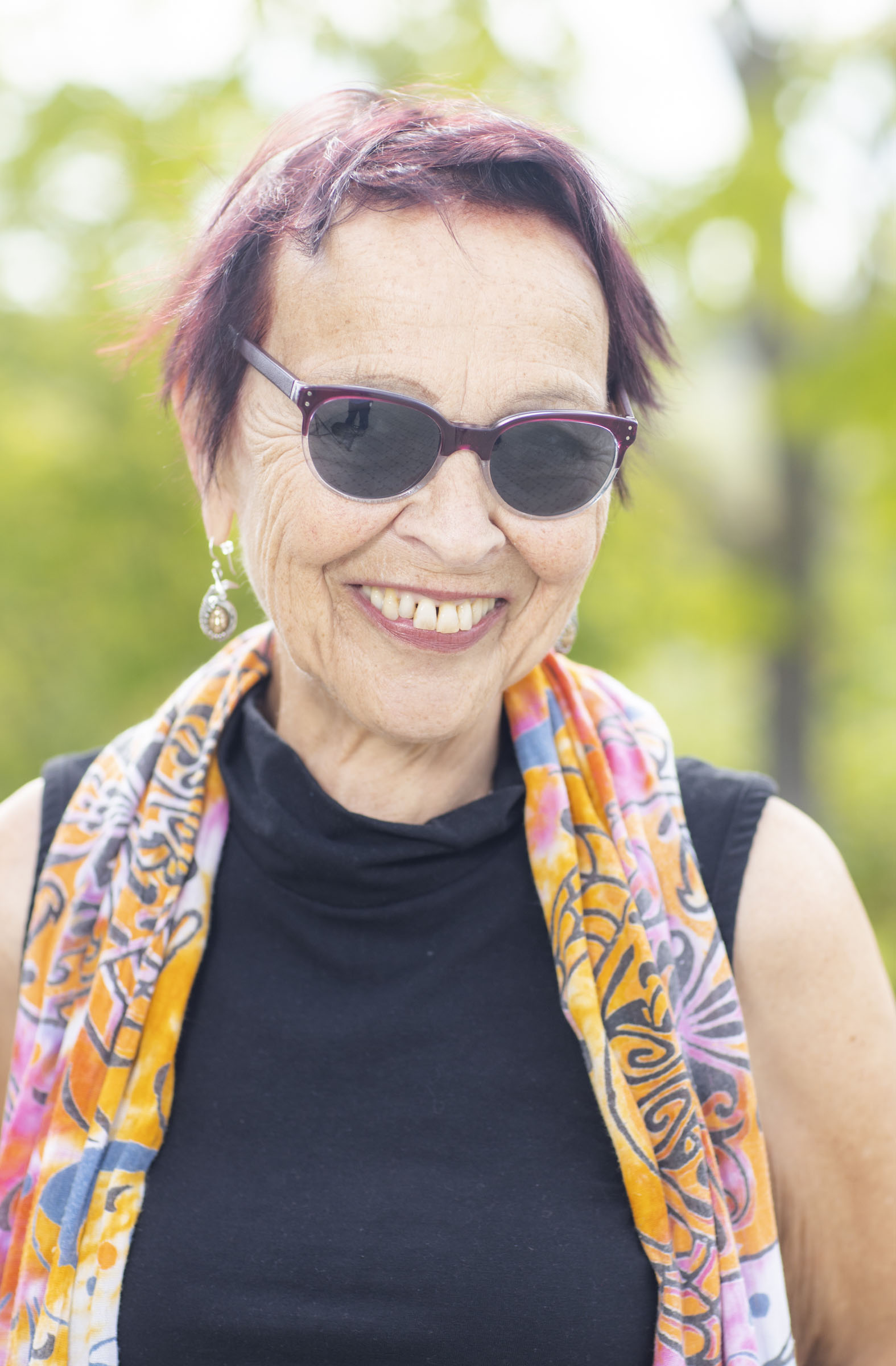
Professor Ursula Hurley is a Chair in Life Writing at the School of Arts, Media and Creative Technologies , University of Salford. She directs the English Research Centre and co-leads Equity, Diversity and Inclusion initiatives. Her career spans teaching, advertising, and community engagement before academia. Chair in Life Writing (2023) Co-lead for Equity, Diversity and Inclusion Founding Director of Salford’s Doctoral School (2018-2021) Her research bridges creative writing with digital fabrication , disability studies , and social engagement . She pioneered the UK’s first inclusive mobile FabLab (2016) and explores surrealist methodologies, gender politics, and interdisciplinary approaches to auto/biographical expression. Recent publications focus on failure pedagogy , postcolonial narratives , and experimental life writing . They reveal trends in: Disability-inclusive technology Decolonizing curricula Failure-positive leadership Hybrid critical/creative scholarship Scientific recognition includes: AHRC funding (2016) Multiple teaching awards As a PhD supervisor, she mentors projects on film theory to experimental essays and Jungian psychoanalysis . Her grant work spans community regeneration, digital inclusion, and educational resilience initiatives. She leads labs like the In the Making digital fabrication project and collaborates with teams in the English Research Centre and Creative Technology Research Centre .
Elaine Radmer, Ph.D., serves as an Associate Professor in the Teacher Education department within the School of Education at Gonzaga University. Her academic work critically examines test-based education reform, organizational accountability, and societal inequities in schooling systems. Her educational background includes: Ph.D. in Educational Psychology, Washington State University M.A. in International Studies and Teaching English as a Second Language, Wheaton College B.A. and B.S. in Education & Biology, Eastern Washington University A.A., Walla Walla Community College Radmer's research interrogates unexamined assumptions in educational institutions and explores how humans learn in social settings beyond formal schools. She champions collaborative inquiry into assessment practices and investigates culturally responsive pedagogy, particularly through young adult literature's impact on reading comprehension. Her work consistently addresses power dynamics, privilege, and strategies for making schools responsive to diverse learners. Her publication trajectory reveals evolving focus from classroom-level assessment (2012-2017) toward systemic leadership and equity (2018-2024), with recent emphasis on data-informed attendance systems, culturally intelligent leadership, and perseverance in re-engaged students. This progression demonstrates increasing engagement with institutional change while maintaining core commitments to equity and teacher empowerment. No major scientific awards are documented in available sources. Radmer actively mentors student researchers, as evidenced by asterisked co-authors across her publications spanning literacy, mathematics education, and leadership studies. Her collaborative projects with colleagues like Darragh, Garoui, and Conlin reflect sustained engagement with K-12 practitioners, though specific grant funding details aren't provided. Conference presentations at AERA and WERA demonstrate consistent scholarly dissemination. Her work involves cross-disciplinary partnerships with librarians, mathematics educators, and literacy specialists through professional organizations including AERA and WERA, focusing on practical applications of research in school settings.
Elena Tkachenko is a Lecturer at Oslo Metropolitan University, affiliated with the Faculty of Teacher Education and International Studies and the Department of Primary and Vocational Teacher Education, where she serves as Study Leader for Area 3. Based at Pilestredet 42, 0167 Oslo, she maintains active research and teaching responsibilities focused on language education. Dr. Tkachenko holds a degree in Applied Linguistics from St. Petersburg State University, which forms the foundation of her expertise in language acquisition and multilingual education. Her academic journey has centered on practical applications of linguistic theory in educational settings, particularly within Norwegian contexts. Her primary research interests include Norwegian as a second language, children's language development, and multilingualism, with special attention to translanguaging practices in early childhood education. Dr. Tkachenko conducts research on multilingual children, students, and staff, collaborating closely with practitioners to develop effective multilingual practices in education. Her work examines how linguistic diversity can be leveraged as a resource rather than a challenge in learning environments, particularly focusing on newly arrived immigrant populations including Ukrainian children in Norway. Analysis of Dr. Tkachenko's recent publications reveals a strong trajectory toward understanding how educational institutions can better support multilingual development through teacher training, policy implementation, and classroom practices that validate students' full linguistic repertoires. Her work spans Nordic early childhood education settings, examining translanguaging strategies, language policy implementation, and the use of AI in second language learning, demonstrating practical applications of theoretical frameworks in real educational contexts. Dr. Tkachenko actively contributes to research projects including the current pilot project on 'Second language students' use of AI and the use of AI in second language learning' and previously contributed to 'Increased quality in early literacy education in Ethiopia.' She regularly presents her findings at international conferences and participates in professional development seminars for educators. She is a member of the research groups 'Beginner training' and 'Cultural diversity and multilingualism in a global perspective,' where she collaborates with colleagues on advancing understanding of inclusive educational environments. Her work with language helpers and minority language assistants demonstrates her commitment to practical, community-based approaches to language education.




/prod01/yorksjacuk/media/content-assets/safe-images/1600-x-1000/CHRIS-HALL-6.jpg)