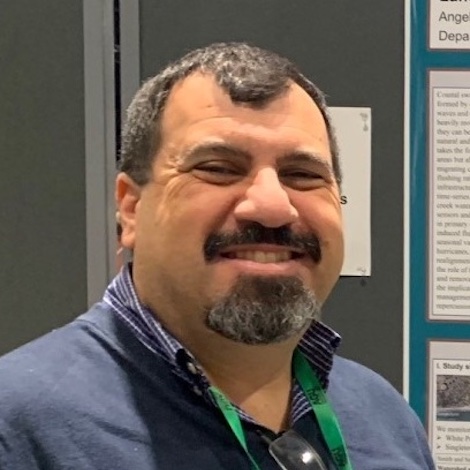
Angelos K. Hannides is an Associate Professor in the Department of Marine Science at Coastal Carolina University's College of Science, where he conducts research and teaches courses in marine and coastal biogeochemistry. His work focuses on understanding the complex interactions between physical, geological, chemical and biological processes in coastal environments, particularly sandy shores, estuaries, and the coastal ocean. Education: Ph.D. in Oceanography from the University of Hawai`i (2008) M.S. in Marine Environmental Sciences from SUNY Stony Brook (2001) B.S. in Marine Science and Biology from the University of Miami (1997) Dr. Hannides is a marine biogeochemist whose research centers on organic matter cycling and nutrient dynamics at the land-ocean margin. His primary research areas include the biogeochemistry of sandy shores and diagenetic processes in sandy sediments, land-ocean exchange of pollutants (particularly nutrients), coastal and estuarine eutrophication, hypoxia and acidification, and the biogeochemical implications of coastal engineering interventions such as beach nourishment and channel realignment. His work integrates field observations, monitoring, and experimental approaches to understand baseline conditions, natural variability, and human impacts on coastal systems. Dr. Hannides teaches courses including introduction to marine science, marine chemistry, environmental chemistry, and coastal and marine biogeochemistry, emphasizing the nexus of science and society. His recent publication record reveals a strong focus on coastal water quality issues in South Carolina, with significant attention to tidal creek systems, beach monitoring programs, and coastal acidification. His research demonstrates how physical, geological, chemical and biological characteristics interact to affect coastal function and exchange processes, with particular interest in human impacts through eutrophication, hypoxia, acidification, and coastal engineering interventions. The temporal scope of his work ranges from diel patterns to seasonal and interannual variability, providing comprehensive insights into coastal dynamics. Dr. Hannides actively collaborates with multiple organizations including the South Carolina Beach Advocates, the U.S. Coastal Research Program, and the American Shore and Beach Preservation Association. He is a key participant in the Southeast Ocean and Coastal Acidification Network (SOCAN) and works closely with CCU's Environmental Quality Laboratory and Waccamaw Watershed Academy on coastal monitoring initiatives. He mentors numerous undergraduate and graduate students through the Coastal Biogeochemistry VIP program, with research projects spanning sand biogeochemistry, tidal creek dynamics, coastal acidification, and eutrophication impacts. His research is supported by funding from local government entities including Horry County and the city of North Myrtle Beach, as well as the South Carolina Sea Grant Consortium for coastal monitoring projects at Apache Pier and Cherry Grove Pier. Dr. Hannides leads a comprehensive monitoring program that includes real-time data collection at Singleton Swash and White Point Swash through live camera feeds and sensor loggers recording water level, temperature, salinity and oxygen. His group is conducting South Carolina's first coastal and estuarine acidification assessment, developing both scientific understanding and educational outreach programs to address this critical environmental issue affecting coastal communities and ecosystems.