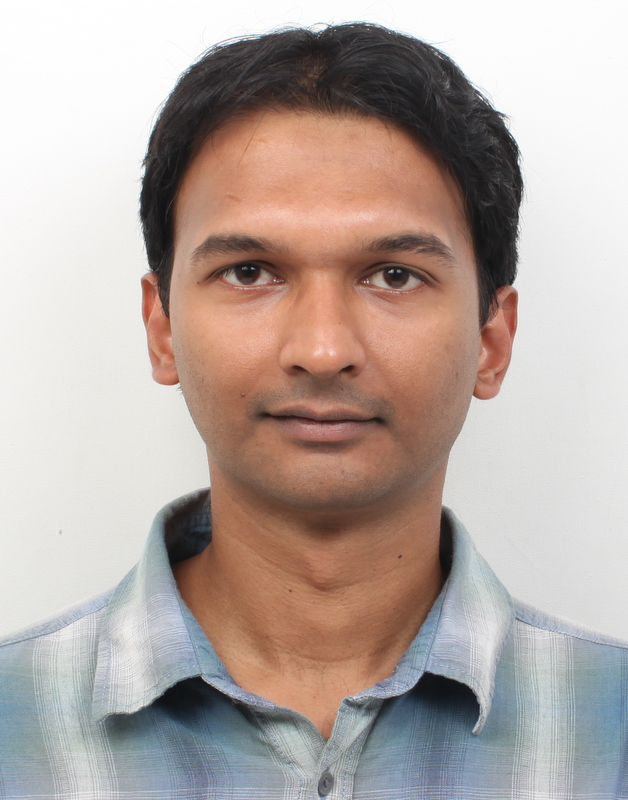
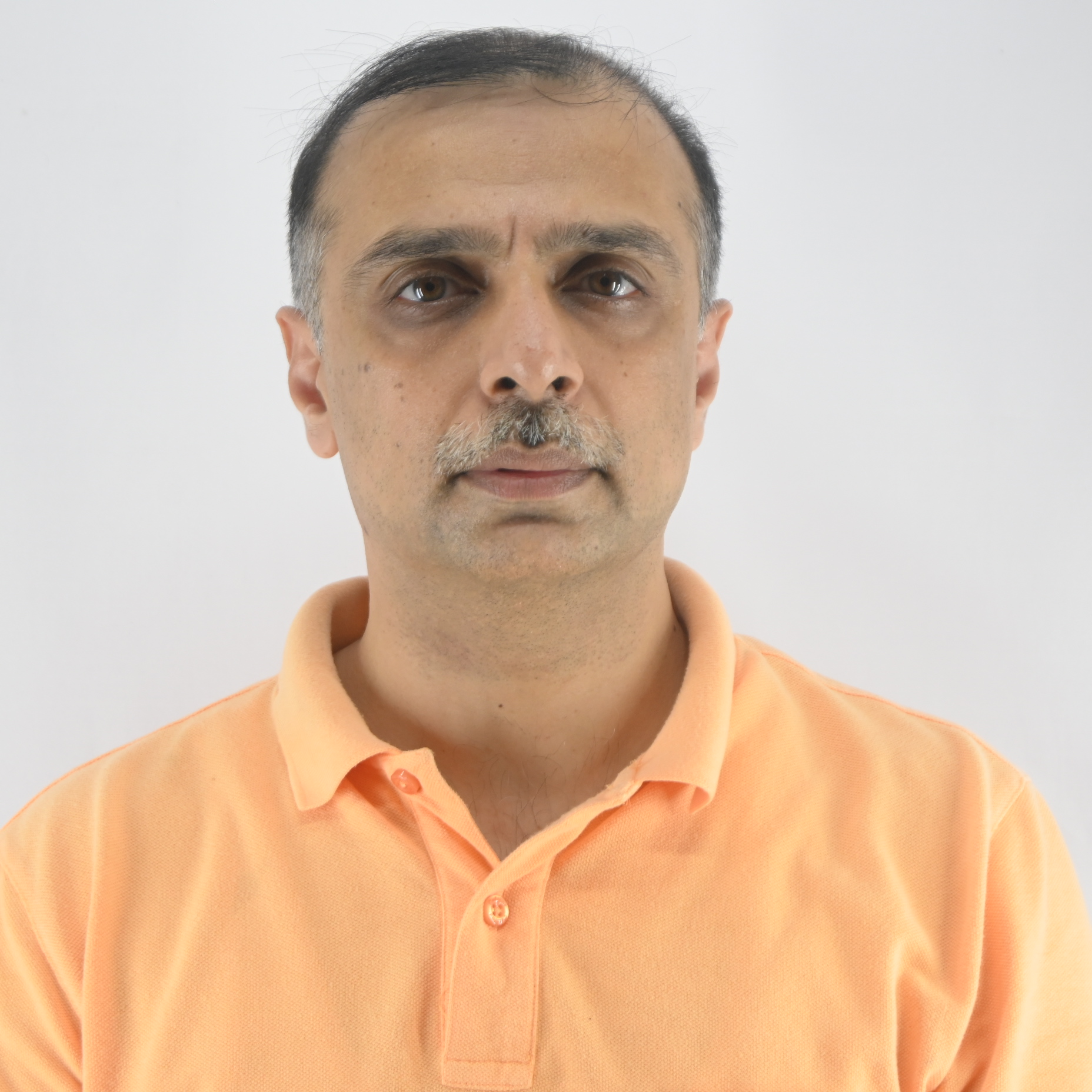
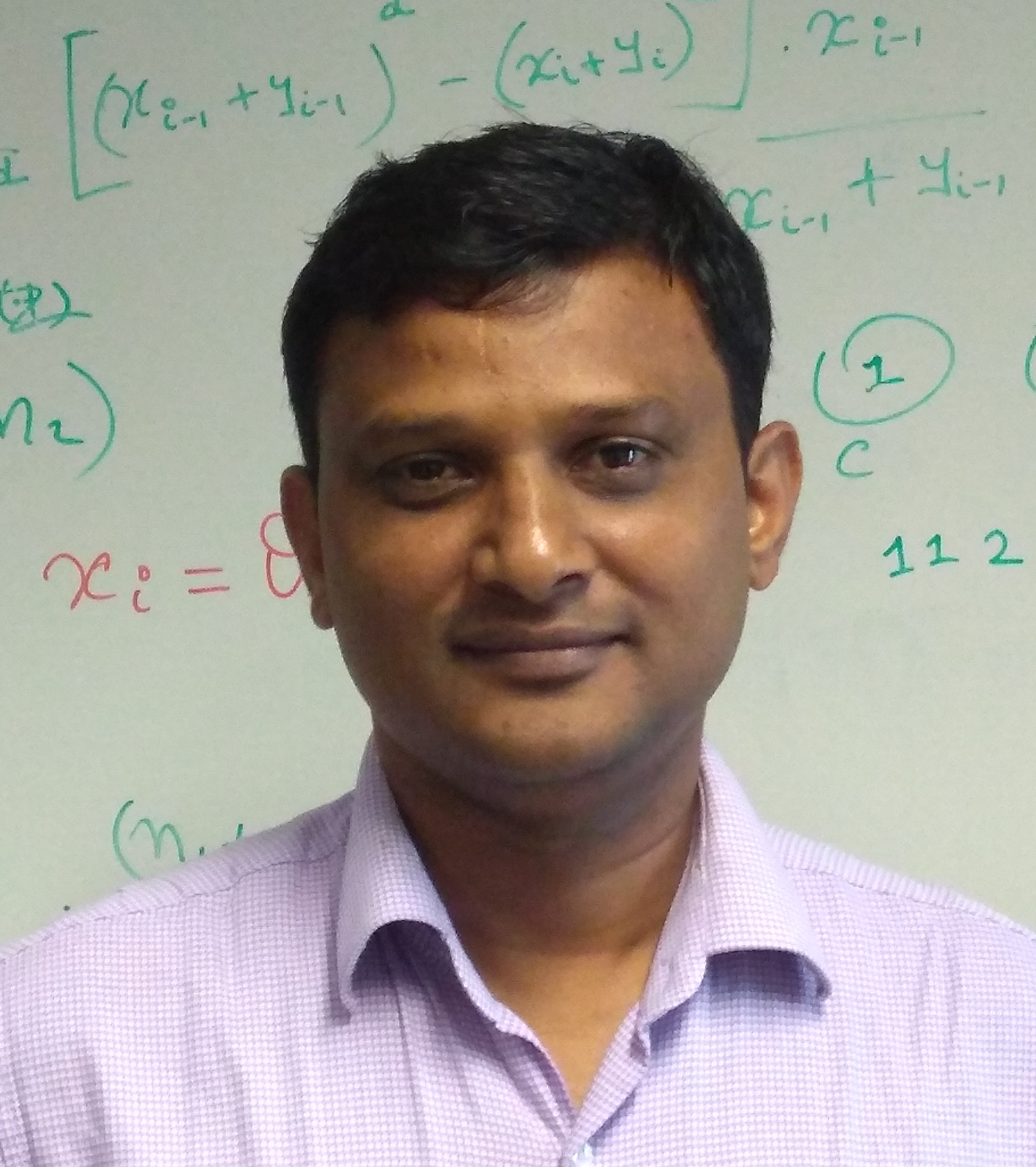
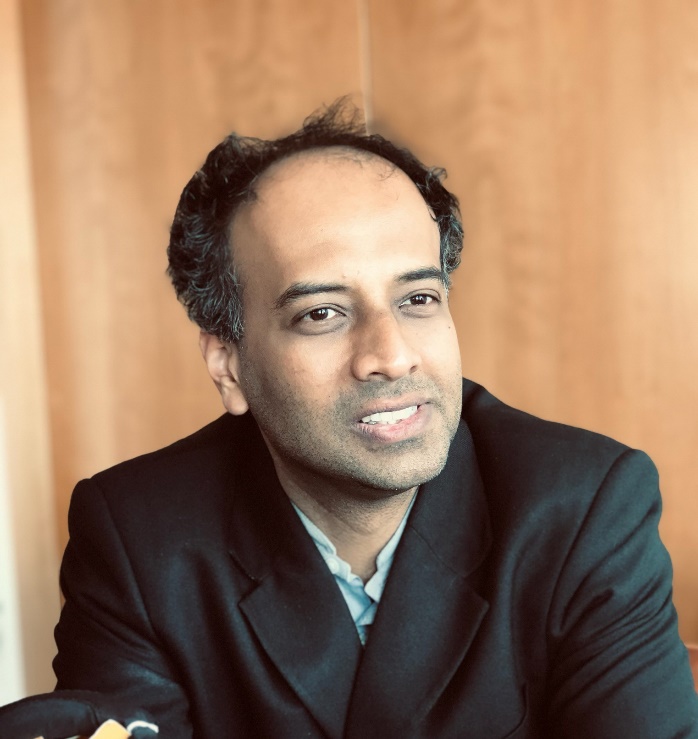
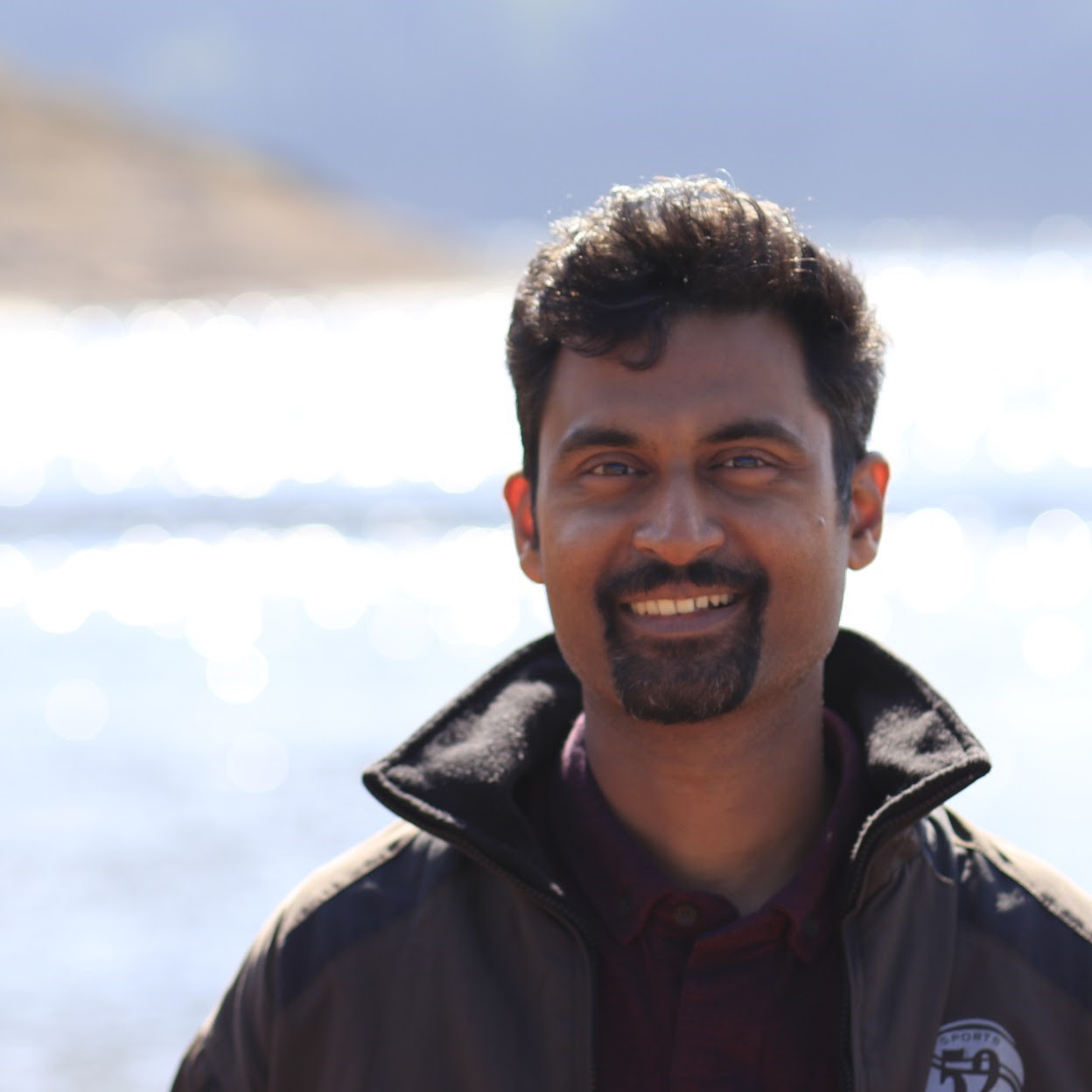
Shivaram Kalyanakrishnan is an Associate Professor at the Department of Computer Science and Engineering , Indian Institute of Technology Bombay , specialising in Artificial Intelligence and Machine Learning . His research spans sequential decision making , multiagent learning , multi-armed bandits , and humanoid robotics , with applications in robot soccer , computer games , and online advertising . He teaches advanced courses like CS 747: Foundations of Intelligent and Learning Agents and CS 748: Advances in Intelligent and Learning Agents , focusing on end-to-end system design and theoretical analysis. His scientific awards include the Best Student Paper Award at RoboCup International Symposium 2006 and nomination for Best Student Paper Award at AAMAS 2007 . His work on reinforcement learning and policy iteration has been published in leading venues such as IJCAI , ICML , and COLT , with recent contributions to railway scheduling and bandit algorithms. While no explicit list of advisees is provided, his research projects and publications suggest mentorship of students in collaborative efforts. Contact : shivaram@cse.iitb.ac.in .
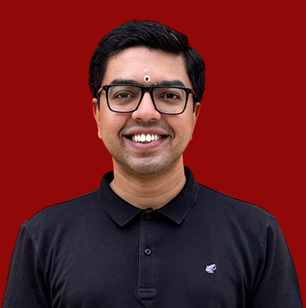
Ajit Rajwade is a Professor at the Department of Computer Science and Engineering , Indian Institute of Technology Bombay. His research spans Artificial Intelligence , Compressed Sensing , and Medical Imaging , with affiliations to the Centre for Machine Intelligence and Data Science and the Koita Centre for Digital Health . Education : PhD in Computer and Information Science and Engineering, University of Florida (2010) MSc in Computer Science, McGill University (2004) BTech in Computer Engineering, University of Pune (2002) His research interests focus on intelligent data acquisition, particularly in neural network analysis , graph signal processing , and medical imaging . He develops compressed sensing algorithms for inverse problems like tomography and MRI reconstruction , alongside applying group testing to pandemic response. Scientific awards include the Prof. S. P. Sukhatme Award (2024) and Departmental Teaching Excellence (2019). His publications demonstrate expertise in image restoration , noise modeling , and epidemiological algorithms . He has advised PhD students like Sabyasachi Ghosh and Jerin Geo James , with a focus on computationally efficient methods in medical imaging and machine learning .
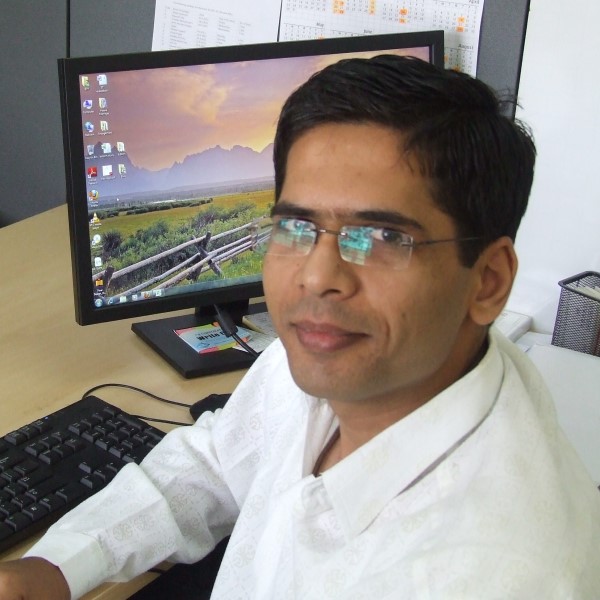
Manjesh Kumar Hanawal is an Associate Professor at the Industrial Engineering and Operations Research (IEOR) center of IIT Bombay , India. His academic journey includes a Ph.D. from University of Avignon/INRIA (2013), M.Sc (Engg) from IISc Bangalore (2009), and B.E. from NIT Bhopal (2004). Pre-Ph.D. work: Scientist-B at DRDO's CAIR Postdoctoral: Boston University (2013-2015) Appointed as first Professor-In-Charge of TCA2I center Research focuses on Machine Learning algorithms for limited feedback environments, Communication Networks resource allocation, and Cybersecurity threat detection. Publications span top venues like IEEE Transactions, NeurIPS, INFOCOM, and AISTATS. Recent work trends include: Bandit algorithms for distributed learning in heterogeneous networks Contextual information integration in sequential selection Energy efficiency optimization in wireless sensor networks Net neutrality violation detection frameworks Anti-jamming countermeasures in cognitive networks Scientific recognition includes the SERB Early Career Research Award (2019-2022) for machine learning applications in wireless networks. Advisees include Ph.D. awardee Arun Verma and Best Masters Thesis Awardee Sayan Chatterjee.
Soumya Dutta is an Assistant Professor in the Department of Computer Science and Engineering at the Indian Institute of Technology Kanpur (IITK), where he leads the INSIGHT: Intelligent Scientific and Visual Computing of Big Data Research Group. He joined IIT Kanpur in October 2022 after working as a Scientist II at Los Alamos National Laboratory (LANL) from July 2019 to August 2022, and previously as a Postdoctoral Research Associate at LANL from June 2018 to July 2019. His educational background includes a Ph.D. and M.S. in Computer Science and Engineering from The Ohio State University (2011-2018), where he was part of the GRAVITY research group, and a B.Tech. in Electronics and Communication Engineering from West Bengal University of Technology, India (2005-2009). Research Interests: Dr. Dutta's research focuses on the intersection of machine learning, visual computing, big data, and high-performance computing. His primary research areas include Machine Learning for Visual Computing and Image Analysis, Big Data Visualization and Analytics, Data Science and HPC, Machine Learning for Scientific Computing, and Explainability and Interpretability of AI Models. His work addresses various big data characteristics including the 5 Vs: Volume, Velocity, Variety, Veracity, and Value. He develops techniques that make complex machine learning models more interpretable and explainable, enabling their effective adoption in real-life applications across scientific domains, social media, IoT, healthcare, and industry applications. Dr. Dutta's research group has secured multiple funded projects including: DAVi: An Intelligent Data Analytics and Visualization Framework (funded by ISRO), Intelligent Visual Computing of Extreme-scale Data for Accelerating Scientific Discovery (IIT Kanpur Initiation Grant), Enabling Interactive Big Data Analytics and Visualization at Exascale (SERB), Development of AI-Enabled National Portal for Efficient Search of Missing People (C3iHub), and Proactive and Generalized Deepfake Defense Mechanisms (C3iHub). Best Reviewer, Honorary Mention Award for IEEE Transactions on Visualization & Computer Graphics (TVCG), 2021 Best Paper Award at ISAV 2021, co-located with Supercomputing (SC) LAAP Award at Los Alamos National Laboratory, 2021 Best Paper Award at TopoInVis 2019 Best Paper Award at ISAV 2018, co-located with Supercomputing (SC) Best Poster Award in 12th Annual CSE Student Poster Exhibition, The Ohio State University, 2018 Best Poster Award in 11th Annual CSE Student Poster Exhibition, The Ohio State University, 2017 Best Paper Honorable Mention Award at IEEE Visualization Conference (IEEE VIS) 2016 Dr. Dutta actively mentors a large group of students including Ph.D., M.Tech., and B.Tech. students. His current Ph.D. students include Shanu Saklani, Sankhadeep Bhowmick, Ananya Chaturvedi, Arpita Santra, Anubhav Dixit (co-supervised), and Robin Shah. He has supervised numerous M.Tech. students with thesis topics ranging from uncertainty-aware neural networks to deepfake detection. Dr. Dutta currently teaches courses including CS360 - Introduction to Computer Graphics and CS661 - Big Data Visual Analytics. The INSIGHT research group collaborates internationally with researchers from Meta, Oak Ridge National Laboratory, and National Taiwan Normal University. The group's work focuses on building machine learning and data science-based solutions to analyze large-scale multifaceted data in a scalable way, enabling interactive and interpretable analytics of complex data from scientific simulations, social media, IoT, healthcare, and other application domains.
Dr. Arnab Bhattacharya is a Professor in the Department of Computer Science and Engineering at the Indian Institute of Technology (IIT) Kanpur since December 2020. He previously served as Associate Professor (2014–2020) and Assistant Professor (2007–2014) at IIT Kanpur. Education: PhD in Computer Science (2007), University of California, Santa Barbara MS in Computer Science (2007), University of California, Santa Barbara Bachelor of Computer Science and Engineering (2001), Jadavpur University Research Focus spans Databases , Data Mining , Information Retrieval , and Artificial Intelligence . His work emphasizes graph analytics , skyline queries , probabilistic data , and knowledge graph management . Article Trends reveal expertise in graph neural networks , trajectory-aware systems , statistical significance in databases , and legal/medical data mining . His methodologies often integrate chi-square statistics , approximate indexing , and provenance tracking . Scientific Awards: IBM Faculty Research Award Yahoo! Faculty Research and Engagement Program Award Best Paper at COMAD 2011 Best Student Paper at COMAD 2010 Top-Five Student Paper at ICDM 2005 ICDM Student Travel Award sponsored by IBM Contact: Office RM 409, Department of Computer Science and Engineering, IIT Kanpur Email: arnabb@iitk.ac.in | Phone: +91-512-259-7650
Krishna Jagannathan is a full-time Professor in the Department of Electrical Engineering at the Indian Institute of Technology Madras (IIT Madras), India. He specializes in stochastic modeling, communication networks, information theory, and queuing theory. He obtained his B.Tech from IIT Madras in 2004, followed by S.M. and Ph.D. degrees from MIT in 2006 and 2010, respectively. After post-doctoral positions at Caltech and MIT, he joined IIT Madras in 2011. Education: B.Tech in Electrical Engineering, IIT Madras (2004) S.M. in Electrical Engineering and Computer Science, MIT (2006) Ph.D. in Electrical Engineering and Computer Science, MIT (2010) Research Interests: His research focuses on stochastic modeling and analysis of communication networks , information theory , and queuing theory . He has made significant contributions to understanding network performance, resource allocation, and risk-aware decision-making in complex systems. He leads the Networks and Stochastic Systems lab at IIT Madras, mentoring a large cohort of Ph.D. and M.S. students working on cutting-edge problems in networking, optimization, and stochastic systems. Scientific Awards: Best Paper Award at WiOpt 2013, Tsukuba, Japan Young Faculty Recognition Award for Excellence in Teaching and Research, IIT Madras (2014) Teaching & Mentorship: He has taught a wide range of courses including Probability Foundations , Stochastic Modeling and Queuing Theory , Convex Optimization , and Signals & Systems , consistently receiving high teaching evaluations. He has supervised over 15 Ph.D. and M.S. students to completion and continues to guide several active researchers.
Subhajit Dutta is an Associate Professor in the Department of Mathematics and Statistics at the Indian Institute of Technology Kanpur. He has established himself as a notable researcher in specialized statistical methodologies with publications in top-tier statistical journals. Dr. Dutta completed his PhD in Statistics from the Indian Statistical Institute (ISI), Kolkata in 2013 under the supervision of Prof. Probal Chaudhuri. His academic journey includes an M.Sc. in Statistics from IIT Kanpur (2007) and a B.Sc. in Statistics from Presidency College, University of Calcutta (2005). He also pursued post-doctoral research at KAUST with Prof. Marc G. Genton. His research focuses on advanced statistical methodologies, particularly in Discriminant Analysis, Inference based on Data Depth, Characterization of Multivariate Distributions, and Classification of Sequence Data. His work bridges theoretical statistics with practical applications, developing robust methods for complex data analysis problems across various scientific domains. Dr. Dutta's publication record shows consistent progression from foundational properties of statistical depth functions to practical applications in classification and sequence analysis, demonstrating both theoretical depth and practical relevance in his scholarly contributions. As a faculty member at IIT Kanpur, one of India's premier technical institutions, Dr. Dutta contributes to both teaching and research in the Department of Mathematics and Statistics, helping to advance statistical science education and methodology development.
Nishchal K. Verma is a Professor at the Department of Electrical Engineering, Indian Institute of Technology Kanpur. He holds a PhD from IIT Delhi (2007), an M.Tech from IIT Roorkee (2003), and a B.Tech from DEI Agra (1996). His postdoctoral research includes work at the University of Tennessee (2009) and Louisiana Tech University (2008). Specialization: Fuzzy Logic, Health Monitoring, Intelligent Informatics Current Research Interests: Intelligent Data Mining, Computer Vision, Smart Grids, Biomedical Applications His research focuses on Fuzzy Systems , Machine Learning , and Health Monitoring with applications to power systems, biomedical data, and wireless sensor networks. He has developed technologies like the Transducers and Instrumentation Virtual Laboratory and Brain Computer Interface Laboratory , emphasizing predictive modeling and fault diagnosis. Key sponsored projects include DST-funded Fuzzy Rule-Based Image Prediction and DRDO-supported Visual Surveillance Systems . His work spans 15+ years of interdisciplinary publications in journals and conferences. Scientific Awards : Devendra Shukla Young Faculty Research Fellowship (2013-16) He has served as Associate Editor for journals and Chairman of IEEE chapters, with leadership roles in academic administration at IIT Kanpur.
Dr. Srijith P.K. is an Associate Professor in the Department of Computer Science & Engineering at Indian Institute of Technology Hyderabad , where he leads research in probabilistic machine learning, Bayesian learning, and deep learning. He is affiliated with the BRAIN (Bayesian Reasoning And INtelligence) Lab , focusing on bridging human and machine learning through interdisciplinary applications in social networks, astrophysics, autonomous navigation, and sustainable cities. Research Interests : Probabilistic machine learning Bayesian learning Continual learning and causal learning Multi-modal learning and physics-informed neural networks Uncertainty quantification and generative modeling Scientific Awards : Sony Research Award 2021 Major Research Grants : Funding from AGC Inc, Japan, on Scientific Large Language Modeling Ministry of Education (MoE) funding for the Centre of Excellence in AI for Sustainable Cities Hyundai funding for Physics-Informed Neural Networks Sony Research India funding for Multimodal Learning JICA funding for Causal Learning in collaboration with RIKEN SERB and DST grants for projects on continual learning and astrophysical data analysis Advising : Supervises a team of students and researchers including Manisha Dubey, Rohan Tondulkar, Uddipta Bhattacharjee, Ayush Jain, Shamik Kundu, Posham Ramesh, Shikhar Sanjay, and Priyambada
Karthik P. N. is an Assistant Professor in the Department of Artificial Intelligence at the Indian Institute of Technology Hyderabad (IIT Hyderabad). He previously served as a Research Fellow at the Institute of Data Science, National University of Singapore (NUS), and completed his Ph.D. and Master of Science (Engineering) at the Department of Electrical Communication Engineering, Indian Institute of Science (IISc), Bengaluru, under the guidance of Prof. Rajesh Sundaresan. Earlier, he worked as a Project Assistant in Prof. Chandra R. Murthy's lab at IISc and earned a Bachelor of Engineering in Electronics and Communications from R V College of Engineering, Bengaluru. Ph.D., Electrical Communication Engineering, IISc Bengaluru M.Sc. (Engineering), IISc Bengaluru B.E., Electronics and Communications, R V College of Engineering His research focuses on Probability Theory, Detection and Estimation Theory, Markov Decision Processes , and Multi-armed Bandits , with applications in Federated Learning, Differential Privacy, Reinforcement Learning, Information Theory , and Statistics . Recent work explores optimal strategies for best arm identification in restless bandits and privacy-preserving machine learning. He has received high instructor ratings for courses like Stochastic Processes and Programming for AI , and was honored with the Faculty Teaching Excellence Award 2025 at IIT Hyderabad. His Google Scholar articles highlight advances in 3D point cloud security, railway accident prevention, and vision-language model robustness . Scientific awards include the Faculty Teaching Excellence Award 2025 and First place in the INAE Kanpur Chapter 100 Seconds Competition (2021) . He collaborates with researchers like Prof. Vincent Y. F. Tan and Prof. Yeow Meng Chee, and has served on technical program committees for conferences such as APWDSIT 2025 and ISIT 2025 . Teaching roles at IIT Hyderabad involve graduate-level courses on Probability and Stochastic Processes , cross-listed with Electrical Engineering.
Ketan P. Detroja is an Associate Professor in the Department of Electrical Engineering at Indian Institute of Technology Hyderabad . With a Ph.D. from IIT Bombay (2006) and a specialization in Multivariable Control, Distributed State Estimation, and AI/ML for Control Applications , his research focuses on ensuring fault-tolerant and economical operation of microgrids , developing distributed Kalman filtering techniques , and applying machine learning to process monitoring and control . Education: B.E., D. D. Institute of Technology, Gujarat, India Ph.D., IIT Bombay, 2006 Research Interests span Advanced Process Control, Fault Detection and Diagnosis, Cooperative Control, Microgrid Optimization and Control , and Hardware-Software Design for Control Systems . His work addresses challenges in data-driven process monitoring , distributed state estimation , and machine learning-based controller design , particularly for large-scale systems. Scientific Contributions include innovative approaches to inverse-free Kalman filters , reinforcement learning-based PI controllers , and data reduction algorithms for fault diagnosis. His publications reflect a focus on control theory, optimization, and machine learning integration , with applications in power systems, wind energy, and fault diagnostics . Scientific Awards: Best Paper Award at ADCONIP - 2011 Best Paper Award at DYCOPS-2013 Advising has been a significant part of his career, with supervision of Ph.D. students working on topics like fault detection in induction motors , microgrid scheduling , and adaptive control using fuzzy logic . His M.Tech students have explored areas such as visual object tracking, battery SOC estimation, and wind farm control , many of whom are now in prominent roles across academia and industry.
Koushik Pal serves as an Assistant Professor in the Department of Physics at the Indian Institute of Technology Kanpur (IIT Kanpur), a premier technical institution in India. Education: PhD from Jawaharlal Nehru Centre for Advanced Scientific Research (JNCASR), 2017 Postgraduate from Jawaharlal Nehru Centre for Advanced Scientific Research (JNCASR), 2013 Undergraduate from Jadavpur University, 2010 Research Focus: Dr. Pal specializes in computational materials science with expertise spanning materials theory and simulation, materials informatics incorporating machine learning techniques, and quantum and energy materials research. His work bridges theoretical frameworks with practical applications to advance understanding of complex material systems. Professional Background: Prior to his current position, Dr. Pal completed significant postdoctoral research at Northwestern University in the USA and Los Alamos National Laboratory, where he developed advanced computational methodologies in materials science. Current Role: At IIT Kanpur, Dr. Pal teaches physics courses, supervises graduate research students, and leads a research group focused on computational approaches to materials science problems, contributing to both academic instruction and cutting-edge research in his field.
Rajesh M. Hegde is a Professor in the Department of Electrical Engineering at the Indian Institute of Technology Kanpur. His research spans multiple domains within artificial intelligence, signal processing, and communication systems. He has established himself as a leading researcher in multimodal information processing and has contributed significantly to speech and audio processing techniques. Education: PhD in Computer Science and Engineering, IIT Madras (2005) ME in Electronics Engineering, Bangalore University (1988) BE in IT Engineering, Mysore University Professor Hegde's research focuses on the intersection of machine learning, artificial intelligence, and signal processing, with particular emphasis on multimodal information fusion. His work bridges theoretical foundations with practical applications in speech recognition, wireless communication, and pervasive computing. He has made significant contributions to group delay analysis in speech processing and developed innovative approaches for speaker segregation and multimodal system design. His research has practical implications for improving human-computer interaction through more natural and context-aware interfaces. Analysis of his recent publications reveals a consistent focus on multimodal systems and speech processing, with increasing attention to federated learning approaches and wireless network applications. His work demonstrates a strong theoretical foundation combined with practical implementation expertise, particularly evident in his prototyping of multimedia acquisition systems. Scientific Awards: P.K Kelkar Research Fellowship (2009-2013) Mentor for best undergraduate engineering design project award at UC San Diego (2005-06) ISCA Grant for INTERSPEECH 2004 IIT Madras PhD thesis recommended for IBM best thesis award (2005) Programme Committee member for ISCA Winter schools Commendation by IIT Kanpur for teaching excellence Professor Hegde has supervised multiple research projects and mentored students in developing innovative multimedia systems. His work on multimodal situation awareness systems has received recognition for its interdisciplinary approach. He has secured research funding through fellowships and institutional support, enabling his laboratory to maintain cutting-edge research facilities. His laboratory is located in ACES 203 and 204 at IIT Kanpur, where his research team works on multimodal information processing, wireless communication systems, and speech/audio processing applications. The lab maintains strong connections with international research institutions, particularly through his involvement with ISCA and previous collaborations with UC San Diego.
Professor Amarendra Kumar Singh is a distinguished faculty member in the Department of Materials Science and Engineering at Indian Institute of Technology Kanpur, specializing in process modeling and simulation of metallurgical processes. With over three decades of academic and industrial experience, he has established himself as a leading expert in steel refining, solidification processing, and computational materials engineering. PhD, IIT Kanpur, 2003 PG, IIT Kanpur, 1990 UG, IIT Kanpur, 1987 Dr. Singh's research focuses on Steel Refining and Casting, Extractive Metallurgy, Integrated Computational Materials Engineering, Solidification Processing, and Sustainable Manufacturing. His work bridges fundamental scientific principles with practical industrial applications, particularly in the steel industry. He employs advanced computational techniques to model complex metallurgical processes, enabling optimization of manufacturing parameters and improvement of material quality. His research has significant implications for energy efficiency, environmental sustainability, and cost reduction in metal production. His publication record demonstrates a consistent trajectory of research excellence, with a focus on mathematical modeling of steelmaking processes, solidification phenomena, and computational approaches to materials engineering. The publications span from fundamental studies of macrosegregation and solidification to applied research on ladle refining, electric arc furnaces, and inclusion engineering in steel. Recent work shows increasing integration of data science approaches with traditional materials modeling. Metallurgist of the Year Award, Ministry of Steel, Government of India, 2014 Distinguished Scientist Award, TCS, 2011 AICTE-INAE Distinguished Visiting Professor at IIT Bombay (2009-2012) Multiple Best Paper Awards from Indian Institute of Metals As a faculty member at IIT Kanpur, Dr. Singh has contributed significantly to academic programs, mentoring students, and advancing research in materials engineering. His professional affiliations with The Minerals, Metals and Materials Society (TMS), Indian Institute of Metals (IIM), Materials Research Society of India (MRSI), and Indian Society of Heat & Mass Transfer (ISHMT) reflect his standing in the academic community. His research has practical applications in industrial settings, particularly in the steel manufacturing sector where process optimization is critical for competitiveness.
Professor K. Muralidhar of the Department of Mechanical Engineering at Indian Institute of Technology Kanpur specializes in fluid dynamics, thermal sciences, and optical imaging techniques. With over 35 years of academic leadership, his work bridges experimental and computational approaches in transport phenomena. PhD from University of Delaware (1985) 20+ Doctoral students supervised 500+ Publications across 13 research areas Fellow of ASTFE, NAS, and INAE His key research domains include: Drop dynamics on hydrophobic surfaces Heat transfer in porous media Crystal growth visualization Biofluid mechanics in vascular systems Advanced tomographic imaging Cryogenic flow modeling Recent work focuses on CO2 sequestration , solar desalination , and non-invasive medical diagnostics , with significant contributions to Physics of Fluids and International Journal of Heat and Mass Transfer . Scientific awards highlight his global recognition: 2019: Fellow-ASTFE 2014: Keynote speaker, International Heat Transfer Conference 2006: INAE Fellowship 1995: Institution of Engineers Prize 1981: IIT Madras Institute Medal Pioneering optical measurement techniques for convection and phase change processes, he has developed novel approaches in schlieren tomography, interferometry, and digital holography. His laboratory's patent portfolio includes medical devices and fluid control systems.