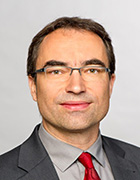
Heiko Falk is a Professor and Head of the Institute of Embedded Systems at Technische Universität Hamburg (TUHH). His roles include serving as Workshop Chair for the 2024 Embedded Systems Week (ESWEEK), Scientific Coordinator for the B.Sc. and M.Sc. Computer Science programs, and Deputy Head of the Board of Examiners for Computer Science and Engineering. His research focuses on real-time systems, compiler optimizations, and worst-case execution time (WCET) analysis. Key areas include multi-core architectures, cache management, energy efficiency, and hardware/software co-design. Falk's work emphasizes practical compiler techniques for improving real-time performance, such as WCET-aware memory allocation, dynamic SPM optimization, and event-driven scheduling. His publications analyze shared cache interference, preemptive/non-preemptive scheduling, and DMA-aware optimizations. Recent work explores multi-objective trade-offs between WCET, energy consumption, and code size in embedded systems. No scientific awards are explicitly listed, but his contributions to WCET benchmarking (e.g., haRTStone project) and compiler frameworks demonstrate significant impact in the field. Advising and grants: No formal advisees are listed in the provided texts. Falk's work is supported through projects like teamplay, focusing on cyber-physical systems optimization. Labs/Teams: His group operates within TUHH's Institute of Embedded Systems, collaborating on projects addressing real-time system challenges in multi-core environments.
Prof. Dr. Andreas S. Schulz is a faculty member at Technische Universität München (TUM), holding a chair in the Department of Mathematics and the Department of Business and Economics. He previously served as the Patrick J. McGovern Chair of Management and Professor of Mathematics at MIT. His research focuses on mathematical optimization, algorithm design, and their applications in logistics, production, healthcare systems, and online advertising. He has held visiting professorships at institutions such as the Sauder School of Business (UBC) and ETH Zurich. Prof. Schulz’s research bridges operations research, theoretical computer science, and economics. He develops analytical methods to solve complex decision-making problems in business, including scheduling, resource allocation, and network optimization. A key interest is applying mathematical approaches to enhance healthcare delivery and system efficiency. Education: PhD in Operations Research (MIT), prior academic roles at MIT and visiting institutions. Key Achievements: Alexander von Humboldt Professorship (2014), Humboldt Research Award (2010), Glover-Klingman Prize (2006). Research Themes: Robust optimization, approximation algorithms, scheduling theory, and algorithmic game theory. His publications span topics like integer programming, optimal transport, and congestion games. He collaborates across disciplines, emphasizing practical applications of theoretical insights.
David Schlipf is a Professor at the Fachbereich Energy and Life Science, Hochschule Flensburg, leading the Wind Energy Technology Institute. His expertise spans lidar-assisted control systems, floating offshore wind turbines, and aeroelastic modeling. He actively collaborates with international initiatives like IEA Wind Task 32 and contributes to projects such as the 'Lidar Knowledge Europe (LIKE)' network. His research focuses on enhancing wind turbine efficiency through advanced control strategies and sensor technology integration. He has been instrumental in developing the TorqTwin open-source framework for multibody modeling and has published extensively on topics including wind field reconstruction, load mitigation, and floating platform dynamics. His work bridges academic research with industrial applications, emphasizing practical solutions for offshore wind energy challenges. Notable projects include the evaluation of lidar-assisted control performance, optimization of floating turbine designs, and contributions to wind energy education's role in climate resilience. His research outputs span over 200 publications, highlighting his global impact in advancing renewable energy systems.
Prof. Dr. Tobias Brandt serves as a Full Professor and Chair of Digital Innovation and the Public Sector at the University of Münster's School of Business and Economics. His academic journey includes roles as Assistant Professor at Rotterdam School of Management (2016-2021) and Research Assistant at the University of Freiburg (2011-2015). He co-founded Geospin GmbH in 2016 and holds memberships in VHB, INFORMS, and AIS. Research Interests: Brandt focuses on digital innovation in public sectors, sustainable urban systems, e-government, and platform ecosystems. His work bridges information systems and operational research to address challenges in mobility, energy, and public service delivery. Recent projects include developing tools for sustainable urban planning, digital platforms for elderly care, and leveraging AI for crisis management. Notable Projects: Current initiatives include the PIONEER II Master's program on public innovation, SMARD-Gov (LLMs for government decision-making), and comuneo (digital sustainability management platform). Completed projects include INNO4S (integrating sustainability in business education) and studies on pandemic-driven digitalization in public administration. Awards: RSM Teaching Award (2020), Daniel H. Wagner Prize (2020), IBM Faculty Award (2016). Grants: €5M+ secured from EU Erasmus+, DFG, and German Federal Ministry of Research. Labs/Teams: Leads the Chair of Digital Innovation & Public Sector, collaborating with ERCIS (European Research Center for Information Systems). Active in GovTech and digital sustainability initiatives.
Hussein T. Mouftah is a Professor at the University of Ottawa , affiliated with the College of Engineering and Computer Science and the Department of Electrical and Computer Engineering . He is a leading figure in Intelligent Transportation Systems , Wireless Networks , and Smart Cities research. His research spans vehicular ad hoc networks (VANETs) , autonomous electric vehicles (CAEV) , edge computing , IoT security , and 5G/6G-enabled infrastructure . He pioneers dynamic wireless charging , deep reinforcement learning , and federated learning for mobility solutions. The 15 most recent articles highlight his work in edge computing (4 entries), vehicular networks (5 entries), machine learning (3 entries), and blockchain (2 entries), with sub-fields including UAV energy management , real-time task offloading , multi-modal fusion , and smart grid integration . His methodology combines deep RL for autonomous driving , federated learning for decentralized energy trading , and blockchain to secure ITS systems . He collaborates extensively with researchers like Parisa Fard Moshiri , Burak Kantarci , and Binod Vaidya on smart city infrastructure and vehicular security projects.
Lena Funcke is an Assistant Professor of Theoretical Physics at Bonn University. Her research focuses on quantum computing, lattice field theory, and machine learning applications in physics. She explores topics such as topological phases, gauge theories, and quantum simulations. Her work bridges high-energy physics and computational methods, with a particular emphasis on overcoming noise challenges in quantum algorithms and leveraging machine learning for optimization tasks. Funcke’s research projects include C01 and C03, focusing on Hamiltonian lattice formulations and quantum computing methods for gauge theories. She investigates hybrid approaches combining Monte Carlo simulations with quantum computing to study quantum electrodynamics and topological systems. Her contributions highlight the interplay between theoretical physics and cutting-edge computational tools. Her publications span quantum algorithms for particle physics experiments, error mitigation strategies, and the application of normalizing flows to complex systems like the Hubbard model. She actively contributes to advancing the theoretical foundations of quantum computing and its practical implementation in solving fundamental physics problems.
Konstantinos Nikitopoulos is a Professor at the University of Surrey , UK, specializing in Wireless Communications and Signal Processing . His research focuses on MIMO Systems , Open-RAN , and Non-Linear Processing for next-generation wireless networks. His recent work explores Analogue Processing for Tbps Wireless Systems and Neuromorphic Computing in MU-MIMO detection. He has developed frameworks like MIMO-SoftiPHY and SACCESS for software-based radio acceleration and power-efficient network design. Key Publications : Power-Efficient RIC, NL-COMM, NeuroMIMO Collaborators : Rahim Tafazolli, George Katsaros, Marcin Filo His research impacts 6G Network Development through innovations in Beamforming , Channel Estimation , and Software-Defined Radios .
Prof. Dr. Julia Rieck is a Full Professor of Business Administration at the University of Hildesheim , leading the Department of Business Administration and Operations Research within the Faculty of Mathematics, Natural Sciences, Economics and Computer Science. As Dean of the Faculty , she oversees academic programs, quality management, and research initiatives. Her roles include academic advising for the Business Information Systems (B.Sc./M.Sc.) programs and active participation in examination boards and quality committees. Education: PhD in Political Science (Dr. rer. pol.) with summa cum laude (2008), Habilitation at Clausthal University of Technology (2014), and studies in Business Mathematics (Diploma, University of Hamburg, 2003) and Mathematics (Georg-August-University Göttingen, 2000). Research: Focuses on Operations Research , Supply Chain Management , Project Planning , and Logistics . Her work integrates mathematical modeling , machine learning , and real-world applications , particularly in disaster response , dynamic transportation , and sustainable e-commerce . Projects: Leads third-party funded initiatives like "IT für die sorgende Gesellschaft" (AI in healthcare/social sectors) and contributes to the HULLS real-lab (AI in aging societies). Collaborates with regional companies (e.g., Youco, ADITUS) and institutions (HAWK, University of Hannover). Teaching: Emphasizes practical application through case studies, industry partnerships, and the IT-Speed Dating event for student-company connections. Her courses cover project resource planning , logistics , and digital transformation . Labs & Teams: Active in the Institute of Business Administration & Business Information Systems , contributing to the KET Kompetenzwerkstatt (entrepreneurship support) and interdisciplinary teams in AI and sustainability research.
Professor Yann Disser is a faculty member in the Department of Mathematics at TU Darmstadt since 2021. He previously held an Assistant Professor (tenure-track) position at TU Darmstadt (2016-2021), a PostDoc position at TU Berlin (2012-2016), and a Visiting Professor role at Augsburg University (2015). His research spans Combinatorial Optimization , Online Algorithms , Graph Exploration , Computational Complexity , and Robust Optimization . Current position: Professor (W2), TU Darmstadt Previous: Assistant Professor (2016-2021), TU Darmstadt PostDoc & Habilitation: TU Berlin (2012-2016) His research focuses on algorithmic approaches to optimization problems, including: Combinatorial Optimization for problems like Steiner trees and knapsack variants Online Algorithms with applications to scheduling and transportation Graph Exploration by mobile agents and complexity bounds Computational Complexity of linear programming pivot rules Network Flows and geometric reconstruction Recent publications analyze incremental maximization with greedy methods, lower bounds for active-set methods , and universal circuit designs . His work appears in top venues like IPCO , ESA , and SODA . He advises a team of researchers including David Weckbecker, Farehe Soheil, and Alexander Birx. Current and past advisees often focus on algorithmic theory, with placements at institutions like HPI Potsdam and Merck.
Arpan Gujarati is a Sessional Lecturer in the Department of Computer Science at the University of British Columbia (UBC), affiliated with the Systopia Lab. He teaches graduate and undergraduate courses such as CPSC 538G (Distributed Systems), CPSC 416 (Operating Systems), and CPEN 432 (Real-Time System Design). He holds a PhD from the Max Planck Institute for Software Systems and TU Kaiserslautern, where he was supervised by Björn B. Brandenburg. PhD: Max Planck Institute for Software Systems & TU Kaiserslautern (2020) Undergraduate: Birla Institute of Technology and Science (BITS Pilani) Postdoctoral Researcher: MPI-SWS Research Associate: UBC Software Development Engineer: Citrix R&D, India His research focuses on real-time and distributed systems, with applications in cyber-physical systems, fault tolerance, and machine learning reliability. He investigates scheduling algorithms, reliability analysis, and the integration of learning-enabled components into safety-critical systems. His work combines theoretical analysis with practical system implementations, often involving real-world testbeds and open-source tools. His recent publications span top-tier venues including RTSS, OSDI, ECRTS, DSN, and Middleware, with a strong emphasis on performance predictability, resilience of ML systems, and real-time communication. His work frequently addresses challenges in timing guarantees, fault tolerance, and system reliability in both cloud and embedded environments. SIGBED Paul Caspi Memorial Dissertation Award Best Paper Award at RTSS 2022 Distinguished Artifact Award at OSDI 2020 Best Student Paper Award at Middleware 2017 Outstanding Paper Award at RTCSA 2025 He advises several PhD students and undergraduate researchers at UBC, including Heng Zhao, Aida Aminian, Zainab Saeed Wattoo, and Philip Schowitz. He has led multiple research projects involving robotic arms, NVIDIA Holoscan, FreeRTOS, and distributed key-value stores. His lab work emphasizes reproducibility, open datasets, and practical system building. He has served on program committees for RTSS, RTAS, ECRTS, and Middleware, and contributes to journals such as Real-Time Systems and JSys.
Britta Peis is a Professor of Management Science at RWTH Aachen University since September 2013. She studied Mathematics and Sports Sciences at the University of Cologne and German Sport University Cologne, respectively. Her academic journey includes positions at TU Dortmund (2006-2007), TU Berlin (2007-2010), and a visiting professorship at Otto-von-Guericke University Magdeburg (2010-2011). Her research focuses on Combinatorial Optimization , Algorithmic Discrete Mathematics , Routing and Scheduling , Robust Optimization , and Algorithmic Game Theory . Her work spans theoretical and applied domains, including network flow analysis, auction algorithms, and strategic decision-making in complex systems. Recent publications (2025-2024) highlight advancements in dynamic auction mechanisms, Stackelberg game formulations, and train routing algorithms. Earlier works (2022-2018) explore matroid theory, packet routing with priority lists, and sensitivity analysis in polymatroid optimization. Key trends include algorithmic design for competitive networks and robustness in time-dependent flows. She is affiliated with the Graduiertenkolleg UnRAVeL (Aachen Institute for Discrete Mathematics and Logic) and contributes to the Chair of Management Science's research agenda in combinatorial optimization and algorithmic game theory.
Yong Zhang is affiliated with Tsinghua University's Research Institute of Information Technology in Beijing, China. His research focuses on machine learning, optimization algorithms, edge computing, and their applications in areas like time series analysis, federated learning, and sensor networks. He has collaborated on projects involving neural networks, scheduling problems, and privacy-preserving techniques. Education: Yong Zhang earned a PhD in Computer Science and Engineering from Fudan University in 2007. His academic career includes roles at institutions like the Chinese Academy of Sciences and the University of Hong Kong, reflecting a strong interdisciplinary background. Research Contributions: His work spans theoretical computer science, algorithm design, and applied machine learning. Notable areas include developing efficient scheduling algorithms for energy systems, creating robust federated learning frameworks for industrial demand forecasting, and advancing methods for sentiment analysis using multimodal data. He has also contributed to biomedical engineering through smartphone-based health monitoring systems. Collaborations: He frequently collaborates with researchers at institutions like the University of Electronic Science and Technology of China, Nanyang Technological University, and The Hong Kong Polytechnic University. Key projects involve data caching optimization in edge computing, distributed algorithms for dynamic networks, and combinatorial optimization problems. Labs & Future Work: His team explores cutting-edge topics in AI-driven systems, including trust-aware machine learning, distributed resource allocation, and real-time data processing for IoT applications. Current research emphasizes scalable solutions for complex optimization challenges in both academic and industrial settings.
Liji Shen is Professor of Operations Management and Chairholder at WHU – Otto Beisheim School of Management, Campus Vallendar, Germany. She is affiliated with the Supply Chain Management Group and leads research in scheduling, optimization, and sustainable manufacturing. Her academic journey includes a Ph.D. and Habilitation from Technische Universität Dresden, and she has held visiting scholar positions at institutions including École des Mines de Saint-Étienne and Huazhong University of Science and Technology. Ph.D. (Dr.rer.pol.), summa cum laude, Technische Universität Dresden (2009) Habilitation, Technische Universität Dresden (2015) Master of Business Administration (Dipl.-Kffr.), Technische Universität Dresden (2006) Liji Shen's research focuses on Operations Management , particularly scheduling optimization in manufacturing systems. Her work spans flexible job shops , parallel machine scheduling , energy-efficient production , and sequence-dependent setup times . She applies advanced techniques such as evolutionary algorithms , hybrid metaheuristics , and mathematical programming to solve complex industrial problems. Her recent publications emphasize sustainability through energy-aware scheduling and time-of-use pricing models. The 15 most recent publications highlight a consistent research trajectory in production scheduling , with increasing emphasis on energy efficiency , distributed manufacturing , and real-world constraints like eligibility and delivery times. Her work frequently appears in top journals such as European Journal of Operational Research , IEEE Transactions on Evolutionary Computation , and Computers & Operations Research , often in collaboration with leading researchers like Dauzère-Pérès, Mönch, and Buscher. Scientific Awards: European Journal of Operational Research, Best Paper Award (2021) DFG and TU Dresden, 'Support the Best' Prize for Outstanding Researchers (2013) Dr. Feldbausch-Prize for Best Dissertation, TU Dresden (2010) Scholarship for Young Researchers in Saxony (2006–2009) DAAD Prize for Best Foreign Students (2007) Best Master’s Thesis, German Operations Research Society (2007) Liji Shen has been an active advisor and researcher, leading projects in operations research and industrial optimization. Her editorial role on Operations Research Perspectives underscores her standing in the academic community. She has directed research labs and collaborated internationally, contributing to both theoretical advancements and practical applications in manufacturing and logistics. No specific grants are mentioned, but her sustained publication record and leadership roles indicate strong research support. She leads the Operations Management research group at WHU, focusing on algorithmic solutions for complex scheduling problems. Her team investigates energy-aware production, hybrid flow shops, and distributed systems, aiming to bridge the gap between theoretical models and industrial implementation. The lab collaborates with researchers across Europe and China, fostering a global research network in operations research and supply chain management.
Prof. Jörn Meissner, PhD, is a Full Professor of Supply Chain Management & Pricing Strategy at Kühne Logistics University (KLU) since 2011. He holds a PhD and Master’s in Management Science from Columbia Business School and a Diploma in Business from University of Hamburg . As an academic and entrepreneur, he founded Manhattan Review and Lancaster Executive . Education: PhD in Management Science, Columbia University (2005) Master of Philosophy, Columbia University (2005) Diplom-Kaufmann, University of Hamburg (1997) Research Expertise: Focus on stochastic and dynamic decision-making using mathematical optimization and machine learning Key projects: Global supply chain optimization , Inventory control , Revenue management , and Operations & service management Industry collaborations with British Telecom , British Airways , Apple Europe , and SAP Germany Publication Trends: Recent work addresses intermittent demand forecasting for spare parts, lateral transshipment optimization , and risk-sensitive capacity control Historical contributions include progressive interval heuristics for multi-item lot sizing and dynamic pricing with customer choice models Teaching Experience: Previously held academic positions at Lancaster University Management School , University of Hamburg , and University of Mannheim Developed MBA electives in Advanced Decision Models , Supply Chain Management, and Revenue Management
Cédric Soutil is a Researcher at the Conservatoire National des Arts et Métiers (CNAM) , affiliated with the CEDRIC Laboratory. His work spans combinatorial optimization , integer programming , quadratic programming , and algorithm design , with a focus on solving complex optimization problems in scheduling and graph theory. Recent publications highlight his expertise in non-separable and non-convex quadratic integer programming , knapsack problems , and online computation . His research trends emphasize mathematical reformulations , upper bound algorithms , and optimization models for real-world applications like horse race scheduling and hydrogen production . He has collaborated extensively with researchers such as A. Houdayer , D. Quadri , and P. Tolla , contributing to over two decades of academic output in operations research and combinatorial optimization .