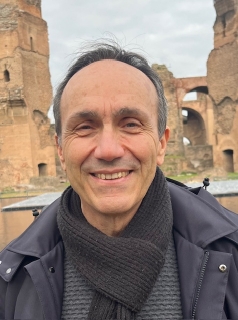
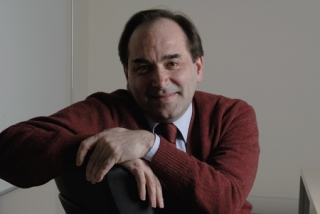
Leonardo Badia is an Associate Professor at the University of Padova . He holds a PhD in Information Engineering from the University of Ferrara and has held academic positions at IMT Lucca Institute and the University of Padova since 2016. Research Interests : His work focuses on mathematical optimization for communication networks, including Markov models for protocol analysis, cross-layer optimization of routing/scheduling/resource allocation, Age-of-Information (AoI) , energy harvesting , and game theory applications. He has published over 200 papers in top-tier journals and conferences. Recent Articles highlight his contributions to AoI optimization, adversarial modeling in CPS, strategic cooperation in IoT/metaverse, and energy-efficient network protocols. His work spans telecommunications , game theory , and networking , with subfields like hybrid ARQ , multi-radio resource management , and QoS-aware scheduling . Awards : Best Paper Awards at IEEE MobiWac 2005, IEEE CAMAD 2006, and IEEE Globecom 2007.
Alessandro Checco is an Assistant Professor in the Computer Science Department at University of Rome La Sapienza. His research focuses on crowdsourcing, distributed systems, and privacy-preserving technologies, bridging theoretical computer science with practical applications that consider human factors in technological systems. He has established himself as a significant contributor to the field of human computation and privacy-aware systems. His educational background includes: 2020: Fellowship of Higher Education from The University of Sheffield, Higher Education Academy 2015: Ph.D. in Mathematics from Hamilton Institute (Design of decentralised algorithms applied to channel/code selection and convex optimisation for throughput fairness of 802.11 networks) 2010: M.Sc. in Mathematical Engineering from University of Roma "Tor Vergata" (110/110 with great distinction) 2009: Erasmus Scholarship at Universiteit Gent, Department of Telecommunications 2007: B.Sc. in Mathematical Engineering from University of Roma "Tor Vergata" (110/110 with great distinction) Checco's research spans multiple areas at the intersection of computer science and social implications of technology. He is particularly interested in Crowdsourcing for Human Computation, Distributed Private Recommender Systems, Information Retrieval, Data Privacy, Distributed Systems, User Data Obfuscation in Web Systems, Societal and Economic Analysis of Online Work, Crowd Workers Unionisation, and Algorithmic Bias. His work often examines how technological systems can be designed to respect user privacy while maintaining functionality, and how crowd work can be structured to be more equitable for workers. His recent publications demonstrate a clear evolution in research focus, beginning with foundational work in wireless networks and distributed algorithms, then shifting toward human computation and privacy-preserving systems. His most recent work increasingly addresses the societal implications of crowd work, including investigations into crowd worker unionization and cooperative models. Several publications examine gender bias in algorithmic systems, reflecting growing attention to fairness and ethical considerations in his field. Among his notable achievements: All That Glitters is Gold-An Attack Scheme on Gold Questions in Crowdsourcing (Best Paper Award) Checco has secured significant research funding and led important projects including the H2020-funded FashionBrain project as Research Director and the EPSRC-funded BetterCrowd project as Research Associate. His work on the FashionBrain project demonstrates his ability to lead large-scale, interdisciplinary research initiatives. He has also received the Technology Innovation Development Award (TIDA) from Science Foundation Ireland. His research has practical applications across multiple domains including recommendation systems (BLC: Private Matrix Factorization Recommenders), peer review assistance using AI, smart farming technologies, and cooperative models for crowd workers (CrowdCO-OP). He has developed frameworks for understanding worker behavior in crowdsourcing platforms and created methods for improving quality control in human computation systems.
Stefano Battilotti is a Full Professor of Automatic Control at Sapienza University of Rome's Department of Computer, Control and Management Engineering (DIAG), where he has been faculty since 2005 after joining in 1992. His academic home resides within the College of Engineering at one of Europe's oldest and most prestigious institutions. Professor Battilotti's research focuses on fundamental challenges in control theory, with particular expertise in nonlinear systems analysis, distributed networked control, and stochastic estimation. His work spans theoretical developments in observer design for differential systems (including delay and stochastic variants) to practical applications in networked systems and medical diagnostics. Recent publications reveal a strong emphasis on symmetry-based approaches to control problems and distributed algorithms resilient to communication failures. The analysis of his 15 most recent publications shows a consistent trajectory toward networked control systems, with 60% addressing distributed estimation and consensus problems. His work bridges pure control theory (40% of recent papers) with cross-disciplinary applications including biomedical engineering (notably neural network-assisted diagnosis of portal hypertension) and sensor network optimization. Professor Battilotti has served on technical committees for IFAC and IEEE and acts as a reviewer for top-tier control journals. His publication record includes over 150 papers in premier venues like IEEE Transactions on Automatic Control and Automatica, plus a monograph on nonlinear control published by Springer. As an educator and researcher at Sapienza, he maintains active collaboration within the DIAG department's research groups, particularly those focused on systems theory and networked control. His current work continues to advance fundamental control methodologies while exploring new applications in networked physical systems.
Alberto De Santis is an Associate Professor in the Department of Computer, Automatic and Management Engineering A. Ruberti at the University of Rome La Sapienza, Faculty of Information Engineering, Computer Science and Statistics. He has maintained this position since 1998 in the sector ING-INF04 - Automatica, following his progression from researcher positions at both the National Research Council and the university's Department of Computer and System Engineering. His educational background includes a degree in Electronic Engineering from University of Rome La Sapienza (1984, with honors) and a Specialization in Control Systems and Automatic Computing Engineering (1985-86). His academic journey included a visiting scholar position at UCLA's School of Engineering and Applied Mathematics (1990-91) and research fellowships at the Institute of Systems Analysis and Informatics. Professor De Santis teaches Fundamentals of Automatic Control for Management Engineering undergraduate programs and Modeling and Identification for Master's degree students. His research spans theoretical and applied domains with particular emphasis on filtering and control theory, signal processing, and system identification. He's also a member of Continuous Optimization research group and since 2011 has been associated with the university spin-off ACTOR SRL focused on Analytics, Control Technologies and Operations Research. His recent publications (2022-2024) demonstrate remarkable interdisciplinary reach, connecting traditional control engineering with aerospace systems, nutrition science, healthcare optimization, and sports medicine. This reflects a research trajectory that has evolved from core control theory to practical applications across diverse fields including aircraft formation, sustainable diet planning, emergency department operations, and dietary supplement usage patterns. He maintains active academic engagement through regular teaching (with documented 2024/25 course schedules), ongoing research collaborations, and participation in university spin-off initiatives. His office is located in room A204 at the university's Department of Computer, Automatic and Management Engineering.
Alessandro Di Giorgio is Associate Professor of Automatic Control at the Department of Computer, Control and Management Engineering Antonio Ruberti (DIAG) , Sapienza University of Rome, where he teaches courses on Automation, Network Control and Handling, and Modeling & Simulation. He coordinates the Smart Energy Research Group of the Consorzio per la Ricerca nell’Automatica e nelle Telecomunicazioni and acts as scientific referent of the university start-up Applied Research to Technologies . Education Ph.D. in Systems Engineering, Sapienza University of Rome, 2010 M.Sc. in Physics (110/110 cum laude), Sapienza University of Rome, 2005 Research interests revolve around advanced control architectures for future power systems, with particular emphasis on smart-grid planning and real-time operation , model-predictive control of micro-grids , large-scale integration of renewable generation and storage , stochastic optimisation of electric-vehicle charging infrastructures , and cyber-physical security against malicious attacks . His work combines systems theory with practical implementations validated within several European and national projects. Recent publications (2023-24) demonstrate a clear trend toward data-driven and stochastic model-predictive strategies that coordinate millions of grid-edge resources—electric vehicles, batteries, renewable plants—while guaranteeing economic efficiency, reliability and resilience of distribution networks. Projects & Technology Transfer Scientific responsible in 10 EU-funded research projects on smart grids and electromobility Principal Investigator of Italian academic and Industria 2015 programmes Co-founder & scientific reference, start-up Applied Research to Technologies (technology transfer on EV-charging optimisation) He is member of the Networked Systems Cybersecurity initiative and serves as reviewer and organiser for major IEEE conferences on power systems and control.
Paola Magillo is an Associate Professor at the University of Genoa, affiliated with the Department of Computer Science, Bioengineering, Robotics and Systems Engineering (DIBRIS) and the Interschool Section of Mathematical, Physical and Natural Sciences. Her academic focus combines theoretical and applied aspects of computing with interdisciplinary engineering domains. Teaching Responsibilities: PROGRAMMING 1 (Code 52473) for Mathematical Statistics and Computer Data Processing PROGRAMMING 2 (Code 48382) for Mathematical Statistics and Computer Data Processing Her research interests span: Computer Science Fundamentals including algorithm design and data structures Bioengineering applications of computational methods Robotics systems development and automation Engineering methodologies for complex systems Contact Information: Email: paola.magillo@unige.it Phone: +39 010 353 6705 Appointments scheduled via email request
Ugo Fiore is an Associate Professor in the Department of Computer Science at the University of Salerno in Fisciano, Italy. He maintains active student engagement through scheduled office hours conducted on Microsoft Teams, accessible by appointment request via email. His academic focus centers on Computer Science, though specific research domains are not elaborated in institutional materials. Departmental context suggests potential alignment with core computing disciplines including algorithms, software engineering, and systems design. Professor Fiore coordinates academic activities through the University's digital platforms and maintains an institutional email for professional correspondence.