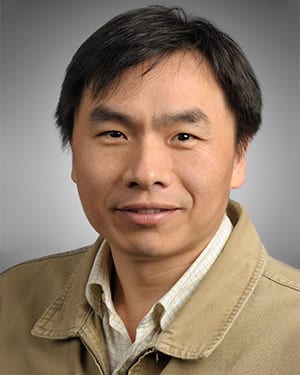
Shitao Liu is an Associate Professor in Clemson University's College of Science, Department of Mathematical and Statistical Sciences. His research specializes in control theory and inverse problems for partial differential equations. Liu's work develops mathematical frameworks for solving inverse problems in wave equations, Schrödinger operators, and viscoelastic systems. Applications span quantum mechanics, medical imaging, and materials science. Methodological innovations include boundary control techniques, stability analysis, and reconstruction algorithms. Recent articles demonstrate sustained focus on parameter recovery in complex physical systems, with emerging applications in computational imaging and operator learning. Theoretical foundations combine functional analysis with practical implementation considerations.
Achim Schädle is Professor at the Mathematical Institute of Heinrich-Heine-Universität Düsseldorf, holding the Chair of Applied Mathematics. His research focuses on mathematical modeling of physical phenomena, particularly developing computational methods for scattering problems and evolution equations. His primary research interests include constructing and analyzing transparent boundary conditions for scattering problems in both frequency and time domains, developing fast algorithms for solving Volterra integro-differential equations that model memory effects in elasticity and anomalous diffusion processes. His work combines theoretical mathematical analysis with practical computational implementations to address problems in wave propagation and material science. Recent publications demonstrate sustained focus on improving boundary condition methodologies for electromagnetic and wave propagation problems, with innovations in pole condition techniques and Hardy space applications. His research contributes to computational physics, numerical analysis, and applied mathematics.
Dr. Marc Olano is an Associate Professor of Computer Science and Electrical Engineering at the University of Maryland, Baltimore County (UMBC). He specializes in real-time 3D graphics, non-graphics applications of graphics hardware, and game development. As director of UMBC’s Game Development Track and 3D photogrammetric scanning facility, he focuses on advancing interactive technologies and environmental monitoring systems like Ecosynth. His research collaborations include work with gaming companies such as Firaxis, Epic Games, and Activision, as well as contributions to virtual reality (VR) applications in healthcare and scientific visualization. Dr. Olano holds a Ph.D. in Computer Science from the University of North Carolina and a B.S. in Electrical Engineering from the University of Illinois. Education: Ph.D., Computer Science, UNC (1998); B.S., Electrical Engineering, UIUC (1990). Research Interests: Computer graphics, GPU acceleration, VR, game development, and ecological 3D scanning. Key Roles: Director of Game Development Track, Editor-in-Chief of the Journal of Computer Graphics Techniques. Olano’s work bridges academia and industry, emphasizing practical applications like texture compression for games, VR-based rehabilitation systems, and UAV-driven environmental analysis. His research often leverages GPU computing to solve real-world problems, from optimizing rendering algorithms to enabling large-scale ecological data collection through Ecosynth. Publications span VR systems, subsurface scattering techniques, and GPU algorithms, reflecting his commitment to advancing interactive and computational graphics. His teaching and mentorship in the Game Development Track prepare students for roles in game design, while his lab facilities provide hands-on experience with cutting-edge technologies.
James T. Gleeson is a Professor in the Department of Physics at Kent State University specializing in complex fluids including liquid crystals, polymers, and proteins in solution. His research examines diverse physical properties such as electro-mechanical coupling, field responses, nanoscale organization, optical phenomena, and electrically induced convective flows. Dr. Gleeson employs experimental techniques including high-resolution imaging, advanced optics, small angle X-ray scattering, and utilizes facilities at the National High Magnetic Field Laboratory and National Synchrotron Light Source. His approach tailors experimental methods to address specific scientific problems in soft matter physics.
Fritz Gesztesy is the Ralph and Jean Storm Professor of Mathematics at Baylor University, where he has been since 2016. He previously held positions at the University of Missouri (1988–2016) and the University of Graz, Austria (1977–1988). His research focuses on operator and spectral theory, with applications to mathematical physics, including spectral theory, differential equations, and completely integrable systems. Education: Ph.D., University of Graz, Austria (1976). Notable honors include the Ludwig Boltzmann Award (1987), Fellowship of the American Mathematical Society (2013), and an Honorary Doctorate from TU Graz (2020). He has authored over 300 publications and co-authored influential books such as Solvable Models in Quantum Mechanics and Soliton Equations and Their Algebro-Geometric Solutions . Research interests span spectral theory, operator theory, and mathematical physics, with recent work emphasizing Birman-Hardy-Rellich inequalities, Sturm-Liouville operators, and Dirac-type systems. His contributions include foundational studies on the xi function, spectral shift functions, and the Krein-von Neumann extension. He has advised 14 Ph.D. students and 7 Master’s students, including prominent mathematicians like Gerald Teschl. Current roles include Editor-in-Chief of the Journal of Spectral Theory . Key contributions include the development of trace formulas, analysis of singular differential operators, and studies on boundary trace theory. He has collaborated extensively with mathematicians like Barry Simon, Helge Holden, and Marius Mitrea.
Natasha Sharma is an Associate Professor with tenure in the Department of Mathematical Sciences at the University of Texas at El Paso (UTEP). Her research focuses on numerical analysis and computational methods for material sciences, particularly crystal growth and drug delivery systems. She holds a Ph.D. from the University of Houston (2011) and completed postdoctoral work at Heidelberg University (2014). Education: Ph.D., University of Houston, 2011 Postdoctoral Fellowship, University of Heidelberg, 2014 Bachelor's and Master's, University of Delhi, India Research Interests: Development of adaptive numerical methods (C0 interior penalty, discontinuous Galerkin) for solving differential equations in material science, microemulsions modeling, and phase field crystal equations. Emphasis on efficiency and accuracy through adaptive mesh and time-step refinement techniques. Funding & Grants: DOE NNSA/MSIPP: Co-PI for the Rio Grande Consortium for Advanced Research on Exascale Simulation (2022–2027) NSF DMS-2110774: PI for Numerical Methods for Sixth-Order Phase Field Models (2021–2024) Publications: Focus on numerical methods for phase field models, error analysis, and adaptive algorithms. Recent work includes stability analysis for phase field crystal equations and microemulsions modeling.
Elena Litvinova is a Professor of Theoretical Nuclear Physics at Western Michigan University (WMU) and an adjunct faculty member at Michigan State University (MSU). Her research focuses on relativistic nuclear many-body theory, quantum field theory, and nuclear astrophysics. She holds a Ph.D. in Nuclear and Particle Physics from the Joint Institute for Nuclear Research (Dubna, Russia). Her teaching interests include nuclear physics and quantum mechanics. Education: Ph.D., Nuclear and Particle Physics, Joint Institute for Nuclear Research, Dubna, Russia (2003) Professional Roles: WMU Nuclear Theory Group leader, former research associate at GSI Helmholtzzentrum (Germany), and Alexander von Humboldt Fellow at TU Munich (2005–2007). Research Interests: Relativistic nuclear many-body problem, electromagnetic response of nuclei (e.g., giant resonances), beta-decay studies, superfluid nuclear systems, and applications to astrophysical scenarios like neutron star mergers and supernovae. Her work emphasizes computational methods like relativistic quasiparticle random phase approximation (RQRPA) and quantum computing for nuclear structure problems. Key Projects: PANDORA project (studying photo-nuclear reactions in light nuclei) and contributions to understanding nuclear response at finite temperatures. Recent studies include low-lying electric dipole strength distributions in Sn isotopes and quantum algorithms for many-body systems. Labs/Teams: Leads the WMU Nuclear Theory Group, collaborates with international teams including NSCL (National Superconducting Cyclotron Laboratory) and iThemba LABS (South Africa).
Demetris P. Gerogiannis is a researcher in the Department of Computer Science & Engineering at the University of Ioannina, Greece. His academic work focuses on Computer Vision and Image Processing, with specific expertise in image registration, pointset registration, and feature extraction. He has maintained a consistent publication record from 2007 through 2020, primarily collaborating with Christophoros Nikou and A. Likas. Gerogiannis' research interests span multiple areas within Computer Vision including Image Segmentation and Registration, Pointset Registration, Feature Extraction, Object Detection and Recognition, Pattern Recognition, Automatic Image Annotation, and Machine Learning applications. His work demonstrates a consistent focus on developing robust algorithms for geometric problems in vision, with particular attention to handling noise and outliers in visual data. He has made significant contributions to point set registration, shape representation, and vanishing point detection. His publication history reveals a strong trend toward developing mathematically rigorous approaches to Computer Vision problems, particularly utilizing statistical models like Student's t-distributions for robust registration. His work bridges theoretical computer vision with practical applications, including consumer-facing technologies like QR code systems. The 15 most recent publications show progression from foundational work in image registration to more applied research in texture analysis, word spotting, and biomedical applications. Gerogiannis is also an active entrepreneur, currently coordinating QReca!, a startup focused on consumer engagement through QR codes and NFC technology. He has previously worked on a Video On Demand startup and is developing a spin-off to commercialize his Computer Vision research through an API framework. He maintains a commitment to open academic knowledge by providing Matlab code for non-commercial use related to his publications. He has volunteered for the Athens 2004 Olympic Games and maintains a passion for Mathematics, particularly Number Theory and Euclidean Geometry. His academic profile suggests a researcher who bridges theoretical computer vision with practical applications and entrepreneurial ventures.
Mirza Karamehmedovic is an Associate Professor at the Department of Applied Mathematics and Computer Science, Technical University of Denmark (DTU). His research focuses on computational mathematics, photonics, and inverse problems, with applications in optical surface metrology and numerical methods for engineering systems. He leads projects involving uncertainty quantification, inverse problem formulations, and bio-nanomaterials. Key research areas include electromagnetic scattering models, failure probability estimation using Gaussian processes, and spectral analysis of random media. His work bridges theoretical mathematics with practical engineering solutions, particularly in photonics and microscopy. Supervised PhD students include L. Baalbaki (Bayesian inverse problems), K. Linder-Steinlein (source localization in random media), and J. Bravo Gadea (geometric analysis). Active in international conferences presenting on topics like photonic nanojets and Helmholtz equation applications.
Sergio Fantini is a Professor at Tufts University School of Engineering , with joint appointments in Biomedical Engineering and Electrical and Computer Engineering . He holds a Ph.D. in Physics from the University of Florence (1992) and has been an inaugural faculty member of Tufts' Biomedical Engineering department since 2002. Primary Research Areas : Biomedical optics, diffuse optical imaging, functional near-infrared spectroscopy (fNIRS), quantitative tissue oximetry, and hemodynamics measurement techniques. Key Contributions : Development of dual-slope FD-NIRS methods for calibration-free absolute optical measurements, coherence hemodynamics spectroscopy (CHS) for cerebral blood flow analysis, and novel instrumentation for optical mammography and muscle studies. His laboratory focuses on photon propagation modeling in turbid media, instrumentation development for medical imaging, and clinical applications in brain and muscle hemodynamics. Recent publications emphasize improving pulse oximetry accuracy across skin tones, adipose/bone tissue compensation in muscle measurements, and advanced diffusion theory implementations. Scientific Recognition : 11 issued patents in biomedical optics Over 200 peer-reviewed publications Key role in establishing fNIRS methodologies He leads the Diffuse Optical Imaging of Tissue (DOIT) Lab , mentoring postdocs, Ph.D. candidates, and undergraduate researchers. The lab's work spans from theoretical modeling (e.g., Rytov approximation, Monte Carlo simulations) to practical implementations in clinical neuroimaging , muscle metabolism studies , and portable medical sensors .
Carlos Borges is an Associate Professor in the Department of Mathematics at the University of Central Florida (UCF), part of the College of Sciences. He holds a Ph.D. in Mathematics from Worcester Polytechnic Institute (2013) and has held postdoctoral positions at the Oden Institute (University of Texas-Austin) and the Courant Institute (NYU). His research focuses on inverse scattering problems, numerical analysis, and neural networks, with applications in computational engineering and mathematical physics. Education: PhD in Mathematics (Worcester Polytechnic Institute, 2013), MS in Mathematics (Instituto de Matematica Pura e Aplicada, 2007), BEng in Computer Engineering (Instituto Militar de Engenharia, 2002). Research interests include inverse scattering (acoustic, electromagnetic), domain decomposition methods, fast solvers, and machine learning integration in numerical analysis. His work emphasizes high-resolution parameter reconstruction and multi-frequency data utilization for obstacle identification. He advises four students: PhD candidates Isabela Vasconcellos Viana and Nick Arustamyan, and undergraduates Tina Tran and Eli Rivera-Sanchez. His recent publications (2023–2025) highlight advances in neural network-driven inverse scattering and robust algorithms for irregular geometries. He organizes the Scientific Computing Seminar at UCF, focusing on numerical analysis and computational methods. His software contributions include solvers for inverse scattering problems, available on GitHub. He is active in professional societies like SIAM and IEEE, and regularly presents at conferences such as SIAM CSE 2025.
Dr. Costas Efthimiou is an Associate Professor of Physics at the University of Central Florida (UCF) since 2000. His academic journey includes a Ph.D. in Mathematical Physics from Cornell University (1994), followed by roles as a Lecturer at Cornell (1994–1995), Research Associate at Tel Aviv University (1995–1997), and Visiting Scientist at Harvard University (1997–1998) and Cornell/Columbia Universities (1998–2000). His research focuses on mathematical physics, quantum mechanics, and physics education. Notable contributions include studies on functional equations, inverse scattering theory, and the application of physics concepts in popular media. He has co-authored a book on functional equations and published papers in journals such as SIAM Review , Am. J. Phys. , and Physics Teacher . Dr. Efthimiou actively mentors undergraduate and graduate students, with several collaborative papers in preparation. His work bridges theoretical physics with educational outreach, addressing scientific accuracy in Hollywood films and innovative teaching methodologies. He also contributes to public discourse on physics through media commentary, such as analyzing the plausibility of stunts in action films like Skyscraper .
Konstantin Makarov is a Professor of Mathematics at the University of Missouri's College of Arts and Science, specializing in mathematical physics, operator theory, spectral analysis, and partial differential equations. With a PhD from Leningrad State University, he has supervised multiple PhD students and authored seminal texts on open quantum systems. His research develops operator-theoretic frameworks for quantum mechanics, dissipative systems, and spectral perturbations. Recent work explores entropy in L-systems, invariant principles for characteristic functions, and Schrödinger operator representations. Key contributions include the Tan 2Θ Theorem in fluid dynamics, diagonalization of saddle point forms, and index formulas for trace class perturbations. Publications integrate functional analysis, number theory, and quantum applications.
Shengli Zou is a Professor and Interim Chair in the Department of Chemistry at the University of Central Florida (UCF). His research focuses on computational chemistry and nano materials, particularly the optical properties of metal nanoparticles, quantum mechanics-driven catalysis, and plasmonic phenomena. He holds a B.S. from Shandong University and a Ph.D. from Emory University. His work bridges theoretical and applied research, addressing challenges in renewable energy, analytical tools, and nanotechnology. Research interests include modeling catalytic reactions using non-metallic catalysts for sustainable energy applications, developing algorithms for Schrodinger equation solutions, and studying energy transfer in quantum dot-metal nanoparticle systems. His group also explores surface-enhanced Raman scattering and novel optical device designs through plasmonic engineering. Dr. Zou teaches courses such as Applied Physical Chemistry (CHM3422), Physical Chemistry II (CHM3411), and Chemical Thermodynamics (CH6240). His lab’s contributions span nanomaterial synthesis, optical property calculations, and interdisciplinary applications in photonics and renewable energy.
Ning Xiang is a Full Professor and Director of the Architectural Acoustics Program at Rensselaer Polytechnic Institute's School of Architecture. His research advances measurement techniques and computational models for room acoustics, signal processing, and acoustic material characterization. Education: PhD, Ruhr-University Bochum BS, Tianjin University His research integrates Bayesian inference, wave propagation theory, and experimental methods to solve problems in architectural acoustics. Recent work focuses on uncertainty quantification in acoustic measurements, diffusion-equation modeling for reverberation prediction, and spherical array processing for sound source localization. Publication analysis reveals three primary themes: (1) Bayesian methods for acoustic parameter estimation; (2) novel measurement systems like high-resolution goniometers; and (3) physics-based modeling of complex acoustic phenomena. His articles combine fundamental theory with practical applications across concert hall design, noise control, and acoustic materials development. Scientific Awards: Wallace Clement Sabine Medal (Acoustical Society of America) Albert Nelson Marquis Lifetime Achievement Award As Architectural Acoustics Program Director, he mentors graduate students and leads research on acoustic sensing systems. He serves as Associate Editor for the Journal of the Acoustical Society of America and has chaired multiple technical committees for international acoustics societies. His laboratory develops advanced instrumentation including laser Doppler vibrometry systems for material characterization and portable goniometers for diffuser evaluation. Current projects include NSF-funded research on Bayesian uncertainty quantification in acoustic measurements.