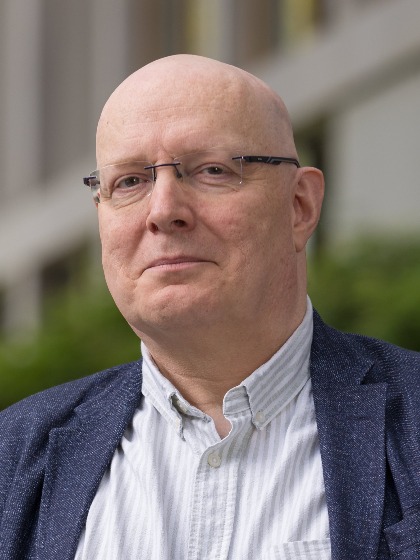
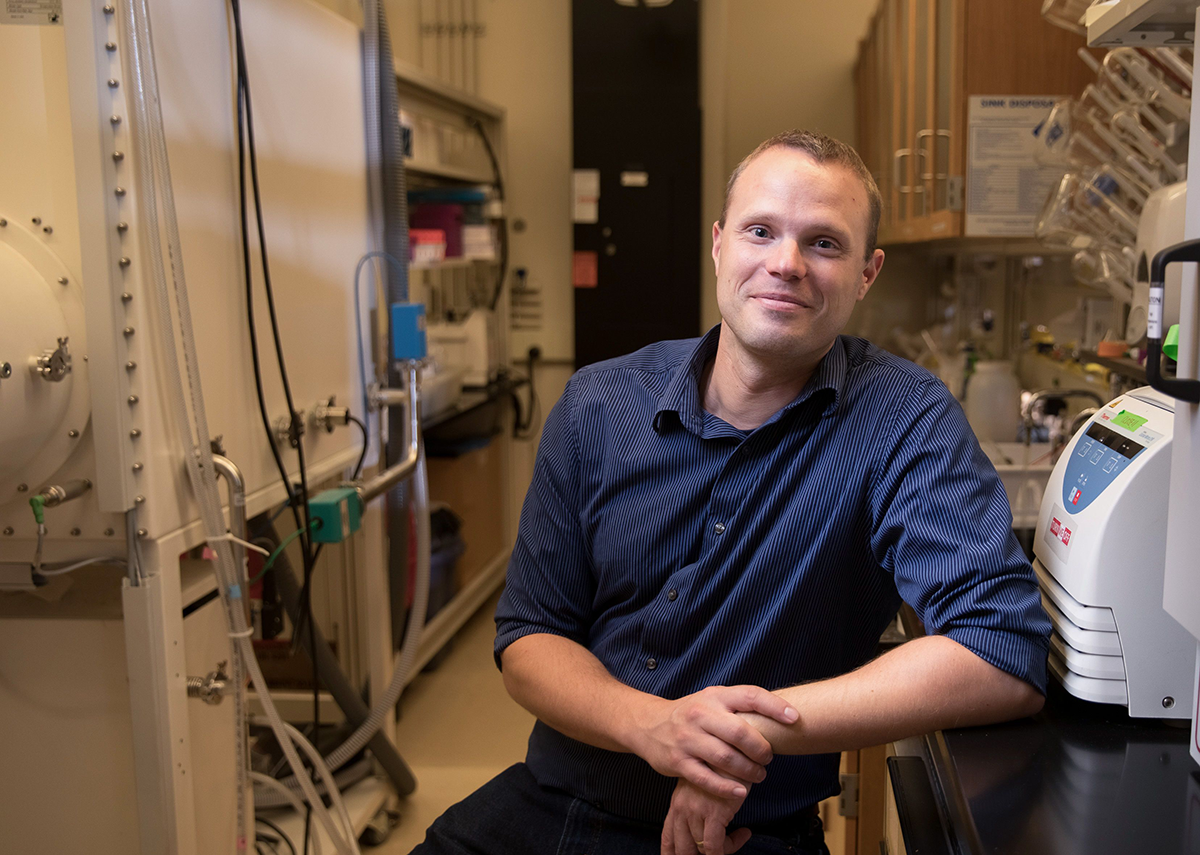
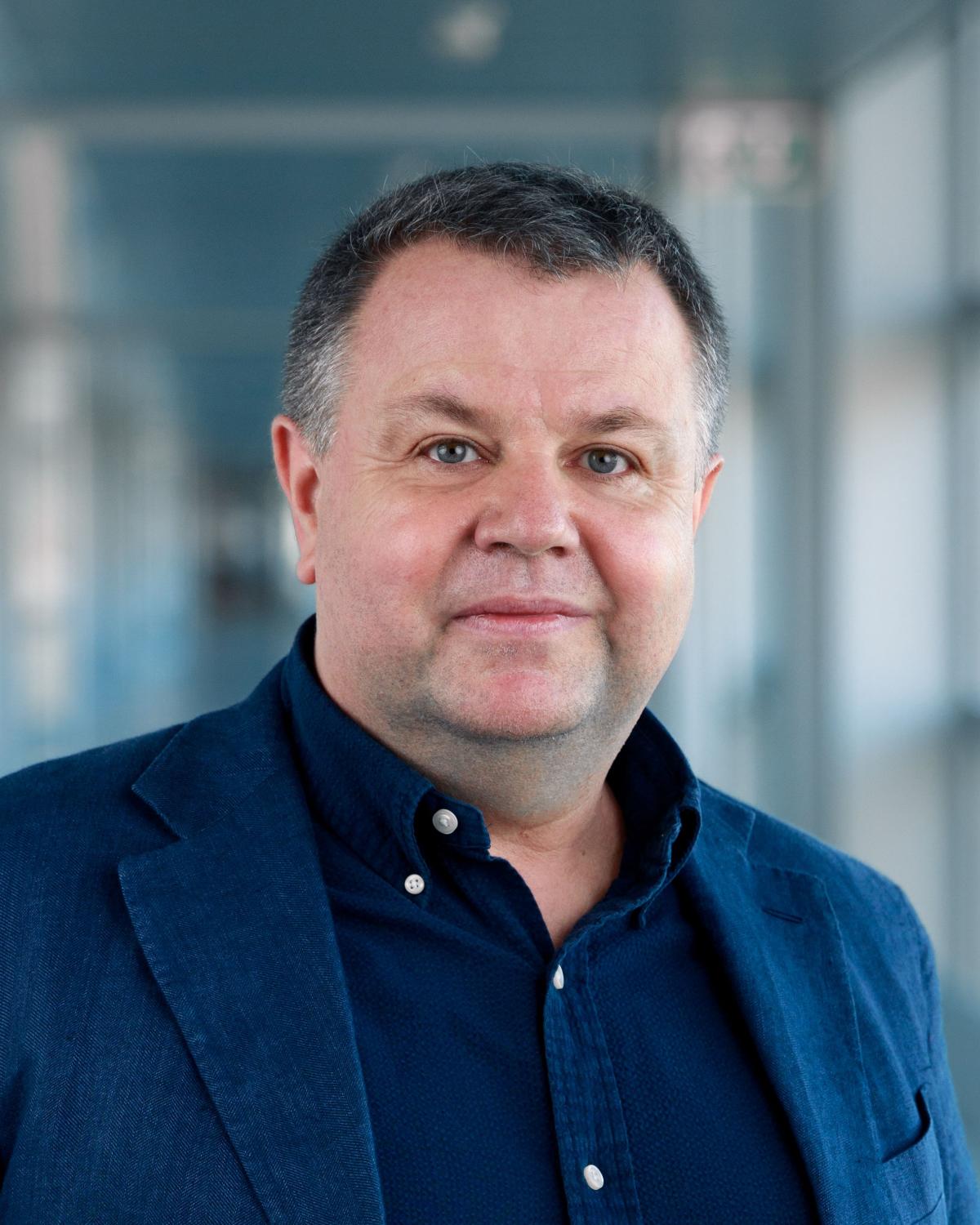
Prof. Rob Timmermans is a Professor of Theoretical Physics and Vice-Dean for Education at the University of Groningen (UG). He is affiliated with the Faculty of Science and Engineering and the Precision Frontier — Van Swinderen Institute for Particle Physics and Gravity. His research focuses on theoretical particle physics, quantum mechanics, and precision measurements, particularly in electric dipole moment (EDM) searches using molecules like BaF. His work includes developing methods for molecular beam manipulation, phase-space analysis, and symmetry violation studies. He has contributed to collaborations such as NL-eEDM, advancing techniques for EDM detection and precision physics. Prof. Timmermans has received nominations for teaching awards, reflecting his commitment to education. Research highlights include studies on nucleon decay, antinucleon-nucleon interactions, and chiral effective field theory. His lab activities involve collaborations on laser-cooled molecules and trapping techniques. Prof. Timmermans’ articles often address fundamental physics questions, such as Lorentz violation in beta decay and parity violation in molecular systems. Awards: Nominated for Faculty Teaching Award 2014, Teacher of the Year 2014-15. Grants/Advising: Leads projects on EDM searches and particle physics, with active roles in international collaborations. Labs/Teams: Van Swinderen Institute, Precision Frontier group.
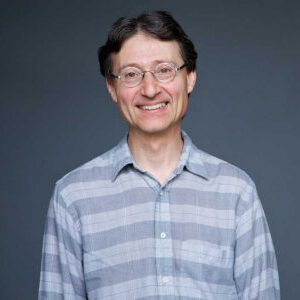
Zhi-Xun Shen is the Paul Pigott Professor in Physical Sciences at Stanford University, holding dual appointments in the Physics and Applied Physics Departments. He is a senior fellow at the Precourt Institute for Energy and serves on advisory boards for the Knight-Hennessy Scholars and Stanford Science Fellows programs. His research focuses on condensed matter and materials physics, particularly the electronic structures of superconductors, topological insulators, and novel materials. Dr. Shen pioneered advanced spectroscopic techniques, including photon-based imaging and scattering methods, and has authored over 600 publications with significant citation impact. His honors include the Kamerlingh Onnes Prize (2000), E.O. Lawrence Award (2010), and Oliver E. Buckley Prize (2011). He co-founded PrimeNano Inc., commercializing technologies from his lab, such as microwave impedance microscopy. His work bridges fundamental physics with energy-related applications, emphasizing the interplay between electronic structure and material properties. Dr. Shen’s research group explores cutting-edge topics like topological surface states, electron-phonon interactions, and superconductivity mechanisms. His inventions, such as non-resonance microwave imaging, have found applications in materials characterization. He remains active in advancing instrumentation and fostering interdisciplinary collaborations through his academic and industry roles.
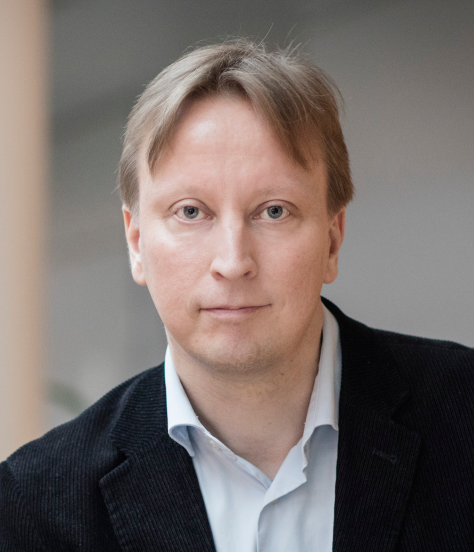
Ali Yazdani is an Adjunct Professor at the University of Illinois Urbana-Champaign's Grainger College of Engineering, Department of Physics, and Director of the Princeton Center for Complex Materials at Princeton University. His research focuses on quantum condensed matter physics, leveraging scanning tunneling microscopy (STM) and spectroscopy to explore novel quantum phases in materials such as graphene, twisted bilayer graphene, and topological insulators. Key achievements include the first direct observation of Hofstadter's fractal energy spectrum in quantum materials (2025), studies on Majorana fermions in atomic chains, and investigations into strongly correlated Chern insulators. His work bridges theoretical predictions with experimental validation, emphasizing quantum materials' topological and correlated properties. Affiliations: Princeton University, Department of Physics; University of Illinois Urbana-Champaign, Grainger College of Engineering. Research Themes: Quantum fractals, topological insulators, superconductivity, Majorana fermions, moiré materials. Research Summary: Dr. Yazdani’s lab employs advanced STM techniques to visualize electronic wavefunctions and study correlated phases. Notable projects include: - Visualization of Hofstadter’s butterfly in twisted bilayer graphene. - Discovery of valley skyrmions in graphene quantum Hall ferromagnets. - Unconventional superconductivity in magic-angle graphene. - Development of methods to detect Majorana zero modes. Labs/Teams: Yazdani Lab at Princeton University focuses on quantum materials and topological phases, collaborating with theorists and experimentalists globally.
Adrien Desjardins is a Professor at the University of British Columbia, jointly appointed in the Department of Mechanical Engineering and Department of Electrical and Computer Engineering within the Faculty of Applied Science. He joined UBC in 2024 after serving as a Full Professor at University College London from 2019-2024, following 13 years on faculty there. His educational background includes a B.Sc. from UBC (2001) and a Ph.D. from MIT and Harvard University (2007). Dr. Desjardins' research program focuses on interdisciplinary development of imaging and sensing modalities and autonomous robotics with marine and biomedical applications. His work integrates photonics, ultrasound, machine learning, and robotics to create innovative diagnostic tools and sensing systems, particularly in optical coherence tomography, diffuse optical spectroscopy, and photoacoustic imaging. His publication record reveals an evolution from foundational neuroimaging work (2001) toward increasingly sophisticated optical systems culminating in breakthroughs like ultrasensitive optical microresonators for ultrasound sensing (2017), demonstrating consistent innovation in biomedical optics with growing emphasis on machine learning integration and real-world applications. His scientific contributions have been recognized through prestigious awards: Research Chair from the Royal Academy of Engineering Healthcare Technologies Challenge Award from EPSRC Starting grants from ERC, EPSRC, and Royal Society World Economic Forum Young Scientist (2015) UCL Provost Teaching Prize (2013) Dr. Desjardins actively mentors graduate students and secures major research funding through competitive grants, with current openings for January/September 2025 intakes. His program involves close industry collaboration indicating strong translational focus, though specific lab names aren't mentioned. The interdisciplinary nature of his work suggests teams spanning engineering, computer science, and medical disciplines working on next-generation imaging systems for healthcare and marine exploration.
Professor Harry E. Ruda holds the Stanley Meek Chair in Advanced Nanotechnology at the University of Toronto's Faculty of Applied Science and Engineering. He directs the Centre for Advanced Nanotechnology and leads the Electronic-Photonic Materials Group. His research spans semiconductor nanostructures, focusing on nanoelectronics and nanophotonics, with notable contributions to nanowire growth, quantum transport, and plasmonic effects. Education: B.Sc. in Physics, Imperial College London Ph.D. in Physics, MIT His research interests include: Semiconductor nanowire growth via VLS process Quantum transport and spintronics Nonlinear optical effects in quantum dots/nanowires Surface state control through passivation Photonic crystal structures for optical devices Carrier dynamics in low-dimensional systems Recent publications highlight advancements in InAs nanowire sensors, Coulomb impurity effects, photonic crystal design, and hybrid superconducting/semiconductor devices. His work bridges fundamental electron dynamics and applied quantum technologies. Scientific Awards: Fellow, Canadian Academy of Engineering Fellow, Royal Society of Canada Fellow, Institute of Physics (UK) Fellow, Institute of Nanotechnology Fellow, Institution of Engineering and Technology Fellow, Institute of Materials, Minerals and Mining Fellow, Canadian Academy of Engineering Teaching: MSE335: Materials Physics MSE490: Professional Ethics and Practice MSE1023: Quantum Transport
Matthew O'Toole is an Associate Professor at Carnegie Mellon University's School of Computer Science, holding joint appointments in the Robotics Institute and Computer Science Department. His research focuses on computational imaging, integrating optics, electronics, and computational processing to innovate visual information capture and display. Education: PhD (Computer Science, University of Toronto, 2016), MSc (2009), BSc (Honors Computer Science and Mathematics, University of British Columbia, 2007). Prior roles include Banting Postdoctoral Fellow at Stanford University and visiting scholar at MIT Media Lab's Camera Culture group. Research interests emphasize programmable imaging systems, transient imaging, non-line-of-sight sensing, and holographic displays. Key innovations include vibration sensing via dual-shutter optics and radar super-resolution for autonomous vehicles. Awards include runner-up best paper recognitions at ICCV 2007, CVPR 2014, and SIGGRAPH 2017 dissertation honors. Advisees include Dorian Chan and Arjun Teh. Grants supported by Canadian Banting Fellowships. Active in workshop organization (CVPR Computational Cameras 2016-2017) and course development on computational imaging at SIGGRAPH 2014. Labs/Teams: Leads research in computational imaging and robotics at CMU, collaborating with industry partners like NVIDIA and MDA. Current projects explore LiDAR-radar fusion, holographic projection systems, and dynamic scene reconstruction.
Professor Simo Särkkä holds a position in Sensor Informatics and Medical Technology at the Department of Electrical Engineering and Automation (EEA), Aalto University. His research focuses on multi-sensor data processing, Bayesian filtering, machine learning, and their applications in medical technology, brain imaging, and inverse problems. He leads research groups including the Helsinki Institute for Information Technology (HIIT) and Sensor Informatics and Medical Technology. His work bridges theoretical advancements in probabilistic methods with practical implementations in healthcare and engineering. Key research interests include Gaussian processes, stochastic differential equations, quantum machine learning, and signal processing. He has contributed to advancements in algorithms for nonlinear state-space models, parallel computing techniques, and medical imaging technologies such as scatter correction in CT scans. His methodologies are applied across domains like autonomous systems, robotics, and bioengineering. Notable publications span topics like quantum-assisted Gaussian regression, physics-informed machine learning for industrial processes, and parallel-in-time numerical methods. His work emphasizes computational efficiency and robustness in high-dimensional and real-time systems.
Changxi Zheng is an Associate Professor in the Department of Computer Science at Columbia University's School of Engineering and Applied Science (SEAS). He directs Columbia's Computer Graphics Group (C2G2) within the Columbia Vision and Graphics Center (CVGC). After receiving his PhD from Cornell University, he joined the faculty of Computer Science Department at Columbia, where he has established himself as a leading researcher in computer graphics and scientific computing. Dr. Zheng's research spans multiple areas of applied computer science with a particular focus on computer graphics and scientific computing. His work centers around developing numerical models for simulating physical phenomena involving complex motions such as fluids, bubbles, and thin rods, along with their resulting acoustic waves. Leveraging computational insights from these models, he devises methods for improving tangible object creation, enabling novel human-computer interactions, and developing software tools for acoustic and photonic devices. His research has attracted significant public interest and media coverage, including projects like FontCode, AirCode, and Computational Metallophone Design. His recent publications reveal a strong interdisciplinary approach, bridging computer graphics, physics simulation, machine learning, and hardware design. His work demonstrates consistent innovation in computational methods for simulating physical phenomena and applying these techniques to practical problems in 3D printing, acoustic modeling, and interactive systems. The breadth of his research spans from fundamental physics-based simulations to practical applications in industry. Columbia SEAS Dean's Fellow (for advised students) NSF Graduate Research Fellow (for Ruilin Xu) Snap Research Fellow (for Rundi Wu) CKGSB Fellow (for Yun Fei) Adobe Research Fellow (for Gabriel Cirio) Marie Sklodowska-Curie Individual Fellow (for Rundi Wu) Best Paper Award at ACM International Conference on Multimedia (ACMMM), 2019 Dr. Zheng actively mentors a diverse group of students, including current PhD candidates and postdoctoral researchers. His research group has received support from various sources that enable their innovative work in computational graphics and physics-based simulation. He has supervised numerous successful students who have gone on to positions at leading technology companies including Adobe, Tencent, Facebook, and academic institutions. As director of Columbia's Computer Graphics Group (C2G2) within the Columbia Vision and Graphics Center (CVGC), Dr. Zheng leads a vibrant research team focused on advancing the state of the art in computer graphics, physics-based simulation, and their applications. The group maintains strong collaborations with industry partners and academic institutions worldwide, fostering an environment of innovation and practical application of theoretical concepts.
Bradley D. Olsen is a full professor in the Department of Chemical Engineering at the Massachusetts Institute of Technology (MIT), where he leads research at the intersection of polymer science, soft matter physics, and bioengineering. His work focuses on designing materials for critical applications in biotechnology, hemostasis, and sustainable polymer development while advancing fundamental understanding of polymer network mechanics and self-assembly. Education: Ph.D. in Chemical Engineering, University of California Berkeley (2007) S.B. in Chemical Engineering, Massachusetts Institute of Technology (2003) Olsen's research spans protein-based materials, block copolymer phase behavior, and mechanochemical hydrogels. He has pioneered methods for quantifying polymer network topology, developing hemostatic nanoparticles, and creating bio-inspired materials for selective biomolecular transport and medical applications. His recent publications emphasize data-driven approaches to polymer characterization and educational outreach in materials science. Scientific Awards: American Physical Society (APS) Fellow (2023) Fulbright Amazonia Scholar (2023) Alexander and I. Michael Kasser Chair in Chemical Engineering (2021) ACS Macro Letters Young Investigator Award (2021) MIT Committed to Caring Honor (2019) AIChE Owens Corning Early Career Award (2019) APS Dillon Medal (2018) Kavli Emerging Leader in Chemistry (2017) ACS Polymer Division Fellow (2016) Camille Dreyfus-Teacher Scholar (2015) Alfred P. Sloan Research Fellow (2014) NSF Career Grant (2013) NIH Postdoctoral Fellowship (2008-2009) Hertz Fellow (2003-2007) Barry M. Goldwater Scholarship (2002) Olsen has received significant grant support including NSF Career (2013) and AFOSR (2012) awards. His teaching activities include innovative international outreach like the 2025 soccer-themed science camp in Brazil. The Olsen Group at MIT explores advanced materials with applications ranging from trauma care to sustainable polymers.
Ravi Ramamoorthi is the Ronald L. Graham Professor of Computer Science and Director of the UC San Diego Center for Visual Computing. He holds a faculty position in the Department of Computer Science and Engineering (CSE) and is an affiliate of the Department of Electrical and Computer Engineering (ECE). He joined UC San Diego in 2014, previously at UC Berkeley and Columbia University. He also holds a part-time appointment as a Distinguished Research Scientist at NVIDIA. His research focuses on visual computing, including rendering, computer vision, light field cameras, and physics-based modeling. Notable contributions include foundational work on spherical harmonic lighting, neural radiance fields (NeRF), and Monte Carlo rendering techniques. His work bridges graphics, vision, and signal processing with applications in sparse reconstruction, importance sampling, and real-time rendering. He teaches courses like CSE 167 (Computer Graphics), CSE 168 (Rendering), and advanced topics in computer graphics. Awards include ACM and IEEE Fellowships, the Okawa Foundation Grant, and multiple Frontiers of Science Awards. His research is supported by NSF, ONR, and industry collaborators including Adobe, Sony, and Qualcomm. Key projects include the Center for Visual Computing, Light Field research, and educational initiatives like edX MOOCs on computer graphics and rendering. His work has influenced industry tools (e.g., Pixar, RenderMan) and modern real-time rendering pipelines with denoising techniques.
Prof. dr. ir. C.H. (Caspar) van der Wal is a Full Professor in Physics of Quantum Devices at the Faculty of Science and Engineering , University of Groningen. His research focuses on spintronic and quantum information functionalities using electron/nuclear spins in semiconductor devices, combining quantum optical and electron transport methods. PhD in Quantum Transport (Delft University of Technology, 2001) Postdoc in Quantum Optics at Harvard University (2001-2003) Scientific Director of Zernike Institute for Advanced Materials (2016-2022) Research keywords include Quantum Optics , Spintronics , Quantum Information , and Semiconductor Physics . Recent work explores 2D/3D semiconductor heterostructures , spin defects in SiC , and transition metal dichalcogenides . His scientific contributions have earned him the NWO-Vidi Grant (2005) , ERC Starting Grant (2011) , and multiple teaching awards. Publications since 2001 span topics like quantum superpositions in superconducting circuits, spin relaxation in quantum dots, and telecom-ready spin centers in silicon carbide. Grants : NWO-Vidi (2005), ERC Starting Grant (2011) Leadership : Scientific Director, Zernike Institute (2016-2022) Teaching : Teacher of the Year (2015), Education Prize (2012) Current affiliations include the Physics of Nanodevices group at the Zernike Institute for Advanced Materials. Collaborations span institutions like MIT, Harvard, and AMOLF.
Ali Mostafazadeh is a Professor at the Department of Mathematics, College of Sciences, Koç University. His research spans Mathematical Physics, focusing on Quantum Mechanics, Scattering Theory, and PT-Symmetry. He has made significant contributions to understanding non-Hermitian Hamiltonians, electromagnetic wave propagation, and geometric scattering phenomena. Education: PhD in Physics (1994) from The University of Texas, BA in Physics and Mathematics (1989) from Boğaziçi University His work explores the intersection of mathematics and physics, particularly through spectral singularities, transfer matrix methods, and nonlinear optical systems. Recent publications highlight advancements in broadband directional invisibility, exact Born approximations, and time-dependent Hilbert spaces in quantum systems. 2011 Outstanding Success Award 2007 TÜBİTAK Science Award 2006 Werner-von-Siemens Excellence Award 2001 TÜBA Outstanding Young Scientists Award 2001 Parlar Foundation Research Incentive Award
Jörg F. Löffler is a Full Professor of Metal Physics and Technology at the Department of Materials, ETH Zürich , where he has been since 2003. He previously served as Chairman of the Department (2010–2013) and holds Adjunct Professor positions at Tohoku University (Japan) and a Visiting Faculty role at Caltech. His research focuses on bulk metallic glasses , metallic biomaterials , and magnetic materials , combining synthesis, characterization, and applications in biomedical and structural contexts. Educations : Studied Physics and Materials Science at Saarland University (Germany), earned his doctorate at ETH Zurich and Paul Scherrer Institute on magnetism and neutron scattering (1997). Research Trends : Recent work explores additive manufacturing (e.g., laser powder bed fusion), biodegradable magnesium alloys for implants, and magneto-structural coupling in metallic glasses. Collaborative efforts integrate in situ analysis with computational modeling. Scientific Awards : International Magnesium Science and Technology Award (2023) MRS Fellow (2021) DGM 'Breakthrough' Prize (2016) Masing Memorial Prize (2005) ETH Zurich Medal (1998) Alexander von Humboldt Fellowship (1998-2001) Löffler advises the Department of Materials Science and Engineering at UC Davis and serves on editorial boards. His group at ETH Zürich investigates advanced metallic materials using synchrotron radiation and neutron scattering facilities.
Ali Feizmohammadi is an Assistant Professor, Teaching Stream (LTA) in the Department of Mathematics at the University of Toronto Mississauga, affiliated with the Mathematical and Computational Sciences division. His research focuses on inverse problems, partial differential equations, and geometric analysis. He holds a position emphasizing teaching excellence within the university's framework. His work addresses advanced mathematical challenges such as coefficient identification in subdiffusion equations, fractional Laplacian problems on Riemannian manifolds, and nonlinear elliptic equations on manifolds. Recent articles highlight contributions to the Calderón problem in various contexts, wave equation control, and spacetime finite element methods. No scientific awards or grants are explicitly listed in the provided information. He has not yet listed advisees in the available data. His research trends emphasize rigorous mathematical analysis of inverse problems in both classical and fractional PDE frameworks, with applications to geometric and control-theoretic questions. Dr. Feizmohammadi's work spans theoretical advancements in inverse problems, numerical methods for control systems, and the interplay between differential geometry and PDEs. His contributions address both fundamental theory and applied methodologies in mathematical physics and engineering.
Benoit Forget is the Korea Electric Power Professor of Nuclear Engineering and the Department Head of Nuclear Science and Engineering at MIT. He joined MIT in 2008 and leads the MIT Computational Reactor Physics Group (CRPG), which focuses on advancing computational methods for reactor simulation. His research spans Monte Carlo and deterministic transport methods, multiphysics coupling, and uncertainty quantification. He co-developed OpenMC and OpenMOC, open-source tools for reactor analysis. Forget holds a PhD from Georgia Tech and has received awards including the 2013 Landis Young Member Engineering Achievement Award. He teaches courses such as 22.05 Neutron Science and Reactor Physics, and actively contributes to MIT’s computational science initiatives. Educations: PhD in Nuclear Engineering (Georgia Tech, 2006), MS and BS in Energy Engineering (École Polytechnique de Montréal, 2003). Research Interests: Computational reactor physics, radiative transport, high-performance computing, Monte Carlo and deterministic methods, multiphysics coupling, nuclear data uncertainty. Labs/Teams: MIT Computational Reactor Physics Group (CRPG), Consortium for Advanced Simulation of Light Water Reactors (CASL).