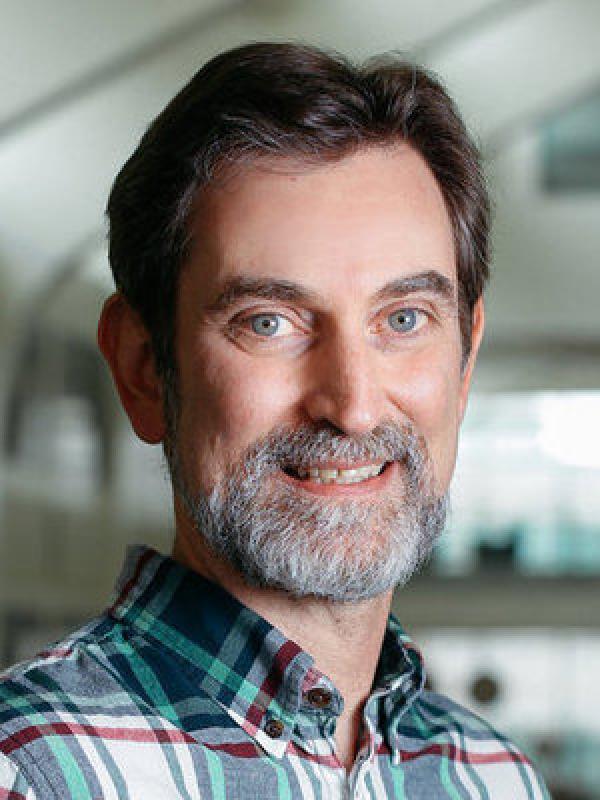
Richard J. Furnstahl is a Professor in the Department of Physics at The Ohio State University. His research focuses on effective field theory (EFT), renormalization group methods, computational nuclear physics, and low-energy nuclear theory. He holds prestigious fellowships from the American Physical Society (2001) and the American Association for the Advancement of Science (2007), and was recognized as an APS Outstanding Referee (2009). He also received the OSU Alumni Award for Distinguished Teaching (1997). Education: B.S. in Physics from MIT (1981), Ph.D. in Physics from Stanford University (1986). Research emphasizes applying EFT and Bayesian methods to nuclear systems, including neutron star equations of state, nucleon-nucleon scattering, and uncertainty quantification. His work bridges computational techniques like eigenvector continuation and reduced-order emulators with foundational theories such as chiral EFT. Recent efforts focus on interpolating between small- and large-coupling regimes and quantifying correlated truncation errors in dense nuclear matter models. Key contributions include developing the Density Matrix Expansion approach for energy density functionals and advancing the FRIB Theory Alliance for nuclear dynamics studies. His emulators reduce computational costs while maintaining accuracy in scattering problems. He also explores the intersection of machine learning and nuclear theory through Bayesian additive regression trees and neural network applications. He leads projects on nuclear symmetry energy, proton Compton scattering experiments, and the NUCLEI initiative for ab initio nuclear structure calculations. His work emphasizes rigorous uncertainty analysis and theoretical consistency across scales.