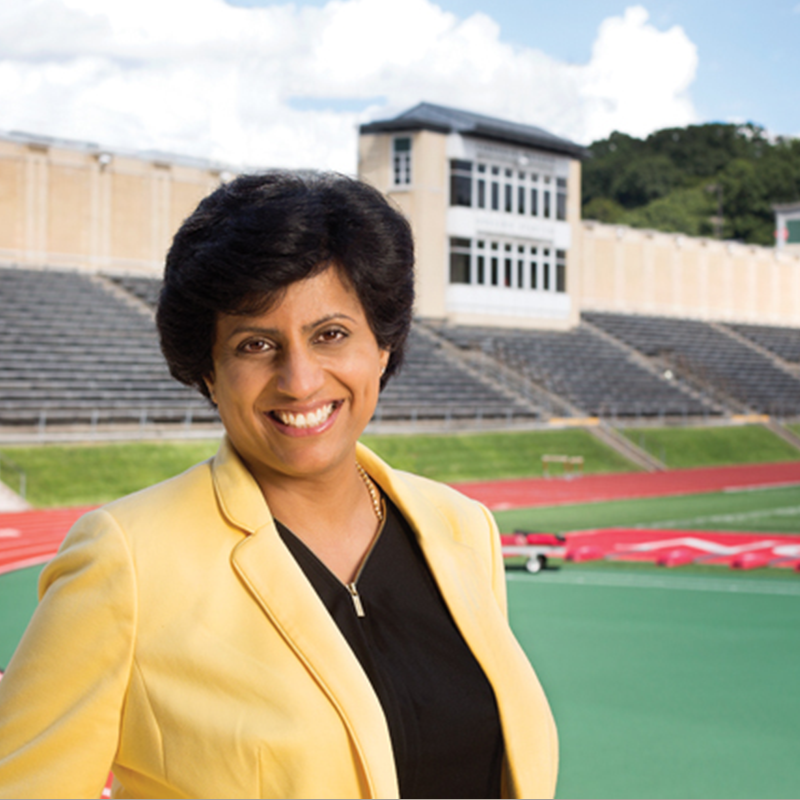
Priya Narasimhan is a Professor of Electrical & Computer Engineering at Carnegie Mellon University (CMU), affiliated with the College of Engineering. Her research focuses on dependable distributed systems, fault-tolerance, embedded systems, mobile systems, and sports technology. She leads the Intel Science and Technology Center in Embedded Computing (ISTC-EC) and founded YinzCam, a CMU spin-off providing mobile live streaming to sports venues. She holds multiple awards, including the Sloan Fellowship and NSF CAREER Award. Education: Ph.D. and M.S. in Electrical & Computer Engineering from UC Santa Barbara. Notable roles include former CTO of Eternal Systems, Director of Intel Labs Pittsburgh, and Director of CMU's CyLab Mobility Research Center. Research spans failure diagnosis in distributed systems, live upgrades, mobile cloud computing, football technology, assistive tech for the blind (Trinetra), and civic tech (iBurgh). Over 30+ students advised across Ph.D., M.S., and undergraduate programs. Active in entrepreneurship, teaching (courses like 18-349 Embedded Systems), and industry collaborations.
Jiangwen Sun is an Assistant Professor in the Department of Computer Science at Old Dominion University (ODU), within the College of Science. He directs the ODU Computational Systems Medicine Lab and focuses on machine learning approaches for analyzing multi-dimensional biological data (phenome, genome, transcriptome, etc.) to advance precision medicine and its automation. His research is supported by ODU and federal agencies like NIH and NSF. Education: Ph.D., University of Connecticut M.E., Nanjing University, China B.M., Secondary Military Medical University, China Research Interests: Machine learning/data mining for medicine, health, drug discovery, and bioinformatics Multi-view bi-clustering and integrative analysis of genomic/phenotypic data Phenotype refinement and genetic association studies for complex diseases Applications in addiction medicine, cardiovascular biology, and bovine development Publications: Over 40 peer-reviewed articles in top venues like NIPS, ICML, Bioinformatics, and BMC Genomics. Recent work focuses on cryo-EM protein structure analysis, single-cell multiomics, and epigenetic modeling. Awards/Grants: NIH/NSF funding pending; previously supported by UConn's Health Informatics Lab and collaborations with University of Pennsylvania. Teaching: Courses include Machine Learning (CS722/822), Data Structures (CS361), and Deep Learning in Medicine (CS795/895). Labs/Teams: Leads the ODU Computational Systems Medicine Lab and collaborates with UConn Health Informatics Lab, Penn Medicine, and others.
Andrea Santilli is a Research Scientist at Nous Research and holds a PhD in Computer Science from GLADIA at Sapienza University of Rome. His research focuses on large language models (LLMs), robustness, reliability, and multimodal learning. He previously worked at Apple MLR, Hugging Face’s BigScience, and Pi School. He earned his MSc and BSc in Computer Science from Tor Vergata University and Sapienza. Education: PhD in Computer Science, Sapienza University of Rome (2024) MSc in Computer Science, University of Roma Tor Vergata (2020) BSc in Computer Science, University of Roma Tor Vergata (2018) Research Interests: Santilli’s work spans LLM robustness , mechanistic interpretability , multimodal neural databases , and instruction-tuning . He introduced Parallel Jacobi Decoding and contributed to projects like BLOOM, Camoscio, and Fauno. His research bridges syntax-aware NLP, privacy-preserving LLMs, and cross-modal alignment. Publications: His work includes advancements in 3D-text latent space alignment (CVPR 2025), evolutionary merging (ICML 2025), and efficient decoding (ACL 2023). Over 15+ peer-reviewed papers span venues like ACL, CVPR, and ICLR. Awards: Received the Emanuele Pianta Award for his MSc thesis on continual language learning with syntax-based episodic memory. Grants & Projects: Winner of ‘Machine Learning Algorithms for Translation’ grant (2022), developing Parallel Decoding Co-PI for ‘Multimodal AI for 3D Analysis’ (2021) with Ecole Polytechnique Labs & Teams: Active in GLADIA (Sapienza), Apple MLR, and Hugging Face’s BigScience initiative. Core contributor to open-source projects like PromptSource and BLOOM.
Haohan Wang serves as Assistant Professor at the School of Information Sciences, University of Illinois Urbana-Champaign, with additional appointments as Affiliate at the Carl R. Woese Institute for Genomic Biology and Assistant Professor at the National Center for Supercomputing Applications (NCSA). His interdisciplinary work bridges machine learning, genomics, and AI security, focusing on trustworthy systems for biomedical applications and foundational AI research. Wang's research centers on robust and secure artificial intelligence, with emphasis on large language model vulnerabilities (jailbreaking, safety evaluation), federated learning personalization, and genomic data analysis. He develops techniques for privacy-preserving dataset distillation, confounding factor correction in genome-wide studies, and multi-agent frameworks for scientific discovery. His fingerprint highlights expertise in Machine Learning (94%), Linear Mixed Models (87%), and Confounding Factor Correction (41%), reflecting his focus on methodological rigor in complex data environments. Analysis of his 2025 publications reveals dominant trends in AI security (jailbreak evaluation frameworks like GuardVal, adversarial attacks such as InfoFlood), biomedical AI (transcriptomic analysis, wearable data privacy), and foundational methods (federated learning optimization, synthetic data generation). These works consistently address real-world challenges in model trustworthiness while advancing computational techniques for genomics and healthcare. Through NCSA's high-performance computing resources and the Institute for Genomic Biology's collaborative ecosystem, Wang integrates supercomputing capabilities with biological research to tackle data-intensive problems in disease modeling and AI safety testing, as evidenced by media coverage of his team's AI security testing methods.
Professor John D. Kubiatowicz is a faculty member at the University of California at Berkeley in the Department of Electrical Engineering and Computer Sciences since 1998. He holds a PhD in Electrical Engineering and Computer Science (minor in Physics) from MIT (1998), an M.S. in EECS (1993), and a double B.S. in Electrical Engineering and Physics (1987) from MIT. His research interests span Quantum Computing Architectures Distributed Systems and Storage Network Security and Peer-to-Peer Protocols Introspective and Manycore Operating Systems Edge and Fog Computing Hardware-Assisted Security He has pioneered systems like OceanStore , a global-scale distributed file system, and Tessellation , a manycore OS with continuous adaptation. The scientific awards he has received include Presidential Early Career Award (PECASE, 2000) Scientific American 50 (2002) Diane S. McEntyre Teaching Award (2003) IEEE ICRA Best Paper (2025) George M. Sprowls Award for MIT PhD thesis (1998) Okawa Research Grant (1998) Best Paper at International Conference on Supercomputing (1993) His recent publications focus on Quantum Circuit Design and Optimization Edge/Fog Computing Architectures Secure Runtime Systems Distributed Garbage Collection Manycore OS Innovations Hardware-Assisted Security Mechanisms He leads the Quantum Architecture Research Center and co-founded the SWARM Lab at Berkeley, advancing a vision of self-adapting, secure systems from the chip level to internet scale.
Ibrahim Sabek is an Assistant Professor in the Thomas Lord Department of Computer Science at the University of Southern California (USC), with a courtesy appointment in the Dornsife Spatial Sciences Institute. He leads the Next-generation Data-Intensive Systems Group (NexDIG) and previously held postdoctoral positions at MIT's Data Systems Group and an NSF/CRA Computing Innovation Fellowship. He earned his PhD in computer science from the University of Minnesota, Twin Cities in 2020, with recognition for his dissertation's excellence. His research focuses on integrating machine learning and quantum computing into data management systems, emphasizing scalable systems design, algorithms, and data structures. Notable awards include the Google Systems and ML Junior Faculty Award (2025), the NSF/CRA Computing Innovation Fellowship, and the Best Demo Award at ACM SIGSPATIAL 2024. His work spans quantum-augmented database engines, learned query optimizers, and causal inference for system debugging. He actively serves on program committees for top conferences like VLDB and SIGMOD, and organizes workshops such as Q-Data. Current courses include CSCI 543 on modern data management, emphasizing prerequisites like CSCI-485/585. Key contributions include frameworks like LIMAO, TurboReg, and Flash, addressing challenges in spatial probabilistic modeling and scalable regression. His research bridges machine learning, quantum computing, and traditional database systems, with applications in spatial data analysis and system optimization.
Haochen Li is an Assistant Professor in the Department of Civil and Environmental Engineering at the University of Tennessee, Knoxville, within the College of Engineering. He leads the multidisciplinary Water Infrastructure Laboratory (Ψ Lab), which focuses on advancing urban water infrastructure through high-fidelity computational fluid dynamics (CFD), physical modeling, and physics-informed machine learning (ML). Education: PhD in Environmental Engineering, University of Florida, 2019 MS in Mechanical Engineering, University of Florida, 2019 MS in Civil Engineering, University of Florida, 2015 BS in Coastal Engineering, Hohai University, 2013 His research centers on environmental fluid dynamics , particularly multiphase and multiphysics flows in urban water systems. He investigates turbulence, particulate matter transport, pathogen fate, and chemical dynamics using advanced CFD simulations, volumetric particle image velocimetry (PIV), and AI-driven models. His lab develops open-source tools like InterAdsFoam for adsorption systems and integrates ML with CFD to optimize infrastructure design, retrofit, and regulatory frameworks. The recent publications reflect a strong trend toward hybrid CFD-ML frameworks for water infrastructure, with applications in clarifier design, stormwater basin optimization, and real-time sensing. His work emphasizes model validation, scalability, and practical deployment, including web-based tools for engineers. Scientific Awards: Rudolph Hering Medal, ASCE, 2023 Editor choice, Journal of Environmental Engineering ASCE, 2021 Editor choice, Journal of Environmental Engineering ASCE, 2020 Graduate School Fellowship, University of Florida, 2015 Academic Achievement Award, University of Florida, 2013 Haochen Li actively advises researchers and students in his lab, including Kai Liu, Mohamed Shatarah, and Ahmed Abdelmeguid. His team works on AI-empowered reactive flows, physics-informed ML, and CFD applications in energy and environmental systems. He has served as a reviewer for top journals and is a member of the ASCE/EWRI Computational Fluid Dynamics Committee. His lab is equipped with state-of-the-art HPC platforms and physical modeling facilities for experimental validation.
Maozhen Li is a Professor in the Department of Electronic and Electrical Engineering at Brunel University of London , within the College of Engineering, Design and Physical Sciences . He serves as the Vice-Dean of the NCUT Transnational Education (TNE) programme, overseeing a joint school with North China University of Technology. He has been at Brunel since 2002, progressing from Lecturer to Professor in 2013. Education: PhD, Institute of Software, Chinese Academy of Sciences (1997) Postdoctoral Research, School of Computer Science and Informatics, Cardiff University (1999–2002) His primary research interests lie in high performance computing, big data analytics, and artificial intelligence, with applications in smart grids, smart manufacturing, and cybersecurity. He focuses on developing interpretable, robust, and lightweight AI models, including work in causal AI, parallel machine learning, and edge computing. His research integrates advanced techniques such as deep learning, reinforcement learning, and blockchain for real-world system optimization. An analysis of his recent publications reveals a strong and consistent research trajectory in AI-driven solutions for environmental monitoring (e.g., PM2.5 prediction), industrial defect detection, IoT security, and intelligent transportation. His work frequently combines deep learning with graph-based modeling and federated or reinforcement learning, emphasizing scalability, efficiency, and robustness in distributed and edge environments. Scientific Awards and Recognition: Fellow of the Institution of Engineering and Technology (IET) Fellow of the British Computer Society (BCS) Shortlisted for the Computing UK BIG DATA EXCELLENCE AWARDS 2018 in the category of Most Innovative Big Data Solution Maozhen Li has successfully supervised 25 PhD students and examined over 30 PhD theses externally. He has secured significant research funding from EPSRC, the European Union (Horizon 2020), Innovate UK, and the Royal Society , with projects including Z-BRE4K, IoRL, and TDX-ASSIST. He serves as an Associate Editor for journals such as the Journal of Cloud Computing and the International Journal of Grid and High Performance Computing . Research Groups and Teams: He is affiliated with the Intelligent Engineering Frameworks (IEF) research group at Brunel, contributing to collaborative efforts in AI, IoT, and smart systems. His leadership in transnational education also fosters international research collaboration between Brunel and Chinese institutions.
Sebastian Stich is a tenured faculty member at the CISPA Helmholtz Center for Information Security , where he leads research in Trustworthy Information Processing . He has been a tenure-track faculty since 2021 and was promoted to tenured professor in 2025. He is also a member of the European Lab for Learning and Intelligent Systems (ELLIS) . Education: PhD in Computer Science, ETH Zurich (2010–2014) MSc and BSc in Mathematics, ETH Zurich (2005–2010) Research Scientist, EPFL (2016–2021) Research at CORE/ICTEAM, UCLouvain (2014–2016) His research centers on optimization for machine learning , with a focus on federated, decentralized, and distributed learning . He investigates methods for communication efficiency , adaptive stochastic optimization , privacy-preserving training , and generalization theory . His work bridges theoretical guarantees with practical scalability. His recent publications (2023–2025) consistently address gradient compression , error feedback , local updates , and decentralized consensus , demonstrating a strong trend toward making distributed learning more efficient, robust, and scalable—especially under heterogeneous data and limited bandwidth. Scientific Awards: ERC Consolidator Grant 2024 (CollectiveMinds) Google Research Scholar Award (2023) Meta Privacy-Enhancing Technologies Research Award (2022) Sebastian Stich actively advises PhD students and postdocs, including Anton Rodomanov , Xiaowen Jiang , and Yuan Gao . He has secured competitive grants such as the ERC CollectiveMinds project, supporting collaborative research on scalable federated learning. He teaches advanced courses at Saarland University and serves as an area chair for NeurIPS, ICML, and ICLR. He leads a research group at CISPA focused on trustworthy and efficient machine learning systems , contributing to both foundational theory and real-world applications in privacy and security.
Dr. Hui Lu is an Assistant Professor in the Department of Computer Science and Engineering at The University of Texas at Arlington (UTA), where he has been serving since September 2023. Prior to joining UTA, he was an Assistant Professor at SUNY Binghamton from 2017 to 2023. His academic journey includes a Ph.D. in Computer Science from Purdue University (2017), and Master’s and Bachelor’s degrees in Electronic Engineering from Shanghai Jiao Tong University. Ph.D., Computer Science, Purdue University, 2017 M.S., Electronic Engineering, Shanghai Jiao Tong University, 2009 B.S., Electronic Engineering, Shanghai Jiao Tong University, 2006 Dr. Lu's research centers on systems software with a focus on operating systems, virtualization, cloud computing, file and storage systems, and computer networks. His work emphasizes performance optimization and security in cloud-native environments. He has collaborated with leading industrial research labs including HPE Labs, IBM Research, Microsoft Research, AT&T Labs, and NEC Labs. His recent publications span top-tier venues such as OSDI, SOSP, USENIX ATC, and VLDB. The article trends reflect a strong emphasis on secure container technologies, memory tiering, packet processing optimization in virtualized networks, and efficient cloud storage systems. His work increasingly integrates hardware-aware optimizations and lightweight security mechanisms. NSF CAREER Award (2023) UT System Rising STARs Award (2023) Summer Faculty Fellowship, Air Force Research Lab (2019) Dr. Lu has successfully advised multiple Ph.D. students, including Jiaxin Lei, who is now an Assistant Professor at Kean University. His research is supported by major grants from the National Science Foundation (NSF) and the Air Force Research Lab (AFRL), focusing on secure containers, non-volatile memory management, and cloud-native virtualization. He has served as Principal Investigator (PI) on multiple funded projects, demonstrating strong leadership in research and innovation. He is actively involved in teaching core courses such as Operating Systems and advanced topics in systems and architecture. He mentors a growing group of Ph.D. students and welcomes motivated individuals to join his research group.
Ayman Habib is the Thomas A. Page Professor of Civil Engineering at Purdue University's College of Engineering. He serves as Co-Director of the Civil Engineering Center for Applications of UAS for a Sustainable Environment (CE-CAUSE) and Associate Director of the Joint Transportation Research Program. His work focuses on integrating remote sensing technologies like LiDAR and UAV systems into infrastructure monitoring, environmental management, and transportation engineering. Key areas include sensor calibration, mobile mapping systems, and applications in forest inventory, pavement maintenance, and stockpile monitoring. Research interests span remote sensing, geomatics, and UAV-based solutions for civil engineering challenges. He actively develops methodologies for automated data processing, LiDAR intensity normalization, and machine learning-driven infrastructure assessment. His projects address sustainability through precise environmental and transportation systems analysis. Selected publications highlight advancements in LiDAR-based road cracking detection, forest reconstruction via neural networks, and UAV calibration for agricultural and environmental applications. His work emphasizes scalable solutions for infrastructure maintenance and environmental monitoring, leveraging interdisciplinary approaches in civil engineering and computer science.
Sonia A. Fahmy is a Professor of Computer Science and Associate Department Head at Purdue University's Department of Computer Science (College of Science). She holds a PhD from The Ohio State University (1999). Her research focuses on network architectures, protocols, and security, with over 100 refereed publications. Key areas include virtual reality networking, cellular network optimization, and network experimentation tools like NFV-VITAL and ENVI. Her work is supported by NSF, DHS, industry partners, and she leads Purdue's CERIAS cybersecurity initiatives. Education: PhD in Computer and Information Science from The Ohio State University (1999). Research Interests: Network security, distributed systems, wireless sensor networks, and network function virtualization. Notable contributions include the HEED clustering algorithm and Contain-ed latency management system. Awards: NSF CAREER Award (2003), IEEE Fellow. Grants: NSF, DHS, AT&T, Cisco, Juniper, and Meta-funded projects. Professional service includes leadership roles in IEEE ICNP, INFOCOM, and editorial roles in top journals. Advising: Mentored over 20 PhD students and postdocs. Current advisees include Umakant Kulkarni and Yufeng Chen. Research teams collaborate with industry partners like Hewlett-Packard and Sandia National Labs. Labs/Teams: Active in Purdue's CERIAS, leading projects on secure network protocols and experimentation frameworks. Tools developed include EMIST, Testbed Mapping, and iHEED for sensor networks.
Junhong Chen is the Crown Family Professor of Molecular Engineering at the University of Chicago's Pritzker School of Molecular Engineering and Lead Water Strategist at Argonne National Laboratory. His research focuses on hybrid nanomaterials, 2D materials, sensors for chemical/biological molecules, and energy devices. He has pioneered innovations in real-time water sensing and energy storage, with applications in environmental sustainability and healthcare. Chen holds a PhD from the University of Minnesota (2002) and a postdoc from Caltech (2003). He previously directed the NSF Industry-University Cooperative Research Center on Water Equipment & Policy and served as a NSF program director. Education: PhD in Mechanical Engineering (2002, University of Minnesota), Postdoc in Chemical Engineering (2002–2003, Caltech) Research Interests: Nanomaterials, Sensors, Energy Storage, Water Pollution Control Awards: Fellow of National Academy of Inventors, ASME, IAAM Medal, Wisconsin Innovation Award (2016) Chen's lab group develops nanosensors and energy devices using molecular engineering, with a focus on scalable manufacturing and AI integration. Recent work includes graphene-based sensors for real-time water monitoring and novel battery technologies. His research also addresses global challenges like PFAS contamination and sustainable manufacturing.
Ryan Browne is an Assistant Professor in the Department of Statistics and Actuarial Science at the University of Waterloo. He holds a BMath (2004), MMath (2006), and PhD (2009) from the same institution. His research focuses on model-based clustering , classification , and measurement system quality assessment , with applications in multivariate analysis and statistical inference. He is particularly known for contributions to mixture models and their computational optimization. Education: BMath in Statistics, University of Waterloo (2004) MMath in Statistics, University of Waterloo (2006) PhD in Statistics, University of Waterloo (2009) Ryan’s work emphasizes flexible statistical methodologies , including advancements in skewed distributions, high-dimensional data analysis, and robust algorithms for clustering and classification. He has received the prestigious 2011 W.J. Youden Award from the American Statistical Association for his PhD research on measurement system evaluation. His research trends span computational statistics (e.g., sketching algorithms for big data) and model-based clustering innovations (e.g., mixtures of generalized hyperbolic distributions). Recent work explores parsimonious models, nested Gaussian structures, and efficient parameter estimation for complex datasets. Key Awards: 2011 W.J. Youden Award (American Statistical Association) Ryan collaborates on applied projects, including industrial ecology and sensory data analysis. He has developed R packages like mixture and MixGHD , which implement his methodological contributions.
Prof. Dr. Sören Laue is a Professor of Machine Learning at the University of Hamburg's Department of Informatics. His research focuses on optimization algorithms, machine learning frameworks, and high-performance computing. He leads the Machine Learning research group and developed the GENO optimization framework and the Matrix Calculus toolset. His work emphasizes GPU acceleration, tensor operations, and scalable solutions for classical machine learning problems. Projects: GENO solver (Python-based optimization), Matrix Calculus (derivative computation), and SQL-based tensor operations. Key Research Themes: Optimization frameworks, GPU computing, neural network scalability, and algorithm design. Selected recent publications highlight contributions to tensor calculus benchmarks, GPU-optimized machine learning pipelines, and novel optimization methods. His work bridges theoretical foundations and practical software tools for the machine learning community.