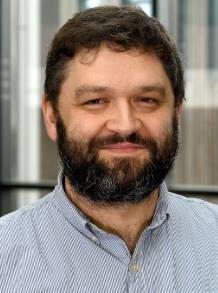
Alexey Ignatiev is a Senior Lecturer in Monash University's Department of Data Science & AI. His research develops SAT/SMT-based methods for AI applications including explainable AI, automated software debugging, and neuro-symbolic systems. Key projects: Formal Explainability for Neuro-Symbolic AI (ARC-funded) Hierarchical Abstractions for Neuro-Symbolic Systems Recent publications focus on formal explanation techniques for machine learning models, including defect prediction systems and interpretable rule extraction.
Enric Rodríguez Carbonell is a faculty member at the Department of Computer Sciences within the Faculty of Computer Science at Universitat Politècnica de Catalunya (UPC). He is a key member of the LOGPROG - Lògica i Programació research group, focusing on formal methods, automated reasoning, and combinatorial optimization. Research Interests: His work centers on satisfiability (SAT), satisfiability modulo theories (SMT), and their applications in program verification, constraint solving, and optimization. He investigates techniques such as conflict-driven learning, invariant generation, and Max-SMT for proving termination and safety. His research bridges theoretical foundations with practical applications in software analysis and industrial problem-solving. Publication Trends: His recent publications (2020–2024) show a sustained focus on enhancing SAT and SMT solvers, particularly in pseudo-Boolean reasoning, integer linear programming, and multi-conflict analysis. Earlier works established contributions in non-linear arithmetic, termination proofs, and efficient encodings for cardinality constraints, reflecting a long-term commitment to foundational and applied aspects of automated reasoning. Scientific Awards: Best student paper award at SAT 2024 Advising and Grants: Rodríguez Carbonell has contributed to multiple competitive R+D+i projects under Spain’s State Research Plans, indicating active grant involvement. He has co-authored doctoral theses and educational initiatives like Jutge.org, demonstrating engagement in academic supervision and pedagogical innovation. Labs and Teams: He is a core researcher in the LOGPROG group at UPC, which specializes in logic and programming, with strong collaborations across formal methods, verification, and constraint technologies.
Thomas C Henderson is a tenured Professor at the School of Computing within the College of Engineering at the University of Utah. His research focuses on autonomous systems , computational models , and intelligent machine systems , with specific interests in biosystem simulation, distributed systems, and adaptive algorithms. He has contributed to Bayesian sensor networks , UAS traffic management , and probabilistic logic frameworks for intelligent agents. Current academic appointments since 1989 Adjunct roles in Biomedical Engineering Active in IEEE committees (2024-2025) Research trends in recent publications emphasize autonomous aircraft coordination , probabilistic reasoning , and multi-sensor integration . Key subfields include lane-based airspace modeling, reinforcement learning for UAS, and pseudogradient navigation techniques. His work has received recognition through a Best Paper Award (IEEE 2008) and the US Air Force Summer Faculty Fellowship . Strategic deconfliction protocols Dynamic data-driven applications Structural health monitoring systems He actively mentors undergraduate research through courses like Deep Learning Capstone and Senior Capstone Design . Current grants include "Deep Learning in AI and Robotics" (2024-2029) and "Robust Reasoning using Geometric SAT/PSAT" (2022-2023).
Ruzica Piskac is a Professor of Computer Science at Yale University, where she leads the Rigorous Software Engineering (ROSE) group. She has made significant contributions to the fields of software verification, security, automated reasoning, and code synthesis, focusing on improving software reliability and trustworthiness through formal techniques. Dr. Piskac received her PhD from the Swiss Federal Institute of Technology (EPFL) in 2011, where her dissertation won the Patrick Denantes Prize. Prior to joining Yale, she led an independent research group at the Max Planck Institute for Software Systems in Germany (2012-2013). Her research spans several key areas: symbolic execution for Haskell (G2), privacy-preserving formal methods (PPFM), functional reactive synthesis, verification of configuration files, and analysis of software updates. Her work consistently bridges theoretical formal methods with practical applications in real-world systems. Dr. Piskac's recent publications demonstrate a strong trend toward applying formal verification techniques to emerging challenges including large language models, quantum computing security, legal accountability of automated systems, and cyber-physical systems. Her research increasingly intersects with AI, cryptography, and legal domains while maintaining strong foundations in formal methods. Her scientific achievements have been recognized with numerous prestigious awards: Multiple Amazon Research Awards Yale University's Ackerman Award for Teaching and Mentoring Facebook Communications and Networking Award Microsoft Research Award for the Software Engineering Innovation Foundation (SEIF) Patrick Denantes Prize for her PhD dissertation Dr. Piskac has graduated five PhD students, four of whom have gone on to become assistant professors of computer science. She has served as Program Chair of the 37th International Conference on Computer Aided Verification and is on the Steering Committee of the Formal Methods in Computer-Aided Design conference. She leads the Rigorous Software Engineering (ROSE) group at Yale, which focuses on several key projects including: Symbolic Execution Engine for Haskell (G2) Privacy Preserving Formal Methods (PPFM) Functional Reactive Synthesis Verifications for Configuration Files Analysis of Software Updates and Configuration Files
Yannis Dimopoulos is a Professor in the Department of Computer Science at the University of Cyprus. He has previously held research positions at the Max-Planck Institute for Computer Science in Saarbrücken and the University of Freiburg in Germany. He earned his B.Sc. and Ph.D. in Computer Science from the Athens University of Economics and Business. His primary research interests include: Knowledge representation and reasoning Planning Nonmonotonic reasoning Constraint satisfaction Machine learning His recent research, based on publications from 2017 to 2024, focuses on the theoretical and computational aspects of abstract argumentation, particularly control argumentation frameworks, probabilistic extensions, and the integration of argumentation with Boolean networks and negotiation under incomplete information. He has also contributed significantly to Answer Set Programming (ASP) for planning, developing the plasp 3 framework for effective ASP-based planning solutions. His scholarly work appears in top-tier venues such as AAAI, IJCAI, ECAI, KR, AAMAS, and journals like Artificial Intelligence and Autonomous Agents and Multi-Agent Systems. His most frequent collaborators include Pavlos Moraitis, Jean-Guy Mailly, Antonis C. Kakas, and Wolfgang Dvorák. No scientific awards or honors are mentioned in the provided text. Yannis Dimopoulos has advised or collaborated with several researchers, including Jean-Guy Mailly, Pavlos Moraitis, Nabila Hadidi, and Muhammad Adnan Hashmi, though formal student-advisor relationships are not explicitly detailed. His work often involves theoretical and computational modeling, and while specific grants or funding sources are not listed, his sustained publication record suggests active research support. He is actively involved in research teams and collaborations focused on argumentation, multi-agent systems, and automated reasoning, as evidenced by his extensive co-authorship network.
Mary Elizabeth Kurz is an Associate Professor in the Department of Industrial Engineering at Clemson University's College of Engineering, Computing and Applied Sciences. Her research focuses on scheduling optimization, metaheuristics, and assembly line balancing for complex manufacturing systems. Education: B.S., Systems Engineering, University of Arizona (1995) M.S., Systems Engineering, University of Arizona (1997) Ph.D., Systems and Industrial Engineering, University of Arizona (2001) Research interests include: Development of heuristics and metaheuristics for scheduling Assembly line balancing with ergonomic constraints Flexible flowline scheduling with sequence-dependent setups Application of genetic algorithms and particle swarm optimization Recent work trends show applications in opioid crisis modeling, photolithography scheduling, and automotive configuration management. She has presented at INFORMS and IISE conferences, with special emphasis on multi-objective optimization and real-world industrial constraints. Scientific awards: Third Place Best Paper, ASME Manufacturing Engineering Division (2014) As an INFORMS member and Institute of Industrial Engineers Senior member, she has taught courses in operations research, decision support systems, and metaheuristics. Her work spans both theoretical and applied domains, with a strong focus on manufacturing system efficiency.
Alan Hu is a Professor in the Department of Computer Science at the University of British Columbia (UBC), part of the Faculty of Science. His research focuses on formal verification, algorithms, computer architecture, and electronic design automation. He teaches courses such as Intermediate Algorithm Design and Analysis (CPSC 320) and Introduction to Formal Verification and Analysis (CPSC 513). Dr. Hu has received notable awards, including the IEEE Council on Electronic Design Automation Outstanding Service Award and the IBM Faculty Award. His work emphasizes scalable verification techniques, SAT-based algorithms, and optimization in cloud computing and hardware systems. His research spans formal methods for hardware/software systems, including verification of embedded software, cache coherence, and network function virtualization. Notable contributions include advancements in SAT modulo theories, data race detection in heterogeneous systems, and cloud resource allocation frameworks like Cospot. Dr. Hu has been actively involved in teaching and curriculum development, consistently offering courses on algorithms, formal verification, and software design since 2000. His publications reflect a blend of theoretical foundations and practical applications in electronic design, cloud infrastructure, and verification tools. His scientific achievements include innovations in post-silicon validation, emulation-based coverage reduction, and formal analysis for debug trace optimization. He also contributes to the academic community through conference organization and editorial roles in formal verification and computer-aided design.
Zachary Kincaid is an Associate Professor in the Department of Computer Science at Princeton University. His research focuses on program analysis , logic , and programming languages , with emphasis on making analysis compositional and robust . PhD, University of Toronto (2016) BSc, Western University Research Interests Dr. Kincaid develops algebraic program analysis frameworks combining symbolic methods with abstract interpretation. His work addresses challenges in: Compositional analysis of concurrent and recursive programs Termination analysis for loops with complex control flow Non-linear numerical invariant generation Strategy synthesis for logical games Parameterized program verification Publication Trends His research output spans program analysis (2024-2010), formal verification (2018-2010), concurrency (2016-2010), and automated synthesis (2013-2012). Recent work (2024) explores polynomial ideals and nonlinear ranking functions , while foundational contributions include vector addition systems and recurrence-based invariants . Scientific Engagement Dr. Kincaid contributes to the academic community through: Program Committee service (PLDI, POPL, CAV, IJCAI, LICS, FMCAD, ESOP, etc.) Co-developing the Duet analyzer for unbounded concurrency Collaborative work with leading researchers (Tom Reps, Azadeh Farzan, Jason Breck) Advising & Grants He advises PhD students and leads research funded by the ONR grant N00014-19-1-2318 . Current advisees include Jake Silverman and Shaowei Zhu, while former student Charlie Murphy (PhD 2023) now holds a postdoctoral position at University of Wisconsin-Madison. Labs & Teams Dr. Kincaid co-developed the Duet program analyzer and contributes to tools like Srk and SimSat . His work integrates SMT solvers (MathSAT, Z3) and mathematical frameworks (rational vector addition systems, recurrence relations) for robust program analysis.
Ondřej Čepek is an Associate Professor at the Department of Theoretical Computer Science and Mathematical Logic, Faculty of Mathematics and Physics, Charles University in Prague. His academic career spans several decades with numerous publications demonstrating his expertise in theoretical computer science, particularly in Boolean logic, computational complexity, and operations research. Čepek's research primarily focuses on Boolean functions, Horn formulas, and computational complexity. His work explores structural properties of logical constructs, minimization techniques, and applications in knowledge representation. He has made significant contributions to understanding satisfiability testing complexity, CNF minimization, and Boolean function representations using interval structures. His research also extends to scheduling problems, particularly just-in-time scheduling with periodic time slots, where he has developed efficient algorithms for multislot scheduling on identical parallel machines and nonpreemptive flowshop scheduling with machine dominance. Analysis of his recent publications reveals a consistent research trajectory from theoretical foundations to practical applications. His work demonstrates expertise in tractable classes of Boolean formulas, knowledge compilation techniques, and the relationship between computational complexity and logical representations. The recurring themes include efficient representations for logical formulas, characterization of tractable problem classes, and development of optimization algorithms for discrete structures. His collaborations with researchers like Petr Kučera, Roman Barták, and Endre Boros have produced influential work in constraint programming and artificial intelligence. Distinguished Paper Award at CP2004 for 'Unary resource constraint with optional activities' While specific details about his advising activities are not provided in available sources, his extensive publication record spanning from 1989 to 2017 suggests substantial involvement in academic mentoring. His numerous collaborations both within Charles University and internationally indicate an active role in the academic community. His research has practical applications in knowledge-based systems, constraint satisfaction problems, and artificial intelligence. Čepek maintains an active research profile with publications continuing through 2017. His recent work has focused on knowledge compilation techniques, recognition of tractable DNFs, and the complexity of CNF minimization. He has also explored applications of Boolean techniques to DNA microarray data analysis, demonstrating the interdisciplinary nature of his research.
Philipp Wendler is an academic lecturer in the Department of Computer Science at Ludwig-Maximilians-Universität München (LMU Munich). He is affiliated with the Software and Computational Systems Lab and actively involved in research, teaching, and open-source tool development. As an employee representative in the steering committee of the Institute of Informatics, he contributes to institutional governance. His research focuses on software verification, formal methods, and program analysis. Key projects include CPAchecker (a configurable verification framework) and BenchExec (a benchmarking tool). His work emphasizes practical applications in automated testing, energy-efficient algorithms, and reproducible benchmarking. Publications span topics like interpolation-based model checking, energy measurement tools, and strategies for software verification competitions. He has contributed to advancing predicate analysis, k-induction, and refinement selection techniques. Notable achievements include leading the development of CPAchecker and BenchExec, which are widely used in academic and industrial verification efforts. His research addresses challenges in scalable verification, flaky test analysis, and energy-aware computing.
Adrian Rebola Pardo is a Researcher at the Institute of Computer Engineering (E192-04) within the Faculty of Informatics at TU Wien. His work focuses on formal methods, automated reasoning, and SAT solving, with an emphasis on proof theory and verification. He holds a PhD in Computer Science from TU Wien (2021), where he developed interference-based proof systems for SAT solvers. **Education**: PhD in Computer Science, TU Wien (2021) **Research Interests**: His research centers on advancing SAT solving techniques, proof complexity, and formal verification. Key areas include quantified Boolean formulas, DRAT proof systems, and efficient proof generation. His work intersects computational logic and theoretical computer science, with applications in automated theorem proving and verification frameworks. **Grants & Projects**: LCS Project (2017–2025): Interpolants and Interference BITVECTOR Project (2016–2020): Exploring SAT refutation verification techniques **Advising**: Supervised Jakob Altmanninger's 2019 diploma thesis on SAT proof generation and DRAT checking. **Labs/Teams**: Member of the Formal Methods in Systems Engineering group at TU Wien.
Matti Järvisalo is a Professor in the Department of Computer Science at the University of Helsinki, Finland, holding the title of Docent and serving as Supervisor for the Doctoral Programme in Computer Science. He is affiliated with the Helsinki Institute for Information Technology (HIIT), a leading collaborative research institute between the University of Helsinki and Aalto University. His research centers on computational logic and constraint-based reasoning, with core expertise in Boolean optimization, SAT/MaxSAT solving, and argumentation frameworks. He develops declarative approaches for combinatorial problems in computational social choice, judgment aggregation, and fair division, emphasizing certified algorithms and preprocessing techniques. His work bridges theoretical computer science with practical implementations in optimization and AI. Recent publications (2024-2025) reveal a strong focus on multi-objective optimization, certified reasoning, and argumentation under incomplete information. Key trends include symmetry-aware core learning for Pseudo-Boolean optimization, Pareto-optimality certification in MaxSAT, and novel algorithms for manipulation analysis in judgment aggregation, demonstrating his leadership in advancing SAT-based AI methods. Professor Järvisalo's significant contributions have been recognized by prestigious awards: IJCAI-JAIR Best Paper Prize (2019) Best Researcher Award from University of Helsinki Department of Computer Science (2011) CP 2017 Distinguished Paper Award ECAI 2016 Runner-Up Best Student Paper Award Honorary Mention at ICCMA 2015 He actively mentors the next generation of researchers and secures major research funding: Supervision: 6 doctoral theses and 6 Master's/Licentiate theses Active Grant: Academy of Finland project 'Next-generation Unsatisfiability-based Declarative Optimization' (2023-2027) Past Projects: 'Symbolic Techniques for Formally Verified and Explainable AI' (2020-2022), 'Declarative Boolean Optimization: Pushing the Envelope' (2019-2023) As a core member of HIIT, he collaborates within Finland's premier information technology research ecosystem, contributing to the institute's mission of advancing fundamental and applied IT research through interdisciplinary teamwork and international partnerships.
Zhoulai Fu is a tenured Associate Professor at the State University of New York (SUNY), Korea, specializing in programming languages and software security. He also holds joint appointments as a Research Associate Professor at Stony Brook University and is affiliated with the Electrical and Computer Engineering Department at Virginia Tech. His educational background includes: Ph.D., 2009-2013, INRIA – Université de Rennes 1, France M.Eng., 2008-2009, Télécom ParisTech, France M.S, B.S, and French engineer degrees (Ingénieur), 2005-2008, École Polytechnique, France Professor Fu's research focuses on the intersection of Programming Languages, Software Security, and Large Language Models, with special emphasis on improving software reliability through formal methods, numerical error analysis, and scalable verification techniques . His work spans abstract interpretation, automated testing, and verification tools development. He has made significant contributions to floating-point analysis and program verification, with publications at top-tier conferences including PLDI, POPL, OOPSLA, ICSE, and CAV. His publication record shows a consistent trajectory in programming language theory with increasing practical applications. Early work focused on foundational aspects of abstract interpretation and floating-point analysis, while recent papers address security concerns through programming language techniques and incorporate modern approaches like incorrectness logic. Key themes across his publications include formal verification of low-level code, numerical error analysis, and developing scalable analysis tools for real-world software systems. His notable achievements include: Principal Investigator for DARPA E-BOSS Program funding Sole Principal Investigator for National Research Foundation of Korea funding Program Committee membership for POPL 2026, FSE 2024, and PLDI 2023 Professor Fu actively mentors students and has taught courses including Foundations of Computer Science, Programming Abstractions, and Research in Computer Science. His research is supported by significant grants from DARPA and NRF, enabling him to lead the Data & Intelligent Computing Lab at SUNY Korea. He is currently seeking postdocs, PhD, and graduate students to join his research team. He leads the Data & Intelligent Computing Lab, which focuses on advancing programming language techniques for software reliability and security. The lab collaborates with institutions including Virginia Tech, Stony Brook University, and international partners across Europe, working on projects that bridge theoretical computer science with practical software engineering challenges.
Dr. Felix Ulrich-Oltean is a Lecturer in the Department of Computer Science at the University of York. His research focuses on constraint satisfaction, combinatorial optimization, boolean satisfiability, and machine learning applied to automated algorithm selection and configuration. He holds a PhD in Computer Science from the University of York (2019–2023), a PGCE in Secondary Mathematics from Leeds Trinity University, and a BSc in Computer Science from the University of York. His recent work emphasizes SAT encoding techniques for pseudo-boolean and linear integer constraints, with contributions to automated tabulation methods in constraint models. Research trends include integrating machine learning for algorithm selection, optimizing constraint satisfaction problem resolution, and developing efficient SAT-based solutions for complex combinatorial problems. No scientific awards or grants are explicitly mentioned in the provided texts. He advises no listed students and has no disclosed lab affiliations. His office is located at CSE/108, and contact is facilitated through a university web form to protect email privacy.
Sorina Ionica is a Lecturer at the University of Picardie Jules Verne, specializing in Cryptography , Mathematics , and Artificial Intelligence . Her research focuses on the application of optimization techniques and algebraic geometry to cryptographic protocols, particularly in the context of genus 3 curves and isogeny-based cryptography. Research Interests: Cryptography, isogeny graphs, complex multiplication, index calculus, and AI-driven optimization algorithms. Projects: Involved in BforSAT (application of SAT solvers to cryptographic problems) and POSTCRYPTUM (post-quantum cryptography research). Recent Articles: Her work spans mathematical cryptography (e.g., CM curves and Weil descent attacks), algorithm optimization (Crossbred algorithm), and AI integration in cryptanalysis (tree search and SAT solvers). Labs: Sorina is affiliated with the OCIA Lab (Optimization and Cryptography, AI).