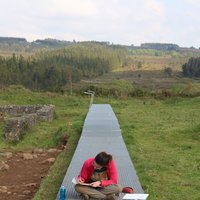
Alba Antía Rodríguez Nóvoa is a post-doctoral researcher at the Department of History, Art and Geography , University of Vigo, affiliated with the Research Center on Atlantic Cultural Landscapes . Her work focuses on Roman and Iron Age archaeology in Galicia, particularly pottery analysis and functional studies of material culture. She contributes to Marie Curie projects like Galtfish , investigating ancient fish-salting industries, and employs LiDAR and 3D photogrammetry for site documentation. Research Themes : Use-wear analysis of ceramics Experimental archaeology methodologies Coastal and inland settlement patterns Integration of GIS and remote sensing Publications : 18 peer-reviewed works, including studies on Roman fish-salting factories and Castro culture Key collaborations with institutions like University of Oxford and Ludwig-Maximilians-Universität München Outreach : Developed informative panels for the Armea archaeological site Co-organized sessions on functional methodologies in archaeology
Prannoy Suraneni serves as an Associate Professor in the Department of Civil, Architectural and Environmental Engineering at the University of Miami's College of Engineering. His academic position places him at the forefront of concrete technology research with a strong emphasis on sustainable construction materials and innovative engineering solutions. Dr. Suraneni's research spans multiple critical areas in concrete science, with particular expertise in supplementary cementitious materials, sustainable alternatives for traditional concrete components, and advanced concrete processing techniques. His work addresses pressing industry challenges including carbon reduction in concrete production, durability enhancement under extreme conditions, and the development of novel construction methods like 3D concrete printing for specialized applications such as marine infrastructure. Analysis of his recent publications reveals a strong focus on sustainable concrete technologies, with particular emphasis on waste material utilization (eggshells, basaltic fines), advanced characterization of cementitious systems, and performance optimization for challenging environments. His research demonstrates consistent innovation in both fundamental material science and practical engineering applications, with significant contributions to understanding structure-property relationships in complex cementitious systems. Dr. Suraneni maintains active collaborations across multiple institutions as evidenced by his co-authorship on numerous publications. His research program addresses critical industry needs including carbon footprint reduction in concrete production, enhanced durability mechanisms, and innovative material processing techniques that push the boundaries of conventional concrete technology.
Prof. Dr. Fatih Üstel , founder and president of the Thermal Spray Research and Application Laboratory (SAU-TESLAB) at Sakarya University , is a leading expert in thermal spray coatings , biomedical materials , and surface engineering . Since joining the Faculty of Engineering’s Department of Metallurgical and Materials Engineering, he has pioneered research in YSZ thermal barrier coatings , hydroxyapatite composites , and industrial coating applications . His work has been recognized through multiple awards, including the 1st Publication Encouragement Award (TÜBİTAK, 2010) DAAD research grants (2003, 2006) 2016 patent for antibacterial nanosilver coatings Prof. Üstel’s recent publications focus on thermal barrier durability , biomedical implant surface treatments , and composite coating innovation . He has secured funding from institutions like TÜBİTAK, DPT, and the Ministry of Industry, while mentoring numerous PhD and Master’s students at SAU-TESLAB. His research emphasizes industry-university collaboration , with projects spanning aerospace , dental implants , and corrosion-resistant industrial coatings .
Gheorghe Borodi is a Leading Researcher (R4) at the National Institute for Research and Development of Isotopic and Molecular Technologies (INCD TIM) in Romania, where he works in the Department of Isotopic and Molecular Technologies as part of the Complex Molecular and Biomolecular Systems research team. His educational background includes: BSc in Physics/Solid State Physics (1972) from Babeș-Bolyai University, Cluj-Napoca, Romania PhD in Physics of Materials (1998) from Babeș-Bolyai University, Cluj-Napoca, Romania Dr. Borodi's research focuses on crystallography and materials science with expertise in X-ray diffraction techniques, both powder and single crystal methods. His work spans solid-state physics, crystal engineering, and supramolecular chemistry. He has made significant contributions to the structural characterization of various materials including pharmaceutical compounds, nanomaterials, and advanced composites. His research methodology combines experimental techniques with computational approaches to understand and manipulate material properties at the molecular level. His recent publications demonstrate a strong focus on polymorphism in pharmaceutical compounds, nanomaterial synthesis and characterization, environmental applications of advanced materials, and structural studies of complex molecular systems. The research spans multiple disciplines including pharmaceutical sciences, environmental engineering, and advanced materials development. Throughout his career, Dr. Borodi has been involved in several significant research projects including: Development of new tools and smart composites based on advanced nanotechnology for medical applications (2012-2016) Security paper with embedded magnetic nanoparticles (2014-2017) Improvement of manufacturing technology for lead-acid batteries (2014-2017) Issues and challenges for hydrogen storage in composites with metal-organic frameworks (2011-2016) His laboratory work primarily involves X-ray diffraction facilities for structural analysis of materials, with applications ranging from pharmaceutical development to advanced materials engineering. Dr. Borodi maintains strong collaborations with Babeș-Bolyai University and other Romanian research institutions, contributing to Romania's scientific infrastructure in materials science and crystallography.
Samantha McBride serves as the William K. Gemmill Term Assistant Professor of Mechanical Engineering within the School of Engineering and Applied Science at the University of Pennsylvania. Her research program integrates materials science, fluid physics, and water chemistry to develop innovative antifouling materials that enhance sustainability and reduce operational costs in water treatment systems. Her academic credentials include: Ph.D. in Mechanical Engineering from the Massachusetts Institute of Technology Master’s degree in Chemical Engineering from Rensselaer Polytechnic Institute Bachelor’s degree in Environmental Engineering from the University of Nevada McBride's research centers on antifouling technologies for water sustainability, with emphasis on crystal self-removal mechanisms , biofilm inhibition , and nutrient recovery systems . She pioneers engineered surfaces that enable passive salt crystal ejection from superhydrophobic substrates, addressing critical challenges in desalination and wastewater treatment. Her work spans fundamental fluid dynamics of multiphase displacement to applied space biofilm studies, consistently bridging laboratory discoveries with environmental solutions through interdisciplinary approaches. Analysis of her 15 most recent publications reveals three dominant research trajectories: (1) antifouling surface engineering demonstrated through 7 papers on crystal liftoff and self-ejection phenomena, (2) sustainable resource recovery explored in membrane distillation-crystallization and nutrient extraction studies, and (3) space-environment biofilm research documented in 4 NASA-related publications examining Pseudomonas aeruginosa behavior in microgravity. This portfolio highlights her unique position at the intersection of terrestrial water challenges and extraterrestrial life support systems. McBride currently leads two major funded initiatives: Understanding Regulations on Agricultural Fertilizer Application to Reduce Waste and Protect Water (July 2025) and Nutrient Recovery from Wastewater for Sustainable Fertilizer Production (June 2024), demonstrating her commitment to translating fundamental research into practical environmental policy and circular economy applications.
Suraj Persaud, PhD, P.Eng, is an Associate Professor in the Department of Mechanical and Materials Engineering at Queen's University. As a UNENE Research Chair, he leads corrosion research focused on nuclear power plant materials across their entire lifecycle—from advanced reactor design to waste disposal—with significant industry collaboration through UNENE and NWMO partners. His primary research examines mechanistic corrosion processes using high-temperature fracture tests, electrochemical measurements, and atomic-scale microscopy. Key focus areas include: Stress corrosion cracking (SCC) of nickel alloys and stainless steels SMR corrosion in molten salt/liquid Pb environments Nuclear waste canister material degradation High-temperature oxidation of model alloys (e.g., Fe-Cr-Al) Irradiation-assisted SCC and hydrogen attack mechanisms Dr. Persaud operates specialized facilities including high-pressure autoclaves, SMR corrosion loops, and oxidation reactors while collaborating with the Reactor Materials Testing Laboratory (RMTL). He actively recruits Master's/Doctoral students for industry-integrated projects with competitive stipends, emphasizing multi-disciplinary skills in nano-scale materials analysis for nuclear applications.
Jean Colombani is a Professor at the Institute of Light and Matter (Université Claude Bernard Lyon 1). He leads the Liquids and Interfaces team and focuses on materials science, fluid dynamics, and colloidal physics. Previously, he was active in the Mechanical and Production Engineering department for over two decades. Research Highlights: His work explores colloidal gel mechanics solute transport phenomena (Soret effect) durability of mineral materials dissolution-precipitation processes drop evaporation on reactive substrates recycling of paper electronics Collaborations span institutions like UCLA, Tokyo University, Padua, and Grenoble, with multiple Arqus grants supporting international exchanges. He mentors PhD candidates such as Alexandra Mailleur and engages in science-art partnerships. Scientific Awards: Arqus grant (2022) Arqus grant (2020) Arqus grant (2017)
Dr. Yiming Feng is an Assistant Professor and Extension Specialist at the Virginia Seafood Agricultural Research and Extension Center , affiliated with the Department of Biological Systems Engineering in the College of Engineering at Virginia Tech. He leads the Sustainable & Intelligent Seafood Bioprocessing Lab , focusing on seafood safety and waste valorization. Ph.D. and B.S. in Food Science and Human Nutrition from the University of Illinois, Urbana-Champaign Dr. Feng’s research integrates hyperspectral imaging and machine learning for real-time seafood safety monitoring (e.g., microplastic detection) and transforms food processing waste into biochar , bio-fungicides , and biogases . His work aligns with circular economy principles and addresses industry challenges like thermal validation and traceability regulations . Recent publications highlight advancements in non-destructive food sensing , plant-based seafood analogs , and agricultural waste conversion for energy and packaging. Grants include a USDA-SCBGP award for olive byproduct valorization and a 4-VA Collaborative Research Grant for microplastic detection. Food Processing Operation Award (Cal Poly, 2021–2023) Food Engineering Award (Cal Poly, 2021–2023) Food Quality Assurance Award (Cal Poly, 2021–2023) Advanced Food Processing Award (Cal Poly, 2021–2023) Dr. Feng actively recruits graduate students and collaborates with industry partners to bridge academic research with practical seafood sector solutions. His lab specializes in thermal validation studies , machine vision , and sustainable bioprocessing .
Chandrasekaran Murugesan is an Assistant Professor in the Department of Food Science and Biotechnology at Sejong University, South Korea. With over a decade of academic experience, he previously served as an Assistant Professor at Konkuk University (2014-2017) and completed postdoctoral research at Chugbuk National University (2012-2014). His research profile shows consistent productivity with 69 total publications and an h-index of 26. His educational background includes: B.Sc. from Bharathidasan University (2001) M.Sc. from Bharathidasan University (2003) Ph.D. from Bharathidasan University (2011) Dr. Murugesan's research spans multiple interdisciplinary areas at the intersection of microbiology, plant science, and environmental biotechnology. His primary research interests include Microbial Biotechnology, Enzymology, Plant Molecular Biology, Plant-Microbe Interactions, and Meta-analysis. His work demonstrates deep expertise in arbuscular mycorrhizal fungi (100% research fingerprint), meta-analysis approaches (79%), nanoparticle applications (59%), and Solanum lycopersicum research (58%). His publication trend shows significant expansion in recent years (2024-2025) into critical environmental challenges including microplastics pollution, nanotechnology applications in agriculture, biodegradation of plastics, and bioethanol production from waste materials, while maintaining his core focus on plant-microbe interactions and stress responses. This evolution reflects both continuity in his foundational research and adaptation to emerging global environmental concerns. Dr. Murugesan has established extensive international collaboration networks across multiple continents, as evidenced by his co-authorship patterns. His research output demonstrates strong translational potential with applications in sustainable agriculture, environmental remediation, and food security.
Diego Morais Chaves is a Researcher at the University of Minho, Portugal, working with the InnoFiber Research Group (2C2T) on sustainable textile materials. Previously, he was a Postdoctoral Researcher (2022-2024) and Collaborative Researcher at the Federal University of Viçosa, Brazil (2021-2022). His expertise spans natural fiber processing, catalysis, and biomass valorization for circular economy applications in textiles. Education: Post-doctorate in Materials Engineering - Textiles, University of Minho (2023-2024) D.Sc. in Agrochemistry (Inorganic Chemistry - Catalysis), Federal University of Viçosa (2016-2020) M.Sc. in Agrochemistry (Catalysis), Federal University of Viçosa (2014-2016) B.Sc. in Chemistry, Federal University of Viçosa - Campus Florestal (2009-2013) Chaves specializes in Textile Engineering and Sustainable Materials, with focus on natural fiber extraction (pineapple, banana), catalytic biomass conversion, and circular economy solutions. His work bridges advanced material science and chemical engineering to transform agricultural waste into high-value textile resources, emphasizing environmental sustainability and industrial applicability. His publication portfolio reveals strong trends in sustainable textiles and biomass conversion, particularly in natural fiber characterization, cellulignin production for biofuels, and catalytic furfural synthesis. Key interdisciplinary themes include lignocellulosic biomass valorization, catalyst reusability, and process optimization for textile circularity, demonstrating consistent innovation from fundamental catalysis to applied textile engineering. Scientific distinctions: ABRAFATI Science in Paints Award (2017) Postdoctoral Scholarship by University of Minho (2023) Doctoral Scholarship by CAPES (2016) Master's Scholarship by CAPES (2014) Honor to Merit by Brazilian Chemical Society (2013) Chaves has supervised master's and undergraduate students during his postdoctoral period at MCDALab, co-orienting a Master's thesis on NbOPO 4 .nH 2 O catalyst reuse. His research is supported by major grants including Portugal's Be@t PRR project (Bioeconomy at Textiles) and Brazilian agencies (CAPES, CNPq, FAPEMIG) for biomass valorization initiatives. He actively contributes to the InnoFiber Research Group at the Center for Science and Textile Technology (2C2T), developing sustainable fiber processing techniques under the Be@t project to enhance circular economy practices in Portugal's textile industry through agricultural waste valorization.
Dr. Youngwoo Choo is a Chancellor's Postdoctoral Research Fellow at the University of Technology Sydney , affiliated with the School of Civil and Environmental Engineering . He previously worked at institutions including Seoul National University , Brookhaven National Laboratory , Yale University , and University of California, Berkeley . His research focuses on functional nanomaterials , metal-organic frameworks , and electrochemical systems for ion separation and rare earth element recovery from unconventional sources like brine water and acid mine drainage. PhD , Chemical and Environmental Engineering, Yale University (2019) MS , Chemical and Biological Engineering, Seoul National University (2011) BS , Chemical and Biological Engineering, Seoul National University (2009) His expertise spans electron microscopy , X-ray diffraction , and dynamic light scattering for nanomaterial characterization. Current research emphasizes polymer membrane design for highly selective ion uptake , particularly in capacitive deionization systems. He has published 35 peer-reviewed papers with over 1,200 citations (h-index 18) and serves as peer reviewer for journals including Desalination and ACS Applied Engineering Materials . Key awards include the Korean National Science and Technology Scholarship and Frank J. Padden Symposium Finalist (American Physical Society). He leads funded projects like "Designing Advanced Membranes for Selective Rare-Earth Recovery" (2024) and "Next-generation membrane: Highly selective rare-earth element recovery from mining wastewater" (2022-2025). As of 2023-2024, he teaches Chemical Process Engineering and Fluid Mechanics at UTS.
Distinguished Professor Huu Hao Ngo is a world-leading environmental engineering researcher at the University of Technology Sydney , serving as Deputy Director of the Centre for Technology in Water and Wastewater and co-director of the Joint Research Centre for Protective Infrastructure Technology and Environmental Green Bioprocess with Tianjin Chengjian University. His work focuses on sustainable water treatment technologies, bioprocessing innovations, and zero-emission systems. Key research themes: Wastewater treatment, environmental biotechnology, membrane processes, resource recovery As a prolific scholar with over 750 publications and 62,000 citations, Ngo leads in membrane bioreactor development (notably the patented GemFloc bioflocculant) and sustainable bioprocessing. His recent work explores biochar-assisted systems, advanced oxidation processes, and microbial community engineering for wastewater treatment. 2025 article highlights: Enhanced membrane fouling mitigation, novel biochar catalysts for antibiotic removal, sulfate reduction optimization, and hydrogen production analysis Scientific recognition includes: Clarivate Highly Cited Researcher (Environment/Ecology, Biology/Biochemistry) SciVal World #1 ranking in Waste Management Scholar GPS™ Top 2 Environmental Scientist Research Magazine Field Leader awards He supervises PhD students globally, delivers keynote lectures worldwide, and serves as Editor-in-Chief of Chemical Engineering Journal and several other top-tier publications.
Liming Huang is a Postdoctoral Researcher at the Department of Building Technology within Chalmers University of Technology, Sweden. His work focuses on advancing sustainable cementitious materials through experimental and simulation-based studies. Institution: Chalmers University of Technology Department: Building Technology Research areas include: Hydration mechanisms of Portland cement with chemical additives Moisture and ion transport in blended cement Characterization of pore structures and hydration products Carbonation propagation in low-CO 2 concretes Activation of volcanic/clay materials as SCMs Project collaborations involve Swedish Research Council (VR) , Formas , SBUF , and European Commission , with co-authorships across institutions like Lund University and MIT.
Masahiko Matsukata is a Professor at the School of Advanced Science and Engineering of Waseda University, with a focus on Applied Chemistry . His academic credentials include a Doctor of Engineering from Waseda University. Education: Ph.D. in Applied Chemistry, Waseda University (1989) B.Eng. in Applied Chemistry, Waseda University (1984) Research Interests span multiple cutting-edge domains: Zeolite and metal-organic framework (MOF) membrane synthesis Catalytic processes for hydrocarbon conversion Energy-efficient separation technologies Hydrogen production and carbon dioxide utilization Plastic chemical recycling methods Advanced adsorption and diffusion mechanisms Article Trends reveal extensive work on zeolite membrane development for forward osmosis, isomer separation, and catalytic membrane reactors. His recent studies emphasize defect healing techniques, hierarchical pore architectures, and hybrid systems for energy-saving separations. Scientific Awards include: The Japan Petroleum Institute Award (2025) nano tech Prize (Green Nanotechnology Category, 2014) Japan Energy Society Progress Award (2001) Catalysis Society of Japan Award (1999) His work has been pivotal in advancing microporous membrane technology for industrial applications, as highlighted by his leadership in multiple research projects and contributions to chemical engineering journals.
Eun Young Lee, Dr.rer.nat., is a Senior Research Fellow at the Institute of Geology, Faculty of Geosciences, Geography and Astronomy, University of Vienna. She has maintained a productive research career since completing her doctoral studies at the University of Vienna (2010-2015) in Sedimentary Basin Analysis. Her research focuses on Earth system evolution with interactions of geological/geodynamic processes and climate changes. Her primary research interests include multidisciplinary investigation into Earth history and geosystem evolution, sedimentary basin analysis and modeling in an Earth system framework, and the interplay of tectonics, sedimentation, and paleo-environment/climate. She has developed numerical techniques and software for geoscientific data analyses and specializes in interpretation and correlation of geologic, petrophysical, geophysical, and geochemical data. Her recent work increasingly addresses anthropogenic impacts on Earth and environmental systems. Analysis of her publication record shows consistent research output across multiple geological settings including the Gulf of Suez, Vienna Basin, South China Sea, and Australian continental margins. Her work integrates field observations with numerical modeling approaches, particularly in sedimentary basin analysis. She has made significant contributions to understanding Cretaceous climate and tectonics through her participation in IODP expeditions. Young Geologist Award of Korea (2020) ECORD MagellanPlus Award (2017) EKC Best Poster Award (2014) Brain Pool Fellowship (2017-2021) Multiple IODP Expedition Post-cruise Research Grants Dr. Lee has secured substantial research funding including the Scientific & Technological Cooperation of Austria and South Korea (2022-2024), CNU Research Grant (2020-2021), and WISET Research Grant (2020-2021). She has served as Guest Professor at the University of Vienna teaching Sedimentary Basin Analysis (2022) and Basin Analysis (2021). She actively collaborates with Michael Wagreich's Lab at the University of Vienna and has participated in multiple International Ocean Discovery Program (IODP) expeditions as a shipboard scientist.