- Cosmology
- Astrophysics
- General Relativity
- +۸ مورد دیگر
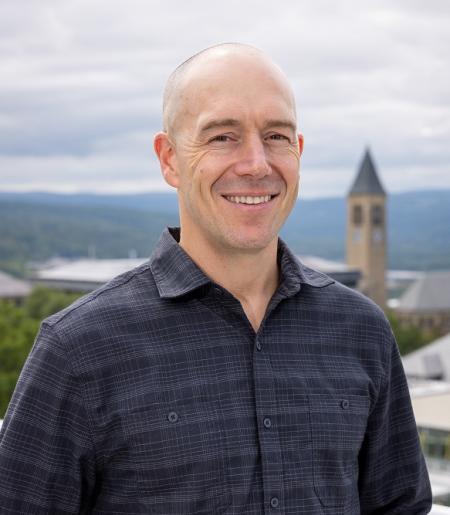
Michael Niemack is a Professor of Physics and Astronomy at Cornell University, where he has been a faculty member since 2013. He is affiliated with the College of Arts and Sciences and holds joint appointments in both the Physics and Astronomy departments. His research focuses on experimental cosmology and astrophysics, particularly through precision measurements of microwave radiation. Education: B.A. Physics, Amherst College, 2002 Ph.D. Physics, Princeton University, 2008 Professor Niemack's research interests span cosmology, astrophysics, and fundamental physics, with a focus on studying inflation, dark energy, dark matter, neutrinos, galaxy clusters, and galaxy evolution using cosmic microwave background and sub-mm measurements. His work also encompasses detector arrays and applied superconductivity, including low-temperature detector arrays, superconducting detectors, transition-edge sensor bolometers, and SQUID measurement systems. Additionally, he specializes in astronomical optics and receivers, with expertise in optics design, optical coatings, material properties, and cryogenic instruments. His research group develops new instrumentation to study the formation and evolution of the universe through precision measurements of microwave radiation, building on past measurements of the cosmic microwave background that provided an exquisite picture of the early universe. Professor Niemack's work has led to significant advancements in cosmological observations, including contributions to the Atacama Cosmology Telescope (ACT) which operated from 2008-2022, and ongoing work with the CCAT Observatory, Simons Observatory, and CMB-S4 projects. His research has produced first detections of the power spectrum of CMB gravitational lensing and the kinematic Sunyaev-Zel'dovich effect, as well as some of the best constraints on the Hubble constant yet. Scientific Awards: Centennial Fellow, Princeton University (2002-2007) National Research Council Postdoctoral Fellow, National Institute of Standards and Technology, Boulder, CO (2008-2010) NSF CAREER Award Young Scientist by World Economic Forum (2018) Professor Niemack has advised numerous graduate students and postdoctoral researchers, including Zachary Huber, Benjamin Keller, Lawrence Lin, Alicia Middleton, Cody Duell, Eve Vavagiakis, and others. His research is supported by major funding sources including the National Science Foundation, National Aeronautics and Space Administration, and Simons Foundation, which have enabled the development of cutting-edge instrumentation for cosmological observations. His work has led to significant advancements in detector technology, including the design, build, and deployment of some of the largest arrays of superconducting detectors yet, with thousands of transition-edge sensor (TES) detectors cooled to sub-Kelvin temperatures. Professor Niemack leads the Experimental Cosmology and Astrophysics group at Cornell, which works in the Cornell Nanoscale Facility developing new optics and detector microfabrication techniques. The group has played a significant role in building and observing with the six-meter Atacama Cosmology Telescope and is now developing new instruments for the CCAT Observatory and Simons Observatory, as well as longer-term development of CMB-S4 to measure microwave radiation with far better sensitivity than previous observatories.