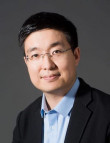
Colin Raffel , currently an Associate Professor at the University of Toronto and Associate Research Director at the Vector Institute , is a leading researcher in machine learning and natural language processing . His career spans roles at Hugging Face (Faculty Researcher), Google Brain (Senior Research Scientist), and UNC Chapel Hill (Assistant Professor). Education: PhD in Electrical Engineering (Columbia), MA in Music/Science (Stanford), BA in Mathematics (Oberlin) Key affiliations: Google Brain (2016-2020), Hugging Face (2021-present), Vector Institute (2023-present) His research focuses on language model development , attention mechanisms , efficient machine learning , and music information retrieval . Recent work explores model merging , parameter-efficient fine-tuning , and data-constrained language models . Teaching : Has instructed courses at University of Toronto and UNC Chapel Hill on Neural Networks , Deep Learning , and Information Theory . Academic service includes organizing ICLR workshops and serving as Senior Area Chair for NeurIPS and EMNLP . Notable awards : NSF CAREER (2022), Caspar Bowden Award (2023), NeurIPS Outstanding Paper (2023) Key contributions : Core developer of WT5 , Git-Theta , and mir_eval software
Sheila McIlraith is a Professor in the Department of Computer Science at the University of Toronto, holding the Canada CIFAR AI Chair at the Vector Institute and serving as Associate Director and Research Lead at the Schwartz Reisman Institute for Technology and Society. Her research spans AI safety, ethics, reinforcement learning, and knowledge representation, with a focus on human-compatible AI and long-term societal impacts. Her career includes six years as a Research Scientist at Stanford University and a year at Xerox PARC. McIlraith’s work has been recognized through ACM and AAAI fellowships, as well as prestigious awards like the SWSA 10-Year Award (2011) and the CAIAC Lifetime Achievement Award (2024). Research Interests: AI Safety and Alignment Human-Compatible AI Reinforcement Learning with Ethical Constraints Semantic Web Services Cognitive Robotics and Diagnostic Systems Probabilistic and Logical Reasoning Recent Contributions: Her work emphasizes ethical AI integration, such as the Embedded Ethics Education Initiative (E3I), and addresses challenges in long-term AI risks, multi-agent systems, and interpretable decision-making frameworks. Awards and Honors: ACM Fellow AAAI Fellow 2023 IJCAI-JAIR Best Paper Prize 2024 CAIAC Lifetime Achievement Award Labs and Teams: McIlraith leads initiatives at the Schwartz Reisman Institute and contributes to the Vector Institute, focusing on societal and ethical dimensions of AI technology.
Ming-Syan Chen is a distinguished academic holding dual roles as a Distinguished Research Fellow and Director of the Research Center for Information Technology Innovation (CITI) at Academia Sinica, Taiwan, and a Distinguished Professor jointly appointed across multiple departments at National Taiwan University (NTU), including Electrical Engineering (EE), Computer Science and Information Engineering (CSIE), and the Graduate Institute of Communication Engineering (GICE). His career spans academia and industry, with prior roles as a research staff member at IBM Watson Research Center and leadership positions in Taiwan's technology sector. Education: He earned a B.S. in Electrical Engineering from National Taiwan University, followed by M.S. and Ph.D. degrees in Computer, Information, and Control Engineering from the University of Michigan, Ann Arbor. Research Interests: Chen's work focuses on databases, data mining, machine learning, multimedia networking, and cloud computing. He has authored over 350 papers and holds numerous patents, contributing to foundational advancements in query processing, data management, and networked systems. Award Highlights: Recipient of ACM and IEEE Fellowships, National Chair Professorship (lifetime honor), Teco Award, Pan Wen Yuan Distinguished Research Award, and IBM's Outstanding Innovation Award. His contributions span research, teaching, and technology commercialization. Leadership & Service: Former Dean of NTU's College of Electrical Engineering and Computer Science, CEO of Taiwan's Networked Communication Program, and Editor-in-Chief of the International Journal of Electrical Engineering. He has chaired international conferences and served on editorial boards of journals like IEEE TKDE and VLDB. Labs & Teams: Leads the Network Database Laboratory and collaborates on national initiatives in information and communication technologies. His research groups focus on data science, distributed systems, and social network analysis.
Maher Elshakankiri is an Assistant Professor, Teaching Stream at the University of Toronto's Faculty of Information. He holds a Ph.D. in Computer Engineering from Ain Shams University (Egypt), followed by a postdoctoral fellowship at the University of Regina. His research focuses on IoT, Wireless Sensor Networks (WSN), and pedagogical integration of technology and gaming. He has supervised over 100 student projects and authored a book on WSNs. Education: Ph.D. in Computer Engineering, Ain Shams University, Egypt M.Eng., B.Eng. in Engineering, Ain Shams University, Egypt Postdoctoral Fellowship, University of Regina, Canada Research Interests: IoT in healthcare, agriculture, and sports Active learning classrooms and technology in education Wireless communication protocols (V2V, UAV, RFID) Leadership & Grants: Director, Bachelor of Information (BI) Program (2024–present) Coordinator, Information Systems and Design (ISD) Concentration (2023) SSHRC Grant: 'Gaming in teaching towards a more inclusive class' (2022–2023) Professional Activities: Member, SCC IoT & Digital Twins Standards Committee Reviewer for journals including Wireless Networks , Telematics and Informatics , and Computational Intelligence Technical Program Committee member at multiple conferences Teaching: Courses include INF1340 (Programming for Data Science), INF1005/1006 (IoT Workshops), and INF452 (Information Design Coding).
Chaitanya Swamy is a Professor and University Research Chair in the Department of Combinatorics & Optimization at the University of Waterloo, Canada. His primary affiliation is within the Faculty of Mathematics, and he holds positions in both the Department of Combinatorics & Optimization and the School of Computer Science. He obtained his Ph.D. in Computer Science from Cornell University under the supervision of David Shmoys, followed by postdoctoral research at Caltech's Center for the Mathematics of Information. Swamy’s research focuses on algorithms, particularly in combinatorial optimization, approximation algorithms, algorithmic game theory, stochastic optimization, network design, scheduling, and online algorithms. His work spans theoretical contributions and practical applications, including algorithm design for facility location, network routing, and mechanism design. He has contributed to foundational results in approximation algorithms, such as the development of primal-dual methods and LP-rounding techniques. Swamy has held significant editorial roles, including as an associate editor for Discrete Optimization and SIAM Journal on Computing . He has organized major conferences like CanaDAM 2021 and sessions at ISMP 2018. His teaching record includes courses on combinatorial optimization, scheduling, and algorithmic game theory. He has advised numerous Ph.D. and Master’s students, many of whom have gone on to prestigious academic and industry positions. Swamy’s research has been recognized through awards for his students, including the University of Waterloo Alumni Gold Medal. He actively contributes to the academic community through committee work for conferences like STOC, APPROX, and SODA, and his publications reflect a deep engagement with both theoretical and applied aspects of algorithms and optimization.
Professor Peter F. Driessen is a faculty member in the Department of Electrical and Computer Engineering at the University of Victoria, with a cross-appointment in the School of Music. He holds a BSc and PhD from the University of Victoria and is a Professional Engineer (PEng). His research focuses on communication systems, signal processing, control, and interdisciplinary projects in computer music and wireless technologies. Key areas include audio/video signal processing, radio propagation, sound recording, and multimedia systems. He leads the University of Victoria Propagation Laboratory, which explores radio wave propagation and Amateur radio integration with engineering education. His work spans theoretical research and applied projects like ECOSat satellite systems, software-defined radio (SDR), and innovative musical instruments such as the Radio Drum. He supervises undergraduate and graduate projects in these domains through ELEC 499 courses. Notable contributions include the APEGBC Editorial Board Award for Best Paper (2002) and patents in wireless networking and signal processing. His teaching includes courses in signal analysis and electromagnetics, and he collaborates on interdisciplinary programs like the Music/Computer Science degree. Education: BSc in Electrical Engineering, University of Victoria PhD in Electrical Engineering, University of Victoria Research Interests: Audio and video signal processing for music and media Software-defined radio and Amateur radio technologies Satellite communication and ground station development Gesture-based interfaces and musical instrument design Error mitigation in streaming audio/video Optical and microwave-photonic systems Labs & Collaborations: Propagation Laboratory (radio wave research) UVic Experimental Radio Group (Amateur radio club) UVic Satellite Design Team (ECOSat projects) UVic Centre for Aerospace Research Grants & Awards: APEGBC Editorial Board Award (2002) Multiple US patents in wireless systems and signal processing
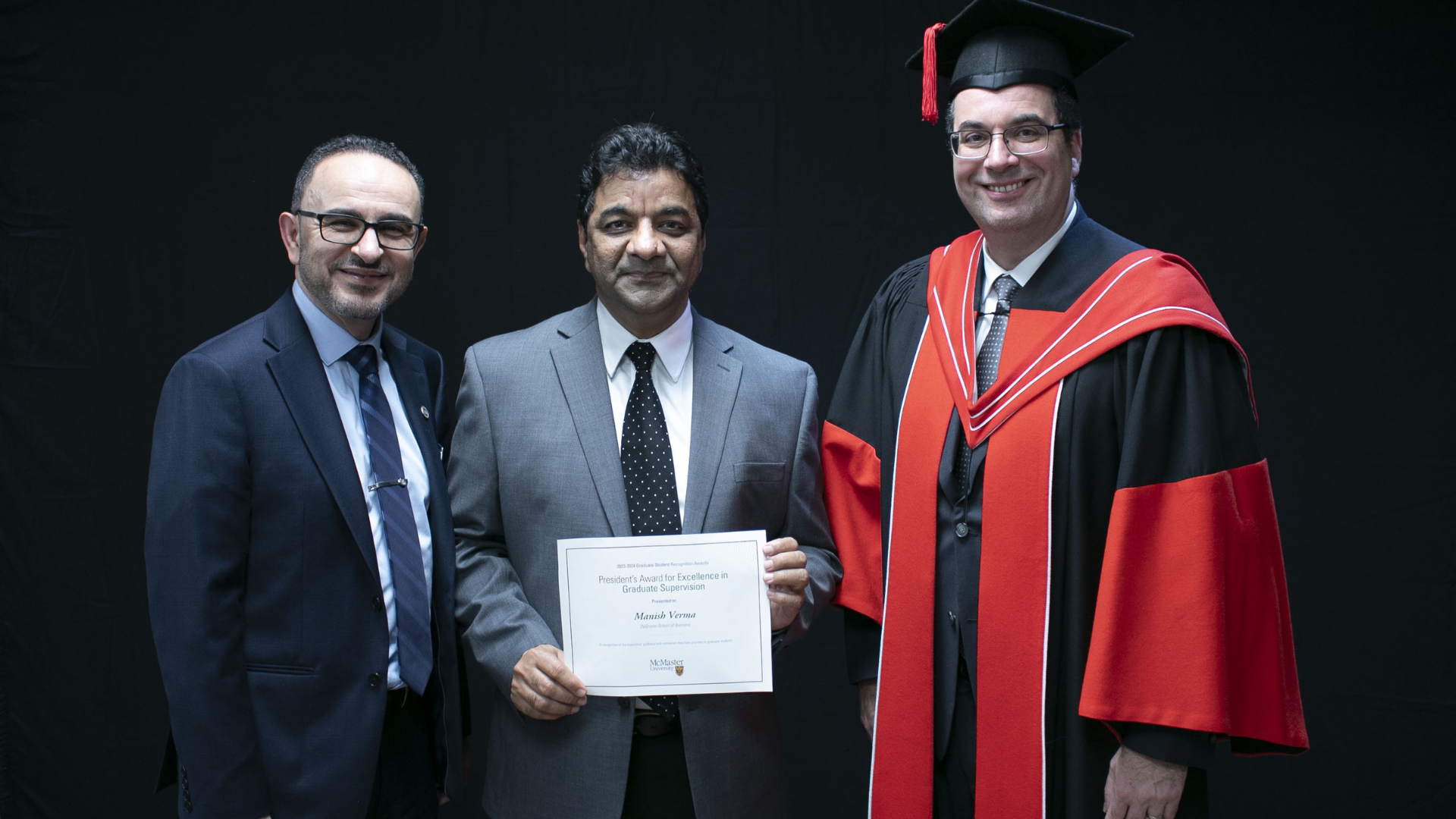
Manish Verma is Professor of Operations Management and Associate Dean, Graduate Studies at the DeGroote School of Business, McMaster University. His academic journey began with an MBA and PhD in Business Administration with Operations Management/Management Science specialization from Desautels Faculty of Management at McGill University. Dr. Verma's research focuses on multimodal transportation of dangerous goods, risk assessment, network design and planning in transportation, humanitarian logistics, green supply chain management, and disruption/resilience in transportation systems. His current research engagements center on safety and security issues in freight transportation and humanitarian logistics, funded by NSERC and SSHRC grants. He has been frequently approached by media to comment on railroad accidents involving dangerous goods. An analysis of his recent publications reveals a strong emphasis on hazardous materials transportation risk management, with significant contributions to rail-truck intermodal systems, hazmat risk modeling using value-at-risk methodologies, and emergency response planning for transportation networks. His work bridges theoretical operations research with practical transportation safety applications. $245K research grant for rail safety research from Government of Canada As an educator, Dr. Verma has taught courses including Predictive Analytics for Managers, Network Design Issues in Freight Transportation, and Management Science Research Issues. His scholarly impact is evidenced by publications in leading journals such as Transportation Research Part E, European Journal of Operational Research, and Safety Science. He actively contributes to real-world transportation safety through media commentary and research that informs policy decisions regarding dangerous goods transportation.
Michael Feeley is an Associate Professor in the Department of Computer Science at the University of British Columbia (UBC), affiliated with the Institute for Computing, Information and Cognitive Systems (ICICS). His research focuses on operating systems, distributed systems, and their applications in scalable file systems, cloud storage, and mobile computing. He leads projects such as the Unico file system, Parallax storage system, and Remus virtual machine replication framework. His research interests include peer-to-peer file systems, mobile ad hoc networks, interference mitigation in wireless networks, and system software for workstation clusters. He has supervised numerous graduate students, contributing to advancements in distributed systems and networking. His work often addresses challenges in resource management, fault tolerance, and performance optimization. Publications span topics like interference detection in WiFi networks, dynamic program analysis (Tralfamadore), and distributed storage solutions. Feeley teaches courses such as CPSC 213, emphasizing operating systems fundamentals. His office is located in CISR 393, with contact details available via email and phone.
Bilal Farooq is an Associate Professor and Program Director for the Master of Engineering in Interdisciplinary Engineering (MEIE) at Toronto Metropolitan University, holding the Canada Research Chair in Disruptive Transportation Technologies and Services within the Department of Civil Engineering. His educational background includes a PhD from the University of Toronto (2011), MASc from Lahore University of Management Sciences (2004), and BSc from the University of Engineering and Technology (2001). Dr. Farooq's research pioneers disruptive transportation solutions through cyber-physical systems, AI/machine learning applications, behavioral modeling, and optimization techniques. His work specifically targets on-demand multimodal systems, sustainable urban transportation, urban air mobility, automated vehicles, and extended reality applications, addressing critical urban mobility challenges with human-centered approaches. Analysis of his recent publications reveals a strong trend toward quantum-enhanced computational methods, privacy-preserving federated learning frameworks, and sustainability-focused decarbonization strategies across transportation domains, with increasing emphasis on human factors and real-world implementation. Notable scientific awards include: Ontario Early Researcher Award (2018) Canada Research Chair (2017) MassMotion Academic Pedestrian Modelling Project of the Year (2016) Québec Early Researcher Award (2014) Dr. Farooq actively supervises graduate students and secures significant research funding through his Canada Research Chair position and Early Researcher Awards. He directs the Laboratory of Innovations in Transportation (LiTrans), which develops interdisciplinary solutions integrating mathematics, engineering, computer science, and economics to address emerging transportation challenges. LiTrans focuses on disruptive transportation technologies, complete streets design, cyber-physical systems, pedestrian dynamics, resilience, and climate change impacts, collaborating with industry and government partners to translate research into practical urban mobility innovations for smart cities worldwide.
Dr. Xiaodong Lin is a Professor at the University of Guelph's School of Computer Science and an IEEE Fellow (2017) for contributions to secure vehicular communications. He leads the Blockchain Technology and Cybersecurity (BTC) lab, focusing on privacy-enhancing technologies, digital forensics, wireless network security, blockchain applications, and DeFi security. PhD, Beijing University of Posts and Telecommunications, China PhD, University of Waterloo, Canada His research bridges theoretical and applied domains in cybersecurity, particularly vehicular networks, smart grids, and decentralized systems. Recent work examines blockchain security, privacy-preserving protocols for IoT, and secure data aggregation in wireless networks. Key publication trends include secure fog computing for vehicular crowdsensing, privacy-preserving authentication in 5G, and cryptographic solutions for smart grids. Awards highlight multiple Best Paper recognitions at IEEE conferences. IEEE Fellow (2017) Best Paper Awards (IEEE INFOCOM 2018, GLOBECOM 2017, SECURECOMM 2016) Dr. Lin supervises graduate students in blockchain security, AI security, and digital forensics. His lab provides financial support to qualified students.
Xiaohui Yu is a Professor and Graduate Program Director in the School of Information Technology at York University. He holds a BSc from Nanjing University, an MPhil from the Chinese University of Hong Kong, and a PhD from the University of Toronto. His research focuses on the intersection of data management and machine learning, including ML-based database systems, large-scale machine learning, and spatio-temporal data analysis in contexts like intelligent transportation systems and social networks. Supported by grants from NSERC and industry partners, his work has been published in top venues such as SIGMOD, VLDB, and TKDE. He serves as an Associate Editor for journals like IEEE TKDE and ACM TKDD, and actively participates in conference program committees. Education: BSc (Nanjing University), MPhil (Chinese University of Hong Kong), PhD (University of Toronto). Research Interests: Big data management, database systems, machine learning, spatio-temporal data analytics, and video query processing. Recent articles emphasize ML-driven database components, efficient video query optimization, and scalable algorithms for large-scale data. His work addresses challenges in query processing, indexing, and real-time systems. Service: Serves on editorial boards (e.g., Information Systems), and chairs/workshops (e.g., Symposium on Data Markets). Active in program committees for SIGMOD, ICDE, and other leading conferences. Advising & Grants: Directs graduate programs and leads research groups. Collaborates with industry on data marketplaces and AI model integration. No specific student names listed, but actively recruits PhD/Master’s candidates.
Dr. Yujie Tang is an Assistant Professor in the Faculty of Computer Science at Dalhousie University, Canada, where she has been serving since September 2022. Prior to this, she was an Assistant Professor at Algoma University (2019–2022) and a Post-Doctoral Fellow at the University of Waterloo (2017–2019). Her academic journey includes a PhD from the University of Waterloo and earlier degrees from Harbin Institute of Technology and Lanzhou Jiaotong University. PhD – University of Waterloo (2017) M.E. – Harbin Institute of Technology, Shenzhen, China B.E. – Lanzhou Jiaotong University, Lanzhou, China Her research focuses on intelligent networking and computing technologies for future IoT and 5G/6G systems. Key areas include Internet of Vehicles (IoV), AI-empowered edge computing, resource management in heterogeneous networks, software-defined networking, and UAV-assisted communications. She employs machine learning and optimization techniques to design energy-efficient and high-performance network protocols. The most recent publications reflect a strong trend in applying AI and machine learning to solve complex problems in vehicular networks, edge caching, and spectrum management. Her work spans top-tier IEEE journals such as IEEE Transactions on Vehicular Technology , IEEE Internet of Things Journal , and IEEE JSAC , with a clear emphasis on real-world deployable solutions for next-generation wireless systems. Faculty Research Startup Fund, Dalhousie University, 2022 NSERC Discovery Grant, 2021–2026 Algoma University Research Fund, 2021 Faculty Research Startup Fund, Algoma University, 2019 Best Speaker Award, University of Waterloo, 2017 Faculty of Engineering Award (4 times), University of Waterloo, 2013–2017 University of Waterloo Graduate Scholarship, 2013–2015 International Doctoral Student Award, 2012–2016 Graduate Research Studentship (twice), 2011–2012 Provost Doctoral Entrance Award for Women, 2011 Dr. Tang actively supervises graduate and undergraduate students and has secured competitive research grants, including the NSERC Discovery Grant. She serves on the technical program committees of major IEEE conferences such as INFOCOM, GLOBECOM, and ICC, and regularly reviews for top journals like IEEE JSAC , IEEE TWC , and IEEE TVT . She currently leads a research group focusing on B5G/6G networks, IoV, and edge computing, and she is actively recruiting new students and visiting scholars. Her research group operates within the Faculty of Computer Science at Dalhousie University, where she leads projects in intelligent resource management, AI-driven networking, and integration of space-air-ground networks. She is a member of IEEE, IEEE Communications Society, and IEEE Vehicular Technology Society.
Minsu Kim is a CIFAR AI Safety Post-doc Fellow at KAIST and Mila, collaborating with Prof. Yoshua Bengio, Prof. Sungjin Ahn, and Prof. Sungsoo Ahn. His work bridges System 2 Deep Learning, Bayesian posterior inference, and combinatorial optimization. Ph.D., Industrial Engineering, KAIST (2025) M.S., Electrical Engineering, KAIST (2022) B.S., Mathematics and Computer Science (Dual Degree), KAIST (2020) Kim's research focuses on enabling AI systems to measure uncertainty, represent causality, and perform sequential reasoning for safety-guaranteed planning. His methodology integrates GFlowNets and diffusion models with off-policy amortized inference, targeting applications in scientific discovery , hardware design optimization , and large language model alignment . Recent work explores Bayesian posterior inference through GFlowNets, aiming to unify deep learning with probabilistic reasoning. His 15 most recent publications (2025–2024) reveal a trend of combining combinatorial optimization with generative models for tasks like molecular graph discovery, vehicle routing, and neural architecture search. He also investigates diffusion samplers for Bayesian inverse problems and symmetry-based neural methods (Sym-NCO) to enhance sample efficiency. Jang Yeong Sil Fellowship (2025) KAIST Presidential Best Ph.D. Thesis Award (2025) Qualcomm Innovation Fellowship (2023) DesignCon Best Paper Awards (2021–2022) Kim's collaborations span KAIST's Industrial Engineering department and Mila's AI research groups. He actively contributes to academic peer review for top conferences (NeurIPS, ICML, ICLR) and journals (IEEE TNNLS, TPAMI), emphasizing the intersection of AI safety , uncertainty quantification , and systemic reasoning .
Xuemin (Sherman) Shen is a University Professor in the Department of Electrical and Computer Engineering at the University of Waterloo. He is a Fellow of the Institute of Electrical and Electronics Engineers (IEEE), the Royal Society of Canada, the Canadian Academy of Engineering, and the Engineering Institute of Canada. Professor Shen serves as Editor-in-Chief of multiple prestigious journals including the IEEE Internet of Things Journal and Springer Peer-to-Peer Networking and Applications. Dr. Shen received his Doctorate in Electrical Engineering from Rutgers University in 1990, following a Master of Applied Science from the same institution in 1987. His undergraduate degree is a Bachelor of Applied Science in Electrical Engineering from Dalian Marine University, China (1982). Professor Shen's research spans wireless communications and networking, with particular expertise in resource allocation, mobility management, wireless network security, and privacy preservation. His work extends to IoT applications, connected and automated vehicles, network digital twins, and satellite-terrestrial networks. His research has been applied to vehicular networks, wireless body area networks, remote e-healthcare systems, and smart grid technologies, demonstrating both theoretical depth and practical impact across multiple domains. His recent publications reveal strong trends in AI-assisted networking, security and privacy preservation for IoT applications, and energy management in vehicular and smart grid systems. The research shows an increasing focus on integrating AI techniques with traditional networking approaches, addressing critical challenges in security, privacy, and resource management for next-generation wireless systems. R.A. Fessenden Award (2019) from IEEE Canada James Evans Avant Garde Award (2018) from the IEEE Vehicular Technology Society Joseph LoCicero Award (2015) from the IEEE Communications Society Education Award (2017) from the IEEE Communications Society West Lake Friendship Award from Zhejiang Province (2023) President's Excellence in Research from University of Waterloo (2022) Canadian Award for Telecommunications Research (2021) Professor Shen has mentored over 100 graduate students and postdoctoral fellows throughout his career, with many now holding prominent academic positions at top universities worldwide. His supervision has been recognized with multiple awards including the Award of Excellence in Graduate Supervision (2006) from the University of Waterloo. He has served in numerous leadership roles including Past President of the IEEE Communications Society and has chaired major international conferences including IEEE Globecom 2024.
Natalie Enright Jerger is a Professor in the Department of Electrical and Computer Engineering at the University of Toronto's Faculty of Applied Science and Engineering. She holds the Canada Research Chair in Computer Architecture and serves as Director of the Division of Engineering Science (2023-2028). Previously, she was the Percy Edward Hart Professor (2016-2019). She received her B.S. in Computer Engineering from Purdue University (2002), and M.S./Ph.D. in Electrical Engineering from University of Wisconsin-Madison (2004/2008). Her research focuses on: Multi/many-core architectures and on-chip networks Cache coherence protocols and memory hierarchy optimization Approximate computing and sustainable systems Intermittent computing for energy-harvesting devices Hardware acceleration for machine learning Her publications demonstrate strong emphasis on networks-on-chip (NoC) innovations, including routing algorithms, deadlock handling, power-efficient designs, and topology optimizations. Recent work expands into approximate computing, mobile architectures, and ML-driven hardware design. Major Awards: Fellow of Engineering Institute of Canada (2023) McLean Senior Fellow (2019) IEEE Micro Top Picks (2016) ACM/IEEE Microarchitecture Hall of Fame (2015) Sloan Research Fellowship (2015) Canada Research Chair (current) Distinguished Scientist, ACM Fellow, IEEE She leads the NEJ research group and collaborates with industry partners including Intel, AMD, Qualcomm, and IBM. Her work is funded by NSERC, CFI, and industrial grants. She co-chaired ASPLOS 2023 and HPCA 2014, and actively promotes diversity through WICARCH and ACM initiatives.