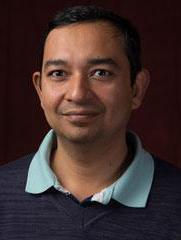
Suman Banerjee is an Associate Professor in the Department of Computer Sciences at the University of Wisconsin-Madison, with an affiliate appointment in the Department of Electrical and Computer Engineering. He leads the WIsconsin WIreless and NetworkinG Systems (WiNGS) Laboratory, focusing on wireless/mobile networking, distributed systems, and cyber-physical systems. His research includes innovative projects like Airshark (non-WiFi interference detection), WiRover (vehicular connectivity), and Wiscape (wide-area cellular monitoring). He has received the ACM SIGMOBILE Rockstar Award (2013) and NSF Career Award (2008). Education: PhD in Computer Science from University of Maryland (2003). Teaching includes courses on mobile systems, wireless networking, and computer networks. Professional service includes chair roles at ACM MobiCom, IEEE SECON, and ACM SIGMOBILE leadership. Key contributions span spectrum sensing, vehicular networks, and network measurement techniques.
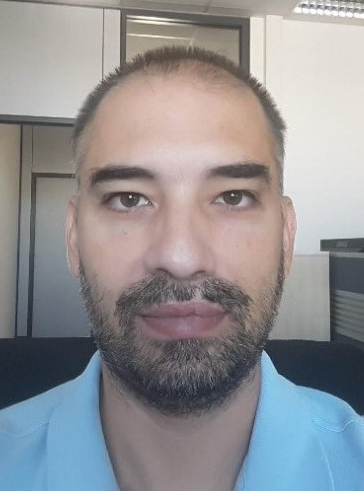
Dr. Marco Eilers is a **Lecturer** in the **Department of Computer Science** at **ETH Zürich**, Switzerland. His research focuses on formal verification, programming languages, and cybersecurity, with particular expertise in smart contract verification for blockchain systems like Ethereum and Libra’s Move language. He has contributed to tools such as Viper’s symbolic execution backend and frameworks for modular program verification. His work emphasizes practical applications of formal methods to ensure security and correctness in concurrent, distributed, and GPU-based systems. Key research areas include static analysis for information flow security, product program models, and SMT-based type inference for languages like Python. He is affiliated with the Professur für Software Technology at ETH Zürich’s CAB H 89 laboratory. Publications highlight advancements in verifying real-world systems such as internet routers, GPU kernels, and blockchain smart contracts. Though no awards are explicitly listed, his contributions reflect significant impact in formal verification and programming language research. Eilers’ advising and grants are not detailed here, but his involvement in cutting-edge projects like Igloo and modular product programs indicates active collaboration in distributed system verification and secure software development.
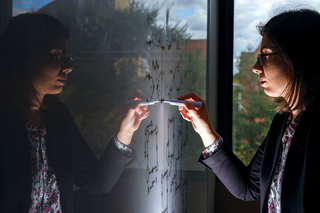
Shruti Puri is an Assistant Professor of Applied Physics at Yale University, affiliated with the Yale Quantum Institute (YQI). Her research focuses on quantum information processing, quantum computing, and quantum optics, with an emphasis on reducing resource overheads in quantum error correction through circuit engineering and noise-tailored codes. She leads the Puri Group, collaborating with experimental groups to advance quantum technologies. Education: Ph.D. in Applied Physics from Stanford University (2014), followed by postdoctoral research at the University of Sherbrooke (2014–2017) and Yale University (2017–2020). Awards include the NSF CAREER Award (2022). Research interests span quantum error correction for biased noise, bosonic qubits, and fault-tolerant architectures. Her work addresses challenges in stabilizing cat qubits, designing scalable QRAM, and optimizing decoders for quantum LDPC codes. Key projects include 'Bias-preserving gates with stabilized cat qubits' and 'Scalable fault-tolerant quantum error correction with bosonic qubits.' Recent contributions include studies on mid-circuit erasure conversion, dual-rail cavity qubits, and high-threshold codes for neutral-atom qubits. Collaborations involve experimental teams to bridge theory and practice in quantum computing. Advises graduate students working on topics like topological codes, optomechanical control, and quantum annealing. Leads the development of novel quantum protocols and devices, such as hypergraph decoders and phononic memory systems.
James Propp, Ph.D., is a Professor in the Department of Mathematics & Statistics at the University of Massachusetts Lowell (Kennedy College of Sciences). He specializes in Combinatorics, Probability, and Dynamical Systems. His work bridges theoretical mathematics with applications in discrete structures and algorithmic processes. Propp has been actively mentoring undergraduates in research since joining UMass Lowell in 2006. Education: Ph.D., University of California at Berkeley Research Interests: Propp’s research focuses on tilings of geometric structures (e.g., Aztec diamonds, benzels), combinatorial dynamics, and homomesy phenomena. He explores probabilistic models in discrete systems and develops bijections for enumeration problems. His work often combines algebraic, geometric, and computational approaches. Recent Research Trends: Propp’s recent publications highlight advancements in tiling theory, toggle dynamics, and spectral analysis of combinatorial systems. His work on homomesy elucidates invariant averages under dynamical actions, while his studies on chip-firing games and rotor-routers model probabilistic phenomena deterministically. Awards: No awards explicitly mentioned in the text. Advising & Grants: While no specific grants are listed, Propp is noted for encouraging undergraduate research participation in mathematics. His advising contributions are central to his role as a mentor. Labs/Teams: No specific labs or collaborative teams are detailed in the provided information.
Suman Banerjee is the David J. DeWitt Professor in the Department of Computer Sciences at the University of Wisconsin-Madison. He leads the WIsconsin WIreless and NetworkinG Systems (WiNGS) Laboratory, focusing on wireless and mobile networking, distributed systems, and network security. Education: Ph.D. (Computer Science, 2003) from University of Maryland; M.S. (1999) and B.Tech. (1996) from University of Maryland and IIT Kanpur, respectively. Research Interests: Mobile and wireless networking systems, overlay systems, traffic classification, and network security. His WiNGS lab explores topics like interference detection (Airshark), enterprise WLAN optimization (FLUID), and vehicular networking (WiRover). Awards: ACM SIGMOBILE Rockstar Award (2013), NSF Career Award (2008), ACM MobiCom Best Paper (2009), and Wisconsin Governor’s Business Plan Competition Grand Prize (2011). Grants & Activities: Over $4M in NSF and industry grants since 2005. Served as Program Chair for ACM MobiCom, IEEE SECON, and ACM CellNet. Editor-in-Chief of Mobile Computing and Communications Review. Labs & Teams: WiNGS Lab develops systems like WiRover for vehicular connectivity and Airshark for non-WiFi interference detection. Collaborates with industry partners like Cisco, Microsoft, and Intel.
Dr. Arnab Kumar Biswas is a Lecturer at the School of Electronics, Electrical Engineering and Computer Science, Queen's University Belfast. He is affiliated with the Centre for Secure Information Technologies (CSIT), an academic center of excellence for cyber security research (ACE-CSR) recognized by the UK National Cyber Security Centre (NCSC). His research focuses on securing embedded systems through hardware-software co-design, network security, and quantum/post-quantum cryptography, with applications in remote healthcare, satellite communication, and IoT. He has secured significant funding and equipment including an Impact Acceleration Account (IAA) grant for Space 2.0 research, a CHERI-enabled Morello board from ARM, and Intel's DE10Pro Stratix 10 GX/SX accelerator. He also received 12 PYNQ Z2 boards from AMD for teaching and projects. His work emphasizes secure-by-design concepts and hardware acceleration for cryptographic solutions. Biswas is actively involved in PhD supervision, offering projects in decentralized trust zones for remote health monitoring and zero-trust power management for on-chip systems. His research contributions span network-on-chip security, IP protection via timing channels, and countermeasures for wireless NoC attacks. He has been recognized with awards such as the Fredrik and Catherine Eaton Fellowship (2024) and the Richard Newton Young Fellow award (2014). Research interests: Hardware-software co-design, network security, quantum cryptography acceleration, embedded system security, IoT for healthcare Equipment: Morello board (ARM), Alpha-Data ADK-VA600, Intel DE10Pro, PYNQ Z2 boards Collaborations: CSIT, ARM, Intel, AMD
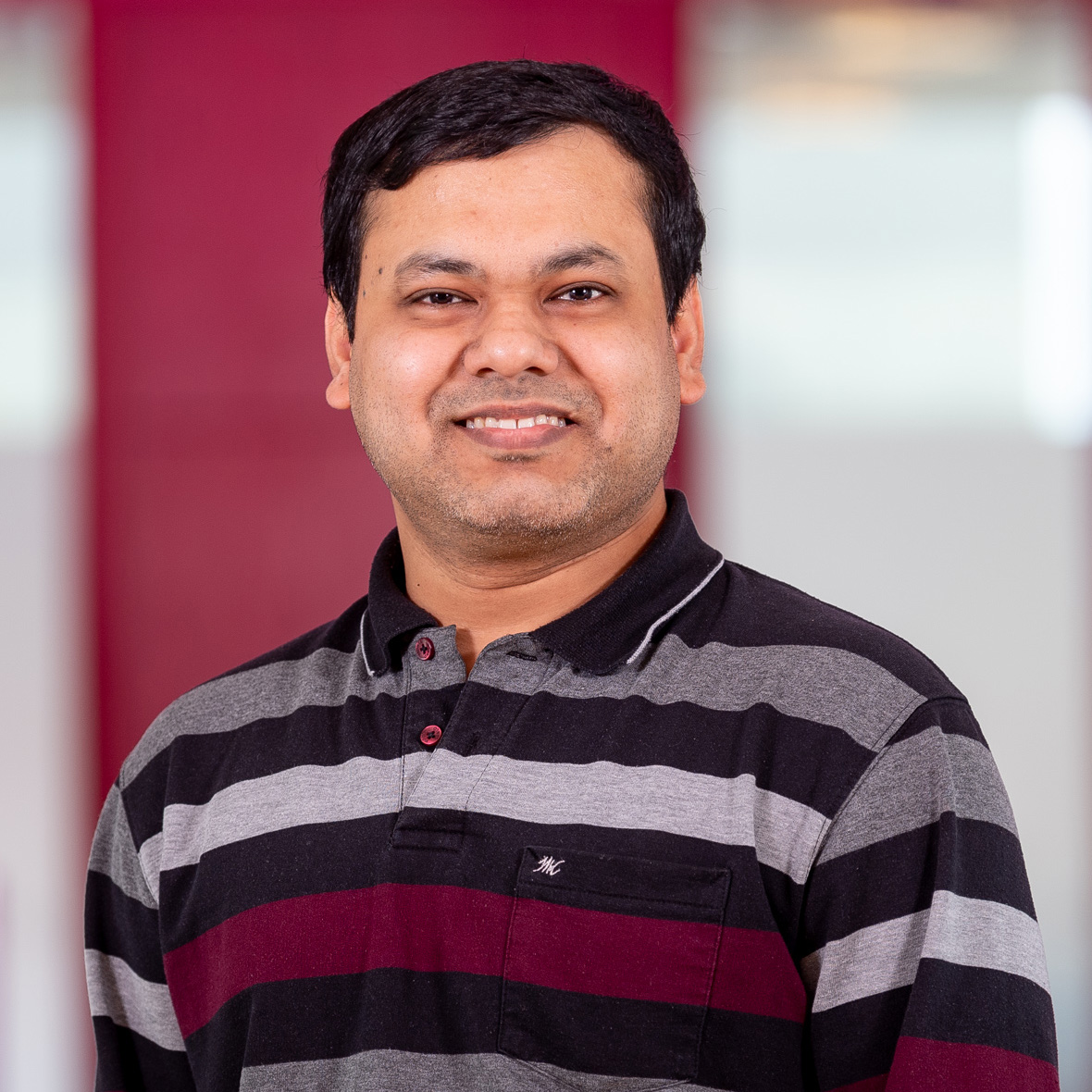
Ryan Doenges is a Distinguished Postdoctoral Fellow at Northeastern University in Boston, working with Amal Ahmed. He holds a PhD from Cornell University under Nate Foster and completed undergraduate studies with Zach Tatlock. His educational background includes: PhD in Computer Science, Cornell University Bachelor's degree, institution unspecified Doenges' research focuses on enhancing programming safety through type systems and verification, specializing in program logics for effects/resources like concurrency and memory. His doctoral work established formal semantics and verification frameworks for the P4 network programming language, ensuring termination and correctness. His publications (2017-2025) show consistent advancement from distributed systems verification to network programming (P4) and foundational program logics, culminating in categorical semantics for separation logic. Key themes include certified equivalence, stateful packet processing, and fibrational weakest preconditions. No scientific awards are documented in available sources. He formally supervised Tia Vu's Master's thesis (Cornell MS, now MIT PhD) and informally mentored eight students including Rudy Peterson (ETH Zürich PhD) and Amanda Xu (UW Madison PhD). No grant details are provided. Doenges collaborates with Amal Ahmed's group at Northeastern and previously worked in Nate Foster's Cornell research team focused on network programming languages.
Dr. Kihong Park is an Associate Professor in the Department of Computer Science at Purdue University, affiliated with CERIAS and the Santa Fe Institute. His research focuses on high-speed networks, network security, distributed systems, and stochastic cellular automata. He joined Purdue in 1996 after earning his PhD from Boston University in 1996, where his thesis explored cellular automata dynamics under noise. He has authored influential works on self-similar network traffic modeling, noncooperative game theory in QoS allocation, and proactive defenses against DDoS attacks. Education: BA in Management (Seoul National University, 1988), MS in Computer Science (University of South Carolina, 1990), PhD in Computer Science (Boston University, 1996). Research interests include traffic control in IP networks, scalable network security, robust distributed systems, and cellular automata theory. His work bridges networking, security, and theoretical computer science, with contributions to both foundational understanding and practical implementations like Cisco router scheduling algorithms. He has received the NSF CAREER Award and served on editorial boards of Computer Networks and IEEE Communications Letters. Key publications include seminal work on self-similar traffic origins (SIGCOMM '96), route-based DDoS defense mechanisms (SIGCOMM '01), and noncooperative game theory in network resource allocation (JCSS 2004). His lab, the Network Systems Lab, investigates complex system behaviors in networks and distributed computing.
Christodoulopoulos Konstantinos is an Assistant Professor at the Department of Informatics and Telecommunications, National and Kapodistrian University of Athens. His research focuses on optical communications, networking, and machine learning applications in network optimization. He has contributed to advancements in resource allocation, quality of transmission (QoT), and cybersecurity through quantum key distribution (QKD). His work includes field demonstrations of encrypted networks, techno-economic studies in metro-core systems, and scalable industrial network solutions. Education details are not explicitly provided in the text, but his academic role suggests a Ph.D. in a related field. Key research interests span optical network design, SDN-enabled architectures, and hybrid optical-electrical data centers (e.g., NEPHELE projects). He has published extensively on topics like slotted optical datacenter networks, machine learning for QoT estimation, and marginless optical network operations. Notable contributions include experimental demonstrations of disaggregated white-box networks, real-time SDN control frameworks, and collaborative projects with institutions like the University of Patras. His work emphasizes practical implementations, such as industrial-grade PONs and fault localization in optical networks.
Jeremy Shellhorn is a Professor of Visual Communication Design at the University of Kansas, leading the Design Outside Studio—a course-based research initiative focusing on outdoor experiential learning and environmental communication. He holds a BFA from the University of Kansas (1999) and an MGD from North Carolina State University (2003). His work bridges design practice, education, and environmental stewardship, emphasizing public space engagement and heritage preservation. Key projects include the National Park Typeface (2020), digitizing iconic park signage; the Argentine Food Access Initiative (2018), addressing food equity through participatory design; and collaborations with national parks like Rocky Mountain and Grand Teton. He has authored tenkara–the book (2014), a seminal guide to Japanese fly fishing, integrating interactive QR codes and cultural narratives. Honored with the Golden Apple Award (2012) and Byron Shutz Teaching Award (2013), Shellhorn’s research focuses on design strategies for fostering public understanding of natural and cultural heritage. His studio partners with organizations like the National Park Service, Leave No Trace, and Tenkara USA to create impactful communication solutions.
Edoardo S. Biagioni is an Associate Professor at the University of Hawaii in the Department of Information and Computer Sciences , where he has been since 1997. His primary research focuses on decentralized networking , wireless security , and systems programming , with long-term projects including the Allnet project (since 2011) and earlier PODS micro-sensor networks (2000-2003). Current research since 2024 includes formal verification of file systems and correctness properties in systems programming Technical interests span protocol decomposition , language-based OS design , and congestion control Teaching emphasizes Java fluency , data structures , and algorithm complexity in courses like ICS 211 Prior roles included directing the Advanced Network Computing Laboratory (1997-2005) and contributions to the Fedora Core project. Students under his supervision have worked on projects ranging from network measurement to ATM transport protocols . His work bridges theoretical concerns like IP fragmentation theory with practical implementations in SML database systems and IPv6 transitions .
Vassilis D. Papaefstathiou is a researcher in computer architecture and high-performance computing, affiliated with the Department of Computer Science at the University of Crete and the Institute of Computer Science at FORTH-ICS. His work focuses on energy-efficient manycore systems, network-on-chip design, FPGA prototyping, and RDMA-based communication. His educational background includes a Ph.D. (2013), M.Sc. (2005), and B.Sc. (2002), all from the University of Crete. His research spans advanced topics in computer systems, including hybrid memory management, cache optimization, and scalable interconnects. His research interests include Computer Architecture , Network-on-Chip (NoC) , Reconfigurable Computing , Energy-Efficient Computing , RDMA , and High-Performance Computing . He has made significant contributions to FPGA-based prototyping of manycore systems and low-latency interconnects. His recent publications demonstrate a strong trend in optimizing on-chip networks, memory hierarchies, and communication mechanisms for performance and energy efficiency. Key areas include dual data-rate NoCs, hybrid memory systems with intelligent data migration, and RDMA-enhanced architectures. His work often integrates hardware-software co-design principles for scalable and efficient computing. HiPEAC Paper Award (2012) HiPEAC Paper Award (2016) HiPEAC Paper Award (2017) HiPEAC Paper Award (2020) Best Paper Award Finalist at IEEE/ACM NOCS 2018 He has advised several researchers and students, including Antonis Psistakis, Evangelos Vasilakis, and Ahsen Ejaz, who have co-authored significant publications with him. His collaborative projects include SARC, ExaNeSt, and ECOSCALE, often funded by EU initiatives or research councils. These projects focus on next-generation HPC systems, reconfigurable computing, and scalable architectures. He is a key contributor to the Formic FPGA prototyping platform and has worked extensively on RDMA-capable NICs, cache-integrated network interfaces, and virtualized communication systems. His work is deeply embedded in international research consortia and high-impact venues.
Michael Hatridge is an Associate Professor of Applied Physics at Yale University, leading the Hatlab. His research focuses on quantum computing and superconducting circuits, emphasizing scalable architectures and quantum control systems. He earned his B.S. from Texas A&M University and his Ph.D. from the University of California, Berkeley. His work explores modular quantum computer design, qubit control techniques, and low-noise measurement systems. Notable contributions include the development of microwave quantum state routers and architectures for multinode superconducting quantum computers. Research interests also span Josephson junction-based devices, quantum amplification, and cryogenic electronics. Publications highlight advancements in quantum module coupling, sub-harmonic qubit control, and noise reduction strategies. The Hatlab collaborates on interdisciplinary projects involving quantum engineering and materials science, aiming to bridge theoretical models with practical implementations in scalable quantum technologies.
Balajee Vamanan is an Associate Professor in the Department of Computer Science at the University of Illinois at Chicago (UIC), where he has held a faculty position since October 2015. His office is located in CDRLC 4458 and SEO 1310, with contact details including email bvamanan@uic.edu and phone (312) 996-9442. He teaches core systems and networking courses such as CS 361 (Systems Programming), CS 450 (Introduction to Networking), and CS 594 (Advanced Computer Networking), emphasizing hands-on programming and critical problem-solving in modern networked environments. Education: Bachelor's degree from Birla Institute of Science & Technology (BITS), Pilani, India. Ph.D. from Purdue University (August 2015). Research Interests: His work centers on computer networks , with primary focus on datacenters , low-latency networks , software-defined networking (SDN) , router architecture , and cellular networks . Secondary interests include computer systems research, memory system architecture, and in-memory caches. He bridges theoretical networking concepts with real-world implementation, leveraging industry experience from NVIDIA and Google to address performance bottlenecks in network hardware and protocols. Publication Trends: Recent work (2020-2025) demonstrates concentrated innovation in datacenter transport protocols (e.g., MTP for in-network computing), programmable switch optimizations (TCAM utilization, memory management), and congestion control for RDMA environments. His research increasingly intersects distributed machine learning training with networking challenges, while maintaining strong contributions to cellular background traffic management and topology design for incast workloads. Scientific Awards: No scientific awards, fellowships, or medals are documented in the provided materials. Advising and Grants: He advises multiple Ph.D. students (Seyri, Vardekar, Saxena) and undergraduate researchers. Past students have secured roles at Google, Cisco, Microsoft, and VMware. His lab receives sustained funding from the National Science Foundation (NSF) through grants including BIGDATA: RDMA-Based Datacenter Networks for Big Data Applications, FMitF: Injecting Formal Methods into Internet Standardization, and CNS Core: Network-wide Policy Enforcement in Programmable Networks. Labs and Collaborations: Leads a research group within UIC's BITS Lab, a cross-disciplinary hub for networking, systems, and security. Maintains active industry partnerships with AT&T Research, Microsoft, and NVIDIA, alongside academic collaborations with UT Austin, University of Utah, Purdue University, and Indian Institute of Science's Parimal Parag group.
Erik Jan Marinissen serves as Scientific Director at imec (Leuven, Belgium) and holds a Visiting Researcher position at Eindhoven University of Technology's Department of Electronic Systems. With over 270 publications and 18 patent families, his career spans NXP Semiconductors, Philips Research, and imec since 1992. He holds MSc and PDEng degrees from Eindhoven University of Technology (1990, 1992). His research focuses on semiconductor test engineering for advanced technologies, particularly 3D-stacked ICs , chiplet-based packages , and sub-5nm CMOS nodes . Key contributions include diagnostic frameworks for Network-on-Chips, test standards for TSV-based integration, and cell-aware testing methodologies. His work bridges industrial applications (NXP, Philips) and academic research through imec's ecosystem. Marinissen's publication trends show increasing focus on heterogeneous integration (2018-2024), with 60% of recent articles addressing chiplet interconnect testing and 3D IC validation. His 2023-2024 work pioneers device-aware testing for quantum components and 3nm technology nodes. Most Significant Paper Awards at IEEE ITC (2008, 2010) Best Paper Awards at IWLPC (2018), LATS (2019), DATE (2020) IEEE Standards Association Emerging Technology Award (2017) HiPEAC Tech Transfer Award (2015) IEEE Fellow (2011) As founder of the 3D-TEST workshop series and IEEE Std P1838 Working Group, he has secured industry-wide adoption of test standards. His supervision of 43 MSc/PhD students demonstrates strong academic mentorship, while his editorial roles at IEEE Design & Test and Springer's Journal of Electronic Testing shape research dissemination. Current work at imec focuses on test solutions for STT-MRAMs and silicon photonics.