Dr. Aurélien Bailly is affiliated with the University of Zurich in the Department of Plant and Microbial Biology . His research focuses on volatile organic compounds (VOCs) as signaling molecules in plant-microbe communication, particularly in mediating growth and immune responses. Research Interests Molecular mechanisms of VOC-mediated cross-kingdom signaling Plant perception of bacterial volatiles Trade-offs between growth and immunity via phytohormones Functional characterization of microbial VOC bouquets Publication Trends highlight work on Arabidopsis thaliana and rhizobacteria, with emphasis on auxin transport , systemic resistance , and biocontrol strategies . His articles span disciplines including microbial ecology , plant physiology , and chemical biology .
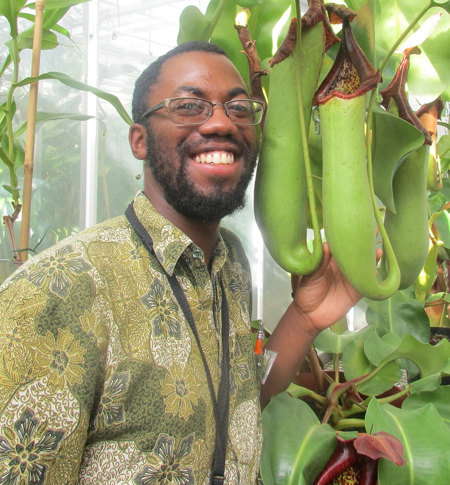
Kadeem Jamal Gilbert is an Assistant Professor at Michigan State University (MSU) affiliated with multiple programs and institutes: Plant Biology, Kellogg Biological Station, Molecular Plant Sciences Program, Plant Resilience Institute, and Ecology, Evolution & Behavior Program. His research focuses on plant-animal/microbe interactions, symbiosis, physiological regulation of leaf microenvironments, and carnivorous plants. Education: Ph.D. from Harvard University Dr. Gilbert's work integrates ecological and physiological approaches to study plant interactions with insects, microbes, and environmental gradients. His lab employs transcriptomics, chemical ecology, and community ecology frameworks to investigate carnivorous plant adaptations, phylloplane regulation, and global change impacts on species interactions. Recent publications highlight his research trajectory across plant physiology, microbial ecology, and evolutionary biology. These include studies on anthocyanin-mediated plant-insect interactions, fluid regulation in Nepenthes pitcher plants, and landscape-scale transcriptomic responses to environmental stressors. His work reveals fundamental insights about ecological filters in plant microhabitats and evolutionary tradeoffs in carnivorous species. Current research themes include plant volatile signaling in herbivore specialization, pH-mediated microbial community assembly, and ecological transcriptomics across environmental gradients. The Gilbert Lab maintains active outreach and press engagement while maintaining field sites at the Kellogg Biological Station.
Dagmar Woebken is Associate Professor and Head of the Department for Microbiology and Ecosystem Science at the University of Vienna, where she leads the Division of Microbial Ecology. Her research investigates microbial survival strategies in challenging soil habitats, particularly focusing on adaptation mechanisms to environmental stressors. Research encompasses three primary themes: Dormancy and reactivation dynamics in desert soil microbial communities Assembly and function of plant-associated microbiomes Ecological success factors of Acidobacteria in terrestrial environments Her group employs molecular techniques including metagenomics, stable isotope probing, and single-cell approaches (NanoSIMS, Raman microspectroscopy) combined with cultivation-based methods. Publications demonstrate expertise in: Microbial adaptation to extreme environments Plant-microbe-nutrient interactions Genomic basis of bacterial ecological strategies Recent work increasingly utilizes advanced imaging and isotopic tracing to investigate microbial processes at cellular scales. Dr. Woebken pioneered the NifMAP bioinformatic pipeline for analyzing nitrogen-fixing communities and developed methods combining Gold-FISH with NanoSIMS for targeted analysis of plant-associated bacteria. She leads research projects on microbial symbioses funded by the Austrian Science Fund (FWF). She directs a research group investigating microbial ecology across ecosystems from deserts to forests. Current projects include studies of ant-plant-microbe associations and microbe-mediated nitrogen cycling in grasslands. The group maintains collaborations with international institutions and participates in public outreach through science communication platforms.
James B Nardi serves as a Researcher in the Department of Entomology at the University of Illinois Urbana-Champaign, with 64 scholarly outputs including a 2023 Princeton University Press book. His work focuses on insect model systems like Manduca sexta and hemipterans to investigate developmental biology, immunology, and host-microbe symbiosis through cellular and morphological analyses. Dr. Nardi's research centers on Insect Immunology, Developmental Biology, and Entomology, with key investigations into hemocyte function, epithelial monolayer dynamics during metamorphosis, and microbial interfaces in insect midguts. His fingerprint analysis highlights Manduca Sexta (100%), Hemocytes (61%), and Epithelial Cells (53%) as core research pillars, utilizing advanced techniques to study tissue remodeling and immune responses. Recent publications (2018-2023) reveal concentrated exploration of insect midgut physiology and developmental transitions, particularly protein secretion during molting, luminal membrane structures in lace bugs, and abdominal epithelial remodeling in Manduca. These studies bridge Cell Biology, Microbial Ecology, and Insect Physiology, emphasizing the interplay between developmental processes and microbial associations. Scientific Awards: No awards, fellowships, or medals were documented in the source materials. Advising and grants: Information regarding student mentorship, postdoctoral supervision, or research funding sources was not provided in the available data. Laboratory infrastructure: While collaborations with Miller, Bee, and Wallace are evident, specific research teams, laboratory facilities, or institutional centers were not described.
Paul Schulze-Lefert is Director of the Department of Plant Microbe Interactions at the Max Planck Institute for Plant Breeding Research (MPIPZ) in Cologne, Germany, and Honorary Professor at the University of Cologne. His research bridges genetics, molecular biology, and biochemistry to study plant-microbe interactions, with focus areas including: Structure/function of Arabidopsis root microbiota (ERC Advanced Grant ROOTMICROBIOTA) Intracellular immune sensors and non-self perception mechanisms Evolutionary conservation of NLR-triggered immunity His work explores how plants distinguish beneficial microbes from pathogens, and how root microbiota influence nutrient uptake and disease resistance. Research utilizes Arabidopsis, barley, and Lotus japonicus models to decode immune receptor functions and microbial community assembly. Major scientific honors include election to the National Academy of Sciences (USA), German National Academy of Sciences (Leopoldina), and American Academy of Microbiology. He co-founded AgBiome to translate microbiome research into crop protection solutions. Dr. Schulze-Lefert leads an active research group with 6+ PhD students/postdocs investigating: Bacterial root endophytes NLR receptor biochemistry Microbiota-mediated nutrient cycling Cross-kingdom immune mechanisms Current projects include ERC-funded work on root microbiota evolutionary trajectories and structural studies of immune receptors.
Professor Jarno Vanhatalo is a Professor of Statistics at the University of Helsinki, serving as vice director of the Research Center for Ecological Change. He is affiliated with both the Faculty of Biological and Environmental Sciences and the Faculty of Science, where he leads the Environmental and Ecological Statistics Group. His work bridges advanced statistical methodology with pressing ecological and environmental challenges. His research focuses on the development and application of statistical models for ecological and environmental data. Key areas include: Bayesian statistics and hierarchical modeling Gaussian processes and spatial statistics Species distribution modeling Ecological risk assessment Climate change impact analysis Biodiversity monitoring and conservation Professor Vanhatalo's publication record shows a consistent focus on integrating sophisticated statistical methods with ecological applications. His recent work demonstrates increasing emphasis on climate change impacts on biodiversity, spatially explicit modeling of ecological processes, and the development of Bayesian methods for uncertainty quantification in environmental predictions. His research spans terrestrial and marine ecosystems, with particular attention to Nordic and Baltic regions. Among his notable contributions are advancements in: Joint species distribution modeling Bayesian calibration of environmental models Spatiotemporal survey design Model-based variance partitioning in ecological studies Statistical approaches to Arctic risk management Professor Vanhatalo has received significant research funding, including an ERC grant for "Predective Understanding of the effects" (2024-2029) and leadership roles in multiple Academy of Finland and EU-funded projects focused on biodiversity, ecological change, and risk management in polar waters. He actively contributes to the academic community through: Supervising doctoral students in Wildlife Biology and Mathematics and Statistics programs Serving on editorial boards for journals including Conservation Biology and Ecology Letters Peer reviewing for numerous statistical and ecological journals Organizing workshops on statistical methods in ecology
Benton Taylor is an Assistant Professor of Organismic and Evolutionary Biology and Faculty Fellow at the Arnold Arboretum, Harvard University. His research focuses on terrestrial ecosystem responses to global change drivers such as rising CO2, nutrient pollution, and extreme weather. He leads the Taylor Lab, investigating symbiotic nitrogen fixation, below-ground tree responses, and soil carbon dynamics across tropical to boreal ecosystems. His work integrates field experiments, observational studies, and global data analyses to understand feedbacks between ecosystems and climate change. Key research themes include nitrogen-fixing plant symbiosis, CO2 effects on root systems, and soil carbon sequestration mechanisms. Taylor collaborates internationally, with projects ranging from Costa Rican rainforests to Alaskan tundra. His lab emphasizes interdisciplinary approaches to address questions at molecular to ecosystem scales. Recent publications highlight novel insights into root exudation under elevated CO2, tropical nitrogen cycling gaps, and microbial mediation of tree responses. The lab actively mentors graduate students (e.g., Calvin Heslop, Carina Berlingeri) and postdocs (e.g., Lindsay McCulloch) exploring nutrient-cycling frontiers. Taylor’s team also prioritizes environmental justice through science communication and inclusive research practices, as stated in their lab’s diversity value statement.
Dr. Maria Harrison is the William H. Crocker Distinguished Professor at Cornell University's School of Integrative Plant Science and Adjunct Professor in Plant Pathology. Her research investigates arbuscular mycorrhizal symbioses, focusing on phosphate transfer mechanisms and plant defense biochemistry. Using model legumes and poplar trees, her lab studies fungal colonization, symbiotic gene regulation, and metabolic pathways for bioactive compounds. She was elected to the Royal Society in 2024, recognizing her contributions to plant-microbe interactions. Her publications reveal insights into lipid provisioning, kinase signaling in symbiosis, and development of plant biosensors. Research integrates molecular genetics, cell biology, and genomics to address nutrient acquisition challenges in agriculture.
Professor Feike Dijkstra is a Professor in Terrestrial Biogeochemistry at the University of Sydney's School of Life and Environmental Sciences. He joined the university in 2010 and holds a prestigious ARC Future Fellowship (2011-2015). His affiliations include the Sydney Institute of Agriculture and the Centre for Carbon, Water and Food. Feike Dijkstra obtained his PhD in 2001 and MSc in 1996 from Wageningen University in the Netherlands. Prior to his current position, he worked at the US Department of Agriculture (2007-2010), and as a postdoc at the University of California, Santa Cruz (2004-2006), and the University of Minnesota (2001-2004). His research focuses on understanding carbon, nitrogen, and phosphorus dynamics in grasslands, forests, and agroecosystems. Key areas include: Plant-microbial interactions and their impact on nutrient cycling Effects of global climate change on ecosystems Soil organic matter decomposition and stabilization Role of root exudates and rhizosphere processes Carbon sequestration strategies and soil health Recent publications highlight advancements in understanding soil carbon dynamics under acidification, nitrogen retention mechanisms, and the role of microbial activity. Research also explores the effects of grazing and environmental changes on greenhouse gas emissions and nutrient cycling in diverse ecosystems. Awards: ARC Future Fellow (2011-2015) He advises students on projects such as drought impacts on root plasticity, iron oxides in soil organic matter preservation, and phosphorus availability in intercropping systems. His work contributes to interdisciplinary initiatives in sustainable land management and climate resilience through affiliations with the Centre for Carbon, Water and Food.
Brian Pickles is an active academic researcher affiliated with the University of Reading, School of Biological Sciences, where he contributes to research in ecology, mycorrhizal symbioses, and environmental conservation. His work spans forest ecology, urban biodiversity, paleontology, and forensic science, reflecting a highly interdisciplinary approach to ecological challenges. University: University of Reading School: School of Biological Sciences Department: Department of Ecology and Evolutionary Biology Academic Rank: Senior Lecturer His research focuses on mycorrhizal fungi and their role in plant-soil interactions, forest resilience under climate change, and biodiversity conservation. He investigates how ectomycorrhizal networks influence tree communities, how urban trees affect microclimates, and how decomposition processes alter soil ecosystems. His work integrates field experiments, molecular ecology, and remote sensing techniques. Recent publications show a strong trend in applying ecological theory to practical conservation, including reptile habitat management, invasive species policy, and urban green space planning. His studies often employ robust experimental designs such as before-after control-impact (BACI) and leverage large collaborative networks. Brian Pickles has co-authored numerous high-impact papers in journals like New Phytologist , Proceedings of the Royal Society B , and Frontiers in Forests and Global Change . His work on ectomycorrhizal networks, forest carbon dynamics, and urban tree radiative performance demonstrates both theoretical depth and applied relevance. He has also contributed book chapters on mycorrhizal mediation of soil processes and spatial ecology of fungal communities. Brian Pickles collaborates extensively with researchers across the UK, Canada, and globally. Notable collaborators include Suzanne Simard, Melanie D. Hart, Ian C. Anderson, and Miranda M. Hart. These collaborations span topics from fungal community assembly to inter-plant communication via mycorrhizal networks. No formal scientific awards or prizes are mentioned in the provided text. However, his consistent publication record in top-tier journals suggests recognition within the ecological research community. Brian Pickles contributes to research grants and collaborative projects focused on forest resilience, urban ecology, and soil biodiversity, though specific grant titles or funding bodies are not listed. His leadership in experimental design and data interpretation indicates an active role in securing and managing research funding. He is involved in several research teams and labs, particularly those focused on mycorrhizal ecology and forest dynamics. His work with the Simard Lab (University of British Columbia) and collaborations with UK-based environmental monitoring groups highlight his integration into major ecological research networks. He also contributes to urban ecology initiatives using remote sensing and ground-based validation.
Dr. Taryn L Bauerle is a Professor and Director of Graduate Studies at the Department of Horticulture , School of Integrative Plant Science , Cornell University . With a research focus on woody root physiological ecology , her work examines root responses to water stress , hydraulic redistribution , and root herbivory in temperate forest systems. Education : PhD in Plant Science (Pennsylvania State University, 2007), MS in Botany (University of Washington, 2001), BS in Plant Science (Humboldt State University, 1998) Her research integrates whole plant water status with root physiological characteristics , addressing both fundamental ecological questions and industry-relevant stress management in horticultural crops. Key projects investigate localized water stress effects , root population dynamics , and rhizosphere metabolomics through NSF-funded initiatives. Laboratory at Cornell develops soil-swimming robots for root-soil interaction studies under a $2 million NSF grant. She teaches PLSCI 1115: The Nature of Plants , PLSCI 3050: Arboriculture , and PLSCI 4900: Plant Sciences Experiential Learning . Contact : 136 Plant Science Building , Ithaca, NY 14853 , (607) 254-4867 , tlb33@cornell.edu
Christopher Blackwood is a Professor in the Department of Plant Biology at Michigan State University, with additional appointments in Plant Soil and Microbial Sciences and the Ecology, Evolution & Behavior Program. Based in the Plant Biology Lab (S124), his research examines soil-plant-microbe interactions and their critical roles in ecosystem processes and soil carbon dynamics. Education: Ph.D. from Michigan State University His research spans community ecology of plants and microorganisms, plant-fungal interactions, root traits, and soil biogeochemistry. Current projects investigate coexistence mechanisms of closely related plant species, cascading effects of tree root traits on pathogens and soil carbon, forest restoration dynamics, and urban green roof performance. His work integrates field studies with molecular approaches to understand belowground ecological processes. Analysis of recent publications (2021-2025) reveals consistent focus on plant-soil feedbacks, fungal community ecology, and soil carbon dynamics. Key themes include mycorrhizal influences on plant-fungal coevolution, root trait evolution across plant lineages, and applications to sustainable land management. His work bridges fundamental ecological theory with practical restoration ecology. Dr. Blackwood leads an active research laboratory funded by competitive grants, mentoring graduate students in plant and soil ecology. His team investigates soil biota across diverse ecosystems including temperate forests, agricultural landscapes, and urban green infrastructure. His laboratory conducts research on soil organism ecology, plant-microbe interactions, and ecosystem functioning, with ongoing projects in forest restoration, green roof optimization, and soil carbon dynamics across multiple spatial scales.
Dr. Yunying Fang is a Senior Lecturer at Griffith University's School of Environment and Science, affiliated with the Australian Rivers Institute. She holds a PhD from the University of Sydney and previously worked at the NSW Department of Primary Industries (2013–2023). Her research focuses on Soil Biogeochemistry, Soil Carbon/Nutrient Cycling, and Greenhouse Gas Emissions, with an emphasis on Nature-Based Solutions to Climate Change and Soil Health Resilience. Education: PhD in Soil Science, University of Sydney Research Interests: Soil Carbon Sequestration Mechanisms Impact of Land Management and Climate Change on Ecosystem Processes Stable Isotope Methodologies for Soil Amendment Studies Funded Projects (Selected): Developing Standard Protocols for Microplastics in Soils (Solving Plastic Waste CRC, 2025–2028) Climate Change Effects on Phosphorus Cycling (Griffith University Internal Grant, 2023) Innovative Microbial Carrier Products Evaluation (High Performance Soils CRC, 2023–2026) Teaching & Supervision: Associate Supervisor for doctoral projects on Land Management in Rubber-Based Systems and Organic Amendments in Soil Carbon Sequestration Affiliations: Member of Australian Rivers Institute Research Entity Griffith Sciences Group
Tarah Sullivan is an Associate Professor and Soil Microbiologist in the Department of Crop and Soil Sciences at Washington State University (WSU), affiliated with the College of Agricultural, Human, and Natural Resource Sciences (CAHNRS). She also holds roles as a Faculty Researcher in Molecular Plant Sciences and an Affiliate with the Center for Native American Research and Collaborations. Her work bridges Western science with Indigenous knowledge to address soil health, microbial ecology, and agricultural sustainability in the Pacific Northwest. Education: Ph.D. in Soil Science (Cornell University, 2010), M.S. in Soil Science (Colorado State University, 2004), B.S. in Restoration Ecology (Colorado State University, 2002). Research Interests: Sullivan investigates soil microbiome functions, including microbial interactions with plant health, metal bioavailability, and soil acidification. Her projects emphasize agroecology, Indigenous partnerships, and sustainable practices for smallholder farmers. Key areas include rhizosphere microbiome dynamics, microbial contributions to soil health, and the use of biochar and cover crops in dryland systems. Grants & Awards: Recipient of the 2025 Francis E. Clark Distinguished Lectureship in Soil Biology. Her work has been funded by NSF-RaMP and other initiatives focused on bridging DEI in science and traditional ecological knowledge. Teaching: Courses include SOIL_SCI 541 (Soil-Plant-Microbe Interactions) and SOIL_SCI 531L (Soil Microbiology Lab), focusing on microbial ecology, bioremediation, and nutrient cycling. Labs & Collaborations: Sullivan’s lab uses molecular techniques and cultivation-based methods to study microbial communities. Partnerships include tribal nations and organizations addressing environmental justice in agriculture and resource management.
Lindsey Slaughter is an Associate Professor in the Department of Plant and Soil Science at Texas Tech University's Davis College. Her work focuses on soil microbial ecology and biochemistry, with a specialization in soil health and ecosystem function in semi-arid systems. Dr. Slaughter earned her Ph.D. in Soil Science from the University of Kentucky, preceded by a Master’s in Plant and Soil Sciences from the same institution and a Bachelor’s in Natural Resource Management from the University of Tennessee-Martin. She teaches undergraduate and graduate courses including Principles and Practices in Soils and Advanced Soil Microbial Ecology . Her research examines how environmental disturbances (e.g., water/nutrient scarcity, urban development) and agricultural practices (e.g., grazing, crop production) influence soil microbial communities, with implications for carbon sequestration, greenhouse gas emissions, and drought resistance. She frequently targets arbuscular mycorrhizal fungi (AMF) and employs microscopy and biochemical analyses to study plant-microbe-soil symbioses. Key research themes: Soil microbial ecology, nutrient cycling, conservation agriculture, climate change adaptation. Recent article trends: Publications emphasize tillage impacts on microbiomes, climate mitigation in cotton systems, AMF dynamics under elevated CO2, and urban soil microbial composition. Labs & Teams: Slaughter Soil Ecology Lab investigates microbial responses to conservation strategies, climate change, and agricultural practices in semi-arid ecosystems. Collaborates with institutions like the Universidade Federal de Lavras (Brazil) through student exchange programs. She advises Ph.D. and Master’s students and has mentored award-winning presentations at the PSS Student Research Symposium and SSSA meetings.