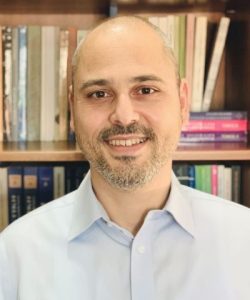
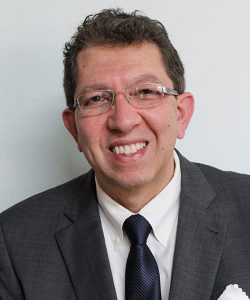
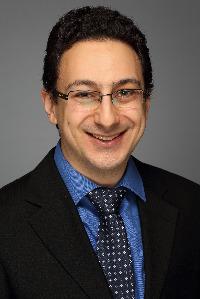
Stelios Timotheou is an Associate Professor at the Department of Electrical and Computer Engineering and faculty member at the KIOS Research and Innovation Center of Excellence, University of Cyprus. He holds a Dipl-Ing from National Technical University of Athens, and MSc/PhD from Imperial College London. His research focuses on developing real-time distributed methodologies using mathematical optimization, machine learning, and computational intelligence to enhance efficiency in critical infrastructure systems. Research interests center on data-driven decision making for urban mobility management, traffic control systems, and energy optimization. Key areas include: Intelligent UAV-based sensing for traffic monitoring Cooperative control algorithms for multi-agent systems Optimization of renewable energy integration Robust infrastructure protection strategies Recent publications demonstrate strong focus on traffic state estimation (76%), energy system optimization (16%), and UAV applications (8%). Awarded the Cyprus Research Award (2017) and ERC Consolidator Grant for URANUS project. Secured multiple research grants focusing on real-time control systems.
Marios Polycarpou is a Professor of Electrical and Computer Engineering and Director of the KIOS Research and Innovation Center of Excellence at the University of Cyprus. He holds honorary positions at Imperial College London and is a member of Academia Europaea. His expertise spans intelligent systems, adaptive control, machine learning, and critical infrastructure. Education: B.A. Computer Science (Rice University, 1987) B.Sc. Electrical Engineering (Rice University, 1987) M.S. Electrical Engineering (University of Southern California, 1989) Ph.D. Electrical Engineering (University of Southern California, 1992) Research Focus: Polycarpou’s work emphasizes fault diagnosis in cyber-physical systems, water distribution networks, and adaptive control. He pioneers digital twin technologies for infrastructure resilience and develops algorithms for real-time anomaly detection and system optimization. Article Trends: His recent publications address adaptive control strategies, cybersecurity in networked systems, and AI-driven solutions for water management. Key themes include distributed control, event-triggered mechanisms, and transformer-based anomaly localization. Awards: 2023 IEEE Frank Rosenblatt Technical Field Award 2016 IEEE Neural Networks Pioneer Award Fellow of IEEE and IFAC Grants & Leadership: He secured prestigious grants including ERC Advanced and Synergy Grants. He led KIOS CoE’s Horizon 2020 projects and served as IEEE Computational Intelligence Society President (2012–2013). Labs & Teams: Directs the KIOS CoE, a hub for AI in critical infrastructure. Collaborates on projects like ERC Water-Futures, focusing on long-term water system transitions and contamination mitigation.
Christos Nicolaides is an Assistant Professor at the Department of Business and Public Administration within the School of Economics and Management at the University of Cyprus (UCY), holding a secondary appointment as a Digital Fellow at MIT's Initiative on the Digital Economy. Previously, he spent three years as a James McDonnell Foundation-funded Postdoctoral Fellow at MIT Sloan School of Management. His educational background includes a PhD in Engineering from Massachusetts Institute of Technology (2014), SM from MIT (2011), MSc in Applied Mathematics from Imperial College London (2009), and BSc in Physics from University of Thessaloniki (2008). Nicolaides' research applies mathematical, statistical, and computational tools to large-scale empirical questions in social influence mediated by digital technologies. His work spans Data Science , Machine Learning , Social Networks , and Computational Social Science , with significant contributions to understanding human mobility patterns, disease transmission dynamics, and social contagion effects. His research has established novel methodologies for analyzing complex network structures in mobility data and social interactions. Analysis of his 15 most recent publications reveals a consistent focus on applying network science to real-world problems, particularly in pandemic response (12 publications), human mobility analytics (9 publications), and social contagion dynamics (7 publications). His work demonstrates increasing interdisciplinary integration, combining computer science, epidemiology, and organizational behavior since 2020. Marie S. Curie Fellow Two Highly Cited Papers by Web of Science (2017, 2020) Best Paper Award by Risk Analysis Society (2019) Professor of The Week by Poets & Quants (2020) As principal institutional investigator, Nicolaides has secured over €1 million in research funding from the European Commission, industry partners, Cyprus Innovation and Research Foundation, and Cyprus Ministry of Health. His current teaching includes Social Networks and Entrepreneurship, Introduction to Operations Management, and Quantitative Methods in Management. Media coverage of his work spans major outlets including The New York Times, CNN, Nature, and Science, with significant impact on public health policy discussions during the COVID-19 pandemic.
Professor Mohammed Salamah is a distinguished faculty member in the Computer Engineering Department at Eastern Mediterranean University's Faculty of Engineering. He maintains an office in room 114 and can be contacted at +90 392 630 1149/1334 or via email at muhammed.salamah@emu.edu.tr. His academic website provides additional resources for students and colleagues. Dr. Salamah earned his BS, MS, and PhD degrees in Electrical and Electronics Engineering from Middle East Technical University in 1988, 1990, and 1996 respectively, establishing a strong foundation for his career in network communications and wireless systems. His research interests span multiple critical areas in modern networking, with particular expertise in Wireless Sensor Networks, Internet of Things (IoT) security, Mobile Communications, and Energy Efficiency in network protocols. Professor Salamah has made significant contributions to the understanding of network security mechanisms, trust management systems, and optimization of wireless communication protocols. An analysis of his recent scholarly output reveals a strong focus on security challenges in IoT communication systems, controller placement optimization in software-defined wireless sensor networks, and trust-based malicious node detection schemes. His work demonstrates consistent attention to practical network performance issues while addressing emerging challenges in next-generation communication technologies. Throughout his academic career, Professor Salamah has demonstrated exceptional commitment to student mentorship, supervising numerous graduate students through their research journey. His administrative contributions include service as an associate editor, reviewer, and session chair for academic conferences. His laboratory work focuses on practical implementations of wireless communication protocols, with emphasis on energy efficiency, security mechanisms, and performance optimization for various network architectures including cellular networks, cognitive radio systems, and wireless sensor networks.
Angelos Georghiou is an Associate Professor of Operations Management at the Department of Business and Public Administration, University of Cyprus. He previously held academic positions as Assistant Professor at McGill University (2016–2019), Post-Doctoral Researcher at MIT (2012–2013), and Postdoctoral Researcher at ETH Zurich (2013–2016). His work bridges computational methods in stochastic and robust optimization with applications in healthcare, energy systems, and operations management. Ph.D. in Operations Research, Imperial College London (2012) M.Sci. in Mathematics, Imperial College London (2008) His research focuses on stochastic optimization , robust optimization , and decision rules , addressing challenges in healthcare analytics , energy-efficient control systems , and machine learning integration . Recent publications in Management Science and Operations Research highlight his contributions to decision-dependent information discovery and computational frameworks. Key trends in his 15 most recent articles include: Advancing robust optimization techniques for multistage problems Applications in healthcare (psychiatric risk prediction) and energy systems Integration of machine learning with stochastic programming Development of tractable algorithms for complex decision environments Scientific Awards : Esdras-Minville Best Student Paper Award (2023) He serves on editorial boards of Operations Research Letters (Area Editor) and Management Science , and collaborates with institutions like MIT, ETH Zurich, and McGill University. His work with undergraduate students includes a 2021 paper in SIAM Undergraduate Research Online .
Savvas G. Loizou is a faculty member at the Cyprus University of Technology , affiliated with the Department of Mechanical and Materials Science and Engineering . He established the Robotics, Control, and Decision Systems Laboratory (RCDS Laboratory) in 2011. Education: PhD in Mechanical Engineering (2005) and Eng. Diploma (2000) from National Technical University of Athens (NTUA). Postdoctoral Experience: GRASP Laboratory, University of Pennsylvania (2005–2007). His research focuses on control theory for autonomous robotic systems , with applications in underwater, aerial, ground, and micro-robotics . Key areas include multi-agent coordination , human-robot interaction , task planning , and sensor-based navigation . Recent work emphasizes logistics automation , UAV hardware platforms , and bounded control algorithms . Dr. Loizou has contributed to multi-agent formation control , underwater vision systems , and nonlinear model predictive control for electric vehicles. He is active in control system design and navigation transformations for complex environments. His laboratory, RCDS , serves as a hub for research in autonomous systems and decision-making algorithms.
Dimitrios Loukidis serves as Associate Professor in the Department of Civil and Environmental Engineering at the University of Cyprus, where he has been a core faculty member since January 2009. His academic foundation includes a Civil Engineering degree from the National Technical University of Athens (1999) and advanced geotechnical specialization through MSCE (2000) and PhD (2006) degrees from Purdue University, followed by postdoctoral research there (2006-2008). Educational Background: Civil Engineering, National Technical University of Athens (1999) MSCE in Geotechnical Engineering, Purdue University (2000) PhD in Geotechnical Engineering, Purdue University (2006) Professor Loukidis maintains a robust research program addressing critical geotechnical challenges through both theoretical and applied approaches. His work spans foundations engineering , expansive soils behavior (particularly Nicosia marl), slope stability and landslide mechanics , offshore geotechnics for pipeline systems, and advanced computational geomechanics including constitutive modeling and seismic analysis. Recent investigations integrate machine learning with traditional geotechnical methods to enhance landslide susceptibility mapping. His 15-year publication trajectory reveals evolving expertise: early work focused on fundamental soil-pile interaction and bearing capacity mechanisms (2008-2012), transitioning toward complex geohazard analysis including fault-rupture propagation (2009), offshore pipeline-fault interactions (2020-2023), and sophisticated modeling of expansive soil behavior (2018-2024). The 2025 publication demonstrates cutting-edge integration of machine learning with geotechnical parameters for landslide prediction in Southwestern Cyprus. No scientific awards are documented in the provided materials. While specific student advising details and grant information aren't disclosed, his collaborative publications with researchers like Triantafyllaki, Tzampoglou, and Papanastasiou indicate active participation in Cyprus-focused geotechnical research teams. Current investigations center on urban development impacts on paleolandslides (Pissouri case study) and machine learning-enhanced geohazard assessment. Laboratory work appears centered on computational geomechanics modeling, with recent publications utilizing advanced numerical techniques for large deformation analysis and hybrid optimization algorithms. The research group maintains strong field validation components, particularly for Nicosia marl behavior and offshore pipeline performance under tectonic stresses.
Prof. Dr. Osman Kukrer is a full-time faculty member at Eastern Mediterranean University (EMU), Faculty of Engineering, Department of Electrical and Electronics Engineering. He has been actively supervising graduate students in power electronics, control systems, and renewable energy integration since the 1990s. His research spans advanced power conversion topologies, including quasi-Z-source inverters multilevel converters active power filters grid-connected systems adaptive beamforming algorithms electric vehicle grid integration Notable contributions include the EMU Publication Citation Award (2017) and extensive supervision of 41 graduate theses, with research interests aligning with modern energy systems and signal processing techniques.
Shahab Dehghan is a Research Fellow specializing in sustainable energy systems at the University of Leeds. His work focuses on optimization models for microgrid planning under uncertainty, renewable integration, and resilient power networks. He contributed to the CRESUM-HYRES project developing tools for hybrid renewable systems. Technical Expertise: Stochastic optimization, distributionally robust modeling, and power system security constraints.
Christis Hassapis is an Associate Professor in the Department of Finance at the University of Cyprus, affiliated with the School of Economics and Management. He holds a Bachelor's in Mechanical Engineering from The George Washington University and a Master's and PhD in Economics from Boston College, USA. Vice Dean, Graduate School (2014-2018) Vice Dean, School of Economics and Business Administration (2014-2017) Elected Member, University of Cyprus Council (multiple terms) Chairman, UCY-Voice Radio Station His research focuses on Macroeconomics, Banking, and International Finance, with emphasis on policy uncertainty, portfolio optimization, and financial dynamics. Recent work explores contagion effects in housing markets, robust portfolio strategies, and nonlinear interest rate dynamics. Key contributions include studies on economic policy uncertainty impacts, group decision-making in investments, and crisis analysis in Greece. He has served in leadership roles at academic and institutional bodies, including the UCY Diogenis Business Incubator and Teaching Resource Center.
Dr. Somayyeh Lotfi is a Lecturer in Finance and Deputy Course Leader of the BA (Hons) in Accounting and Finance at the University of Central Lancashire Cyprus. She holds dual PhDs in Finance (University of Cyprus, 2022) and Applied Mathematics (University of Guilan, 2016), alongside advanced degrees in Applied Mathematics. Her research focuses on financial optimization, risk management under ambiguity, and behavioral finance, with notable contributions in political risk hedging, Eurozone debt analysis, and robust portfolio models. She is a member of the Financial Management Association and Multinational Finance Society. Education: PhD in Finance, University of Cyprus (2022) PhD in Applied Mathematics, University of Guilan (2016) MSc in Applied Mathematics, Ferdowsi University of Mashhad (2011) BSc in Applied Mathematics, Ferdowsi University of Mashhad (2009) Her research bridges theoretical models with practical financial decision-making, addressing topics like equity home bias and household under-diversification. She has received prestigious awards, including the Outstanding Peer-Reviewer Award (2018) and the Best Doctoral Paper Award (2017). Her work has been published in high-impact journals like the European Journal of Operational Research and Journal of Financial Stability. Awards/Grants: University of Cyprus Scholarship (2017-2022) Iran Ministry of Science and Technology grant for research abroad (2015) Dr. Lotfi actively contributes to academic discourse through seminars and conferences, including presentations at the World Finance Conference (2024) and the Multinational Finance Society Annual Conference (2023). She teaches modules in Corporate Finance, Investments, and International Financial Economics, emphasizing practical applications of financial theory.
Prof. Dr. Aykut Hocanin is a faculty member in the Department of Electrical and Electronics Engineering at Eastern Mediterranean University (EMU). He holds a PhD in Electrical and Electronics Engineering from Bogazici University, an MS in Electrical Engineering from Texas A&M University, and a BS in Electrical and Computer Engineering from Rice University. PhD: 1994-2000, Bogazici University MS: 1992-1993, Texas A&M University BS: 1988-1992, Rice University Research Interests: Dr. Hocanin specializes in adaptive signal processing algorithms, wireless communication systems, and sparse system identification. His work focuses on developing efficient algorithms for impulsive noise environments and improving CDMA system performance through robust detection and interference cancellation techniques. He has contributed significantly to adaptive filtering methods, including recursive inverse algorithms and variable step-size LMS approaches. Scientific Contributions: His recent research (2020-2024) includes fast quasi-Newton adaptive algorithms and data-reuse extended NLMS techniques. Earlier work (2011-2015) explored entropy-based subspace separation, 2D recursive inverse filtering, and mobility modeling in wireless networks. He has supervised numerous graduate theses on these topics. Professional Role: As a professor at EMU, Dr. Hocanin teaches courses like INFE362 and EENG461 while maintaining active research in digital signal processing and wireless communication. He serves as an associate editor and reviewer for academic journals and conferences.
Georgios Polykratis is a Researcher and PhD student at the Computation-based Science & Technology Research Center (CaSToRC) of the Cyprus Institute since October 2020. He holds a BSc in Physics from the National and Kapodistrian University of Athens, Greece, and a MSc in Theoretical Physics from École Normale Supérieure in Paris, France. His research focuses on quantum computing, quantum error mitigation, and lattice gauge theory simulations on quantum hardware. Key projects include implementing classical bit-flip correction for error reduction in quantum computations and exploring depolarizing noise effects in quantum circuits. He also contributes to detector simulation advancements in particle physics using MadAnalysis 5. Georgios has published extensively on quantum hardware implementation, error correction strategies, and computational methods. His work bridges theoretical physics with practical quantum computing challenges, aiming to enhance quantum algorithm reliability and scalability.
Dr. Antonia Lemonari – Sophocleous is an Assistant Professor in the Department of Architecture at the University of Cyprus, affiliated with the School of Humanities and Social Sciences. She holds a Civil Engineering degree from the National Technical University of Athens and a Ph.D. in 'Adaptable Dual Control Systems' from the National University. Her professional qualifications include memberships in CSTC, CyACE, and CCEAA. Dr. Sophocleous has been actively involved in research since 1994, focusing on structural analysis, earthquake-resistant design, and adaptable systems. She coordinates master's programs and integrates research-based teaching methods with technology tools. Her research interests span structural engineering, seismic design, parametric analysis, and architectural adaptability. Notable contributions include studies on cable bracing systems, dual control frameworks, and kinetic structures. She has presented at over 15 international conferences and published in refereed journals across Europe and Asia. Her work bridges academic research with professional practice as a structural consultant. Dr. Sophocleous' publications emphasize earthquake-resistant innovations, such as damper systems in MR frames and adaptive dual control mechanisms. Her recent work (2022–2024) explores cutting-edge applications like the Sydney Opera House case study and salt lake ecosystem management. She advocates for urban sustainability through structural systems integration and participatory design approaches. Her professional service includes roles as a consultant for organizations and a coordinator for academic programs. While no specific grants or labs are detailed, her contributions highlight interdisciplinary collaboration between architecture, engineering, and urban planning.
Christian Vitale serves as a Senior Research Associate at the KIOS Research and Innovation Center of Excellence, University of Cyprus, a position he has held since March 2019. He was awarded an Individual Widening Marie-Curie Fellowship and contributes to European and National projects investigating wireless technologies' impact on autonomous systems and critical infrastructures, with a focus on robust optimization-based trajectory planning for multi-agent systems. His educational background includes a B.S. and M.Sc. in Telecommunication Engineering from the University of Pisa and a Ph.D. in Telematics from Universidad Carlos III de Madrid. Prior research appointments span Politecnico di Torino, Telecom Paris, and industrial research at NEC Europe. Dr. Vitale's research encompasses: Autonomous Unmanned Systems Wireless Networks Complex Systems Modeling Robust Optimization Multi-agent Systems Critical Infrastructures With over 30 peer-reviewed publications, his work demonstrates consistent focus on mathematical modeling of autonomous systems and wireless networks, emphasizing efficiency improvements through optimization techniques. His publication trends reveal strong interdisciplinary connections between control theory, network engineering, and infrastructure security. Scientific Recognition: Best Paper Award at Online GreenComm Honorable Mention at COMSNETS Dr. Vitale actively secures competitive research funding through European and National projects, leveraging his Marie-Curie Fellowship as a foundation for collaborative work. His grant portfolio centers on real-world applications of wireless technologies in autonomous systems, though specific student mentorship details are not provided in available materials. As a core member of the KIOS Research and Innovation Center of Excellence, he contributes to cross-institutional teams developing intelligent solutions for critical infrastructure monitoring and control, with particular emphasis on resilience against wireless interference and multi-agent coordination challenges.