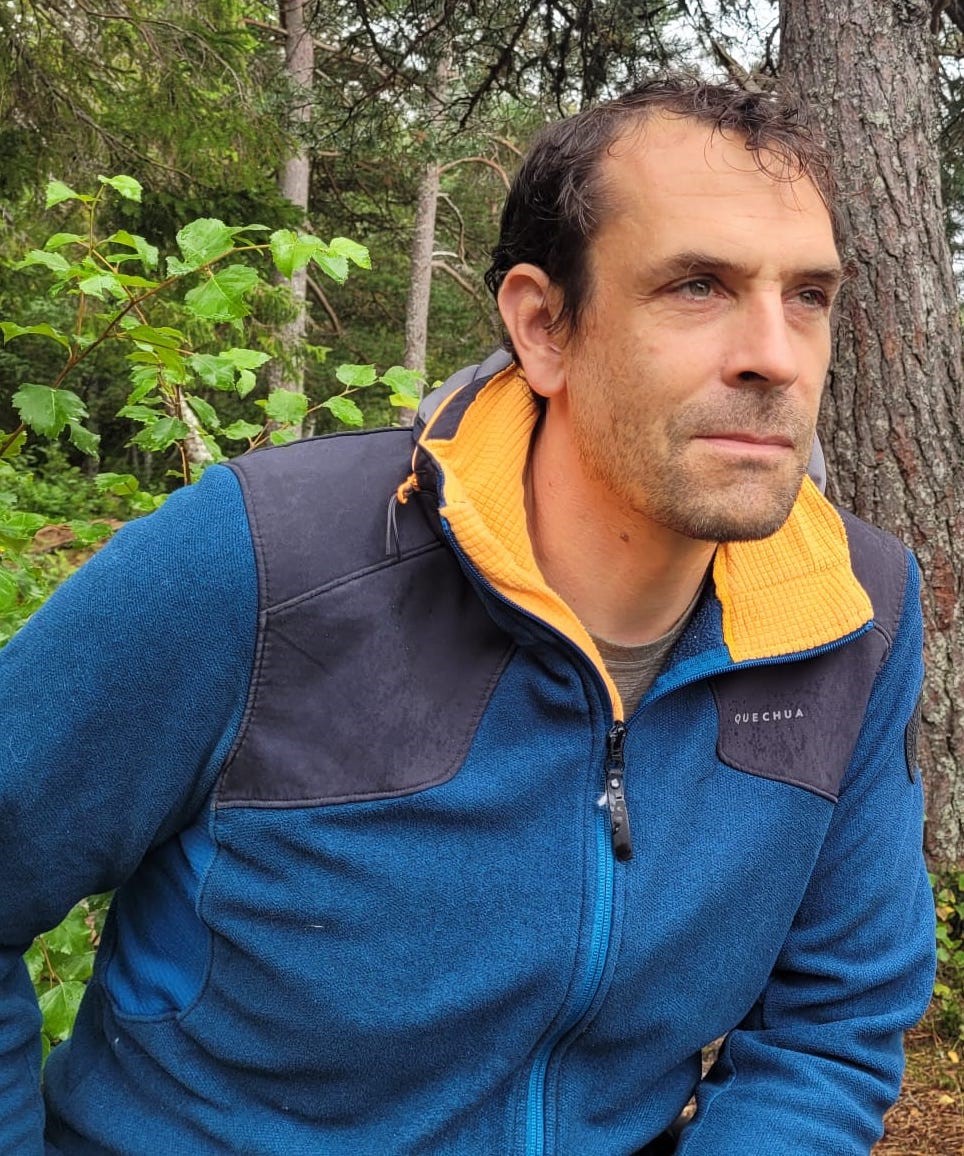
Mathias Nygaard Larsen is an Instructor at the Department of Mathematical Sciences and Department of Computer Science (DIKU) at the University of Copenhagen. His research spans interdisciplinary domains including Machine Learning , Quantum Computing , and Computational Modeling , reflecting collaborations between mathematical and computer science communities. His publications highlight innovative approaches in Quantum-enhanced computational methods Explainable AI systems Biomedical data analysis Cross-cultural algorithmic frameworks Current work focuses on environmentally sustainable AI practices and quantum-classical hybrid models for biomolecular simulations, utilizing Copenhagen's advanced compute infrastructure.
Ulrik Nyman is an Associate Professor in the Department of Computer Science at Aalborg University's Technical Faculty of IT and Design. His research focuses on formal verification, real-time systems, embedded software, and cyber-physical systems. He is affiliated with the CISS - Center for Embedded Software Systems and has contributed to projects like Digital Technologies for Industry 4.0 and compositional verification of real-time systems. Research Interests: Formal Methods and Verification Real-Time and Embedded Systems Cyber-Physical Systems Power Electronics Control Modal Transition Systems Interface Theories Projects: Digital Technologies for Industry 4.0 (2019–2021): Focused on industrial automation and predictive models. Compositional Verification of Real-Time Multi-Core Safety-Critical Systems (2017–2021): Addressed safety-critical avionics and multicore schedulability. CRAFTERS: Framework for Tailoring Embedded Real-Time Systems (2012–2015): Developed application-driven middleware. Publications: Nyman’s recent work explores statistical model checking in power electronics, falsification testing for cyber-physical systems, and formal verification of OS-based software. His research bridges theoretical formal methods with practical applications in embedded systems. Labs/Teams: Active in the CISS Center, collaborating on embedded software systems and real-time frameworks.
Kaiyuan Lu is an Associate Professor at Aalborg University's Faculty of Engineering and Science, affiliated with the Mechatronic Systems department. He specializes in advanced motor control systems, energy-efficient drives, and renewable energy applications. His research focuses on sensorless control, parameter uncertainty mitigation in electric drives, and optimal control strategies for refrigeration systems. Education details are not explicitly stated in the provided text, but his academic trajectory aligns with a PhD in Electrical Engineering or related field, given his current rank and research output. Research interests include Permanent Magnet Synchronous Motor (PMSM) drives, machine learning-enhanced control systems, energy harvesting, and high-dynamic compressor systems. His work bridges theoretical advancements in control algorithms with practical industrial applications, such as improving refrigeration compressor efficiency and developing robust sensorless drive solutions. He has supervised 7 PhD students, including Cai R. and Schou M. M., and led/co-led 22 research projects, including 'Machine Learning Improved Sensorless Control for PMSM Drives' (2025–2027) and 'Optimal Control for Refrigeration Compressor Systems in High Dynamics Situations' (2023–2025). Labs/Teams: Active contributor to AAU Energy's research initiatives, collaborating on projects involving I-F startup methods and web search-based control solutions for compressors.
Simon Lennart Sahlin is an Associate Professor at Aalborg University's Faculty of Engineering and Science, Department of Thermal Engineering. His research focuses on advanced biofuels, hydrogen and electro-fuels, offshore drones/robotics, and sustainable energy systems. He leads and participates in major projects such as NEST (National Research Infrastructure Roadmap), FC-COGEN (Micro-CHP integration), and BlueDolphin (waste heat utilization in fuel cells). His work addresses energy transition challenges through innovations in fuel cell systems, energy storage, and renewable integration. Sahlin has authored/co-authored over 40 publications and secured significant research funding from EUDP, Innovation Fund Denmark, and others. He collaborates with industry partners and academic teams on cutting-edge technologies like high-temperature PEM fuel cells and SOE-based energy storage systems. Education : Not explicitly stated in provided texts. Research Interests : Fuel cell diagnostics, renewable energy systems, electrochemical processes, and sustainable infrastructure. Recent publications emphasize data-driven fault diagnosis in fuel cells, microgrid control systems, and high-pressure electrolysis performance. Media coverage highlights his contributions to green hydrogen solutions and energy-efficient technologies. Sahlin advises two PhD students and actively engages in interdisciplinary research initiatives.
Amin Timany serves as an Associate Professor in the Department of Computer Science at Aarhus University, Denmark. His research focuses on foundational aspects of programming languages and formal verification systems, with particular expertise in logical frameworks for program correctness. His primary research interests span: Programming Languages Theory Formal Methods and Verification Type Systems and Type Soundness Separation Logic for Concurrency Logical Relations and Denotational Semantics Mechanized Proof Systems Analysis of Timany's recent publications (2022-2025) reveals a strong emphasis on separation logic extensions for distributed systems, guarded recursion techniques, and type soundness proofs. His work frequently bridges theoretical foundations with practical verification challenges, particularly in capability-based security and CRDT verification. The publications demonstrate consistent contributions to top venues including POPL, PLDI, and CPP. Timany actively participates in academic service, having served as conference chair for CPP 2025. His research involves significant collaboration with international teams, particularly with researchers at Aarhus University and other European institutions. The publication record shows steady output with 40+ research items, including 2 PhD supervisions noted in his profile.
Marta Perera Pérez serves as a Postdoctoral Researcher in the Department of Biomedical Sciences at the University of Copenhagen, affiliated with the reNEW international stem cell research center and the Brickman Lab. Her primary research基地 is located at Blegdamsvej 3B in Copenhagen, where she investigates fundamental mechanisms of embryonic development using interdisciplinary approaches. Her research focuses on developmental plasticity and molecular regulation during early embryogenesis, with particular emphasis on transcriptional networks governing cell fate decisions. Key areas include ERK signaling dynamics in context-specific responses, lineage priming through transcription factor co-expression, and the role of primitive endoderm in regulative development. Her work bridges molecular biology, stem cell systems, and computational modeling to decipher how embryonic cells coordinate self-renewal versus differentiation. Analysis of her recent publications reveals a consistent trajectory in understanding developmental robustness, with increasing focus on human-mouse comparative models since 2022. Her 2024 studies highlight emergent network properties in signaling systems and the mechanical basis of lineage plasticity, while earlier work established foundational principles of blastocyst formation through minimal rule sets. She operates within the Brickman Lab at the University of Copenhagen's Faculty of Health and Medical Sciences, collaborating extensively with researchers across Denmark and internationally as evidenced by multi-institutional publications. The lab environment emphasizes quantitative approaches to developmental biology, integrating wet-lab experiments with computational analyses.
Ida Vind serves as a Clinical Associate Professor within the Department of Clinical Medicine at the University of Copenhagen, specializing in Gastroenterology and Hepatology under the Internal Medicine division. Her clinical and academic work is based at the Capital Region of Denmark (Region H) hospital facility located at Blegdamsvej 3 in Copenhagen, where she maintains an active research profile with 49 documented publications focusing on inflammatory bowel diseases and artificial intelligence applications in gastroenterology. Dr. Vind's research program centers on advancing inflammatory bowel disease (IBD) management through pharmacological optimization and artificial intelligence integration. She has led clinical trials evaluating novel therapeutic regimens like the EASI trial for 5-aminosalicylate in ulcerative colitis, investigated antibiotic impacts on IBD flare-ups using Danish nationwide data, and pioneered AI tools for real-time diagnosis and endoscopic severity classification. Her work bridges clinical practice with computational approaches to improve diagnostic accuracy and treatment personalization, frequently leveraging large-scale population studies and European collaborations. Analysis of her 2022-2025 publications reveals a strategic evolution toward AI-driven diagnostic solutions for ulcerative colitis alongside continued investigation of biologic therapies and pharmacological interventions. Her research consistently appears in high-impact gastroenterology journals, demonstrates translational clinical relevance, and influences European practice through initiatives like the I-CARE study. The interdisciplinary nature of her work connects clinical medicine with computer science to address critical gaps in IBD management. No scientific awards or honors are documented in the available materials for Dr. Vind. While specific details about student supervision are absent from the provided text, her extensive publication record in collaborative clinical trials and cohort studies indicates active research mentoring. Her work on multicenter projects like I-CARE and Danish nationwide studies suggests successful acquisition of competitive research funding, though specific grant mechanisms aren't detailed in the source material. Dr. Vind operates within robust research networks including the European I-CARE Collaborator Group for biologics safety assessment and Danish nationwide consortia examining IBD treatments. Her work integrates clinical practice at Copenhagen University Hospital with academic research at the University of Copenhagen, facilitating immediate patient care improvements while contributing to long-term advances in gastroenterological science through population-based and AI-enhanced methodologies.
Lei You is an Assistant Professor in Applied Mathematics at the Department of Engineering Technology, Technical University of Denmark (DTU), located in Ballerup, Denmark. With a Ph.D. in Computer Science specializing in Mathematical Optimization from Uppsala University (2019), Dr. You has established expertise in distributed data analytics, data-driven optimization, and machine learning interpretability. Dr. You's research focuses on the theories of interpretability and efficiency of machine learning models toward On-Device AI. Key areas of investigation include: Strategies to streamline complex models without performance loss Unraveling the intricate mechanisms of decision-making models Understanding the synergy between model simplification and explainability Distributed data analytics and federated learning systems Optimization techniques for wireless communication and edge computing Dr. You's recent publications demonstrate a strong focus on counterfactual explanations, optimal transport theory, neural network pruning, and multi-objective optimization for federated learning. The research spans applications from explainable AI to 6G-satellite systems and energy-efficient base station management. A notable trend is the integration of causal inference and distributional analysis in machine learning optimization problems, with significant contributions to federated learning efficiency and robustness. Scientific awards and recognition: Doctoral Dissertation Award for Operations Research in Telecommunications and Network Analytics awarded by INFORMS in 2020 Dr. You actively supervises student projects and research activities, with recent supervisions including work on remote sensing assessment, network pruning techniques, Microsoft Graph API optimization, and applications of large language models in business contexts. Current research projects include 'Machine Learning for Beehives Monitoring' and 'InnoTech - TaskForce,' focusing on practical applications of machine learning in environmental monitoring and digital transformation. Dr. You maintains active industry connections through previous roles at Bolt, Wolt (Doordash), and The Boston Consulting Group, ensuring research relevance to real-world challenges.
Radu Grosu is a full professor and head of the Institute of Computer Engineering at the Faculty of Informatics, Vienna University of Technology (TU Wien). He also serves as a research professor in the Department of Computer Science at the State University of New York at Stony Brook (USA). His leadership extends to directing the Cyber-Physical Systems research group at TU Wien and previously co-directing the Concurrent-Systems Laboratory and co-founding the Systems-Biology Laboratory at SUNY Stony Brook. His research focuses on the modeling, analysis, and control of cyber-physical and biological systems. Key application domains include distributed automotive and avionic systems, Internet of Things (IoT), autonomous mobility, green operating systems, mobile ad-hoc networks, and biological networks such as cardiac, neural, and genetic regulatory systems. His methodological expertise lies in formal methods, hybrid systems, and compositional design. The recent trend in his publications emphasizes formal frameworks for cyber-physical system design, verification of AI-based controllers, green computing, and modeling of biological systems using hybrid and stochastic models. His work bridges theoretical rigor with practical applications in safety-critical domains. Scientific Awards: National Science Foundation Career Award State University of New York Research Foundation Promising Inventor Award Association for Computing Machinery Service Award Advising and Grants: Radu Grosu has co-directed research laboratories and mentored students in concurrent and systems biology research. He has secured competitive funding, evidenced by the NSF CAREER Award and other institutional recognitions. His leadership in founding and directing labs indicates strong grant acquisition and team mentorship capabilities. Labs and Research Groups: He leads the Cyber-Physical Systems group at TU Wien and previously co-directed the Concurrent-Systems Laboratory and co-founded the Systems-Biology Laboratory at SUNY Stony Brook, fostering interdisciplinary research in formal methods and biological computing.
Subham Sahoo is an Associate Professor at Aalborg University's Faculty of Engineering and Science, Department of Applied Power Electronic Systems. His research focuses on power electronic control, reliability, and system optimization with particular emphasis on reliability of power electronic converters. He holds a PhD in Electrical Engineering from Indian Institute of Technology Delhi with dissertation on Coordinated Control of DC Microgrids. Dr. Sahoo's research interests span power electronics, microgrid systems, cyber-physical systems, reliability engineering, and AI applications for power systems. His work integrates advanced control strategies with cybersecurity considerations for modern power systems. He has developed innovative approaches for stability assessment, cyber-resilient control, and condition monitoring of power electronic systems. His recent publications demonstrate a strong focus on addressing critical challenges in modern power systems including cyber threats to microgrids, stability of grid-forming inverters, and data-light methods for system assessment. The research shows a clear trajectory toward more reliable, flexible, and secure power electronic systems with increasing integration of AI techniques. Scientific Awards: Innovative Students Projects Award 2019 - Doctoral Level Dr. Sahoo serves as Principal Investigator and Co-Investigator on multiple significant research projects including PRISM (Probabilistic bio-plausible machine learning) funded by The Lundbeck Foundation and SAFEr Grid (Store-And-Forward Energy Grid) funded by HORIZON-ERC-SYG. He has supervised PhD students and collaborated with institutions including Massachusetts Institute of Technology where he was a guest researcher from October 2023 to March 2024. His external engagement includes serving as Chair of the IEEE Joint IES/IAS/PELS Chapter since January 2025. His work contributes to UN Sustainable Development Goals related to clean energy and sustainable infrastructure.
Julian Kager is an Assistant Professor at the Department of Chemical and Biochemical Engineering, Technical University of Denmark (DTU). He is affiliated with the PILOT PLANT research group. His research focuses on bioprocess and biosystems engineering, emphasizing the optimization and control of bioprocesses across pharmaceutical, industrial, and environmental biotechnology applications. He has expertise in experimental verification at lab and pilot scales, particularly in model development and real-time applications. Education: PhD in Bioprocess Engineering from Vienna University of Technology, Austria (2015–2019) MSc in Biotechnology from University of Natural Resources and Life Sciences, Vienna, Austria (2012–2015) MSc in Environmental Science from Florida A&M University, USA (2013) BSc in Biotechnology from University of Natural Resources and Life Sciences, Vienna, Austria (2008–2012) BSc in Biomedical Engineering from Universitá degli Studi di Milano, Italy (2010–2011) Research Interests: Julian's work centers on advancing bioprocess control and optimization through mechanistic modeling and real-time monitoring. He explores the integration of digital twins and AI tools in bioprocess development, aiming to enhance efficiency in pharmaceutical and industrial applications. His research also addresses challenges in raw material variability and process scalability, leveraging soft-sensor technologies and advanced control algorithms. Grants and Advising: Julian supervises multiple PhD students, including David Pfaff, Maksim Semenov Petrov, Ana Valdeira Caetano, Michael Lemperle, and Pratik Pably. His projects span topics like model-based control of bioprocesses, digital quality by design, and bioprocess intensification. He has held external positions as a Senior Researcher at Competence Center CHASE GmbH and a Postdoctoral Research Associate at Vienna University of Technology. Labs and Teams: Julian is part of the PILOT PLANT research group at DTU, which focuses on pilot-scale bioprocess development and digitalization. His work contributes to UN Sustainable Development Goals related to affordable and clean energy, industry innovation, and climate action.
Prof. Sebastien Nicolas Gros is a Full Professor and Head of the Department of Cybernetics at NTNU (Norway). He holds a PhD from EPFL (2007) and has held positions at Strathclyde University, KU Leuven, and Chalmers University of Technology. His research focuses on Model Predictive Control (MPC), Reinforcement Learning, Stochastic Optimal Control, and their applications in energy systems, autonomous systems, and bioengineering. Education: PhD in Control Systems, EPFL, Switzerland (2007) Postdoc at KU Leuven (2011-2013) Associate Professor at Chalmers University (2013-2017) Research Interests: Safe Reinforcement Learning, Data-Driven MPC, Energy Management in Buildings, Wave Energy Conversion, Artificial Pancreas Systems. His work is applied to industries like Equinor, DNV, and CorPower Ocean. Collaborations: Co-supervises PhD projects on Multi-Rotor Wind Turbine Control and Artificial Pancreas Industry partnerships with Volvo, SINTEF, and Pixii Labs: ITK Smart House, Hydroponics Units, Wave Energy Testbeds Grants & Projects: MAIDOM project for smart home energy management AWEbox framework for Airborne Wind Energy National and industrial grants for control systems research
Abderezak Lashab is an Assistant Professor at Aalborg University's Department of Electric Power Systems and Microgrids within the Faculty of Engineering and Science. He specializes in microgrid technologies, photovoltaic systems, and power electronics. His research focuses on enhancing the stability, efficiency, and resilience of energy systems, particularly in renewable energy integration, smart grids, and electric vehicle infrastructure. Key projects include the HECATE initiative exploring hybrid electric regional aircraft distribution technologies. Affiliations: AAU Energy, Microgrids Research Group Research Interests: Microgrid control strategies, photovoltaic system optimization, battery storage solutions, and cybersecurity in energy networks. His work emphasizes practical applications such as disaster-resilient mobile microgrids and EV charging infrastructure sustainability. Publications (82+): Focus on advanced control algorithms, power electronics, and renewable energy systems. Recent trends highlight grid stability under high PV penetration and smart grid resilience. Grants: HECATE project (2023-2025) funded by Horizon JU Innovation Action Labs/Teams: Active contributor to AAU's energy research groups, collaborating on projects involving hybrid electric systems and IoT-enabled cybersecurity.
Erik Lund is a Professor in the Department of Materials and Production at the Faculty of Engineering and Science, Aalborg University, Denmark. His work centers on computational mechanics and structural optimization, particularly in the context of wind turbine blade design and composite materials. PhD in Mechanical Engineering, Aalborg University (1994) His research focuses on Finite Element Method , Design Sensitivity Analysis , Structural and Topology Optimization , and Material Optimization for engineering systems. He has made significant contributions to the optimization of laminated composite structures and wind turbine components, integrating manufacturing constraints and fatigue considerations into design frameworks. Recent publications (2023–2025) highlight a strong trend in multi-material optimization , open-source modeling of offshore wind blades, and stress-constrained topology optimization . His work bridges theoretical mechanics and industrial applications, especially in renewable energy. He also explores methods for generating manufacturing instructions directly from structural designs, enhancing design-to-production workflows. Årets underviser på AAU Engineering (2020) Lund has supervised multiple PhD students (7 indicated in supervision metrics) and secured significant research grants, including projects like Future Core Materials for Wind Turbine Blades . He is active in research networks and has contributed to professional societies such as the International Society for Structural and Multidisciplinary Optimization (ISSMO) and the Danish National Committee of IUTAM. His work is highly collaborative, involving both academic and industrial partners. He leads and participates in advanced research projects that integrate computational modeling with real-world engineering challenges, particularly in sustainable energy systems. His lab or research group appears to focus on solid and computational mechanics, with an emphasis on applying numerical methods to optimize structural performance under complex constraints.
Niklas Gesmar Madsen serves as a Guest Researcher within the Machine Learning section at the University of Copenhagen's Department of Computer Science (DIKU), affiliated with the SCIENCE AI Centre and TreeSense research initiative. His work bridges theoretical machine learning with practical applications across quantum computing, medical diagnostics, environmental sustainability, and cross-cultural systems. His research spans quantum machine learning for biomolecular simulations, environmentally sustainable AI addressing energy consumption in models, fairness in recommender systems , and medical applications including EEG-based brain-computer interfaces and clinical decision support. Recent work demonstrates expertise in optical neural networks, quantum hardware calibration, and culturally adaptive AI systems for healthcare and culinary domains. Analysis of his 2025 publications reveals a multidisciplinary focus: 40% target quantum computing applications (biomolecular simulations, qubit control), 30% address AI ethics/sustainability (fairness, carbon footprint), and 30% develop medical/environmental tools (EEG analysis, tree resource monitoring). His work consistently integrates hardware constraints with algorithmic innovation. No scientific awards were documented in available sources. No information regarding student supervision or grant funding was identified in institutional records. Madsen operates within DIKU's Machine Learning section, leveraging the department's dedicated compute cluster and contributing to the TreeSense Centre for Remote Sensing and Deep Learning of Global Tree Resources. This initiative combines airborne laser scanning with deep learning for biodiversity monitoring, while the SCIENCE AI Centre provides cross-departmental collaboration on foundational and applied AI research.