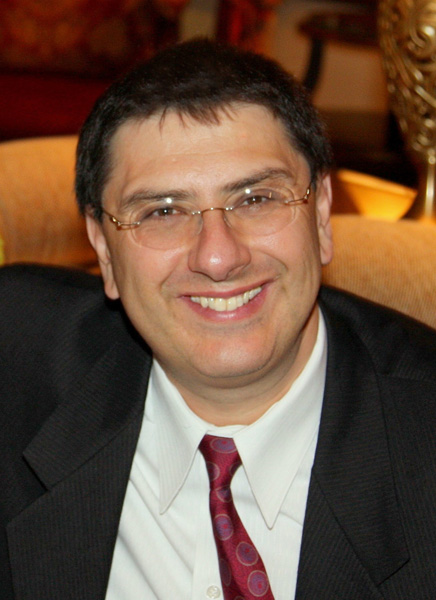
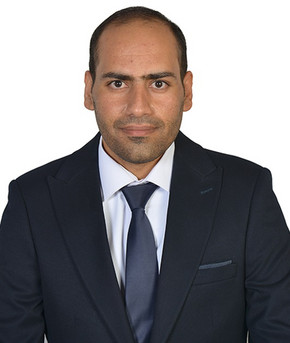
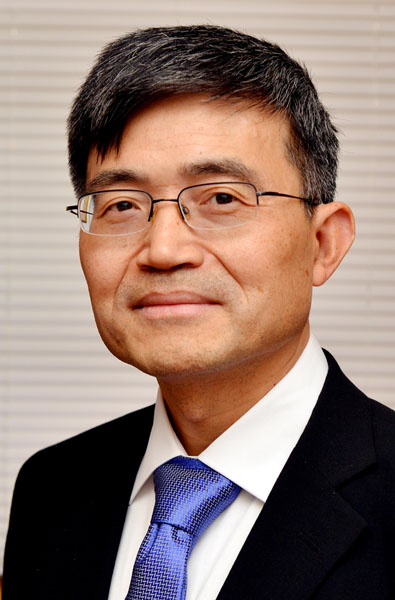
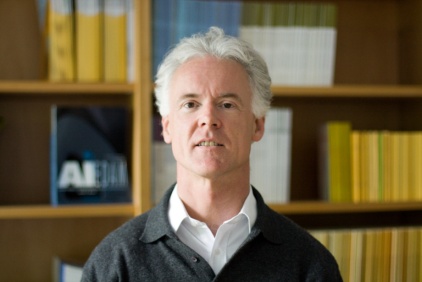
Rafail Ostrovsky is a Professor of Computer Science and Mathematics at UCLA , affiliated with the Center for Information and Computation Security at the Henry Samueli School of Engineering and Applied Science. He earned his Ph.D. in Computer Science from MIT in 1992 under Silvio Micali. Research Focus: His work spans cryptography, algorithms, and theoretical computer science, emphasizing secure multi-party computation, zero-knowledge proofs, oblivious RAM, and high-dimensional data analysis. Applications include privacy-preserving data mining, systems security, and quantum cryptography. Article Trends: Recent publications address concurrent security protocols, robust secret sharing via expander graphs, and efficient multi-party computation. Topics intersect computational complexity, cryptographic reductions, and practical security implementations. Awards: Recipient of the 2018 RSA Conference Excellence in Mathematics Award , 2017 IEEE Fellow , and multiple IEEE/ACM honors. Holds 14 U.S. patents and over 290 refereed papers. Advising: Supervised 27 Ph.D. students, many now professors at top institutions. Served on 40+ program committees, including FOCS 2011 Chair. Labs: Leads the CICS research center, fostering interdisciplinary work in information security and cryptographic systems.
Zhang Yi-Cheng is a Full Professor of Theoretical Physics at the University of Fribourg, Switzerland, since 1992. His academic career includes visiting professorships at Nordita (Denmark) and INFN (Italy), and postdoctoral research at Brookhaven National Lab (USA). He specializes in interdisciplinary fields such as Econophysics , Statistical physics , and Complex network sciences , focusing on applications in financial markets, social systems, and global trade networks. His research explores topics like market dynamics, network structures, and algorithmic ranking systems. Notable awards include the 2011 Honorary Director of the Complexity Sciences Research Center and recognition as a 2011 Chinese '1000 Talents' awardee . His work bridges physics-based methodologies with socio-economic systems, addressing challenges in information-driven economies and networked societies. Zhang has contributed to influential studies on ranking algorithms, percolation theory in networks, and the interplay between economic complexity and trade. His interdisciplinary approach has led to advancements in understanding systemic risks, market inefficiencies, and the role of information in shaping global economic interactions.
Sara van de Geer is a Full Professor at the Seminar for Statistics within the Department of Mathematics at ETH Zürich since 2005. She previously held academic positions at the University of Leiden, Université Paul Sabatier (Toulouse), and others. She earned a Master's (1982) and Ph.D. (1987) in Mathematics from Leiden University. Her research focuses on high-dimensional statistics, empirical processes, and mathematical foundations of machine learning. Van de Geer has received prestigious recognitions including the Van Wijngaarden Award (2016), Knight in the Order of Orange-Nassau (2015), and membership in Leopoldina (2013). She served as President of the Bernoulli Society (2015–2017) and Chair of the Seminar for Statistics at ETH Zürich. Her contributions include landmark works on statistical learning theory and high-dimensional inference, with key publications in top journals like Annals of Statistics and SIAM/ASA Journal on Uncertainty Quantification. Her academic leadership includes organizing Saint Flour Lectures, Wald Lectures (2016), and delivering plenary lectures globally. Her research bridges theoretical statistics with applied methodologies, emphasizing rigorous mathematical frameworks for modern data analysis challenges.
Alex X. Liu is a Professor in the Department of Computer Science & Engineering at Michigan State University (2016-2022), currently serving as Chief Information Security Officer and President of Midea Software Engineering Institute. His academic career includes roles as Associate Professor (2012-2016) and Assistant Professor (2006-2012) at the same institution. He holds a Ph.D. and M.S. in Computer Science from The University of Texas at Austin, and a B.S. in Computer Science from Jilin University, China. Education Ph.D. in Computer Science (UT Austin, 2006) M.S. in Computer Science (UT Austin, 2002) B.S. in Computer Science (Jilin University, 1996) Liu's research focuses on Dependable computing , Networking algorithms , Cloud computing , Mobile computing , Privacy computing , and Computer/network security . His work spans secure systems, network protocols, and resource optimization in distributed environments. Recent publications address quantum neural networks , microservices autoscaling , RFID tag recognition , network traffic classification , and hybrid physical-layer authentication , demonstrating expertise at the intersection of AI and network security. Key trends include deep learning applications for cloud systems and robust security protocols. Scientific Awards IET Fellow (2021) IEEE Fellow (2019) ACM Distinguished Scientist (2019) Withrow Distinguished Scholar Awards (Senior 2019, Junior 2011) NSF CAREER Award (2009) IEEE & IFIP William C. Carter Award (2004)
Daniel Dörler is a Senior Scientist at the Institute of Zoology, University of Natural Resources and Life Sciences, Vienna (BOKU), where he has been employed since 2019. His academic background includes a doctorate in Natural Resources and Life Sciences from BOKU and studies in Biology/Zoology from the University of Vienna. He is a leading figure in the Austrian and European citizen science movement, with a focus on biodiversity, road ecology, and public engagement in science. Institution: University of Natural Resources and Life Sciences, Vienna (BOKU) Department: Institute of Zoology Position: Senior Scientist (wissenschaftlicher Mitarbeiter) Email: daniel.doerler@boku.ac.at ORCID: 0000-0003-2056-4084 Daniel Dörler’s research interests center on citizen science, biodiversity monitoring, and ecological research, particularly in urban and road environments. He investigates the role of public participation in data collection for scientific research and conservation, with a focus on roadkill and amphibian populations. His work bridges ecology, social science, and science communication, emphasizing the transformative potential of citizen science for both science and society. He is deeply involved in methodological development, quality criteria, and the scalability of citizen science projects. His recent publications demonstrate a strong trend towards the integration of technology, policy, and community engagement in citizen science. Works such as automated species detection for anurans, roadkill hotspot analysis, and the development of scalability toolkits highlight a move towards data-driven, policy-relevant, and ethically sound citizen science. The articles consistently focus on practical applications, project design, and the societal impact of participatory research, spanning sub-fields like conservation biology, bioacoustics, and science policy. Daniel Dörler has received numerous scientific awards, reflecting his excellence in research, teaching, and public outreach: 2023: Ars Docendi Award for excellent teaching, Honorary Mention for the Roadkill project (EU Citizen Science Prize), and multiple awards for co-supervised Master’s theses. 2022: Sustainability Award from Austrian Federal Ministries. 2017: BOKU Sustainability Prize and recognition as a Pioneer of Open Innovation in Science. 2018: Nomination for the National Animal Welfare Prize. Dörler is a principal investigator and project leader on numerous research grants from the European Commission, Austrian Science Fund (FWF), and national agencies. He is a key figure in the Citizen Science Network Austria and the platform "Österreich forscht." He frequently presents at international conferences, contributes to policy discussions, and mentors students. His collaborative work with Florian Heigl and others has established a robust network for citizen science in Austria and beyond. Daniel Dörler is a core member of the Citizen Science Network Austria and leads multiple projects such as "Leading Lights," "STEM education," and "Explore Research from East to West in Austria." He is also deeply involved in the "Roadkill" project and the "AmphiBiom" initiative for amphibian conservation. His work fosters a collaborative environment that brings together researchers, citizens, and policymakers to address pressing environmental challenges.
Sophie N. Parragh is Professor and Head of the Institute of Production and Logistics Management at Johannes Kepler University Linz, where she also serves as program director of the master's degree program in Economic and Business Analytics. She received her PhD from the University of Vienna in 2009 and completed her habilitation in 2016, following postdoctoral research at the IBM Center for Advanced Studies in Porto and a visiting professorship at the Vienna University of Economics and Business. Her research focuses on developing exact and heuristic optimization algorithms for complex logistics and transportation problems. Key areas include vehicle routing, green logistics, disaster relief distribution planning, scheduling, and multi-objective optimization. She has particular expertise in branch-and-bound, branch-and-price, column generation, and metaheuristics approaches to solve challenging combinatorial optimization problems. Dr. Parragh's publication record shows a consistent trend toward increasingly complex multi-objective problems, with recent work focusing on electric vehicle routing, multi-echelon production planning under uncertainty, and bi-objective facility location problems with applications in disaster relief. Her research bridges theoretical optimization methods with practical applications in logistics and transportation. Scientific Awards: ÖGOR (Austrian Society for Operations Research) dissertation prize doc.award from the University of Vienna Hertha Firnberg Postdoc fellowship from the Austrian Science Fund (FWF) Dr. Parragh has served as department editor for OR Spectrum and as associate editor for Transportation Science, Transportation Research Part B: Methodological, INFORMS Journal on Computing, and Networks. She has led and participated in numerous third-party funded research projects in operations research, including work in healthcare logistics, field staff routing, production planning, and electric vehicle routing. In 2021-2022, she co-organized the monthly VeRoLog webinar series, demonstrating her active engagement with the international operations research community. She maintains strong research collaborations across Europe, evidenced by her co-authored publications with researchers from institutions in Austria, France, Portugal, Denmark, and beyond. Her work consistently addresses both theoretical challenges in optimization and practical applications in industry and public service contexts.
Dr. Adel Aazami is an Assistant Professor at the Institute of Transport Economics and Logistics at Vienna University of Economics and Business (WU Vienna) since 2023. His academic journey began with a B.Sc. in Industrial Engineering from University of Tehran (2010-2014), followed by an M.Sc. (2014-2016) and Ph.D. (2016-2021) from Iran University of Science and Technology (IUST), Tehran. Prior to his current position, he worked as a Postdoctoral Researcher at Sharif University of Technology (2021-2022) and was a Visiting Researcher at the University of Toronto (2020). His educational background includes: Ph.D. in Industrial Engineering (2016-2021) - Iran University of Science and Technology (IUST), Tehran, Iran M.Sc. in Industrial Engineering (2014-2016) - Iran University of Science and Technology (IUST), Tehran, Iran B.Sc. in Industrial Engineering (2010-2014) - University of Tehran, Tehran, Iran Dr. Aazami's research spans multiple interconnected domains within operations research and supply chain management. His primary focus areas include Operations Research and Optimization, Supply Chain and Logistics, Production and Distribution/Transportation Planning, Competition and Game Theory, Stochastic Programming, and Decomposition Algorithms. His work demonstrates a strong emphasis on developing mathematical models and optimization algorithms for complex supply chain problems, particularly those involving perishable goods, competitive environments, and sustainability considerations. He has made significant contributions to integrating environmental factors into traditional logistics problems and developing robust optimization approaches for supply chain networks. Analysis of Dr. Aazami's publication record reveals a consistent trajectory of increasingly sophisticated research in supply chain optimization. His work shows a clear progression from foundational mathematical optimization techniques to increasingly complex integrated problems involving multiple stakeholders, uncertainty, and environmental considerations. A notable trend is his focus on perishable products within supply chains, developing models that account for limited product lifetimes while optimizing across multiple echelons of the supply chain. More recently, his research has expanded to incorporate green logistics considerations, developing algorithms that balance economic and environmental objectives in transportation and distribution problems. His notable scientific achievements include: Winner of the 'Best Student' award among nationwide students evaluated by the Iranian Ministry of Science (2020) Winner of the Iranian Nobel Prize (known as the Alborz National Foundation Prize) (2019) Winner of the Best Student Award at IUST (2018) Winner of the Top Researcher Award at IUST (2018) Annual Awards of the National Elites Foundation Iran (2015-2020) Dr. Aazami has extensive teaching experience across multiple Iranian universities including Tehran University, Amirkabir Technical University, Isfahan University, Yazd University, Zanjan University, Damghan University, Abrar University and Iran Technical University. His peer review activities include reviewing for prestigious journals such as Soft Computing, Expert Systems with Applications, and Annals of Operations Research. While specific grant information isn't detailed in the provided text, his research output suggests active engagement with complex optimization problems relevant to transportation and logistics industries. At WU Vienna, Dr. Aazami is part of the research team at the Institute of Transport Economics and Logistics, working alongside other faculty members including Prof. Kummer and Prof. Wakolbinger. His research integrates theoretical optimization methods with practical applications in transportation and logistics, contributing to the institute's focus on sustainable and efficient supply chain solutions.
Univ.-Prof. Dr. Norbert Schuch is a Professor of Physics and Mathematics at the University of Vienna, leading the Quantum Information and Quantum Many-Body Physics group. His research bridges Quantum Information Theory, Quantum Computing, and the study of complex quantum many-body systems, with a focus on Tensor Networks, Topological Order, and Symmetry Breaking. He has offices at both the Faculty of Physics (Boltzmanngasse 9) and Faculty of Mathematics (Oskar-Morgenstern-Platz 1). Research Interests : Quantum Information at the interface of Many-Body Physics, including Entanglement Theory, Topological Quantum Computation, Tensor Network algorithms, and Symmetry-Protected Topological (SPT) phases. His work develops numerical and analytical frameworks to study entanglement order parameters and prepare/experiment with topological states in quantum simulators. Teaching : Courses on Quantum Information, Quantum Computing, Theoretical Physics, and seminars on quantum many-body topics. Prior to Vienna, he was a tenured group leader at Max-Planck-Institute of Quantum Optics and a lecturer at Technical University Munich. Scientific Awards : ERC Consolidator Grant SEQUAM (2020–2025) FWF ESPRIT Programme ESP 306 FWF SFB BeyondC FWF Entanglement Order Parameters Research Trends : His recent publications explore Quantum Algorithms, Tensor Networks for Topological Phase Transitions, Entanglement Spectra, and Symmetry-Protected Phases. Key subfields include Non-Abelian Anyons, Chiral Spin Liquids, and Computational Complexity in Many-Body Systems. Group Members : Current team includes postdocs like Dr. Ilya Kull and Dr. András Molnár, with historical alumni spanning PhDs, Masters, and BSc students now at institutions like Xanadu, MIT, and Quantinuum.
Dr. Zhong-Ping Jiang is a Professor in the Department of Electrical and Computer Engineering and an Affiliate Professor in the Department of Civil and Urban Engineering at the Tandon School of Engineering, New York University. He has been with NYU since 2007, previously serving as Associate Professor (2002-2007) and Assistant Professor (1999-2002) at Polytechnic University (now part of NYU). Dr. Jiang received his MSc degree in Statistics from the University of Paris XI in 1989 and his PhD degree in Automatic Control and Mathematics from the Ecole des Mines de Paris in 1993. He has maintained strong international collaborations with researchers across Europe throughout his career. Internationally recognized as a key contributor to nonlinear small-gain theory, Dr. Jiang is also well-known for his seminal work in robust adaptive dynamic programming and robust reinforcement learning for real-time safety-critical control applications. His research spans dynamical networks, nonlinear control theory, data-driven optimization, and reinforcement learning with applications to mechanical, information and biological systems. Dr. Jiang's publications have had significant impact in the field, with over 500 peer-reviewed journal and conference papers, more than 34,300 citations, and an h-index of 90 on Google Scholar. He has also published six research monographs since 2011. His notable awards and honors include: Election to European Academy of Sciences and Arts (2023) Stanford's Top 2% Most Highly Cited Scientists (2023) Election to Academia Europaea (2021) Highly Cited Researchers by Clarivate Analytics (2018) Fellow of Chinese Association of Automation (2017) Fellow of International Federation of Automatic Control (2013) Fellow of IEEE (2008) National Distinguished Professor, Chinese Ministry of Education (2009) Dr. Jiang serves as Deputy Editor-in-Chief for the IEEE/CAA Journal of Automatica Sinica and has held editorial positions for numerous prestigious journals including IEEE Transactions on Automatic Control. He has delivered more than 20 plenary, semi-plenary and keynote speeches at major international conferences and workshops.
Wolfgang Nejdl is a Full Professor of Computer Science at Leibniz Universität Hannover since 1995 and the Head of the L3S Research Center since 2001. His research focuses on Web Science, search and information retrieval, semantic web technologies, peer-to-peer infrastructures, databases, technology-enhanced learning, and artificial intelligence. Education: M.Sc. (1984) and Ph.D. (1988) in Computer Science from Vienna University of Technology. Previous Positions: Assistant Professor in Vienna (1988–1992), Associate Professor at RWTH Aachen (1992–1995), and visiting professor/researcher at Xerox PARC, Stanford, University of Illinois at Urbana-Champaign, EPFL Lausanne, and PUC Rio. His research spans foundational and applied Web technologies, including social networks, trust and reputation, Web infrastructure, digital libraries, semantic web, collaborative filtering, and privacy-preserving systems. Recent projects like PHAROS, OKKAM, LiWA, and LivingKnowledge highlight his work in audio-visual search, web entities, web archive management, and diversity bias algorithms. Wolfgang Nejdl published over 230 scientific articles and held leadership roles as General Chair for AH'08 and PC Chair for WWW'09. He co-founded iSearch IT Solutions in 2006 to commercialize digital library and web engineering research from L3S projects. Scientific Awards: Founding member and head of the L3S Research Center The L3S Research Center, with a 2009 budget of €6 million (75% third-party funding), focuses on connecting the Web to real-world entities through research in Web Science, service computing, and security. Funding comes equally from the European Union and national/industry sources.
Bettina Grün is an Associate Professor and Deputy Head of the Institute for Statistics and Mathematics at Vienna University of Economics and Business (WU). Her research focuses on Bayesian mixture models, cluster analysis, and applying statistical methods to sustainability, tourism, and environmental studies. She has led multiple research projects, including studies on environmental behavior in tourism and advanced text modeling in economics. Grün holds a PhD in Technical Mathematics from TU Wien (2006) and a Habilitation in Statistics from Johannes Kepler University Linz (2012). She has authored over 150 publications in top journals like Journal of Environmental Management and Expert Systems with Applications . Her work emphasizes practical applications, such as reducing hotel waste through behavioral interventions and developing R packages like movMF and circlus for statistical clustering. Grün has received awards including the AIEST Best Contribution Award (2019) and the MRS Silver Medal (2016). Grün teaches courses on statistical modeling and leads projects like Analysis of Central Bank Communication (2022–2026) and Environmentally Friendly Behavior in Tourism (2019–2024).
Prof. Jens Markus Melenk is a Professor at TU Wien's Faculty of Mathematics and Geoinformation, leading the Computational Mathematics Research Group (E101-02-1). His research focuses on advanced numerical methods for partial differential equations, with a strong emphasis on hp-FEM (hp-Finite Element Method), fractional diffusion equations, and wave propagation problems. He has contributed significantly to the development of robust and efficient algorithms for complex domains and heterogeneous media. Key research interests include the application of hp-FEM to fractional operators (e.g., integral fractional Laplacian), boundary element methods (BEM), and the analysis of wavenumber-explicit convergence for Maxwell's equations and elastic wave equations. His work bridges theoretical analysis and computational implementation, addressing challenges in multiscale problems and singular perturbations. Notable contributions: Exponential convergence of hp-FEM for fractional Laplacian problems, wavenumber-explicit error estimates for wave equations in heterogeneous media. Collaborations: Active involvement with researchers like Markus Faustmann, Christoph Schwab, and Dirk Praetorius. Supervised theses: Includes works on hp-FEM for fractional operators, RBF interpolation, and error estimators for elliptic PDEs. His research group develops and analyzes numerical schemes for challenging PDE scenarios, with applications in electromagnetism, acoustics, and computational mechanics.
Ulrich Schmid is a Full Professor and Head of the Research Unit for Embedded Computing Systems at TU Wien. He holds a position in the Faculty of Informatics and leads the department of Embedded Computing Systems (E191-02). His roles include Curriculum Coordinator for the Bachelor and Master programs in Computer Engineering, as well as the Excellence Program Bachelor with Honors. He is also the Chair of the Curriculum Commission for Computer Engineering and a Substitute Member of the Informatics Commission. His research focuses on fault-tolerant distributed algorithms, digital integrated circuits, and topology-based approaches to distributed systems. He coordinates major projects such as the FWF-funded DMAC (2019–2024) and ByzDEL (2020–2025), which integrate topological semantics and hybrid delay models for robust hardware design and distributed system analysis. Schmid has contributed to groundbreaking work in Byzantine fault tolerance, epistemic logic for system recovery, and real-time scheduling through collaborations with researchers like Chatterjee, Függer, and Rajsbaum. Notable awards include the 2018 Edsger W. Dijkstra Prize and the 2021 Principles of Distributed Computing Doctoral Dissertation Award. His research also bridges formal verification techniques with physical hardware implementations, exemplified by projects like HEX (a Byzantine-tolerant clock distribution system) and the Involution tool for timing analysis. Schmid actively contributes to academic governance, advancing rigorous education and research standards in computer engineering. His advising and grant work involve mentoring on fault-tolerant architectures and securing funding from agencies like FWF and the European Commission. Labs and teams under his leadership include the Embedded Computing Systems group, specializing in hardware-software co-design for dependable systems-on-chip, and collaborations with institutions like GSI Helmholtzzentrum and the University of Amsterdam.
Professor Marios Polycarpou is a leading academic in intelligent systems and control engineering at the University of Cyprus, serving as Director of the KIOS Research and Innovation Center. He holds concurrent roles as Visiting Professor at Imperial College London and Founding Member of the Cyprus Academy of Sciences. His expertise spans neural networks, cyber-physical security, and critical infrastructure systems. Education: B.A. Computer Science & B.Sc. Electrical Engineering, Rice University, 1987 M.S. & Ph.D. Electrical Engineering, University of Southern California, 1989-1992 Research Interests: Intelligent systems and networks Adaptive learning control systems Fault diagnosis methodologies Machine learning applications Critical infrastructure resilience Awards: IEEE Neural Networks Pioneer Award (2016) ERC Advanced and Synergy Grants IEEE/IFAC Fellowships Cyprus Distinguished Researcher Award (2015) Grants & Leadership: Directed over 40 research projects Presidency roles in IEEE Computational Intelligence Society and European Control Association Edited prestigious journals including IEEE Transactions on Neural Networks Led major conferences: 2020 IEEE World Congress on Computational Intelligence and 2018 European Control Conference. Labs & Teams: Founder of KIOS Center (EU-funded excellence center) Developed SEMIoTICS semantic control framework
Johann Eder is a full professor for Information and Communication Systems at the Department of Informatics Systems, University of Klagenfurt, Austria, and currently serves as Deputy Head of Department. He previously held positions at the Universities of Linz, Hamburg, Vienna, and Klagenfurt, and was Vice President of the Austrian Science Funds (FWF) from 2005-2013. He was also a visiting scholar at AT&T Shannon Labs, NJ. Educational Background: Diplom-Ingenieur, University of Linz Doctor of Technical Sciences, University of Linz Johann Eder's research focuses on databases, information systems, and data management for medical research, including temporal information modeling, process evolution, and workflow systems. His work spans temporal data warehousing, exception handling in workflows, and application interoperability, with a particular emphasis on privacy and quality in medical data lakes and federated biobanks. Recent publications highlight trends in temporal reasoning for business processes, medical data quality, and service composition optimization. His editorial roles include positions at ACM Transactions on Database Systems and IEEE Transactions on Knowledge and Data Engineering . He leads the Information and Communication Systems Research Group at AAU, contributing to projects like federated biobank integration and blockchain-based smart contracts.