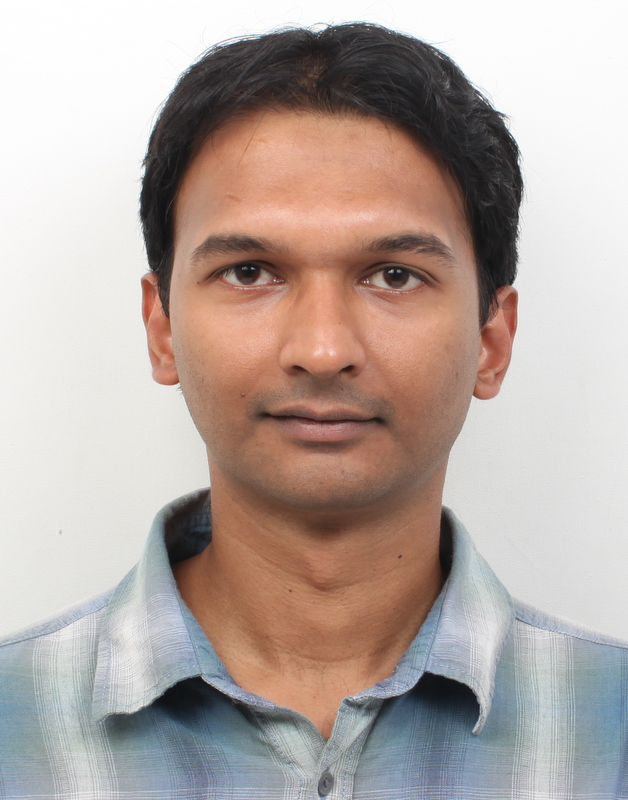
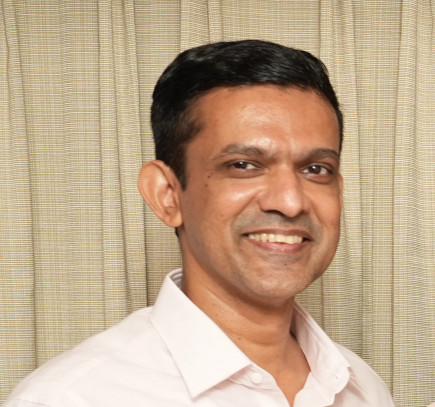
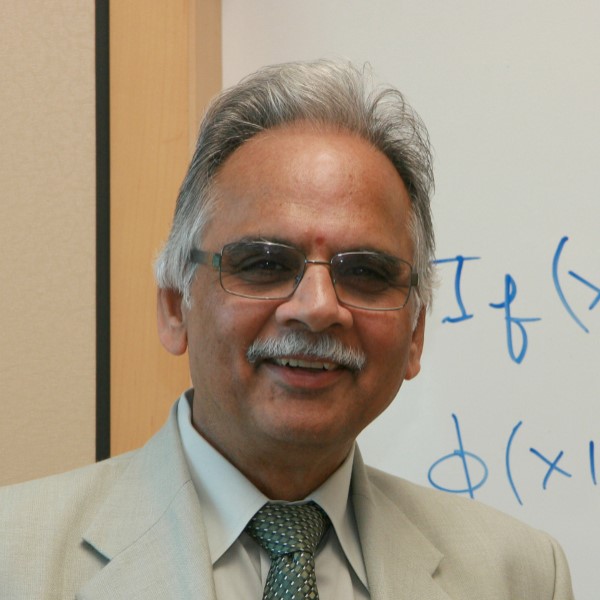
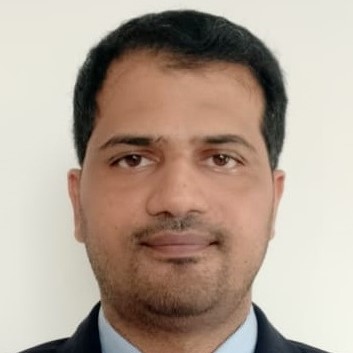
Dr. Balaraman Ravindran is a Professor and Head of the Department of Data Science and Artificial Intelligence (DSAI) at IIT Madras. He also leads the Robert Bosch Centre for Data Science & Artificial Intelligence (RBCDSAI) and the Centre for Responsible AI (CeRAI). His research focuses on reinforcement learning, geometric deep learning, and ethical AI deployment. Education includes a PhD from the University of Massachusetts Amherst (2004) and MSc from the Indian Institute of Science, Bangalore (1996). He holds prestigious fellowships from AAAI and INAE, and is an ACM Distinguished Member. Key contributions include work on class imbalance learning (e.g., TODUS algorithm) and applications in healthcare, transportation, and social networks. He has advised over 20 students and secured grants from Google, TCS Research, and others. Labs/Teams: Heads RBCDSAI and CeRAI, collaborates with TCS Research and Google.
Shivaram Kalyanakrishnan is an Associate Professor at the Department of Computer Science and Engineering , Indian Institute of Technology Bombay , specialising in Artificial Intelligence and Machine Learning . His research spans sequential decision making , multiagent learning , multi-armed bandits , and humanoid robotics , with applications in robot soccer , computer games , and online advertising . He teaches advanced courses like CS 747: Foundations of Intelligent and Learning Agents and CS 748: Advances in Intelligent and Learning Agents , focusing on end-to-end system design and theoretical analysis. His scientific awards include the Best Student Paper Award at RoboCup International Symposium 2006 and nomination for Best Student Paper Award at AAMAS 2007 . His work on reinforcement learning and policy iteration has been published in leading venues such as IJCAI , ICML , and COLT , with recent contributions to railway scheduling and bandit algorithms. While no explicit list of advisees is provided, his research projects and publications suggest mentorship of students in collaborative efforts. Contact : shivaram@cse.iitb.ac.in .
Joel George is an Associate Professor in the Department of Aerospace Engineering at the Indian Institute of Technology Madras (IIT Madras), where he conducts advanced research in aerospace vehicle dynamics, navigation, and control systems. His work spans theoretical studies, experimental validation, and practical applications in both atmospheric flight and space exploration domains. Dr. George's research focuses on several critical areas of aerospace engineering: Hybrid rocket propulsion systems and thrust control mechanisms Spacecraft landing technologies, including soft landing applications Orbital mechanics, particularly periodic orbits around asteroids Unmanned aerial vehicle (UAV) applications for microgravity experiments Propeller modeling for small UAV systems Geophysical flows research as part of IIT Madras's Centre of Excellence His recent publications demonstrate a strong trend toward innovative propulsion systems with practical space applications. Dr. George's work on hybrid rocket motors shows particular promise for safer vertical takeoff and landing systems both in space exploration and terrestrial aviation. His research on UAV-based microgravity platforms offers cost-effective alternatives to traditional space-based microgravity research methods. As a dedicated mentor, Dr. George supervises several PhD students including Anandu Bhadran (hybrid rocket motors), Rishi (asteroid orbital dynamics), and Siddhardha (UAV microgravity platforms). His collaborative work extends to partnerships with Prof. Ramakrishna and other researchers at IIT Madras. Within the Geophysical Flows Lab, a Centre of Excellence at IIT Madras, Dr. George contributes his expertise in UAV design, automation, and environmental monitoring. The lab employs a unified approach combining field measurements, climate modeling, and laboratory studies to advance understanding of air-sea interactions in the northern Indian Ocean, with applications to weather prediction and climate science.
Dipak Kumar Giri is an Assistant Professor in the Department of Aerospace Engineering at the Indian Institute of Technology Kanpur (IIT Kanpur). He received his PhD from IIT Kharagpur and has established himself as a specialist in aerospace control systems with a focus on satellite attitude dynamics and control. Dr. Giri's educational background includes a doctoral degree from IIT Kharagpur, one of India's premier technical institutions. His academic journey reflects a strong foundation in aerospace engineering principles and control theory, which has enabled his transition from research engineer to faculty position at IIT Kanpur. His research program centers on linear and nonlinear control systems for aerospace applications, with particular expertise in satellite attitude control using innovative actuation methods. Dr. Giri has pioneered work in magneto-Coulombic satellite attitude control systems, developing fault-tolerant control strategies and advanced sliding mode techniques. His research bridges theoretical control methodologies with practical aerospace applications, addressing critical challenges in spacecraft orientation and stabilization. The consistent publication of his work in top-tier journals demonstrates his scholarly contributions to the field of aerospace control systems. Analysis of Dr. Giri's publications reveals a sustained research focus on satellite attitude control through magneto-Coulombic systems, Lorentz forces, and magnetic actuation. His work spans theoretical developments in control theory to practical implementations for Earth-pointing satellites. The progression of his research from basic magneto-Coulombic control (2014) to fault-tolerant systems (2015-2019) and applications to aircraft control (2020) shows an expanding research scope while maintaining core expertise in control systems. Dr. Giri has held prestigious positions including DST INSPIRE Faculty at IIT Kanpur (2018-2020), Postdoctoral Research Associate at Singapore-MIT Alliance for Research and Technology (2017-2018), and Postdoctoral Fellow at Ulsan National Institute of Science and Technology in South Korea (2016-2017). These international research experiences have enriched his academic perspective and contributed to collaborative research efforts across borders. His laboratory work focuses on spacecraft dynamics and control systems, with particular attention to innovative actuation methods for satellite orientation. The research environment likely supports both theoretical modeling and simulation studies of spacecraft control systems, with potential applications to real-world satellite missions and aerospace technology development.
Indian Institute of Technology Hyderabad (IITH)India
Dr. Mudrika Khandelwal is an Associate Professor in the Department of Materials Science and Metallurgical Engineering at Indian Institute of Technology Hyderabad. She holds a Ph.D. from the University of Cambridge (2013) and completed her M.Tech and B.Tech at IIT Bombay. Her research focuses on sustainable materials development through cellulose-based composites and nanotechnology for applications in drug delivery, food packaging, energy storage, and environmental remediation. Education: Ph.D. (University of Cambridge), M.Tech/B.Tech (IIT Bombay) Current Role: Associate Professor & Dean of Alumni Relations (appointed 2022) The Cellulose Group at IIT Hyderabad emphasizes interdisciplinary research combining materials science, chemistry, and biomedical engineering. Their work involves manipulating cellulose at nano and micro scales with inspirations from natural structures to address societal challenges in healthcare, food preservation, and renewable energy systems. Key funded projects include the SERB Women Excellence Award for medicated dressings, National Technical Textiles Mission initiatives for filtration applications, and several SERB/DST grants for cellulose-derived energy materials. The group maintains active collaborations across India, UK, Australia, and Singapore. Scientific Awards SERB Women Excellence Award (2022) IIT Hyderabad Faculty Research Excellence Award (2021) Young Associate, Indian National Academy of Engineering (2020) Platinum Jubilee Young Scientist Award (NASI, 2021) Young Engineer Award (INAE, 2020) The group has advanced laboratory facilities including battery testing systems, nanofabrication equipment, and drug release characterization tools. Dr. Khandelwal supervises both PhD and M.Tech students while leading multiple industrial collaborations with companies like Malai Biomaterials and Eaton.
Laxmidhar Behera is a Professor in the Department of Electrical Engineering at the Indian Institute of Technology Kanpur, specializing in Intelligent Systems and Control. With over two decades of academic experience at IIT Kanpur and international research experience at institutions including Fraunhofer Institute of Autonomous Intelligent Systems in Germany, ETH Zurich, and University of Ulster, he has established himself as a leading researcher in cognitive robotics and intelligent control systems. Dr. Behera's research spans multiple cutting-edge domains including Cognitive Robotics, Nano-robotics, Vision based Control, Soft Computing, Information Retrieval in music and language, Semantic Information Processing, Physics of Complex Systems, Cyber Physical Systems, Formation Control of UAVs, Brain-Computer Interface (BCI), and Sanskrit Computational Linguistics. His interdisciplinary approach bridges traditional control theory with modern computational intelligence techniques, creating innovative solutions for complex real-world problems. His extensive publication record in top-tier journals like IEEE Transactions demonstrates his leadership in areas such as brain-computer interfaces, visual servoing, multi-robot systems, and music information retrieval. Notably, his work on quantum neural networks for EEG filtering and multisatellite formation control has received significant attention in the research community. UKIERI Standard Research Award 2008 Best Paper at International Conf. on Intelligent Sensors and Information Processing (ICISIP-2004) Best Paper at WoSco,02, Int. Conf. High-Performance Computing (HiPC, 2002) AICTE career award for young teacher (1997) Senior Member IEEE Multiple IEEE top accessed articles (2009-2010) As an Associate Editor for Autosoft Journal and Technical Committee Member for Intelligent Control at IEEE Control System Society, Dr. Behera actively contributes to the academic community. His laboratory in the Western Lab - 212A of the Department of Electrical Engineering serves as a hub for research in intelligent systems, where he mentors students and collaborates with researchers worldwide on cutting-edge projects in robotics, control systems, and computational intelligence.
Indian Institute of Technology Hyderabad (IITH)India
Mathukumalli Vidyasagar is a Distinguished Professor at the Indian Institute of Technology Hyderabad and previously held the SERB National Science Chair and Cecil & Ida Green Chair in Systems Biology Science at the University of Texas at Dallas. He earned his Ph.D. from the University of Wisconsin, Madison, and has authored 13 books and over 160 peer-reviewed papers.
Ramprasad Potluri is an Associate Professor in the Department of Electrical Engineering at the Indian Institute of Technology Kanpur (IIT Kanpur), where he has been contributing to control systems research and education. His academic journey includes a PhD from the University of Kentucky, USA (2003) and a Master of Science in Electrical Engineering from Saint Petersburg State Technical University, Russia (1996). Dr. Potluri's research focuses on the practical applications of Control Systems theory, with particular emphasis on motor control, autonomous vehicle navigation, and fault-tolerant systems. His work bridges theoretical control concepts with real-world engineering applications, making significant contributions to both academic research and educational practices in the field. His publication record from 2011-2015 demonstrates a strong focus on applying control theory to practical engineering challenges, particularly in the domains of electric vehicles, robotic systems, and educational laboratory development. His research shows consistent progression from theoretical foundations toward increasingly complex real-world applications, with a notable emphasis on making advanced control systems accessible through low-cost educational platforms. Best Teaching Assistant award recipient Manavaalan Gunasekaran developed the new Control Systems Laboratory under his guidance Jitendra Bharadwaj, working with Dr. Potluri and Dr. KS Venkatesh, received a first prize at Techkriti (IIT Kanpur technology festival) His laboratory work in Western Labs 217A focuses on developing practical control systems experiments that make advanced control concepts accessible to undergraduate students, complementing his research on advanced control applications in autonomous vehicles and robotics.
Mohit Law is an Associate Professor in the Department of Mechanical Engineering at the Indian Institute of Technology Kanpur. His research focuses on machining dynamics, machine tool design and analysis, vibration control, and manufacturing systems. With expertise spanning both theoretical modeling and practical applications, Dr. Law has established himself as a notable researcher in precision manufacturing technologies. PhD (2013), University of British Columbia, Canada. Thesis: "Position-dependent dynamics and stability of machine tools." MSc, Michigan Technological University, USA BE, Pune University, India Dr. Law's research spans multiple areas in manufacturing and mechanical engineering, with a strong focus on machining dynamics and machine tool performance. His work addresses critical challenges in precision manufacturing, vibration control, and advanced machining strategies. He has made significant contributions to understanding position-dependent dynamics in machine tools and developing innovative solutions for vibration damping and isolation. His research integrates analytical methods with experimental validation to improve machine tool performance and manufacturing efficiency. Dr. Law's publication record demonstrates a consistent focus on machine tool dynamics, particularly position-dependent behavior. His work bridges theoretical modeling with practical applications in manufacturing, with emphasis on substructuring techniques, vibration isolation, and stability analysis. He has developed novel approaches that have advanced the field of precision manufacturing, particularly in high-performance machining strategies. International Partial Tuition Scholarship, The University of British Columbia, 2009-2013 Graduate Scholar, Sustainable Futures Institute, Michigan Technological University, 2007-2008 Dr. Law has extensive industry experience as a Machine Tool Design Engineer at TAL Manufacturing Solutions (TATA) and Bharat Fritz Werner Ltd. He also served as a Research Associate at the Fraunhofer Institute for Machine Tools and Forming Technology in Germany. He maintains active professional affiliations as a CIRP Research Affiliate and SME Member. His research has practical applications in industrial manufacturing settings, particularly in improving machine tool performance and reliability. Dr. Law is associated with the Manufacturing Science and Solid Mechanics and Design research groups at IIT Kanpur. His work involves developing advanced modeling techniques and experimental methods to improve machine tool dynamics and manufacturing processes. He collaborates with international research institutions and maintains strong industry connections to ensure his research addresses real-world manufacturing challenges.
Bishakh Bhattacharya is a Professor at the Department of Mechanical Engineering , Indian Institute of Technology Kanpur . He specializes in vibration and control, structural health monitoring (SHM), sensors & actuators , and is actively involved in interdisciplinary research spanning robotics, smart materials, and neural modeling. Education: PhD in Aerospace Engineering, Indian Institute of Science Bangalore (1998) M.E. in Applied Mechanics, Jadavpur University (1991) B.E. in Civil Engineering, Jadavpur University (1988) Research Interests: His research spans a wide spectrum of engineering and applied sciences. Major themes include: Active & Passive Vibration Control – developing control strategies for mechanical systems Smart Structures & Adaptive Systems – integrating sensors and actuators for real-time response Structural Health Monitoring – using advanced sensing for damage detection in civil and aerospace structures Child-Robot Interaction Design – exploring human-robot interfaces for developmental applications Neural Oscillation & Brain Modeling – applying multi-scale modeling to understand brain dynamics Awards & Honors: UK-India Research Initiative Award (2012) Young Scientist Award – Systems Society of India (2006) Academic Senate Commendation – IIT Kanpur US Patent: Vibration Damping System and Method Editorial Board Member – Journal of Low Frequency Noise, Vibration and Active Control Laboratory & Facilities: He leads the Applied Dynamics and Vibration Laboratory at IIT Kanpur, located in NL-103. The lab is equipped with advanced instrumentation for vibration testing, sensor integration, and control system prototyping. His team collaborates across disciplines including aerospace, civil, and biomedical engineering.
Indian Institute of Technology Hyderabad (IITH)India
R Prasanth Kumar is a Professor at the Indian Institute of Technology Hyderabad in the Department of Mechanical & Aerospace Engineering. His academic journey began with a BTech from NBKRIST (affiliated to SVU) in 2000, followed by MTech (2002) and PhD (2007) from IIT Kharagpur. Education : BTech (2000), MTech (2002), PhD (2007) His research focuses on Robotics , Multibody Dynamics , Control Systems , and applications of Machine Learning (particularly Reinforcement Learning ) to dynamic systems. His work explores locomotion mechanics, trajectory generation, and control strategies for biped and quadruped robots. Recent publications highlight advancements in parallel mechanisms for quadruped robots, underactuated biped control , and reinforcement learning for balancing tasks. These studies span gait cycle optimization , dynamic stability , and real-time trajectory planning under constraints. He leads the collaborative UAV payload maneuvering project (2021-) and contributes to the Autonomous Passenger Drone initiative (2019-). His patents cover innovations in robot walking stability , flexible manipulators , drones , and airborne vacuum cleaners .
Professor Animangsu Ghatak is a faculty member in the Department of Chemical Engineering at the Indian Institute of Technology Kanpur, specializing in the mechanics of soft materials and related phenomena. Professor, Department of Chemical Engineering, IIT Kanpur Research focuses on soft materials mechanics, adhesion, and interfacial phenomena Dr. Ghatak received his B.Tech (Hons.) from IIT Kharagpur in 1994, followed by an M.Tech from IIT Kanpur in 1998. He earned his PhD from Lehigh University in 2003 and completed postdoctoral research at Cambridge University, UK and Harvard University, USA from 2003-2004. His research interests span multiple areas of soft materials science including mechanics of soft materials, adhesion and friction at soft interfaces, locomotion of soft bodied objects, fracture of soft gels, multiphase flow through micro-channels, membraneless fuel cells, and the design of universal nucleants for protein crystallization. His work bridges fundamental mechanics with practical applications in materials science and engineering. Dr. Ghatak's publications demonstrate a focus on the behavior of soft materials at micro and nano scales, with particular emphasis on interfacial phenomena, material deformation, and innovative fabrication techniques for microfluidic systems. His research has significant implications for biomaterials, soft robotics, and microfluidic device design. Invited speaker at Gordon Research Conference on Adhesion Science, 2011 Humboldt Research Fellowship for Experienced Researchers, 2010 Mr. and Mrs. Gian Singh Bindra Research Fellowship, 2009-2012 Diamond Jubilee Young Achiever's Award of the Indian Institution of Chemical Engineering, 2007 Young Engineer Award of the Indian National Academy of Engineering, 2006 Professor Ghatak maintains an active research program with multiple publications in high-impact journals. His work on nano-wrinkle substrates for protein crystallization and the mechanics of soft cylinders rolling uphill has received significant attention in the scientific community, including press releases from the Royal Society of Chemistry and research highlights in Nature Physics. He is based in the Department of Chemical Engineering at IIT Kanpur, with office contact information available through the university directory.
Supratim Biswas is a Professor in the Department of Computer Science and Engineering at the Indian Institute of Technology Bombay, where he has served since 1995. His academic career spans over four decades, beginning as a Lecturer in the Computer Center in 1980, progressing to Assistant Professor in 1985, Associate Professor in 1990, and achieving full Professorship in 1995. He has held significant administrative roles including Dean of Academic Programs (2007-2010), Head of CSE Department (2000-2003), and Director of IITB-Monash Academy (2009-2010). His research interests focus on Programming Languages, Compiler Optimization, Parallelizing Compilers, Parallel and Distributed computing, and Combinatorial Optimization . Professor Biswas has made substantial contributions to compiler technology, particularly in parallelization techniques for modern architectures. His work bridges theoretical compiler design with practical applications in high-performance computing and CAD systems, demonstrating how compiler optimizations can significantly enhance computational efficiency in real-world applications. The publication record shows a consistent research trajectory spanning nearly four decades, with recent work (2012-2015) focusing on GPU-based parallel algorithms, loop parallelization techniques for non-uniform data dependencies, and mesh processing for CAD applications. His research demonstrates evolution from foundational compiler theory to contemporary parallel architectures, maintaining relevance through practical applications in computational geometry, CAD systems, and high-performance computing. Excellence in Teaching Award (2000) Professor Biswas has supervised over 60 doctoral and master's students, establishing himself as a dedicated mentor in systems software education. His sponsored research portfolio includes significant projects with CDAC (350 lacs), MIT (133 lacs), TCS (81.3 lacs), and Intel Corporation (10 lacs), demonstrating strong industry-academic collaboration. His teaching portfolio spans both undergraduate and postgraduate levels, including foundational courses like Discrete Structures and advanced topics like Parallelizing Compilers, reflecting his commitment to curriculum development across multiple generations of computer science education. His laboratory work has supported students across B.Tech, M.Tech, and Ph.D. programs, with particular emphasis on compiler construction and operating systems. Through the Continuing Education Program, he has extended his expertise to industry professionals, conducting numerous specialized courses for organizations including VSNL, TCS, DRDO, and Reliance.
Soumya Ranjan Sahoo is an Associate Professor in the Department of Electrical Engineering at the Indian Institute of Technology Kanpur. His academic career at IIT Kanpur began with a contract position as Assistant Professor in 2014, progressing to Assistant Professor in 2016, and currently holding the position of Associate Professor since December 2020. Prior to joining IIT Kanpur, he worked as a Scientist Fellow at the National Aerospace Laboratories in Bangalore. PhD in Systems and Control Engineering from IIT Bombay (2013) Thesis Title: Coordination problems with minimal sensing and coarse actuation Thesis Supervisors: Prof. Ravi N. Banavar and Dr. Arpita Sinha B.Tech in Electrical Engineering from University College of Engineering, Burla, Odisha (2008) Dr. Sahoo's research spans the complex intersection of control theory and practical engineering applications. His work primarily focuses on nonlinear dynamical systems, with significant contributions to the control of unmanned vehicles and coordinated control systems. His research has evolved to address modern power system challenges, particularly in the domain of AC and DC microgrids, where he has developed innovative control strategies for improved performance. His work on discontinuous systems demonstrates his ability to tackle mathematically challenging control problems with practical implications. Analysis of Dr. Sahoo's publication record reveals a clear evolution from fundamental control theory to applied research with significant practical impact. His early work focused on theoretical aspects of multi-agent systems and network control, which has progressively shifted toward power systems applications, particularly microgrids. The consistent theme across his publications is the development of robust control strategies that work effectively under realistic constraints such as communication delays, incomplete information, and system heterogeneity. His research bridges theoretical control concepts with practical engineering implementations, particularly in the domains of autonomous systems and modern power grids. Dr. Sahoo teaches several key courses in the Electrical Engineering curriculum including Introduction to Electrical Engineering, Control Systems Analysis, Basics of Modern Control Systems, Nonlinear Systems, Adaptive Control Theory, and advanced topics in Nonlinear Systems. His teaching portfolio reflects his deep expertise in control theory and its applications. His laboratory work, particularly through the DiSCo Lab (as referenced in his homepage), focuses on practical implementations of control algorithms for various applications including unmanned vehicle coordination and microgrid management. This laboratory work bridges the gap between theoretical control design and real-world implementation challenges.
Professor Ashish Dutta is a distinguished faculty member in the Department of Mechanical Engineering at the Indian Institute of Technology Kanpur. He earned his PhD from Akita University, Japan in 2002 under the supervision of Prof. Obinata Goro from Nagoya University, with additional academic credentials including an M.E. from Jadavpur University (1994) and a B.Tech from R.E.C. Calicut (1989). His research expertise spans Robotics, Intelligent Control systems, Microsensors and actuators, and Bio-robotics. Professor Dutta has pioneered work in Ionic Polymer Metal Composite (IPMC) actuators and compliant robotic mechanisms, with applications ranging from micro-assembly to human-robot interaction. His research bridges mechanical engineering, materials science, and robotics to solve complex engineering challenges. Professor Dutta's recent publications demonstrate significant contributions to bipedal locomotion, precision assembly techniques, and dexterous manipulation systems. His work shows a consistent focus on developing innovative robotic solutions with practical applications in manufacturing and biomedical engineering. Japan Ministry of Education fellowship for robotics research in Japan (1998-2002) Professor Dutta has held leadership positions including Associate Dean (Digital Infrastructure) since 2014 and Head of the Computer Centre since 2012. He serves as Secretary of the Robotics Society of India and is a member of IEEE. His teaching portfolio includes Introduction to Robotics (ME 762), Robot Dynamics and Control (ME 763), and several other core mechanical engineering courses.