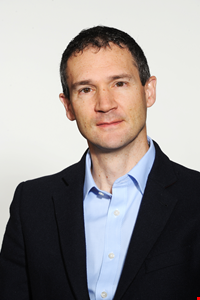
Frede Blaabjerg is Professor at Aalborg University's Department of Energy Technology, specializing in power electronics and renewable energy systems. His research advances power converter technologies for grid integration of renewables, microgrid control, and reliability optimization. Recent publications address synchronization stability in weak grids, harmonic suppression in multilevel inverters, and power module reliability. Work demonstrates innovative control strategies for inverter-based resources and robustness enhancement in power electronic systems. He leads projects on grid-forming converters and sustainable energy integration, collaborating with international research teams on smart grid innovations.
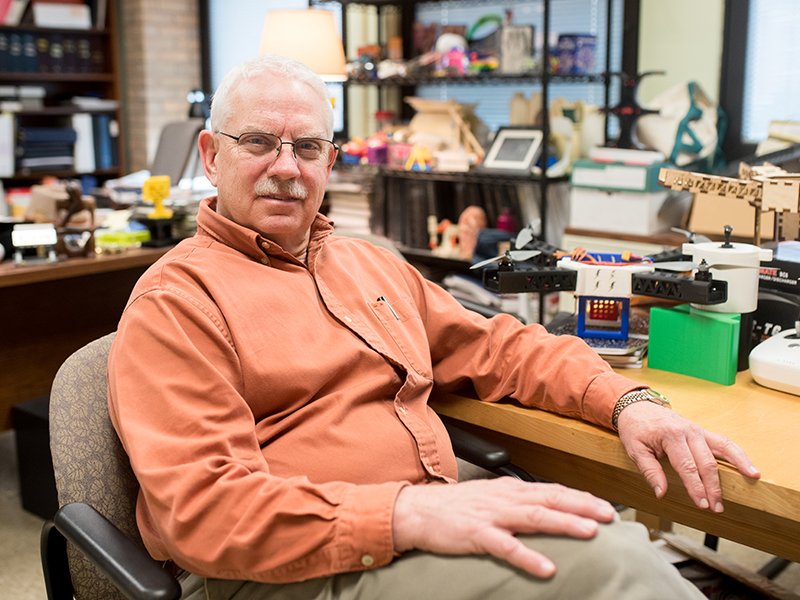
Dr. Richard H. Crawford is a Professor of Mechanical Engineering at the University of Texas at Austin, holding the Earl N. & Margaret Brasfield Endowed Faculty Fellowship. He directs the Design Projects Program and has been affiliated with the university since 1990. His expertise spans mechanical design, geometric modeling, and engineering education. Education: BSME from Louisiana State University (1982), MSME and PhD from Purdue University (1985, 1989). Research focuses on computer-aided design, additive manufacturing, and pre-college engineering education. Notable initiatives include the DTEACh program and the UTeach Engineering track, which developed the Engineer Your World curriculum adopted by over 200 US school districts. Awards include the 1995 Fred Merryfield Design Award, 2010 Ralph Coates Roe Award, and 2011 Regents’ Outstanding Teaching Award. His work bridges academia and industry through collaborations with Ford, IBM, and Sandia National Lab. Recent research emphasizes watertight spline modeling, additive manufacturing processes, and educational frameworks for integrating engineering into science curricula. He leads the annual International Solid Freeform Fabrication Symposium.
Pedro Miguel Pinto Ramos is an Associate Professor in the Department of Electrical and Computer Engineering at the University of Lisbon (Técnico Lisboa), affiliated with the Higher Technical Institute. His research focuses on signal processing, instrumentation, power quality analysis, and non-destructive testing. He teaches courses such as 'Instrumentation and Measurements' and '2nd Cycle Integrative Project in Electronic Engineering.' His work spans embedded systems design, magnetic material characterization, and applications in particle accelerator magnets. Recent contributions include deep learning techniques for power quality monitoring, eddy current testing probes using magneto-resistive sensors, and impedance spectroscopy for sensor modeling. He collaborates on projects like smart composting monitoring and robotic tactile sensors. Ramos has published extensively on topics including harmonic estimation algorithms, genetic algorithms for circuit identification, and low-cost measurement systems. His technical contributions include DSP-based data acquisition systems and real-time processing for eddy currents testing. He also works on low-frequency impedance measurement techniques and uncertainty analysis in electrical measurements. His research lab focuses on advancing non-destructive testing (NDT) through eddy current methods, with applications in friction stir welding inspection and material characterization for high-field superconducting magnets. Collaborations include work with CERN on magnetic material properties for Large Hadron Collider (LHC) upgrades.
Rui Castro is a Full Professor at the Department of Electrical and Computer Engineering, Instituto Superior Técnico (University of Lisbon), and a researcher at INESC-ID. He specializes in Power Systems, Renewable Energy, Energy Storage, and Smart Grids. His research focuses on integrating renewables into energy systems, optimizing offshore wind farms, hydrogen technologies, and grid stability. Professor Castro has authored books like Engineering of Power Systems Economics and Electricity Production from Renewables , and over 100 peer-reviewed papers. He leads industry projects with EDP, REN, and ERSE, addressing energy transition challenges. His work spans energy policy, grid modernization, and sustainable solutions for remote communities. Supervising numerous MSc and PhD students, he emphasizes practical applications of renewable energy technologies and energy market frameworks. Key achievements include pioneering hydrogen-based storage solutions and advancing robotized O&M practices for offshore wind farms. Research Interests Power Systems and Grid Integration of Renewables Offshore Wind and Hydrogen Technologies Smart Grids, Energy Storage, and Battery Systems Electric Vehicles and Demand Response Energy Policy and Market Mechanisms Key Contributions Developed frameworks for optimizing offshore wind farm layouts and robotized maintenance. Advanced green hydrogen production and oxygen valorization strategies. Modelled energy communities and self-consumption schemes in Europe. Published influential works on energy storage systems and grid stability. Grants and Projects Collaborations with EDP, Portugal's Transmission System Operator (REN), and Energy Regulator (ERSE) have shaped national energy policies. His projects include geospatial analysis for renewable-to-hydrogen systems and PPA frameworks for mitigating electricity price risks. Labs and Teams Leads research teams at INESC-ID and Técnico Lisboa, focusing on renewable energy integration, smart grids, and sustainable technologies. Active in international collaborations across Europe, South America, and Africa.
Han Gao is an academic affiliated with Technical University of Denmark (DTU), specifically within the Department of Informatics and Mathematical Modelling at DTU Informatics. Their research focuses on interdisciplinary areas spanning artificial intelligence, machine learning, robotics, and control systems. They have also collaborated with institutions like Zhejiang University, Huawei Technologies, and others, indicating a broad network of academic and industrial partnerships. Key research interests include generative AI models, adversarial machine learning, swarm robotics, and energy systems optimization. Their work often bridges theoretical advancements and practical applications, such as improving UAV localization accuracy under GNSS denial conditions and enhancing cybersecurity in industrial IoT. Publications highlight contributions to 3D reconstruction (e.g., DIG3D), robust backdoor attack mitigation, and unified vision models like DINO-X. Collaborations span domains like healthcare (tongue image segmentation) and environmental sensing (remote sensing analysis). While no explicit grants or awards are listed, their prolific publication record (over 150 papers since 2004) underscores active involvement in cutting-edge research. Ongoing projects include risk-aware robotics, edge computing for logistics, and explainable AI frameworks.
Alexandru Dinu is a Lecturer at the Department of Electronic and Computers within the Faculty of Electrical Engineering and Computer Science at the Technical University of Brasov. His research focuses on functional verification of ASICs, digital electronics, and AI integration in embedded systems. He has contributed to projects involving hardware reconfiguration, sensor peripherals, and cost-efficient verification methodologies. Research interests include: AI-driven hardware verification Microcontroller-based systems Functional coverage optimization Embedded systems programming His recent work explores automation in verification processes using genetic algorithms and reinforcement learning, with applications in FPGA-based sensors and energy management systems. Collaborations include industry-oriented laboratory redesign and educational platforms for alphabet learning. No scientific awards or grants are listed. Advising information is unavailable. Current affiliations include the Technical University of Brasov and participation in interdisciplinary projects spanning engineering education and environmental technology.
Prof Jochen Trumpf is a Professor in the School of Engineering at the Australian National University (ANU). He holds an ORCID identifier and has an h-index of 22 with over 2,500 citations. His research focuses on control theory, observer theory, optimization on manifolds, and applications in robotics, computer vision, and wireless communication. He completed his PhD in Mathematics at the University of Würzburg (2002) and held postdoctoral positions at Ben-Gurion University of the Negev and the University of Notre Dame prior to joining ANU in 2003. His research interests emphasize geometric approaches to nonlinear systems, including equivariant filter design, attitude estimation, and SLAM (Simultaneous Localization and Mapping). He has led or co-investigated multiple projects, including the National Facility for Electricity Grid Security and Resilience Research (2023–2025) and studies on distributed collaborative localization and control. He has collaborated widely, with notable contributions to sensor fusion, inertial navigation, and observer-based control strategies. Prof Trumpf’s work integrates mathematical rigor with practical engineering challenges, with over 90 publications in peer-reviewed journals and conferences. His projects often involve cross-disciplinary teams addressing issues in autonomous systems, navigation, and sensor technology. Despite no explicit awards listed, his citation metrics and project leadership reflect significant academic impact. He supervises research students and has been involved in doctoral training programs, such as the Defence Staff PhD Agreement with Joyce Mau (2018–2022). His research extends to applications in robotics, environmental sensing, and smart grid systems, reflecting a balance between theoretical innovation and real-world problem-solving.
Philippe Xu is a Researcher at the Unité d'Informatique et d'Ingénierie des Systèmes (U2IS) at ENSTA Paris. His work focuses on autonomous systems, sensor fusion, and robotics, with a strong emphasis on localization, perception, and decision-making for autonomous vehicles. He has contributed to projects involving LiDAR integration, HD map-based navigation, and machine learning for object detection and semantic segmentation. Key research areas include cooperative localization in vehicle platoons, map-aided annotation systems, and fusion of evidential classifiers for improved perception. His work often addresses challenges in safety-critical autonomous systems, such as integrity management and real-time data processing. Recent publications (2020–2024) highlight advancements in LiDAR-based obstacle detection, lane-level context analysis, and the application of Dempster-Shafer theory in neural networks.
Dr. Philip Commins is a Senior Research Fellow in Robotics and Automation at the School of Mechanical, Materials, Mechatronics and Biomedical Engineering, University of Wollongong. He leads the Facility for Intelligent Fabrication (FIF) research group, focusing on Industry 4.0 and industrial automation. He holds a B.E. (Hons.) in Mechatronics (2006) and a PhD in High Precision Tubular Linear Motors (2013) from UOW. His research spans robotic automation, augmented reality in manufacturing, and electric vehicle systems. He has secured over $2M in industry partnerships, including collaborations with BlueScope Steel and Downer. Key projects include developing smart manufacturing systems, digital twins for additive manufacturing, and fault current limiter technologies. Commins has supervised multiple PhD/MPhil students on topics like digital twin frameworks and additive manufacturing processes. His awards include the DAAD Fellowship and UOW’s Dean’s Merit Award. He coordinates the 'Introduction to Industry 4.0' course and actively reviews for IEEE Transactions on Power Delivery.
Amin Mahmoudi is a Professor at Flinders University (Australia), affiliated with the College of Science and Engineering. His roles include Deputy HDR Coordinator and Course Coordinator for Electrical & Electronic Engineering and Robotic Engineering. He holds a PhD (2013, University of Malaya), MSc (2008, Amirkabir University of Technology), and BSc (2005, Shiraz University). He is a Fellow of the Institution of Engineers Australia (FIEAust) and a Chartered Professional Engineer (CPEng), as well as a Senior Member of IEEE. His research focuses on electrical energy conversion systems, including electric machines, drives, renewable hybrid power systems, and their integration into electric vehicles and smart grids. He has pioneered sustainable transportation electrification solutions through advancements in motor design, energy management systems, and control strategies. Research Highlights: Optimal design of axial-flux and switched reluctance motors for high-efficiency EV applications Cloud energy storage and microgrid optimization Integration of renewable energy systems with smart grids Dr. Mahmoudi has contributed to 60+ peer-reviewed articles and serves as an Associate Editor for IEEE Access and Energies. He organized AUPEC 2022 and the 2024 International Conference on Advanced Robotics, Control, and Artificial Intelligence (ARCAI 2024). His work has earned a Best Paper Award at AUPEC 2022. He oversees HDR candidates and offers postdoctoral fellowship opportunities in electric machine design. His lab explores cutting-edge propulsion systems and energy storage solutions for a sustainable future.
Wilm Decré is an Associate Professor at KU Leuven, holding a prestigious BOF (Bijzonder OnderzoeksFonds) position in the Department of Mechanical Engineering within the Faculty of Engineering Science. He is a key member of the MECO Research Team, where he leads research in robotics, control systems, and motion planning. His work bridges theoretical control algorithms with practical robotic applications, particularly in optimal control and motion planning. His research interests include: Model Predictive Control (MPC) and optimal control for robotics Time-optimal motion planning and trajectory optimization Non-holonomic path planning algorithms Constraint-based robot programming Human-robot collaboration and safety Real-time implementation of control algorithms Prof. Decré's recent publications demonstrate significant contributions to making advanced control techniques computationally feasible for real-world deployment. His work addresses the gap between theoretical optimality and practical implementation constraints, with applications spanning industrial robotics, autonomous vehicles, and collaborative systems. His research shows a progression from theoretical foundations to increasingly practical applications with real-world impact. His notable scientific contributions include: ASAP-MPC: An asynchronous update scheme for online motion planning Efficient techniques for reducing computational complexity in optimal control Practical approaches for time-optimal MPC implementation Accelerated Reeds-Shepp algorithms for mobile robot path planning Integration of MPC with constraint-based robot programming for unstructured environments Prof. Decré actively supervises PhD students and has developed strong collaborations both within KU Leuven and internationally. His research is supported by the BOF position and appears to involve multiple industry partnerships given the applied nature of many projects. He maintains an active publication record in top robotics and control venues including IEEE Transactions on Robotics, IEEE Robotics and Automation Letters, and major conferences like ICRA and IROS. His laboratory, part of the MECO Research Team, focuses on experimental validation of control algorithms using various robotic platforms including drone systems, mobile robots, and industrial manipulators. The lab emphasizes both theoretical rigor and practical applicability of control solutions, with recent work showing validation on quadcopters navigating cluttered environments and scale model truck-trailers in structured lab environments.
Francesco Verdoja is a Research Fellow at Aalto University's Department of Electrical Engineering and Automation, specializing in robotics and computer vision. His work focuses on safe trajectory generation, localization in dynamic environments, and visual-language semantic mapping. He actively contributes to the Intelligent Robotics research group and has received multiple accolades for his research. Research Interests : Robotics, Computer Vision, Machine Learning, Human-Robot Interaction Key Contributions : Visual-language maps, Dynamic environment modeling, Safer robot navigation frameworks Scientific Achievements : 2024 IEEE/RSJ IROS Best Safety Paper finalist 2022 Best Paper Award PhD scholarship from Sisvel Technology Academic GPU Grant (NVIDIA Titan Xp) Recent publications demonstrate strong emphasis on robotic perception and autonomous navigation , with applications in UAV localization, deformable object manipulation, and people flow prediction. Collaborations include work with Prof. Ville Kyrki and other robotics experts at Aalto University.
Dr Simon Kent serves as an Honorary Reader in the Department of Computer Science within Brunel University London's College of Engineering, Design and Physical Sciences, while currently working at the University of Nottingham. Previously, he held the position of Director of Learning and Teaching in Brunel's Computer Science Department, leveraging his dual background in academia and financial services software architecture to bridge industry-academia gaps. His educational qualifications include a PhD in Artificial Intelligence focused on robot path planning and a Postgraduate Certificate in Learning and Teaching Higher Education. Kent is recognized as a Fellow of the Higher Education Academy and maintains membership in the British Computer Society. Research interests span digital education analytics, machine learning, distributed/cloud computing, and software engineering pedagogy. Kent pioneers industry-aligned educational innovations, notably implementing the UK's first large-scale BYOD digital examination system at Brunel and analyzing assessment data to enhance student outcomes. His work consistently applies computational techniques like genetic programming to cross-disciplinary challenges in healthcare, defense, and finance. Publication trends reveal an evolution from foundational AI work in the 1990s (oral cancer diagnosis, missile systems) through distributed computing applications in the 2000s (video rendering, diabetes monitoring) toward contemporary digital education research. Key thematic threads include real-world problem solving, industry collaboration, and translating technical innovation into educational impact. Scientific recognition includes: Fellow of the Higher Education Academy Member of the British Computer Society As an educator, Kent directs the Level 2 Group Project (CS2001) simulating commercial software development environments and mentors across undergraduate/master's programs. He secured significant research funding including a Sucden UK collaboration for distributed order matching systems and Diabetes UK proposals for diabetic teenager monitoring applications, emphasizing practical industry partnerships. Affiliated with Brunel's CIKM and CSSB research groups, Kent continues advancing digital assessment methodologies while exploring IoT applications for home energy optimization through appliance collaboration networks.
Daniel Ganea is a Professor at Ovidius University of Constanța, Romania, specializing in interdisciplinary research bridging biomechanics and renewable energy systems. His work demonstrates dual expertise in human movement analysis and Black Sea wind energy assessment. His primary research interests include Biomechanics (focusing on human kinematics, gait analysis, and upper limb modeling using neural networks and homogeneous transformation matrices) and Renewable Energy (specializing in Black Sea offshore wind patterns, high-altitude wind assessment, and AWES generator performance). Recent publications reveal strong methodology integration between artificial intelligence and physical modeling. Analysis of his 15 most recent publications shows dominant focus areas: 62% renewable energy research (particularly Black Sea wind dynamics), 32% biomechanics, and 6% educational technology. His energy work consistently targets regional potential assessment using 20-year hindcast data and neural network validation. His academic contributions include developing specialized testing equipment like horizontal bicycles for gait analysis and horizontal transformation frameworks for limb kinematics. Current work emphasizes practical applications in rehabilitation and sustainable energy infrastructure.
Andre Borrmann is Professor and Chair of Computing in Civil and Building Engineering at the Technical University of Munich (TUM), where he leads cutting-edge research at the intersection of computer science and construction engineering. His work spans over two decades with consistent publication output since 2003, demonstrating sustained academic leadership in computational methods for the built environment. His research focuses on: Building Information Modeling (BIM) and its advanced applications Digital Twin development for infrastructure management Point cloud processing and semantic enrichment Artificial intelligence integration in construction workflows Construction automation and robotics systems Analysis of his 2023-2025 publications shows a clear trend toward sophisticated AI applications in construction engineering, with increasing emphasis on graph neural networks, transformer models, and large language models. His work bridges theoretical computer science with practical construction challenges, particularly in model automation, code compliance checking, and digital documentation of existing structures. Scientific recognition includes: Konrad Zuse Medal (2024) Professor Borrmann leads multiple significant research initiatives including AM2PM (Additive to Predictive Manufacturing for Multistorey Construction), AI4CADCAM (AI-based CAD processing), and BauPuls360 (a public service platform for the construction industry). His research group maintains extensive international collaborations across academia and industry, contributing to UN Sustainable Development Goals related to sustainable cities, industry innovation, and climate action through their technological advancements in construction engineering.