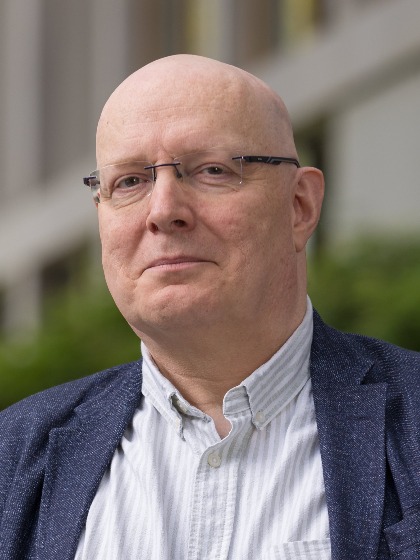
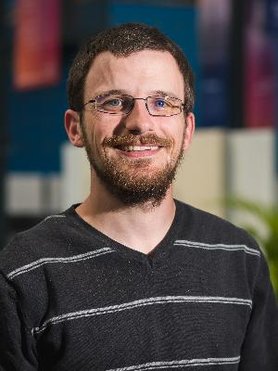
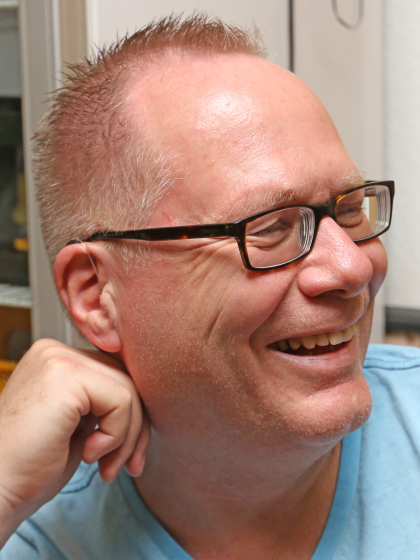
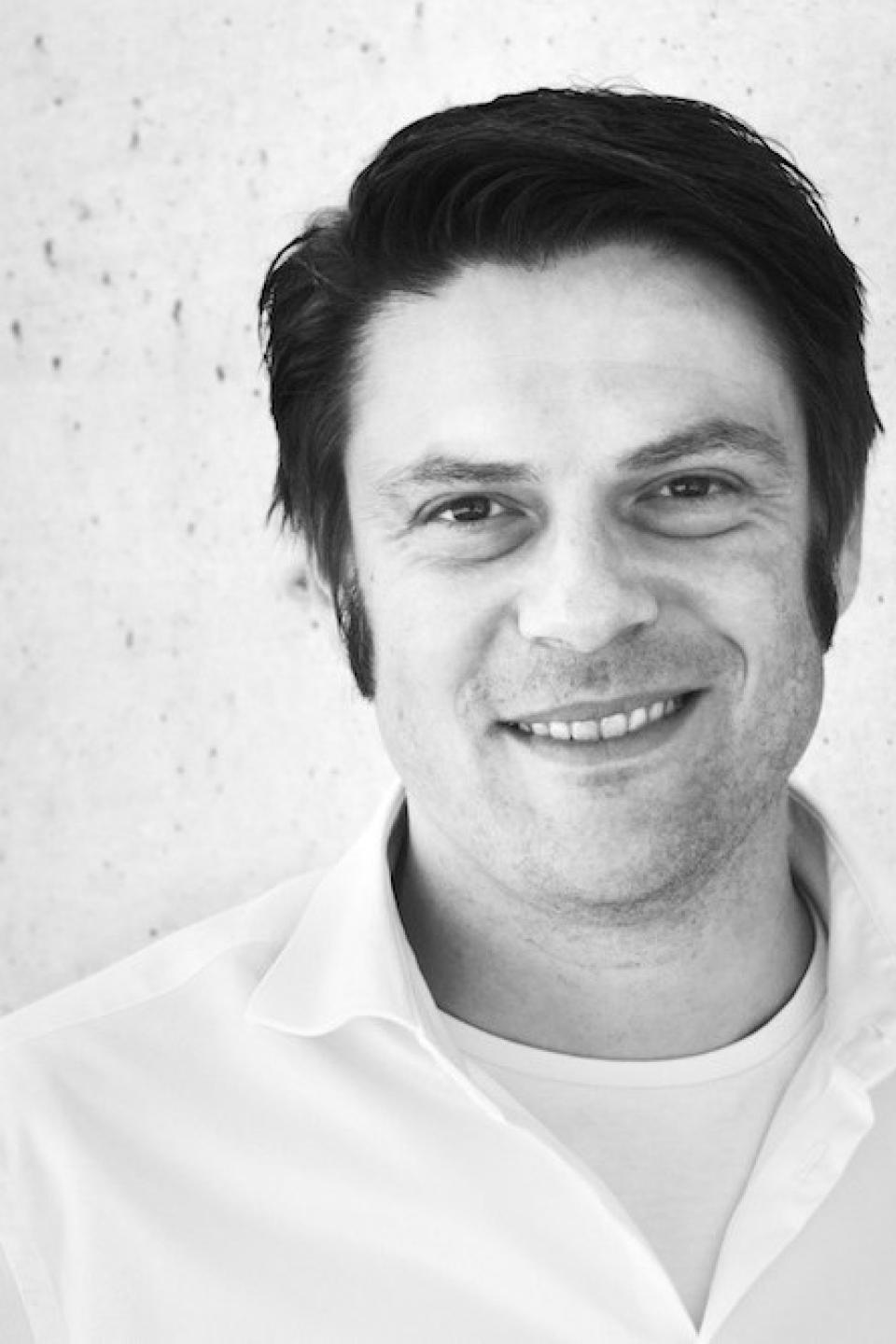
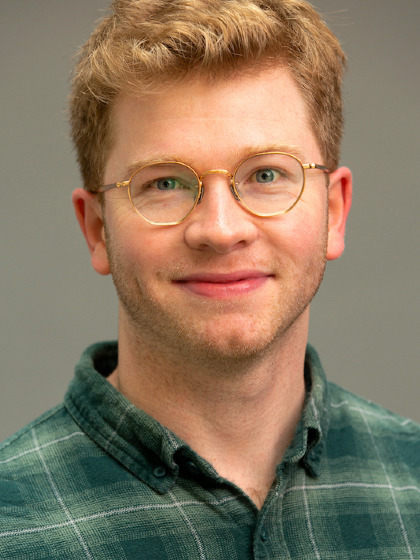
Dr. Guillermo Amador is an Assistant Professor in the Experimental Zoology department at Wageningen University & Research. His research focuses on understanding how animals interact with complex environments through locomotion, adhesion, and fluid dynamics. He investigates biological systems like insects, plants, and marine organisms to inspire bio-engineered solutions for robotics, microfluidics, and material science. Amador received his PhD in Mechanical Engineering from Georgia Institute of Technology (USA), followed by postdoctoral research at the Max Planck Institute for Intelligent Systems (Germany) and a Marie Sklodowska-Curie fellowship at TU Delft (Netherlands). His expertise spans biophysics, biomaterials, and biomechanics, with a focus on self-cleaning mechanisms and bioadhesion. He collaborates with the 4TU consortium on Dutch Soft Robotics to develop bio-inspired designs. His work bridges fundamental biology with engineering applications, emphasizing interdisciplinary approaches to solve challenges in robotics and environmental science. Amador teaches courses including Biomimetics and Functional Zoology , integrating his research into education. His research highlights include studies on cuttlefish suction cups, stick insect adhesion, and pollen transport mechanisms in pollinators.
Prof. Rob Timmermans is a Professor of Theoretical Physics and Vice-Dean for Education at the University of Groningen (UG). He is affiliated with the Faculty of Science and Engineering and the Precision Frontier — Van Swinderen Institute for Particle Physics and Gravity. His research focuses on theoretical particle physics, quantum mechanics, and precision measurements, particularly in electric dipole moment (EDM) searches using molecules like BaF. His work includes developing methods for molecular beam manipulation, phase-space analysis, and symmetry violation studies. He has contributed to collaborations such as NL-eEDM, advancing techniques for EDM detection and precision physics. Prof. Timmermans has received nominations for teaching awards, reflecting his commitment to education. Research highlights include studies on nucleon decay, antinucleon-nucleon interactions, and chiral effective field theory. His lab activities involve collaborations on laser-cooled molecules and trapping techniques. Prof. Timmermans’ articles often address fundamental physics questions, such as Lorentz violation in beta decay and parity violation in molecular systems. Awards: Nominated for Faculty Teaching Award 2014, Teacher of the Year 2014-15. Grants/Advising: Leads projects on EDM searches and particle physics, with active roles in international collaborations. Labs/Teams: Van Swinderen Institute, Precision Frontier group.
Lourens Waldorp is an Associate Professor at the University of Amsterdam within the Faculty of Social and Behavioural Sciences , specifically the Department of Psychological Methods . His research focuses on network theory, causal inference, and statistical modeling in psychology and neuroscience. University of Amsterdam IAS Fellow (2024) His research interests include: Network psychometrics Causal inference in psychological models High-dimensional statistical methods Dynamical systems in psychopathology Graph theory applications Signal processing for biophysical data The trends in his recent publications center on causal modeling, network analysis of psychopathology, and statistical techniques for time-series data. He has developed methods for perturbation graphs, moderated network models, and dynamic intervention frameworks. Notable scientific awards : IAS Fellowship for 6 months (2024) He advises PhD students like Kyra Evers and collaborates with researchers across disciplines, including J. Haslbeck , D. Borsboom , and O. Ryan . His work intersects with network theory and clinical psychology .
Ron H.J. Peerlings is Associate Professor in the Department of Mechanical Engineering at Eindhoven University of Technology (TU/e) , where he leads the Mechanics of Materials research group. Promoted to Associate Professor in 2007 after joining as Assistant Professor in 2000, he has built an extensive portfolio in theoretical and computational mechanics of materials. Education: PhD (1999) – Eindhoven University of Technology, thesis: Enhanced damage modelling for fracture and fatigue Post-doctoral research (1999–2000) – University of Cambridge, Engineering Department Research interests revolve around micromechanics , micro-plasticity , multiscale modelling , homogenisation , damage and fracture , and enriched continuum theories . His work spans advanced high-strength steels, composites, paper and fibrous networks, with strong emphasis on coupling rigorous theoretical developments to industrially motivated problems. His recent publications (2023-2025) demonstrate a clear trajectory towards integrating advanced experimental techniques (e.g., digital image correlation, micro-mechanical testing) with high-fidelity computational frameworks such as crystal-plasticity finite-element modelling, FFT-based solvers and micromorphic homogenisation. Dominant themes include: Deformation and fracture in lath martensite and dual-phase steels Hygro-mechanics of paper and fibrous networks Pattern-transforming mechanical metamaterials Discrete-to-continuum scale bridging methods Scientific awards are not explicitly listed in the provided material; however, his prolific output (294 research items, >6500 citations) attests to significant peer recognition. Teaching & supervision: He delivers courses on Computational Mechanics – Numerical Methods for Fluids and Solids and Fracture Mechanics – Theory and Application , and has supervised >80 student works and numerous PhD candidates whose names appear on joint publications. Laboratory & teams: He heads the Group Peerlings within the Mechanics of Materials cluster, maintaining close collaboration with the Mechanics of Materials Group Geers and extensive national/international experimental and computational networks.
Prof. dr. ir. C.H. (Caspar) van der Wal is a Full Professor in Physics of Quantum Devices at the Faculty of Science and Engineering , University of Groningen. His research focuses on spintronic and quantum information functionalities using electron/nuclear spins in semiconductor devices, combining quantum optical and electron transport methods. PhD in Quantum Transport (Delft University of Technology, 2001) Postdoc in Quantum Optics at Harvard University (2001-2003) Scientific Director of Zernike Institute for Advanced Materials (2016-2022) Research keywords include Quantum Optics , Spintronics , Quantum Information , and Semiconductor Physics . Recent work explores 2D/3D semiconductor heterostructures , spin defects in SiC , and transition metal dichalcogenides . His scientific contributions have earned him the NWO-Vidi Grant (2005) , ERC Starting Grant (2011) , and multiple teaching awards. Publications since 2001 span topics like quantum superpositions in superconducting circuits, spin relaxation in quantum dots, and telecom-ready spin centers in silicon carbide. Grants : NWO-Vidi (2005), ERC Starting Grant (2011) Leadership : Scientific Director, Zernike Institute (2016-2022) Teaching : Teacher of the Year (2015), Education Prize (2012) Current affiliations include the Physics of Nanodevices group at the Zernike Institute for Advanced Materials. Collaborations span institutions like MIT, Harvard, and AMOLF.
Dr. Nienke Smit is an Assistant Professor in the Department of Education at Utrecht University's Faculty of Social and Behavioural Sciences. Her research focuses on scaffolding processes, adaptive teaching, and classroom observational research from a complex dynamic systems perspective. Specializes in teacher-student interaction Expert in adaptive instruction and observational methods Collaborates with Data Science department Develops tools for classroom observation Research interests include language learning and teaching , judgment and decision-making in education , and professional development of teachers . She leads projects like Eye Get It (joint attention in classrooms) and a replication study on adaptive instruction effectiveness. Her work applies dynamic systems theory to second language development and foreign language pedagogy. Recent publications address translanguaging in multilingual classrooms, replication studies , and process-oriented research . She teaches at Utrecht's Graduate School of Teaching and works on initiatives to reduce teacher shortages through improved training programs.
Karsten Lambers is Professor of Digital and Computational Archaeology at the Faculty of Archaeology, Leiden University, where he leads research and teaching in the application of computational methods to archaeological data. His work integrates machine learning, remote sensing, text mining, and citizen science to advance archaeological prospection and heritage management. He is affiliated with the Department of Archaeological Sciences and plays key roles in research groups and university-wide initiatives such as SAILS and ARCHON. His research interests span Digital Archaeology , Machine Learning in Archaeology , Remote Sensing , Geoarchaeology , and Human-Environment Interaction . He investigates how computational tools can extract meaningful archaeological information from large datasets, including LiDAR imagery and excavation reports. His fieldwork spans Central Europe and Latin America, with a focus on prehistoric landscapes and cultural heritage. The analysis of his recent publications reveals a strong trend toward automated detection using deep learning (e.g., R-CNN, WODAN), named entity recognition in archaeological texts (e.g., ArcheoBERTje), and citizen science integration for data validation. His work bridges archaeology with computer science, geomatics, and environmental science, emphasizing interdisciplinary collaboration and methodological rigor. His scientific awards include: Best Thesis Award (University of Zurich, 2005) EUROPA NOSTRA Award (2020, 2022) Membership in the German Archaeological Institute (since 2022) Lambers actively supervises students and leads major research projects such as ABMA, EXALT, and Heritage Quest. He has secured substantial research funding and collaborates widely with computer scientists, geophysicists, and palaeoecologists. His teaching includes digital methods, modeling, and simulation, often linked to ongoing research. He has also contributed to open educational resources and digital textbooks in archaeology. He leads or participates in several research labs and teams, including the Digital Archaeology Research Group (which he chairs), the Heritage Quest citizen science project, and interdisciplinary teams focusing on alpine terraces and Iraqi prospection. His work emphasizes the integration of digital tools into practical archaeological workflows, advocating for complementary human-computer strategies.
Jacky Bourgeois is an Assistant Professor of Data-Centric Design at Delft University of Technology's Faculty of Industrial Design Engineering (IDE), leading the Data-Centric Delft Design Lab. His work bridges Human-Computer Interaction, Data Science, and Participatory Design, focusing on methods like data donation to empower collaborative data exploration. He holds a computer science background, previously researching ubiquitous technologies for domestic energy practices of 'energy farmers' (solar households). Key projects include the PROMISE study on patient-led oncological care and the Data Donation initiative promoting ethical data practices. Education: Background in Computer Science; academic focus on sustainable design engineering and IoT. Teaching includes courses like 'Data-Centric Design for...' (2024) and 'Digital Product Development' (2023). Research Interests: Data as subjective inquiry material, data intimacy, data commons, and human-data interaction in home contexts. Notable contributions include PAIRcolator for collaborative data reflection and Tangi for 360° video insights. Awards include Best Paper at CHI 2025 and DIS '24 Best Paper. Grants & Collaborations: NWO-funded research on hospital sounds (2024), IoT Rapid Proto Labs for industry-academia partnerships, and ancillary role as a scientific employee at The Open University (2025–2027). Labs & Teams: Director of the Data-Centric Delft Design Lab; collaborates with the HCI Data & Design SIG. Current projects address ethical frameworks for data donation and patient-centered healthcare systems.
Dr. Wim Biemans is an Associate Professor at the Faculty of Economics and Business of the University of Groningen, specializing in Innovation Management and Marketing. He holds a PhD from Eindhoven University of Technology (1989) and has over 25 years of experience in research, teaching, and consulting. His work focuses on service innovation, B2B marketing, customer involvement in innovation, and the marketing-sales interface. He has authored over 100 peer-reviewed articles and books, including the best-selling Dutch B2B marketing textbook. His research has been recognized with awards like the Thomas P. Hustad Best Paper Award. He serves as Triage Editor for the Journal of Product Innovation Management and editorial board member for Industrial Marketing Management and Journal of Business & Industrial Marketing. Biemans teaches at the University of Groningen and multiple international institutions, including guest professor roles in Europe, Asia, and the U.S. He also designs executive programs for managerial training in innovation management and customer value creation. His recent research explores humor’s impact on creativity, digital tools in sales-marketing integration, and bridging technology-to-product development gaps. He emphasizes end-to-end value creation through intra-organizational collaboration and has published on the Valley of Death ecosystem challenges in innovation commercialization.
Peter Werner is a Full Professor of Behavioral Economics and Policy Design at Maastricht University's School of Business and Economics, where he leads research in the Department of Economics (Microeconomics & Public Economics section). He progressed from Assistant Professor (2016-2017) to Associate Professor (2018-2023) before attaining his current full professorship, demonstrating sustained academic contribution within the institution. His educational foundation includes: Ph.D. in Economics, University of Cologne (2005-2009), thesis: 'Behavioral Economics and Agency Problems: Empirical Studies' Diplom-Volkswirt in Economics, University of Cologne and Stockholm School of Economics (1999-2005) Werner's research centers on applying behavioral insights to real-world systems , with dual focus on fundamental social preference mechanisms and practical policy design. His work bridges laboratory experiments with field applications, particularly in wage transparency , pension decision architecture , and organizational incentive structures . Recent methodological innovations integrate population-level surveys with experimental economics to measure preference stability during crises like the COVID-19 pandemic. Analysis of his 2022-2025 publications reveals expanding scope from traditional labor economics into climate behavior and intergenerational solidarity, while maintaining core expertise in experimental methodology. Key trends include increased focus on Dutch pension systems, risk communication frameworks, and cross-generational discrimination patterns using nationally representative samples. His primary recognition includes: Marie Skłodowska-Curie Individual Fellowship (2017-2019) for 'Wage transparency in companies' (Horizon 2020 Grant 745894) Werner actively secures competitive funding through major initiatives: Current: Netspar Theme Project on risk preference measurement (Instituut Gak) Recent: Netspar pension savings project (2019-2023) Past: Marie Curie Fellowship (2017-2019) He coordinates the UM Behavioral Insights Center and co-organizes the M-BEES/M-BEPS symposia series, fostering research-practice integration. As co-director of the UM Behavioral Insights Center—one of the university's research spearheads—Werner leads interdisciplinary teams applying experimental economics to public policy challenges, with particular emphasis on pension communication and labor market transparency through partnerships with Dutch governmental and financial institutions.
Javier Alonso-Mora is a Professor in the Department of Mechanical Engineering at Delft University of Technology, specializing in Learning & Autonomous Control. His research focuses on autonomous systems, robotics, motion planning, and transportation logistics, with applications in mobile manipulation, dynamic environments, and urban mobility. He leads key projects such as INTERACT (Intuitive Interaction for Robots among Humans) and ACT (Perceptive Acting Under Uncertainty), exploring human-robot interaction, autonomous vehicles, and healthcare robotics. Notable achievements include an ERC Starting Grant (2022) and a Veni Grant (2017). His work addresses challenges in robot navigation, control systems, and fleet optimization, with contributions to both theoretical advancements and practical implementations. Projects like TRiLOGy focus on sustainable water transportation, while HARMONY advances assistive robotics in healthcare. Alonso-Mora’s research leverages geometric fabrics for motion planning, probabilistic modeling for dynamic environments, and multi-agent coordination. He collaborates internationally and contributes to open-source frameworks for robotics. His recent publications emphasize safety-aware control, instance-aware semantic mapping, and adaptive systems for cluttered environments.
Rik Crutzen is a Full Professor at the Faculty of Health, Medicine and Life Sciences, Maastricht University, specializing in health promotion and digital interventions. His research focuses on leveraging technology to improve health behaviors across diverse populations, including adolescents, older adults, and immigrant communities. He leads projects in the CAPHRI research group for Promoting Health & Personalised Care. Research trends include: Digital health innovations (e.g., helplines, apps, algorithms) Chronic disease management (post-COVID-19, dementia risk) Health equity in immigrant populations (cervical cancer, maternal care) Behavioral interventions (physical activity, sleep, STI prevention) Systematic reviews and mixed-methods studies He has supervised 22 academic works and contributed to datasets on activity patterns and sleep-activity correlations. His work spans public health policy, health education, and technology integration.
Lorena Sosa is an Associate Professor at the Faculty of Law, Economics and Governance, Utrecht University, specializing in International and European Law. She is affiliated with the Netherlands Institute of Human Rights (SIM) and the research program Family & Law (UCERF). Her roles include membership of the management board of the Center for Global Challenges, Director of Education at UGlobe since 2022, and a community-engaged learning ambassador for her faculty since 2023. Education: PhD (cum laude) in Law from Tilburg University (2015), LL.M. in International Public Law (cum laude, National University of Córdoba), and a law degree from the same institution. Prior to Utrecht, she held positions at the University of Buenos Aires, University of Turku, and others. Research focuses on intersectional discrimination, gender-based violence, and human rights law. Key areas include the Istanbul Convention, feminist legal frameworks, and trans rights in criminal procedures. She employs socio-legal methods and collaborates with international organizations like the EU, Council of Europe, and UN. Publications span topics like femicide, domestic violence, and transgender experiences. Recent works include contributions to the Routledge International Handbook on Femicide and Feminicide (2023) and Preventing and Combating Violence Against Women (2023). Awards include the Marie Skłodowska-Curie Fellowship (2018), VENI Grant (2020), and the Max van der Stoel Award (2015) for her PhD on intersectionality in violence against women frameworks. Teaching includes courses on human rights law at Utrecht’s Legal Research Master, PIL Master, and University College Utrecht. She advises on projects related to victim rights, gender diversity, and empirical legal studies.
Jakob Schoeffer is a tenure-track Assistant Professor in the Artificial Intelligence department at the Bernoulli Institute for Mathematics, Computer Science and Artificial Intelligence, Faculty of Science and Engineering, University of Groningen (Netherlands). His work focuses on the intersection of human decision-making and artificial intelligence, particularly in high-stakes contexts where fairness, transparency, and appropriate human-AI collaboration are critical. Dr. Schoeffer's research interests center on responsible and explainable AI, with specific focus areas including: Human-AI collaboration dynamics in decision-making processes Fairness perceptions and interventions in AI systems Appropriate reliance on AI recommendations Explainable AI techniques for high-stakes domains Transparency mechanisms that improve human-AI team performance Label indeterminacy issues in medical AI applications His recent publications (2023-2025) reveal a strong trend toward applying AI research in critical domains like healthcare (particularly neurological recovery prediction), while maintaining a rigorous focus on the human aspects of AI deployment. His work spans both theoretical foundations of human-AI interaction and practical implementations, often employing mixed-methods approaches that combine technical AI development with behavioral studies. Dr. Schoeffer actively collaborates with researchers across institutions including the University of Texas at Austin and has made significant contributions to top conferences in AI ethics, fairness, and human-computer interaction. His research has been featured in multiple news outlets and policy discussions, indicating real-world impact of his work on responsible AI development. Prior to his current appointment, Dr. Schoeffer was a Postdoctoral Research Fellow at the University of Texas at Austin. He received his PhD from the Karlsruhe Institute of Technology (KIT) in Germany with a dissertation titled "On the Interplay of Transparency and Fairness in AI-Informed Decision-Making." He also holds a master's degree in Operations Research from Georgia Tech and industry experience as a Senior Data Scientist at IBM.
Professor Jasper van Wezel is a distinguished academic in the field of Condensed Matter Theory at the University of Amsterdam's Faculty of Science, where he serves as Professor in the Institute for Theoretical Physics (ITFA) within the Institute of Physics. With a career spanning over two decades, he has progressed from Assistant Professor (2014-2016) to Associate Professor (2016-2024) and currently holds the position of Professor since 2024. His academic journey began with a PhD in theoretical condensed matter physics from Leiden University in 2007, followed by prestigious fellowships at Argonne National Laboratory and Homerton College, Cambridge. PhD in theoretical condensed matter physics (cum laude), Leiden University, 2007 Master's diploma in theoretical condensed matter physics (cum laude), Leiden University, 2003 Dutch VWO Diploma (cum laude), Dalton Scholengemeenschap, Den Haag, 1997 US High School Diploma (cum laude), Sanford High School, Maine, USA, 1998 Professor van Wezel's research focuses on several interconnected areas within Condensed Matter Theory. His work explores competing instabilities in Charge Density Wave materials, including Superconductivity and Charge Order, Combined Charge and Orbital Order, and Transition-metal dichalcogenides. He has made significant contributions to Topology in Condensed Matter, particularly examining the Role of crystal symmetries and Topology in non-Hermitian systems. A major theme in his research involves investigating the Connections between Quantum and Classical behaviour, with special emphasis on Spontaneous Symmetry Breaking both in equilibrium (The role of the Thin Spectrum) and dynamically (Spontaneous loss of Unitarity). Analysis of Professor van Wezel's recent publications reveals a strong focus on quantum phenomena in condensed matter systems, with particular attention to topological aspects, symmetry breaking, and connections to fundamental physics concepts like black hole thermodynamics. His work often bridges theoretical concepts with potential experimental realizations, as evidenced by studies on electron patterns in materials like TaS2 and theoretical frameworks for understanding quantum phase transitions. Bristol Physics Teaching Award (2014) Students' Award for Outstanding Teaching (2014) Fellow of the Higher Education Academy (2014) Aneesur Rahman Fellowship at Argonne National Laboratory (2010-2012) Junior Research Fellowship at Homerton College, Cambridge (2007-2010) Physics 'Discovery of the year' by Leiden University Physics department (2005) 'Onderwijsprijs Natuurkunde' teaching award (2004/2005) Professor van Wezel has secured numerous research grants including an ENW-M grant (2023), an ENW-Groot project with Leiden University (2021), and a prestigious VIDI personal grant from NWO (2014). He has supervised over 50 students at various levels, including PhD candidates, MSc students, and BSc students, fostering the next generation of physicists. His leadership extends to organizing conferences, serving on PhD committees, and holding administrative roles such as chair of the educational committee for the Dutch Research School in Theoretical Physics. His research group at the University of Amsterdam's Institute for Theoretical Physics maintains active collaborations with institutions worldwide, including Leiden University, University of Cambridge, University of Bristol, and research centers in France, Germany, and Poland. The group's work combines analytical theoretical approaches with computational methods to tackle fundamental questions in quantum condensed matter physics.