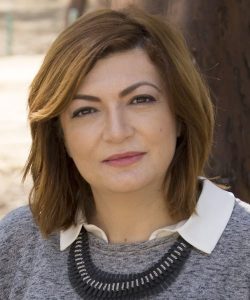
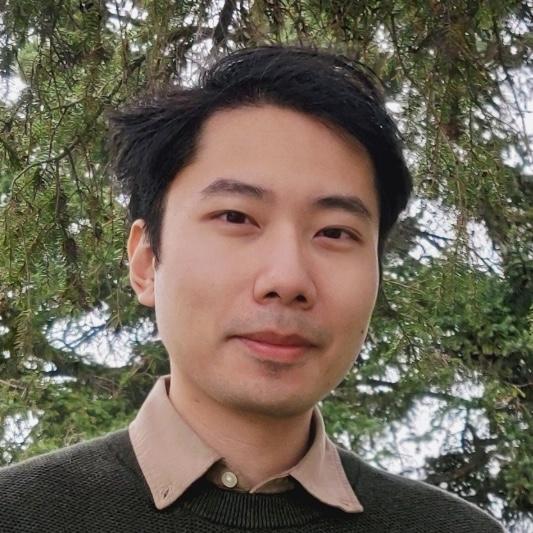
Rachel Oliver is a Professor of Materials Science at the University of Cambridge and Director of the Cambridge Centre for Gallium Nitride. Her research focuses on characterisation techniques for gallium nitride materials used in LEDs and laser diodes, with an emphasis on nanostructure engineering and quantum technology. Awarded OBE (2025), Fellow of the Royal Academy of Engineering (FREng) (2021), and Fellow of the Institute of Materials, Minerals and Mining (FIMMM) (2019) Developed atom-probe tomography and scanning capacitance microscopy to study nitride devices Her work on quantum dots and single-photon emitters has advanced quantum crystallography and optoelectronics. Recent publications highlight trends in nitride semiconductors , solar cell efficiency , and quantum device fabrication . Scientific Awards Royal Society University Research Fellowship (2006-2011) Chair in Emerging Technologies (2023) Grants EPSRC grant for semi-polar nitride structures Oliver's lab at the Department of Materials Science and Metallurgy explores nanoscale nitride structures for future devices, while advocating for gender equality in STEM.
Daniel G Georgiev is a Professor in the Department of Electrical Engineering and Computer Science at the University of Toledo's College of Engineering. He has been on faculty since Fall 2006, following prior roles as a research faculty member at Wayne State University's Center for Smart Sensors and Integrated Microsystems (SSIM). Education : M.S. in Engineering Physics (Quantum Electronics and Laser Equipment) from Sofia University (1994), Ph.D. in Electrical Engineering (Electronic Materials and Devices) from the University of Cincinnati (2003). Research Interests : Dr. Georgiev's work focuses on laser modification and micro-structuring of materials, thin films of semiconducting oxides/nitrides (e.g., NiO, Zn3N2), glassy materials, metal whiskers (Sn, Cu), wide bandgap semiconductors (GaN, Zn3N2), photovoltaics, and biomedical device applications. His expertise spans device fabrication, material characterization, and radiation effects. Article Trends : Recent publications emphasize GaN-based power electronics, hybrid edge termination structures, threshold switching in nanocircuitries, and material innovations via reactive sputtering. Subfields include laser microstructuring, whisker suppression in Sn films, and doping strategies for nitride semiconductors. Collaborations : Co-authorship with researchers across institutions, including contributions to biomedical implants, II-VI nanocrystals, and chalcogenide glasses.
Brett Gordon is an Associate Professor in Exercise Physiology and Head of Department for Rural Clinical Sciences at La Trobe University's Rural Health School in Bendigo, Australia. He is also an Accredited Exercise Physiologist (AEP) with over a decade of academic experience and nearly ten years of clinical practice. PhD from Royal Melbourne Institute of Technology University (2012) MAppSc (Exercise Rehabilitation) from Victoria University BAppSci (Human Movement) from Royal Melbourne Institute of Technology University Professor Gordon's research focuses on the role of exercise in managing chronic disease, particularly examining how exercise can be optimally assessed and prescribed for people with cardiometabolic health conditions. His work utilizes continuous glucose monitoring systems, accelerometers, and GPS monitors to study both healthy individuals and those with health conditions. Early in his career, he investigated exercise benefits for children with chronic fatigue syndrome before shifting focus to cardiometabolic health. Analysis of his recent publications reveals a strong emphasis on practical applications of exercise physiology in real-world settings, particularly in rural communities. His research spans walking football programs for older adults, optimal exercise dosing for cardiac rehabilitation, e-bike health benefits, military transition health issues, and telehealth applications for cardiac rehabilitation. A consistent theme across his work is addressing health disparities in rural populations. Member of Exercise and Sports Science Australia (ESSA), Research Committee Associate Editor for Frontiers in Sports and Active Living Member of Scientific Reports Editorial Board Member of American Association of Cardiovascular and Pulmonary Rehabilitation Professor Gordon has successfully supervised numerous students to completion, including 3 honours students (all H1), 1 master's student, and 5 doctoral students. He currently supervises 5 PhD candidates and 2 Master by Research candidates. His funded research includes projects on walking football for older adults and exercise demands in adolescent athletes. He maintains a broad collaborative network including institutions such as Auckland, Swinburne, Sheffield Hallam, Murdoch, RMIT, and Deakin universities, as well as Bendigo Health, The Austin Hospital, and the Baker IDI Heart and Diabetes Institute. His current research projects focus on prediabetes, diabetes, heart disease, hospital care, military transition, and resistance training, demonstrating his commitment to translating exercise science into practical health interventions for diverse populations.
Deepti Raghavan serves as Assistant Professor in Brown University's Department of Computer Science, specializing in operating systems, networking, and machine learning systems. Her research develops novel networked abstractions to optimize data movement in distributed applications through API redesign. Her educational background includes: PhD in Computer Science from Stanford University (2024) MEng in Computer Science from Massachusetts Institute of Technology (2018) BS in Computer Science from Massachusetts Institute of Technology (2017) Her research integrates systems infrastructure with machine learning workloads , focusing on performance-critical communication patterns. Key innovations include zero-copy serialization techniques and network orchestrators for compound AI systems, bridging theoretical advances with practical deployment in cloud environments. Publication trends (2018-2024) reveal consistent contributions to high-performance networking and ML systems, with increasing focus on AI infrastructure. Her work shows strong collaboration patterns with Stanford/MIT researchers and addresses fundamental challenges in data movement efficiency across distributed systems. Scientific recognition includes: National Science Foundation Graduate Research Fellowship (2019) Stanford School of Engineering Fellowship (2018-2019) Distinguished Artifact Award at SOSP 2023 Best Paper Award at Usenix ATC 2018 She actively recruits PhD students for her research group and teaches advanced systems courses including Cloud and Datacenter Operating Systems. Her research is supported by prestigious fellowships and likely NSF grants, with teaching responsibilities spanning graduate seminars and core undergraduate systems education. Her research group collaborates with Stanford's Systems Lab and MIT's CSAIL Networks group, maintaining strong ties to the Networks and Mobile Systems research community. Current projects focus on next-generation abstractions for AI-driven networked applications.
Dr. Yasmine Abdin serves as an Assistant Professor in the Department of Materials Engineering within the Faculty of Applied Science at the University of British Columbia (UBC). Her research focuses on advancing polymer matrix composite materials through innovative digital simulation and probabilistic design methodologies. Her academic credentials include: B.Sc. from KU Leuven M.Sc. from KU Leuven Ph.D. from KU Leuven Dr. Abdin's research program centers on overcoming limitations in composite material durability through probabilistic design frameworks and multi-scale modeling. She integrates finite element analysis, machine learning, and Industry 4.0 technologies to predict structural reliability under stochastic service conditions, with emphasis on damage tolerance, manufacturing-process-structure relationships, and optimization of carbon fiber production from sustainable precursors like lignin and asphaltenes. Her recent publications (2023-2025) demonstrate strong focus on sustainable composite manufacturing, including carbon fiber production from renewable resources, 4D printing of shape memory polymers, flax fiber-reinforced composites, cellulose nanofibril modification, and fatigue behavior analysis. Key thematic trends include the convergence of digital twin technologies with composite manufacturing, sustainable precursor development, and the application of machine learning to enhance modeling efficiency in structural reliability prediction. Information regarding doctoral students, research grants, laboratory facilities, or scientific awards was not provided in available sources.
Prof. Dr.-Ing. Katharina Schmitz serves as Institute Director and Vice Dean at the Institute for Fluid Power Drives and Systems, RWTH Aachen University. Her leadership within the Production Technology Cluster and extensive contributions to fluid power engineering establish her as a leading authority in mechanical engineering research and education. Her research spans fluid power systems, hydraulic component design, tribology, and physics-informed machine learning applications. She pioneers sustainable propulsion solutions through bio-hybrid fuels research while addressing fundamental challenges in polymer material behavior under hydraulic stresses. Current work focuses on carbon-neutral heavy-duty transportation, physics-based neural networks for lubrication modeling, and advanced control systems for electro-hydraulic actuators. Analysis of her 15 most recent publications reveals a dominant trend toward integrating physics-based modeling with deep learning to solve complex engineering problems. Her team consistently develops novel frameworks for cavitation prediction, flow rate determination, and material compatibility assessment - significantly advancing fluid power system reliability, efficiency, and digitalization. Scientific recognition includes: GfT Förderpreis 2023 for experimental and simulative investigation of partially hydrostatic relieved contacts in variable speed axial piston machines As head of the Institute for Fluid Power Drives and Systems, she leads cutting-edge research in sustainable fluid power technologies. The institute maintains strong industry partnerships while driving innovation in hydraulic component design, digital twins for condition monitoring, and next-generation propulsion systems through its position within RWTH Aachen's Production Technology Cluster.
Prof. Indranil Gupta (Indy) is a Professor of Computer Science at the University of Illinois at Urbana-Champaign, affiliated with the Beckman Institute and ECE department. His research focuses on distributed systems, including cloud computing, IoT, and machine learning systems. He leads the Distributed Protocols Research Group (DPRG) and collaborates with industry to improve production systems. Indy is an IEEE Fellow, ACM Distinguished Scientist, and recipient of the NSF CAREER Award and multiple Best Paper Awards. Education: PhD in Computer Science from Cornell University (2004), B.Tech from IIT Madras (1998). Industry experience includes roles at Google, Microsoft Research, and IBM Research. Teaching: Teaches CS 425 (Distributed Systems), CS 525 (Advanced Distributed Systems), and a Coursera MOOC with 250K+ enrollments. Known for innovative teaching methods, including music-based CS education. Awards: Over a dozen awards including Best Paper recognitions at IC2E, CCGrid, and ICAC. His students have won NSF Fellowships, Rising Stars in EECS, and Microsoft Dissertation Grants. Service: Served as General Chair of ACM PODC 2007, PC co-chair for multiple conferences, and editorial board member for IEEE TCC and ACM TAAS. Hosts the podcast 'Immigrant Computer Scientists.' Research Impact: Contributions include fault-tolerant protocols (e.g., Zeno, SWIM), distributed ML systems, and cloud resource management techniques used by major tech companies.
Dr. Mei-Ling Ting Lee is a Professor in the Department of Epidemiology and Biostatistics at the University of Maryland, College Park. She specializes in developing statistical models, notably the first hitting-time based threshold regression (TR) for analyzing time-to-event survival data, which has been extended to machine learning applications. As the Founding Editor and Editor-in-Chief of the Lifetime Data Analysis journal, she has significantly contributed to the field of time-to-event data methodologies. Her research encompasses genomic data analysis, statistical distribution theory, nonparametric methods, and applications in epidemiology. Dr. Lee has authored over 150 peer-reviewed articles and a seminal monograph, Analysis of Microarray Gene Expression Data (2004), widely used in genomic research. She has also co-edited influential books, including Lifetime Data Models in Reliability and Survival Analysis (1995) and Risk Assessment and Evaluation of Prediction (2013). Education: BS in Mathematics (National Taiwan University), MS (National Tsing Hua University), MA and PhD in Mathematics/Statistics (University of Pittsburgh). Her work focuses on integrating statistical theory with practical applications, including clinical trials, genomic studies, and public health research. She leads initiatives in statistical software development (e.g., R packages like clusrank ) and advocates for rigorous methodological standards in survival analysis.
Yevgen Biletskiy is a Professor in the Department of Electrical and Computer Engineering at the University of New Brunswick (UNB), Fredericton. His academic roles include serving as Co-Director of the RuleML Initiative and Program Co-Chair of RuleML-2007. He holds a Ph.D. and is a licensed Professional Engineer (P.Eng.) in New Brunswick. His teaching spans graduate and undergraduate courses in software engineering, digital systems, and power electronics, including EE 6263 (Knowledge Representation for Software Engineering) and EE 6213 (Advanced Digital Systems). Research Interests: His work focuses on Knowledge-Based Systems , Artificial Intelligence , Semantic Web , Information Extraction , FPGA-based Design , and Renewable Energy . He has supervised over 40 graduate and undergraduate students, including 3 active PhD candidates, 1 completed PhD, 9 Masters, and 30+ research-based Bachelors. Publications: Over 100 peer-reviewed articles, including recent contributions on smart grid optimization, fault diagnosis in power electronics, and ontology-driven systems. Notable works include frameworks for semantic interoperability, rule-based learning systems, and FPGA applications. Professional Activities: Served as a reviewer for NSERC grants, IEEE journals (e.g., TKDE, TE), and conferences (CDC, WTAS). He has chaired tracks at international conferences and contributed to industry partnerships through consulting roles with firms like Netsphare Solutions and Vox Interactif. Labs/Teams: Active in UNB’s research initiatives involving power systems, semantic web technologies, and e-learning systems. His lab collaborates on projects like SEMESIS (semantic search systems) and advanced manufacturing post-processing techniques.
Renata Dividino is an Assistant Professor in the Department of Computer Science at Brock University, Canada. She holds a BSc from the University of Campinas (Brazil), an MSc from Universität des Saarlandes (Germany), and a PhD from Universität Koblenz – Landau (Germany). Her research focuses on graph knowledge representation, machine learning, and their applications in web science, semantic web foundations, and provenance systems. She has worked at institutions like DFKI, Fraunhofer IGD, and the Big Data Analytics Lab at Dalhousie University, bridging academic and industrial sectors. Her industry experience includes roles as an AI Scientist and Director of Data Science in the maritime sector, where she developed patented technologies for AI-driven maritime operations and risk assessment systems. Key research contributions include improving AI system reliability via provenance analysis and advancing knowledge graph applications. Education: BSc in Computer Science, University of Campinas MSc in Computer Science, Universität des Saarlandes PhD in Computer Science, Universität Koblenz – Landau Research Interests: Provenance systems, semantic web foundations, knowledge graphs, graph-based AI, maritime AI applications, and federated learning. Her work emphasizes practical applications in complex networks, web-scale data, and social networks. Awards: No specific awards mentioned, but her contributions include patented technologies and peer-reviewed publications on provenance-driven AI transparency. Advising & Grants: Secured industry grants for R&D projects in maritime AI and data science. Her work on vessel risk assessment and infectious disease prediction demonstrates applied research impact.
Kallol Sett is an Associate Professor in the Department of Civil, Structural and Environmental Engineering at the University at Buffalo (SUNY), within the School of Engineering and Applied Sciences. His research focuses on risk and reliability analysis of civil infrastructure under extreme events, with expertise in uncertainty quantification, multi-hazard resilience, and geomechanics. He leads the Risk and Reliability Research Group, which develops computational tools integrating physics-based and data-driven modeling, stochastic calculus, and high-performance computing. Education includes a PhD from the University of California, Davis (2007), an MS from the University of Houston (2003), and a BE from Jadavpur University (1997). His work is funded by NASA, NSF, USDOT, NIST, and industry partners. Key research themes include probabilistic geotechnical site characterization, stochastic simulation of seismic ground motion, and life-cycle cost-benefit analysis of infrastructure systems. Advising includes mentoring over 10 PhD and MS students, with notable alumni now in academia and industry roles such as Assistant Professors at Embry-Riddle Aeronautical University and Tianjin University. His lab’s recent studies address real-time decision support systems for hurricane-impacted infrastructure, resilience deficit indices, and multi-hazard financial risk assessment of integrated infrastructure systems.
Kostas Magoutis is Professor and Chair of the Computer Science Department at the University of Crete and collaborating researcher with FORTH-ICS. His research focuses on distributed systems, scalable data processing, IoT, and cloud computing, with projects including GreenInCities for urban regeneration and STREAMSTORE for stateful stream processing systems. Research interests include: Distributed computer systems architecture Elastic stream processing platforms Quantum-enhanced computing applications Multi-cloud application lifecycle management Recent publications demonstrate strong focus on federated data systems, quantum computing applications, and IoT-enhanced infrastructure, with consistent output in high-impact conferences and journals. Awards and distinctions: Multiple best paper awards from USENIX conferences Grand Challenge Audience Award at DEBS 2022 Marie Curie Fellowship and IBM Research awards Advises over 20 PhD and MSc students in distributed systems research. Leads multiple EU-funded projects and serves on program committees for top conferences including SOSP, EuroSys, and IEEE BigData. Directs research groups in distributed systems and cloud computing at FORTH-ICS.
Babak Mehran is an Associate Professor in the Department of Civil Engineering at the University of Manitoba (Price Faculty of Engineering). He holds a PhD in Civil Engineering from Nagoya University (2009). His research focuses on transportation network resilience, big data analytics, and AI-driven solutions for traffic management. He leads the Urban Mobility and Transportation Informatics Group (UMTIG), collaborating with government and industry on applied transportation research. Key research areas include autonomous vehicle integration, cold-region traffic vulnerability, and optimization of public transit systems. Dr. Mehran has advised graduate students on topics like traffic safety, sensor placement, and semi-flexible transit design. His work bridges theoretical models (e.g., reinforcement learning algorithms) with real-world applications such as winter road maintenance strategies and transit demand analysis. Recent publications emphasize AI-driven traffic prediction, climate adaptation for infrastructure resilience, and safety metrics for truck operations in harsh environments. He collaborates internationally on transportation policy and has contributed to methodologies for evaluating congestion relief strategies using travel time reliability analysis. Lab: Urban Mobility and Transportation Informatics Group (UMTIG) Key Partners: Government agencies, transportation industries, academic collaborators Current Focus: Autonomous shared mobility, cold-climate traffic systems, data fusion for traffic monitoring
Maria K. Michael is an Associate Professor at the Electrical and Computer Engineering Department (ECE), University of Cyprus, and a cofounding faculty member of the KIOS Center of Excellence. She leads the Center’s Education and Training activities and coordinates the MSc program in Intelligent Critical Infrastructure Systems, a collaboration between UCY, KIOS CoE, and Imperial College London. Her expertise spans dependability, security, and reliability in cyber-physical systems, embedded systems, and AI/ML optimization for edge intelligence. Education: BSc in Computer Science MSc in Computer Science Ph.D. in Engineering Sciences (Computer Engineering), Southern Illinois University, USA Research Focus: Hardware-enabled security, cyber-security in intelligent embedded systems, reliability of edge-based accelerators, and applications in smart grids, UAVs, robotics, and autonomous vehicles. Her work emphasizes safety-critical systems and resource-constrained environments. Grants & Team: Leads a 15-member research team (postdocs, PhD/MSc/BSc students). Funded by EU FP7, H2020, Horizon Europe, NSF, Intel Corp., and the Cyprus Research and Innovation Foundation. No scientific awards listed explicitly in provided text. Labs & Initiatives: Director of Education/Training at KIOS CoE; core contributor to the MSc program in Intelligent Critical Infrastructure Systems.
Tse-Hsun (Peter) Chen is an Associate Professor in the Department of Computer Science and Software Engineering at Concordia University, Montreal. He leads the Software PErformance, Analysis, and Reliability (SPEAR) lab, focusing on improving software quality through log analysis, AIOps, and mining software repositories. His research collaborates with companies like Microsoft, BlackBerry, and Ericsson. Education: PhD, MSc, and BSc in Computer Science from Queen's University and the University of British Columbia. Awards include the Gina Cody Research Award (2021) and recognition as one of the world's most active software engineering researchers (JSS study). Research interests include software testing, DevOps, and leveraging LLMs for SE tasks. Recent work emphasizes log parsing with LLMs (e.g., LibreLog) and fault localization. Graduates from his lab hold academic positions at institutions like York University and DePaul University. Teaching includes courses on software verification, testing, and process management. Active in program committees for ICSE, FSE, and MSR. Over 50 publications in top venues like TSE, ICSE, and FSE.