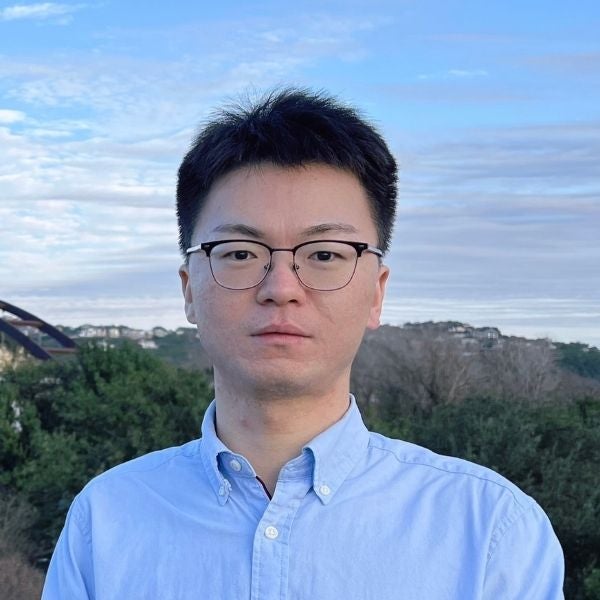
Yang Sui is a Postdoctoral Research Associate in the Department of Computer Science at Rice University, collaborating with Professors Xia (Ben) Hu and Hanjie Chen. His research focuses on Efficient AI and Trustworthy AI, including deep neural networks, large language models (LLMs), diffusion models, and algorithm-hardware co-design. He holds a PhD from Rutgers University (2024), an MS from Jilin University (2019), and a BS from Jilin University (2016). Education: PhD, Computer Science, Rutgers University, 2024 MS, Computer Science, Jilin University, 2019 BS, Computer Science, Jilin University, 2016 Research Interests: Efficient AI: Model Compression (pruning, quantization, low-rank decomposition), Generative AI (diffusion models, LLMs), and algorithm-hardware co-design. Trustworthy AI: Adversarial robustness (backdoor attacks, vulnerability detection). He has interned at Snap Research (2024), Tencent America (2022), and Baidu (2018), contributing to projects like BitsFusion quantization and Paddle-Lite framework. Awards: Paul Panayotatos Scholarship (2024) Best Paper Runner-Up Award (DCAA Workshop at AAAI 2023) First Place in ESWEEK Classification Track (2023) SGS Travel Award (2023) Advising & Grants: Advises students on topics like LLM quantization and multimodal models. Collaborates with industry and academia on grants related to efficient AI and hardware co-design. Led projects like Rice’s “Efficient Deep Learning Reading Group” (2023). Labs & Teams: Contributes to Snap’s Creative Vision team, Rutgers’ research groups, and co-design initiatives with industry partners like Baidu and Tencent.
Francesco Erspamer is a Professor of Romance Languages and Literatures (Italian) and Section Leader at Harvard University's Department of Romance Languages and Literatures. He holds a Laurea in Lettere and a Diploma di perfezionamento from Università di Roma "La Sapienza". His research focuses on Renaissance culture, intellectual history, modern/contemporary Italian novels, and the intersection of literature and politics. He contributes to Harvard Diary (Rai International) weekly and organizes the Zerilli-Marimò Prize for Italian Fiction. He teaches courses like ITALIAN 201R (De Bosis Colloquium) and ITALIAN 111 (Italian Cinema) in Spring 2026. His publications span critical editions of Renaissance texts, analyses of Italian literary history, and explorations of cultural modernity. Erspamer’s work bridges textual scholarship with broader cultural critiques, emphasizing historical context and interdisciplinary approaches. Key Contributions: Founded and oversees the Zerilli-Marimò Prize for Italian Fiction Regular contributor to Rivista dei libri Edited major works by Pietro Aretino and Sannazaro Research Trends: His scholarship spans 16th-century Italian literature, cultural history, and modern Italian narratives. Recent works (2010–2009) address cultural critiques and modernity, while earlier studies (1982–1998) focus on Renaissance epistolary forms, Petrarchan influence, and Arcadian lyricism.
Lorraine Li is an Assistant Professor in the Department of Computer Science at the University of Pittsburgh, affiliated with the Interdisciplinary Science Program (ISP) and the School of Computing and Information. She holds a PhD from the University of Massachusetts Amherst (2022) and conducted postdoctoral research at AI2's Mosaic team. Her work focuses on NLP, machine learning, and socially responsible AI systems. Education: PhD in Computer Science (UMass Amherst, 2022) Research explores evaluation frameworks for commonsense knowledge, model interpretability, and ethical AI applications in domains like education and law. Key interests include probabilistic models, long-tail reasoning, and geographic robustness in LLMs. Recent publications address confirmation bias in reasoning chains (ACL 2025), geographically diverse prompting (CVPR 2024), and uncommon scenario reasoning (NAACL 2024). She co-organized the AAAI 2024 Make symposium and serves on committees for ACL, EMNLP, and NAACL. Grants: Pitt Cyber funding (2024) Lab: Pitt NLP Seminar group
Peter Scheiblechner is a Lecturer at Lucerne University of Applied Sciences and Arts' School of Engineering and Architecture, within the Department of Natural and Humanities Sciences (ING). He holds a PhD in Mathematics from the University of Paderborn (2007) and has held academic positions including Visiting Assistant Professor at Purdue University (2010-2011) and Postdoc at the Hausdorff Center for Mathematics (2011-2012). His business experience includes software development roles at companies like ClassWare GmbH and UBS in Switzerland. Education: PhD in Mathematics, University of Paderborn (2007) Master's in Mathematics (minor: Physics), Albert-Ludwigs University Freiburg (1997) Bachelor's in Mathematics (minor: Physics), Philipps-University Marburg (1993) High School Diploma, Martin-Luther-Schule Marburg (1991) Research Interests: Focus on applying statistics, data analysis, and machine learning to real-world problems; computational algebra/geometry/topology with complexity theory; algebraic and classical complexity theory. Active in projects like ENFLATE (flexibility markets), COSMOS Data Cockpit (personalized medicine), and topological data analysis. Publications: Over 10 peer-reviewed articles in journals like Journal of Symbolic Computation , Foundations of Computational Mathematics , and Communications in Contemporary Mathematics , with focuses on algorithmic algebraic geometry, complexity analysis, and topological computations. Awards: DFG fellowship (2008-2010), 3rd place in German Mathematics Competition (1991), and regional championship in Hessen (1985/86). Teaching: Teaches mathematics, physics, statistics, and numerical methods at bachelor and master levels, including courses on differential equations, linear algebra, stochastic processes, and engineering applications.
Dr. Allen Herman is a Professor in the Department of Mathematics and Statistics at the University of Regina, where he also serves as PIMS Site Director and Chair of the Research Committee. He has been with the university since 1995, progressing from Lecturer to his current position as full Professor. Dr. Herman received his Ph.D. in Mathematical Sciences from the University of Alberta in 1995, following an M.Sc. in Mathematics (also from Alberta) in 1992, and a B.Ed. from the University of Lethbridge in 1988. Dr. Herman's research focuses on the intersection of algebra and combinatorics, with particular expertise in representation theory, association schemes, and computational algebra. His work explores the algebraic structure of adjacency algebras, coherent configurations, and Terwilliger algebras. He has made significant contributions to understanding the representation theory of finite groups and the units of group algebras. His research often involves computational approaches, as evidenced by his development of software tools like wedderga for the GAP system. Dr. Herman's recent publications demonstrate a continued focus on association schemes and their algebraic structures. His work spans theoretical investigations of Schur indices, table algebras, reality-based algebras, and computational methods. A notable trend is his exploration of connections between combinatorial structures and algebraic properties, particularly in the context of representation theory. Dr. Herman has supervised numerous graduate students throughout his career, mentoring researchers who have gone on to make their own contributions to algebra and combinatorics. His research has been supported by multiple NSERC Discovery Grants and Mitacs Globalink Summer Student Fellowships. Dr. Herman maintains active collaborations with researchers internationally, including visits to institutions such as the University of St. Andrews, University of Murcia, and University of Florida. He is particularly known for his work on the computational aspects of representation theory and his contributions to the GAP software system through the wedderga package.
Liang Tao is a Professor of Linguistics and the Chinese Coordinator at the College of Arts and Sciences, Ohio University. He is affiliated with the Department of Linguistics and contributes significantly to the fields of Chinese linguistics, discourse analysis, and psycholinguistics. Education: Ph.D. in Linguistics, University of Colorado, Boulder, 1993 Cognitive Science Certificate, Institute of Cognitive Science, University of Colorado, Boulder, 1993 Liang Tao’s research focuses on interactional linguistics and discourse analysis of Mandarin Chinese, with an emphasis on usage-based models of language and grammaticalization. His work explores second language learning, particularly the cognitive mechanisms of memory and their pedagogical implications. He investigates the grammar of Chinese and English, psycholinguistic processing, and the interplay between language, culture, and cognition. His recent publications highlight self-repair in conversation, tone perception, and metalinguistic awareness in language learners. The 15 most recent articles reflect a strong trend in discourse processing, particularly in Mandarin Chinese conversation, with subfields including self-repair, tone perception, usage-based change, and bilingual processing. Keywords span psycholinguistics, cognitive science, and language acquisition, indicating an interdisciplinary approach grounded in empirical and theoretical linguistics. Scientific Awards: Fellow, Psychonomic Society Liang Tao has been involved in research grants, including serving as Principal Investigator on the Ohio University 1804 Grant for improving pronunciation in Chinese learners using speech recognition strategies. He has collaborated extensively with researchers such as Chao-Yang Lee, Alice F. Healy, and Zinny Bond on projects related to speech perception and cognitive processing. Though a grant proposal to the US Department of Education was denied, his ongoing research activity is evident through regular presentations at national and international conferences. While no specific lab or research team is named, his frequent collaborations and focus on experimental psycholinguistics suggest an active research group or network, particularly in speech processing and second language acquisition at Ohio University.
Jason McCullough is an Associate Professor of Mathematics and co-director of the Postbaccalaureate Certificate Program at Iowa State University. He holds the Scott Hanna Faculty Fellow title. His research focuses on commutative algebra, computational algebra, and algebraic geometry, with notable work disproving the Eisenbud-Goto conjecture, a major breakthrough recognized in the Journal of the American Mathematical Society (2018). He co-organizes the CA+ conference series and leads initiatives to support non-traditional students in mathematics. Education: Ph.D., Mathematics, University of Illinois, 2009 M.S., Teaching of Mathematics, University of Illinois, 2008 B.S., Mathematics and Computer Science, Michigan State University, 2003 His research emphasizes algebraic structures and computational methods. Recent work includes studies on Rees-like algebras, matroid theory, and regularity in algebraic geometry. He actively participates in global conferences, such as the BIRS Workshop (2026) and SIAM Conference (2025), and advocates for open-access publishing, joining the Elsevier boycott in 2021. Awards: Scott Hanna Faculty Fellow, Iowa State University, 2020 He mentors the ISMaRT undergraduate research program and co-directs the postbaccalaureate certificate program, fostering diversity in mathematics. Leadership roles include organizing conferences like KUMUNU (2018) and CA+ (2025), emphasizing collaboration across institutions.
Christian Lomp is an Associate Professor in the Department of Mathematics at the Faculty of Science, University of Porto, Portugal. He has held academic positions at the university since 1998, advancing from Teaching Assistant to his current rank. He serves as the head of the Department of Mathematics (elected in 2025) and was previously the director of the Master’s program in Mathematics from 2022 to 2024. PhD Mathematics, Universität Düsseldorf, 2002 Agregação (Habilitation), University of Porto, 2011 MSc and Diplom in Mathematics, Universität Düsseldorf and University of Glasgow, 1997 Diplom Informatik, Fernuni-Hagen, 2019 His research lies primarily in algebra, focusing on Ring and Module Theory , Hopf Algebras and Their Actions on Rings , Coalgebras , and Algebraic Coding Theory . His work bridges abstract algebra with structures relevant to noncommutative geometry and quantum algebra. He has published extensively in top-tier journals such as the Proceedings of the American Mathematical Society, Journal of Pure and Applied Algebra, and Communications in Algebra. The 15 most recent publications reflect a sustained focus on Hopf algebras, skew polynomial rings, module-theoretic properties, and quantum algebraic structures. Themes include representation theory, injective modules, semiprime conditions, and differential smoothness, indicating deep engagement with both classical and modern aspects of noncommutative algebra. Christian Lomp is a member of the editorial boards of several journals, including: International Electronic Journal of Algebra Mathematical Proceedings of the Royal Irish Academy Palestinian Journal of Mathematics Moroccan Journal of Algebra and Geometry with Applications He has supervised 6 PhD students and 8 Master’s students , and has mentored postdoctoral researchers from institutions in Iran, Turkey, and Brazil. His research has been supported by the Simons Foundation. He has also delivered invited lectures and mini-courses at universities in Turkey, China, Brazil, Poland, and Germany, demonstrating international recognition and academic collaboration. He leads an active research group in algebra at the University of Porto and is involved in organizing academic events, such as the international conference on noncommutative rings and applications held in Lens, France, in 2017.
John Jasper is an Assistant Professor in the Department of Mathematics and Statistics at the Air Force Institute of Technology (AFIT), Wright-Patterson Air Force Base, Ohio. He holds a PhD in Mathematics from the University of Oregon and has previously served as a postdoc at the University of Missouri, a visiting assistant professor at the University of Cincinnati, and an assistant professor at South Dakota State University. Education: PhD in Mathematics, University of Oregon (2011), advised by Marcin Bownik His research centers on frame theory, operator theory, and packing problems , with strong connections to harmonic analysis, combinatorics, algebra, and discrete geometry. His work explores the structure and construction of equiangular tight frames, Grassmannian codes, and the diagonals of self-adjoint operators, often using group actions and finite field geometries. Many of his recent publications focus on optimal arrangements of lines and vectors in complex and real spaces, with applications in signal processing and quantum information. The 15 most recent publications reflect a consistent research trajectory in mathematical signal processing , particularly in constructing optimal configurations of vectors using combinatorial and algebraic methods. Key themes include equiangular tight frames, Grassmannian packings, operator diagonals, and finite field frame theory. These works frequently appear in high-impact journals such as IEEE Transactions on Information Theory , Applied and Computational Harmonic Analysis , and Linear Algebra and its Applications . Scientific Awards and Honors: No awards explicitly listed in the provided text. Advising and Grants: While no formal list of students is provided, John Jasper collaborates extensively with leading researchers such as Matthew Fickus, Dustin G. Mixon, Marcin Bownik, and Emily King. His research is supported in part by the National Science Foundation. He co-organizes the CodEx Seminar, a pan-university remote seminar on harmonic analysis, combinatorics, and algebra, indicating active engagement in academic community building and mentoring. Labs, Teams, and Research Groups: John Jasper is part of a vibrant research group focused on frame theory and discrete geometry, collaborating with mathematicians across institutions. He contributes to the CodEx Seminar, which serves as a virtual research hub connecting scholars in harmonic analysis and related fields. His work is deeply collaborative, often involving interdisciplinary teams working on theoretical foundations with applications in coding and signal processing.
Matthew Tan is Senior Lecturer in Theology at the University of Notre Dame, based at the Sydney Campus within the School of Philosophy & Theology. He previously served as Lecturer in Theology and Philosophy at Campion College Australia and as Visiting Professor in Catholic Studies at DePaul University, Chicago, reflecting his international academic engagement. His research explores the intersections of Theology, Social Theory, Postmodern Culture, and personal identity , particularly as mediated through digital spaces and migration experiences. He is known for his creative engagement with pop culture, technology, and ecclesial life, often drawing from anime, social media, and television to illuminate theological concepts. Matthew’s scholarly work spans Christology, ecclesiology, virtue ethics, and digital religion . His recent publications analyze pornography, Facebook, anime, and online celebrity through a theological lens, revealing how contemporary culture shapes and reflects spiritual realities. This body of work demonstrates a consistent focus on theology in mediatized societies , especially concerning identity, community, and transcendence. He has received the Russell Berrie Fellowship in Interreligious Dialogue (2009–2011) , recognizing his contributions to interfaith understanding. His professional memberships include the Australian Catholic Theological Association and the Colloquium on Violence & Religion, indicating active participation in theological discourse. Matthew advises students in theology-related research, particularly in areas connecting faith with culture and media. Though specific grants are not listed, his fellowship and publications suggest sustained research support. He is the author of two books, numerous peer-reviewed articles, and a regular contributor to public theology via his blog Awkward Asian Theologian and media appearances on ABC and Centre for Public Christianity. He is actively involved in academic communities, presenting at international conferences such as the Centre for Theology and Philosophy, Colloquium on Violence & Religion, and the Australian Catholic Theological Association. His work bridges academic theology, public discourse, and digital culture, positioning him as a distinctive voice in contemporary theological conversation.
Gavin Cawley is a Professor in the School of Computing Sciences at the University of East Anglia (UEA), with additional affiliations to the Data Science and AI group, the Centre for Ocean and Atmospheric Sciences, and the Statistics group. His research spans machine learning, bioinformatics, climate modeling, and environmental data analysis. His primary research interests include Machine Learning , Kernel Methods , Model Selection , Bayesian Regularization , Bioinformatics , and Climate Modeling . He has made significant contributions to understanding overfitting in model selection, sparse logistic regression for gene and cancer classification, and time series classification using ensemble methods. His work bridges theoretical machine learning with practical applications in biology, archaeology, and environmental science. The recent trend in his publications shows a strong interdisciplinary focus, combining machine learning with climate science (e.g., Arctic sea ice prediction) and molecular biology (e.g., protein domain movements). His work often involves developing and evaluating statistical models for complex real-world problems, emphasizing robustness, interpretability, and predictive accuracy. While no specific awards are listed in the provided text, his extensive publication record in top journals such as Journal of Machine Learning Research , Bioinformatics , and Neural Networks , along with high citation counts (e.g., over 1,800 citations for his 2010 paper on overfitting), indicates significant recognition in the academic community. He has also contributed to organizing major machine learning challenges, such as the ChaLearn AutoML and Active Learning challenges. He has supervised or collaborated with numerous researchers across disciplines, though specific student names are not listed. His work involves methodological development in model selection, kernel learning, and survival analysis, often applied to biological and environmental datasets. He has been involved in projects related to predictive uncertainty, ozone forecasting, and microbial growth modeling. While no specific lab or team name is mentioned, his affiliations with the Data Science and AI group and the Centre for Ocean and Atmospheric Sciences suggest active participation in interdisciplinary research teams focused on data-driven environmental and biological modeling.
Anna Rio Doval is an Associate Professor in the Department of Mathematics at the Faculty of Informatics of Barcelona (FIB) at the Universitat Politècnica de Catalunya (UPC). She is a core member of the STNB (Seminari de Teoria de Nombres de Barcelona) research group, which serves as a hub for number theory research connecting UPC with Universitat de Barcelona and Universitat Autònoma de Barcelona. She earned her Mathematics Degree and Mathematics Doctorate from UPC, establishing a long academic career focused on theoretical mathematics with practical cryptographic applications. Her educational background laid the foundation for her expertise in algebraic structures and number-theoretic methods. Rio Doval's research spans Algebra, Number Theory, and Cryptography , with particular emphasis on Hopf-Galois theory, elliptic curves, and algebraic structures. Her work bridges abstract mathematical concepts with concrete applications in secure communications. Over her career, she has published more than 100 scholarly outputs across diverse formats including journal articles, conference presentations, books, and research projects, demonstrating remarkable productivity and sustained scholarly contribution. Analysis of her recent publications reveals a sophisticated evolution in her research focus, moving from foundational work on Galois representations and elliptic curves to more specialized investigations of Hopf-Galois structures and brace theory. Her current work explores the intricate relationships between algebraic structures of specific sizes (np, 8p) and their implications for field extensions, with applications to both theoretical mathematics and cryptographic implementations. While specific individual awards are not prominently documented in the available information, her sustained research productivity, leadership in the STNB research group, and consistent funding from competitive national and European research programs (including HORIZON 2020) indicate significant recognition within the mathematical community. Professor Rio Doval has maintained extensive collaborative networks throughout her career, with particularly strong partnerships with Teresa Crespo, Montserrat Vela, and Daniel Gil. She has contributed to numerous doctoral theses (including Daniel Gil's thesis on Hopf-Galois structures), though specific student names are not comprehensively listed in the available documentation. Her research funding includes multiple competitive grants from Spain's National Research Plans and Catalan research initiatives. As a key member of the STNB research group, she participates in a vibrant intellectual community that organizes regular seminars, workshops, and collaborative projects. The group's activities foster interdisciplinary connections between pure mathematics and applications in computer science, particularly in cryptographic implementations. Her involvement extends to educational innovation projects aimed at enhancing student engagement and integrating cutting-edge mathematical research into undergraduate and graduate curricula.
Dr. Song Shi is an Associate Professor of Property Economics at the University of Technology Sydney's School of Built Environment, where he serves as a leading researcher and educator in housing markets, price forecasting, and sustainable urban development. His interdisciplinary research bridges academic theory with practical industry applications, focusing on the intersection of real estate economics, environmental risk, and social sustainability. With over 120 research contributions, including numerous publications in A* and A-ranked journals, he has established himself as a prominent voice in property economics in Australia. Dr. Shi earned his PhD from Massey University in 2009, following his Master of Business Studies (2006) and Bachelor of Business Studies (Honours) (2004), also from Massey University. His earlier academic foundation includes a Bachelor of Engineering from Southeast University in Nanjing, China (1991). Dr. Shi's research interests span housing market analysis, environmental risk assessment, sustainable urban development, and Chinese investment patterns in Australian real estate. He has pioneered work on flood risk perception in property valuation, demonstrating cognitive limits in how buyers assess low-probability, high-severity flood events. His research on Chinese investment in Sydney housing markets challenged common perceptions about foreign capital's impact on affordability. Currently, he is developing AI-driven housing market forecasting tools to provide real-time insights for investors, homeowners, and policymakers across Australian capital cities. His publication portfolio reveals a clear evolution from traditional property economics toward interdisciplinary research connecting environmental risk, social sustainability, and technological innovation in housing markets. Recent work increasingly focuses on climate change adaptation, flood risk assessment, and the social dimensions of urban development, reflecting both personal research interests and broader academic priorities in sustainable cities. DAB Faculty Award for Highest Impact Research Project or Achievement (2023) UTS Australia-China Relations Institute Research Grants (2020, 2022) UrbanGrowth NSW University Roundtable Research Grant ($127,954) (2019) Third Class Award (2025) Dr. Shi actively supervises Masters and PhD students, with a focus on housing market analysis, forecasting, sustainable urban development, and climate change impacts. His supervision excellence is evidenced by his PhD student Chunyan Yang winning the UTS Chancellor's List in 2023. He has secured significant research funding, including the UrbanGrowth NSW grant for predictive housing price modeling (2018-2020). As a passionate educator, he teaches in the Bachelor of Property Economics program and coordinates postgraduate subjects in the Master of Real Estate Investment program, emphasizing critical thinking and analytical skills for real-world property investment challenges. Dr. Shi maintains strong industry connections through regular media commentary on SBS Mandarin Radio and contributions to The Conversation, where his articles on flood risk and Chinese investment in housing have garnered tens of thousands of reads. His work bridges academic research with practical policy implications, particularly regarding housing affordability, environmental risk management, and sustainable urban development.
Prof. Dr. André Uschmajew is a full professor and holds the Chair of Mathematical Data Science at the Institute of Mathematics, Faculty of Mathematics, Natural Sciences, and Materials Engineering, University of Augsburg, Germany. He has held prominent research and academic positions at institutions including the Max Planck Institute for Mathematics in the Sciences (Leipzig), University of Bonn, and EPF Lausanne. 2022–present: Chair of Mathematical Data Science, University of Augsburg 2017–2022: Research Group Leader, Max Planck Institute MiS Leipzig 2014–2017: Bonn Junior Fellow Professorship, University of Bonn 2013: Ph.D. in Mathematics, TU Berlin His research centers on the theoretical and computational aspects of low-rank tensor and matrix approximations, with deep connections to Riemannian optimization, functional analysis, and high-dimensional scientific computing. He investigates the geometry of low-rank varieties, convergence of alternating algorithms, and applications in data science and dynamical systems. His work combines rigorous mathematical analysis with algorithmic innovation. The recent publications (2023–2025) reflect a strong focus on optimization methods for low-rank structures, dynamical low-rank approximation for PDEs like the Vlasov-Poisson equation, randomized SVD, Sinkhorn-type algorithms with overrelaxation, and Kronecker product operator approximation. Key themes include convergence analysis, algorithmic acceleration, and applications in scientific computing and signal processing. Although no specific awards are listed, his publication record in top-tier journals such as Numerische Mathematik , SIAM Journal on Optimization , and Foundations of Computational Mathematics indicates significant recognition in applied mathematics and numerical analysis. He advises students and researchers in mathematical data science and numerical analysis, though specific advisees are not named. He teaches courses such as Kernel Methods and Linear Algebra II. He has collaborated with leading researchers including Bart Vandereycken, Daniel Kressner, and Wolfgang Hackbusch. His work is supported through institutional affiliations and likely research grants, though specific grants are not listed. He is actively involved in the development of numerical methods for high-dimensional problems, particularly using tensor networks and manifold optimization. He is affiliated with research teams at the University of Augsburg and previously led a group at the Max Planck Institute MiS Leipzig, focusing on mathematical aspects of data science and tensor methods.
Jan Becker is a Professor of Marketing and Service Management at Kühne Logistics University (KLU) in Hamburg, Germany. He holds a Dr. habil. and Dr. sc. pol. in Marketing from Christian-Albrechts-University at Kiel. With over 15 years of industry and consulting experience in digital transformation, his work bridges academic research and practical applications in customer management. Academic Affiliation: Kühne Logistics University (2011–present) Research Focus: Customer Relationship Management, Strategic Marketing, Service Management, Electronic Commerce Teaching: Offers courses in Consumer Behavior, Marketing, Marketing Analytics, and Nonprofit Management across bachelor, master, and doctoral programs His research explores critical areas such as: Geographic proximity effects on social influence Proactive postsales service efficiency Reward-scrounging in referral programs Outcome heterogeneity in entertainment marketing CRM implementation challenges in corporate settings Network effects in peer-to-peer systems Notable scientific awards include the 2018 Sheth/Journal of Marketing Award and the 2015 IJRM Best Paper Award. He is a regular visiting scholar at UCLA’s Anderson Graduate School of Management. Jan Becker’s industry collaborations focus on advanced analytical methods for decision-making in customer management, including churn prevention, referral program optimization, and targeting strategies. His empirical studies span telecommunications, online communities, and digital media sectors, emphasizing both theoretical rigor and practical relevance.