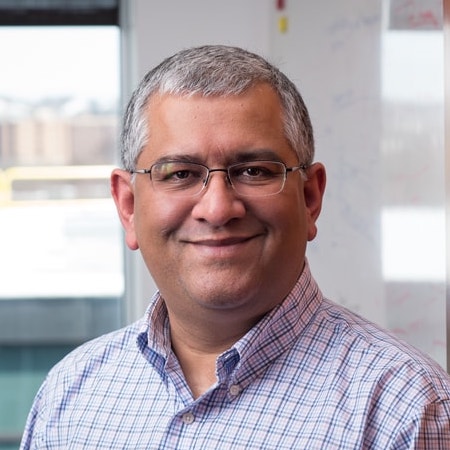
Seth Copen Goldstein is an Associate Professor in the Computer Science Department at Carnegie Mellon University's School of Computer Science. His research spans multiple interdisciplinary domains focusing on ensembles - large collections of interacting agents. He has made significant contributions to reconfigurable computing, molecular-scale devices, programmable matter, and more recently, the impact of technology on labor markets and alternative monetary systems. Education: PhD in Computer Science, University of California at Berkeley BS, Princeton University Goldstein's research agenda has evolved from reconfigurable computing to molecular-scale devices and programmable matter, and most recently to social technology and alternative monetary systems. His early work focused on compiling high-level programming languages directly into configurations for computing ensembles of gates. He then investigated molecular-scale circuits and programmable matter - ensembles of computing elements that can be programmed to change physical properties. Since returning from a startup, he has shifted focus to ensembles of people, studying technology's impact on labor markets and innovation, and developing social technologies to reduce poverty and inequality. His publication trends show a consistent focus on modular robotics, distributed systems, and programmable matter. The research spans theoretical foundations, hardware implementation, and programming languages for large-scale ensembles. Recent work emphasizes energy efficiency, distributed algorithms, and novel programming paradigms for heterogeneous systems. The interdisciplinary nature of his work connects computer science, electrical engineering, and social sciences. Research Leadership: Claytronics project - creating ensembles of cooperating submillimeter robots Development of Meld and LDP programming languages for ensemble systems Phoenix project - computing without processors Building on Local Trust (BoLT) initiative Goldstein has advised numerous PhD students who have gone on to positions at major technology companies including Microsoft Research, Sun Microsystems, and NEC Labs. His work has been supported by significant research grants focusing on modular robotics, programmable matter, and distributed computing systems. He has taught core computer science courses including Compiler Design, Introduction to Computer Systems, and Cloud Computing.
فیلترهای فعال: