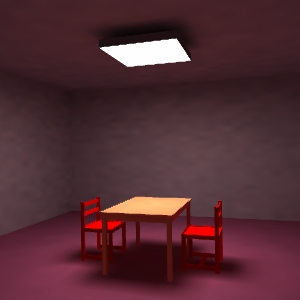
Gonzalo Besuievsky is Associate Professor at the Department of Computer Science and Applied Mathematics of the University of Girona , Spain. He leads research on physically-based rendering and global illumination, with particular emphasis on Monte-Carlo methods and dynamic radiosity environments. Education: PhD in Computer Science, Universitat Politècnica de Catalunya , 2001 — Dissertation: "A Monte Carlo Approach for Animated Radiosity Environments" Research Interests: His work spans several inter-related domains: Global Illumination & Radiosity: developing algorithms for realistic light transport in synthetic scenes. Monte Carlo Techniques: adaptive and hierarchical sampling to accelerate rendering. Dynamic Environments: efficient update schemes for animated lighting and moving light sources. Daylighting Simulation: integrating sunlight models into architectural 3-D workflows. Motion Blur & Temporal Coherence: novel methods to render motion-blurred radiosity images. Publication Trends: Across his 1993–2006 publications, a clear evolution is visible from foundational stochastic ray-tracing work toward sophisticated Monte-Carlo radiosity frameworks that handle dynamic lighting, daylighting, and frame-to-frame coherence for animations. Labs & Groups: He is affiliated with the Girona Graphics Group , a research team devoted to advanced graphics and visualization technologies.
Deena So’Oteh serves as an Assistant Professor of Illustration within the School of Art+Design at Purchase College, where her practice explores emotional and psychological dimensions of visual storytelling through deliberate manipulation of light, composition, and negative space to examine identity, memory, and human connection. Her academic foundation includes: MFA in Illustration as Visual Essay from the School of Visual Arts Central to her research are personal narratives and the human psyche , investigating how environments shape inner worlds through techniques that bend realistic rendering while exaggerating color and structure to evoke mood. Her work synthesizes illustration , psychological art , and surrealism to create layered atmospheric compositions that resonate both viscerally and conceptually. Her scientific recognition spans: Society of Illustrators Art Directors Club American Illustration 3x3 Magazine While teaching Professional Practices at SVA’s Summer Illustration Residency and maintaining her tenure-track position at Purchase College, the source material contains no references to advised students or secured research grants.
Takeo Kanade is the U.A. and Helen Whitaker University Professor of Robotics and Computer Science at Carnegie Mellon University (CMU). He serves as director of the Quality of Life Technology Engineering Research Center and previously led the Robotics Institute (1992-2001). His work spans computer vision, robotics, and multimedia technology, emphasizing mathematical modeling of vision processes and system development. Education: Doctoral degree in Electrical Engineering from Kyoto University (1974) Kanade's research focuses on foundational computer vision (factorization methods, multi-baseline stereo, facial recognition), virtualized reality systems for immersive media applications, and robotics innovations in medical surgery (HipNav) and autonomous helicopters. He pioneered computational sensors integrating VLSI technology. Recent publications emphasize 3D vision, pose estimation, and real-time facial alignment, reflecting his work in social motion capture and scene-specific object recognition. His projects include Informedia (NSF/ARPA/NASA-funded digital video libraries) and EyeVision for immersive sports broadcasting. Scientific Awards: Kyoto Prize (2016), Benjamin Franklin Medal, Bower Prize, IEEE Pioneer Award, ACM/AAAI Allen Newell Award, Joseph Engelberger Award He advises past PhD and Master's students like Omead Amidi, Vladimir Brajovic, and Richard LaBarca. He founded the Digital Human Research Center and leads the Human Sensing Lab at CMU.
Mila Praschma is a Lecturer at Anglia Ruskin University's Faculty of Arts, Humanities, Education and Social Sciences, specifically within the Cambridge School of Creative Industries. She teaches undergraduate courses in Computer Games Art and Computer Games Design, bringing industry experience directly into academic instruction. Praschma holds a 1st Class BA (Hons) in Game Art and Animation from SAE Institute (2022). Her educational background bridges traditional fine arts with digital media, creating a unique fusion of classical artistic techniques and contemporary game development practices. BA (Hons) Game Art Animation, SAE Institute, 2022 (1st Class) Mila specializes in creative practice with focus areas spanning animation, art history, arts and creative industries, computer games, and fine art. Her work embodies what she describes as "an imitation of reality with a fantastical essence" - crafting photo-realistic assets while creating environments that feel "inviting and mysterious" through thoughtful lighting and composition. She brings a storytelling-led approach to technical workflows, drawing on her multidisciplinary background in fine art, theatre, and photography. Her methodology is thorough and methodical, beginning with extensive pre-production planning before moving to blockouts and detailed modeling. Her recent academic contribution includes the 2025 presentation "Hard Surface Workflows: Clean SubD Topology & Baking" at Gamebridge in Cambridge, which demonstrates her expertise in professional-grade modeling techniques that balance aesthetic quality with technical requirements of game engines. This work reflects broader trends in game development toward efficient asset creation pipelines and optimized real-time rendering. Praschma has been featured in industry publications including Creativepool Editorial's #MemberSpotlight, where she discussed her creative process and professional insights. She has contributed to institutional content for SAE Institute UK and participated in interviews regarding "The relationship between video games and global learning." As an educator, Praschma emphasizes maintaining creative passion outside professional work to avoid burnout. She advises aspiring creatives to focus on developing an exceptional portfolio with approximately three showcase pieces and to prioritize gaining initial industry experience, recognizing that internal recommendations often lead to better fitting roles. Her technical expertise spans industry-standard tools including Maya, Substance Painter, ZBrush, Photoshop, and Unreal Engine, with particular proficiency in asset creation, texturing, and cinematic look development.
SungYoung Kim is an Associate Professor in the Department of Electrical and Computer Engineering Technology within the College of Engineering Technology at Rochester Institute of Technology (RIT). His academic work focuses on spatial audio, immersive sound systems, and virtual/augmented reality audio applications, with a research career spanning over a decade of consistent publication and innovation. Dr. Kim's research spans multiple areas of audio engineering and perception. His work investigates how humans perceive spatial audio, develops techniques for more realistic immersive sound reproduction, and creates training methods to improve auditory spatial abilities. He has made significant contributions to understanding the role of height channels in multichannel audio systems, developing methods for personalized spatial audio through head-related transfer functions (HRTFs), and creating augmented reality applications for auditory training. His recent publications demonstrate particular expertise in binaural rendering with head-tracking, automatic audio panning systems, and neurofeedback training applications for auditory spatial attention. His research has practical applications across virtual reality, gaming, music production, and hearing rehabilitation. Recent work includes developing assessment systems for sound localization using Unity and AWS, creating augmented reality auditory training games for hearing-impaired individuals, and investigating the impact of customized interaural time differences on first-person shooter gaming performance. Dr. Kim's publications show a clear progression from fundamental research on spatial audio perception to increasingly applied work with real-world implementation. Japan Society for the Promotion of Science (JSPS) International Fellowships for Research in Japan (L18521), 2018 AES 138th Student Design Competition Silver Award (with Imamura Hidetaka) U.S. Patent US8320590B2 for 'Device, Method, Program, and System for Canceling Crosstalk when Reproducing through Plurality of Speakers Arranged around Listener' (2012) Dr. Kim has secured significant research funding, including grants from Yamaha Corporation totaling over $145,000 for the period 2022-2025, and previously received $179,878 from the Department of Defense for research from 2019-2022. His lab maintains strong industry connections, particularly with Yamaha Corporation, and has extensive international collaborations with researchers in Japan and South Korea. Dr. Kim actively mentors graduate students, as evidenced by his numerous publications with student co-authors across various audio engineering venues, often listing students as first authors to highlight their contributions. Dr. Kim's research group works at the intersection of audio engineering, human perception, and emerging technologies. The lab develops novel audio reproduction techniques, creates assessment tools for sound localization, and explores applications of spatial audio in virtual environments. Recent projects include the development of W-Ambisonics for immersive music reproduction, auditory augmented reality systems that estimate room-specific acoustical materials, and neurofeedback training applications that change oscillatory activity in the parietal cortex related to auditory spatial attention. His work bridges theoretical audio research with practical implementation in real-world applications.