Jens Edlund is a Professor at KTH Royal Institute of Technology's Division of Speech, Music and Hearing. His research focuses on speech technology, dialogue systems, prosody, and evolutionary phonetics. He has contributed to foundational work on speech synthesis, conversational interaction, and multimodal corpora like the D64 corpus. Key projects include the MonAMI Reminder system and analysis of primate vocalizations to understand speech evolution. Edlund has collaborated extensively with global researchers, producing over 150 peer-reviewed works. His work integrates computational methods with linguistic and biological insights, emphasizing human-like dialogue systems and cross-species vocal analysis. Education: Ph.D. in Speech Technology (2011, KTH) Grants: Multiple EU and Swedish Research Council grants for speech technology and interdisciplinary studies Research labs include the KTH Speech, Music and Hearing Lab and collaborations with institutions like Max Planck Institute for Evolutionary Anthropology. Current work explores evolutionary origins of speech biomechanics and AI-driven speech synthesis evaluation.
John Folkesson is an Associate Professor at the Department of Robotics, Perception and Learning at KTH Royal Institute of Technology. His research focuses on mobile robotics, underwater autonomous vehicles (AUVs), and Simultaneous Localization and Mapping (SLAM), particularly addressing challenges in dynamic underwater environments. He leads the AUV group within the Swedish Maritime Robotics Centre (SMaRC2.0) and supervises multiple PhD projects, including those funded by Ocean Infinity and Vinnova. Folkesson has pioneered work on sonar-based SLAM, bathymetric mapping, and autonomous underwater navigation without human intervention. He teaches courses such as Probabilistic Graphical Models (DD2420) and Applied Estimation (EL2320). Recent projects include developing neural rendering techniques for sidescan SLAM and automatic launch systems for AUVs in collaboration with Purdue University and SAAB. His research emphasizes long-term autonomy, environmental ambiguity, and sensor data interpretation in unstructured underwater scenarios. Education: PhD in Robotics (2005, KTH Royal Institute of Technology) Recent Funding: 2024 projects include ALARS (Vinnova), WASP WARA-PS, and industrial collaborations. Research Interests Folkesson's work spans underwater robotics, SLAM algorithms, and sensor fusion. Key areas include: Underwater SLAM and sonar modeling Bathymetric reconstruction using neural networks Autonomous decision-making in AUV missions Real-time terrain modeling and localization Articles Trends Recent publications emphasize neural networks for SLAM optimization, sonar data processing, and autonomous underwater systems. Themes include real-time bathymetric mapping, sensor fusion in dynamic environments, and neural rendering techniques for improving navigation accuracy. Folkesson's work bridges theory and practice, with applications in marine robotics and industrial surveys. Advising & Grants PhD supervision: AUV perception (2024), SLAM with Ocean Infinity, event-response AUV systems. Collaborations: Purdue University, SAAB, Ocean Infinity. Course responsibilities: Over 10 advanced robotics and engineering courses at KTH. Labs & Teams Lead of SMaRC2.0, KTH's official research center for maritime robotics. Active in developing AUV systems for long-duration missions, including ice-covered and deep-sea exploration.
Lennart Svensson is a Professor at Chalmers University of Technology in the Signal Processing research group. His work focuses on nonlinear filtering, multi-object tracking, Bayesian statistics, and deep machine learning with applications in autonomous systems and sensor fusion. Research Interests Nonlinear Filtering and Bayesian Inference Multi-Object Tracking and Sensor Fusion Deep Learning for Autonomous Systems Performance Metrics (GOSPA, T-GOSPA) Lidar-Camera Fusion and Radiance Fields 5G SLAM and mmWave Sensing Publications Trends Recent work emphasizes uncertainty-aware multi-object tracking metrics, trajectory estimation using Poisson Multi-Bernoulli Mixtures, and sensor fusion techniques for autonomous driving. His research integrates Bayesian methods with deep learning for applications in automotive radar, lidar, and 5G positioning systems. Contact Email: lennart.svensson@chalmers.se
Luis Velez Quintero is an Assistant Professor at Stockholm University within the Department of Computer and Systems Sciences (DSV) . He is affiliated with the Data Science Research Group and the Stockholm Technology & Interaction Research (STIR) group, focusing on Human–Computer Interaction. His research spans adaptive immersive systems, affective computing, and physiological signal analysis in extended reality (XR) environments. Education & Background : Holds a PhD in Computer and Systems Sciences from Stockholm University (2023), MSc in Health Informatics from Karolinska Institutet (2019), and BSc in Electronics Engineering from the National University of Colombia (2015). He has led the startup PortalSense since 2018, developing VR solutions for real estate visualization. Research Interests : Combines data science and ML with XR technologies to create context-aware systems for healthcare, education, and professional training. Key themes include: Adaptive VR/AR systems using real-time physiological and behavioral signals Biosignal integration for personalized user experiences Immersive technologies for cognitive assessment and skill development Publications : Over 20 peer-reviewed articles, including work on affective databases (AVDOS-VR), biosignal frameworks (Excite-O-Meter), and XR applications in cybersecurity education. Recent efforts explore third-person locomotion in VR and early-stage Alzheimer’s detection via spatial navigation tasks. Awards & Grants : Wallenberg Foundation Grant (2023-2025): Analyzing non-verbal communication in psychotherapy Swedish Institute Scholarship (2017-2019): Fully funded Master’s and PhD studies Seed funding for PortalSense from Fondo Emprender SENA Colombia (2022-2023) Advising & Projects : Lead researcher in projects like AVDOS-VR and CS:NO . Co-designed the Excite-O-Meter open-source plugin for real-time physiological analysis in VR. Active in industry collaborations for scalable health interventions and immersive training systems. Labs & Teams : Collaborates with multidisciplinary teams at STIR and DSV, advancing human-centered AI and adaptive XR technologies.
Auday Al-Dulaimy is a Senior Lecturer at the Department of Information Science, School of Information and Engineering, Dalarna University. His teaching responsibilities include coordinating courses on Distributed Computing , Internet of Things (IoT) , and Internship in Data Science . His research focuses on cloud computing, IoT, and smart production systems. Distributed Computing (GIK2NX) Internet of Things (GMI2MD) Internship in Data Science (AMI23J) His recent publications explore trends in cloud-based services for smart production, fault tolerance mechanisms, and computing continuum architectures integrating IoT and cloud technologies.
Saghi Hajisharif is a Researcher at Linköping University's Department of Science and Technology (ITN), affiliated with the Media and Information Technology (MIT) group. She holds a PhD in Visualization and Media Technology from Linköping University (2020), an MSc in Advanced Computer Graphics (2013), and a BSc in Computer Science from Amirkabir University (2009). Her work focuses on computational imaging, visual machine learning, HDR imaging, and light field technologies. She is a core member of the Computer Graphics and Image Processing research group. Research interests include sparse representation learning for computational imaging, synthetic data ethics, BRDF material modeling, and algorithmic fairness in AI. Her contributions span interdisciplinary projects recognized in IVA’s 100 List (2024), highlighting societal impact potential. She has co-authored influential studies on topics such as FROST-BRDF sampling techniques and metadata standards for GenAI synthetic data. Her articles reflect expertise in computer vision, graphics, and AI ethics, with key contributions to light field imaging, GAN fairness, and material modeling surveys. The IVA’s 100 List recognition underscores her innovative work’s societal relevance. She collaborates across disciplines to advance imaging technologies and ethical AI practices.
David Black-Schaffer is a Professor at Uppsala University's Department of Information Technology, specializing in computer systems research. As of 2023, he serves as Dean of Research for the Faculty of Science and Technology. His work bridges software and hardware innovations to enhance data movement efficiency in computer systems, with applications commercialized through a startup and integrated into industry standards like OpenCL. Black-Schaffer earned his PhD in Electrical Engineering from Stanford University in 2008, focusing on many-core processor programming. His career spans roles at Apple Inc. (contributing to OpenCL standards), postdoctoral research at Uppsala University, and academic progression from assistant to full professor (2010–2017). He has held leadership roles including Head of the Division of Computer Systems (2022) and department representative on the faculty Advisory Committee for Research (2021). His research spans computer architecture, memory systems, parallel programming, and simulation techniques. Recent publications (2024–2020) explore garbage collection, cache optimization, memory contention, NUMA systems, and instruction scheduling. Key trends include software-hardware co-design for power efficiency, reuse-aware data placement, and machine learning for performance modeling. Knut & Alice Wallenberg Foundation: Wallenberg Academy Fellowship Prolongation (2020–2025), Wallenberg Academy Fellow (2016–2021) Swedish Research Council (VR): Project Grant (2019–2024), Young Researcher Grant (2015–2018), Framework Grant (2012–2017) European Research Council: ERC Starting Grant (2017–2022) Teaching Awards: Uppsala Engineering and Science Student Union Pedagogical Prize (2012), Uppsala University Pedagogical Prize (2016), Uppsala Technical Physics Students' Teaching Award (2019) Other Grants: ScalableLearning flipped classroom project (2012–2020), Arm Ltd. collaborations on memory system designs He pioneered flipped-classroom teaching through the ScalableLearning project, impacting over 80,000 students. His research is conducted in collaboration with institutions like Arm Ltd., with past contributions to Apple's OpenCL implementation and UPMARC research center.
Martin Magnusson is a Professor at the Department of Natural Sciences and Technology, Örebro University, leading the Center for Applied Autonomous Sensor Systems (AASS) and the Robot Navigation and Perception Lab . His research focuses on robotics and artificial intelligence , particularly 3D mapping, localization, radar-based navigation, and human-robot interaction . Email: martin.magnusson@oru.se Phone: +46 19 303870 Location: Room T1222 His work addresses fundamental challenges in achieving robust autonomy through innovations like the 3D Normal Distributions Transform (3D-NDT) and methods for scan registration in dynamic environments. Recent research extends to radar-based navigation and heterogeneous map data integration , with ethical implications regarding military applications of autonomous systems. Key research themes include: Autonomous Perception: Radar and lidar sensor fusion for localization Dynamic Mapping: Flow-aware and quality-assessed environmental models Human-Aware Robotics: Predictive modeling for safe shared-space navigation Professor Magnusson teaches Computer Graphics , connecting academic principles (e.g., ray tracing, light scattering) to applied research in radar simulation models and neural rendering . His research projects span DARKO (agile production robots), NiCE (changing environment navigation), and Radarize (underground autonomous vehicles).
Michael Doggett is an Associate Professor and Senior Lecturer in the Department of Computer Science at Lund University, affiliated with ELLIIT and the LTH Profile Area: AI and Digitalization. His research focuses on image synthesis leveraging custom and programmable hardware, with contributions to real-time rendering, GPU programming, and augmented reality. He holds roles as Director of Third Cycle Studies and Project Manager, and has led initiatives in efficient GPU programming and real-time pixel synthesis. Education details are not explicitly listed, but his work aligns with UN Sustainable Development Goals related to innovation and infrastructure. His research interests emphasize hardware acceleration, light transport algorithms, and rendering efficiency. Recent publications explore opacity micromaps, sparse shading in AR, and caustics modeling. He supervises PhD projects such as 'DLXR: Real-Time Pixel Synthesis' and 'Efficient GPU Programming'. Notable collaborations include work with Facebook (2018-2020) and organizing the ACM SIGGRAPH Symposium. His grants include projects funded by the Swedish Research Council and ELLIIT. Michael is a member of Lund University's Parallel Systems research group and actively contributes to academic conferences and peer review.
Mikael Fridenfalk is a Senior lecturer at the Department of Game Design, Uppsala University, Campus Gotland. He received his PhD in robotics from Lund University in 2003 and completed a postdoctoral research associate position at MIT (2003-2004). Since then, he has been affiliated with Uppsala University Campus Gotland (formerly Gotland University), initially as a lecturer and from 2005 as an associate professor and researcher within computer engineering and AI. With over 40 years of experience in computer programming, primarily using C++, Fridenfalk specializes in artificial intelligence and computer graphics applications. His research spans multiple domains including game design, digital twins, cellular automata, and neural networks. His work demonstrates a consistent focus on the intersection of mathematical principles and practical applications in computer science. Fridenfalk's recent publications (2022-2025) show a shift toward applied research in digital twins for industrial metaverse applications, cloud-edge-terminal collaboration, and game environment design using modular architecture. This reflects an evolution from his earlier theoretical work to more industry-relevant applications while maintaining strong mathematical foundations. Scientific Contributions: Extensive research on cellular automata and modular spaces across numerous publications Development of analytical methods for neural network weight evaluation Innovative applications of L-systems in game environment and music generation Pioneering work on digital twin technology for industrial and marine applications Contributions to photogrammetry techniques for game environments Methods for examination problem distribution in e-learning environments Fridenfalk's work bridges theoretical computer science with practical applications across multiple domains, demonstrating remarkable versatility while maintaining mathematical rigor. His research has been cited in various contexts, including academic papers and Wikipedia references, indicating impact across disciplines.
Henrik Gustavsson is a Senior Lecturer at the University of Skövde within the School of Informatics . He actively contributes to research in software engineering, open source ecosystems, and sustainable digitalization, and teaches courses at both bachelor's and master's levels. Contact details include email henrik.gustavsson@his.se and phone +46 500-448323. Research Projects: 2019 study on GitHub-based assessment in software education, 2005-2007 work on XMI model interchange between proprietary and open-source tools, and the 2021-2023 OSSD project developing a master's program for sustainable digitalization through open systems. Conference Participation: Active since 2005 at venues like OpenSym, ICSM, SIGRAD, and EMMSAD. Collaborations: Frequent co-author with researchers like Björn Lundell, Brian Lings, and Anna Persson across software maintenance, open source adoption, and embedded systems modeling. Publications Trend: Focus on open source integration, model-driven development, and educational innovation in software engineering. Subfields highlight XMI standardization, GitHub data utilization, and toolchain interoperability challenges. Teaching Activities: Coordinates multiple 7.5-credit courses and delivers lectures on software engineering fundamentals, open systems, and digital transformation.
Cristofer Englund is the Dean of the School of Information Technology at Halmstad University and holds a professorship in Information Technology. He earned his PhD in Electrical Engineering in 2007. His teaching focuses on supervising bachelor and master’s theses in machine learning and artificial intelligence (AI), with students receiving awards such as Wimanska priset (2019) and the SAIS Master Thesis Award (2017, 2021). His research spans machine learning applications in emotion/posture recognition, behavior prediction, anonymization, and vehicular communication for traffic safety and automated driving. He currently supervises Felix Rosberg (Engage Studios) on image/video anonymization and Maytheewat Aramrattana (VTI) on connected transportation safety analysis. Research interests include AI ethics, safety-critical systems, and smart city technologies. Recent work emphasizes de-identification systems, drone detection, and federated learning in automotive ecosystems. His articles analyze AI applications in urban infrastructure, cybersecurity for anonymization, and real-time drone surveillance. Notable student awards include grants for Felix Rosberg’s work on anonymization defense mechanisms and Maytheewat’s contributions to traffic safety modeling. Englund collaborates with industry partners like Engage Studios and VTI, integrating academic research with real-world challenges. His work bridges theoretical advancements in machine learning with practical implementations in transportation, cybersecurity, and urban planning.
Tingting Zhang is a Professor at Mid Sweden University's Department of Computer and Electrical Engineering (DET), affiliated with the STC Research Centre. Her work focuses on wireless sensor networks, industrial IoT, and privacy-preserving protocols in vehicular and IoT networks. Research spans VANETs, machine learning for anomaly detection, light field imaging, and secure communication systems. Current projects include PLENOPTIMA, COINS, DAWN, and Smart Industry Sweden. Publications emphasize network reliability, security frameworks for IoT/VANETs, and machine learning applications in sensor networks. She has contributed to patents in wireless communication and video noise reduction. Recent work explores cross-layer optimization, privacy-preserving protocols, and GPU-accelerated light field rendering. Collaborations include institutions in Sweden, Finland, and China.
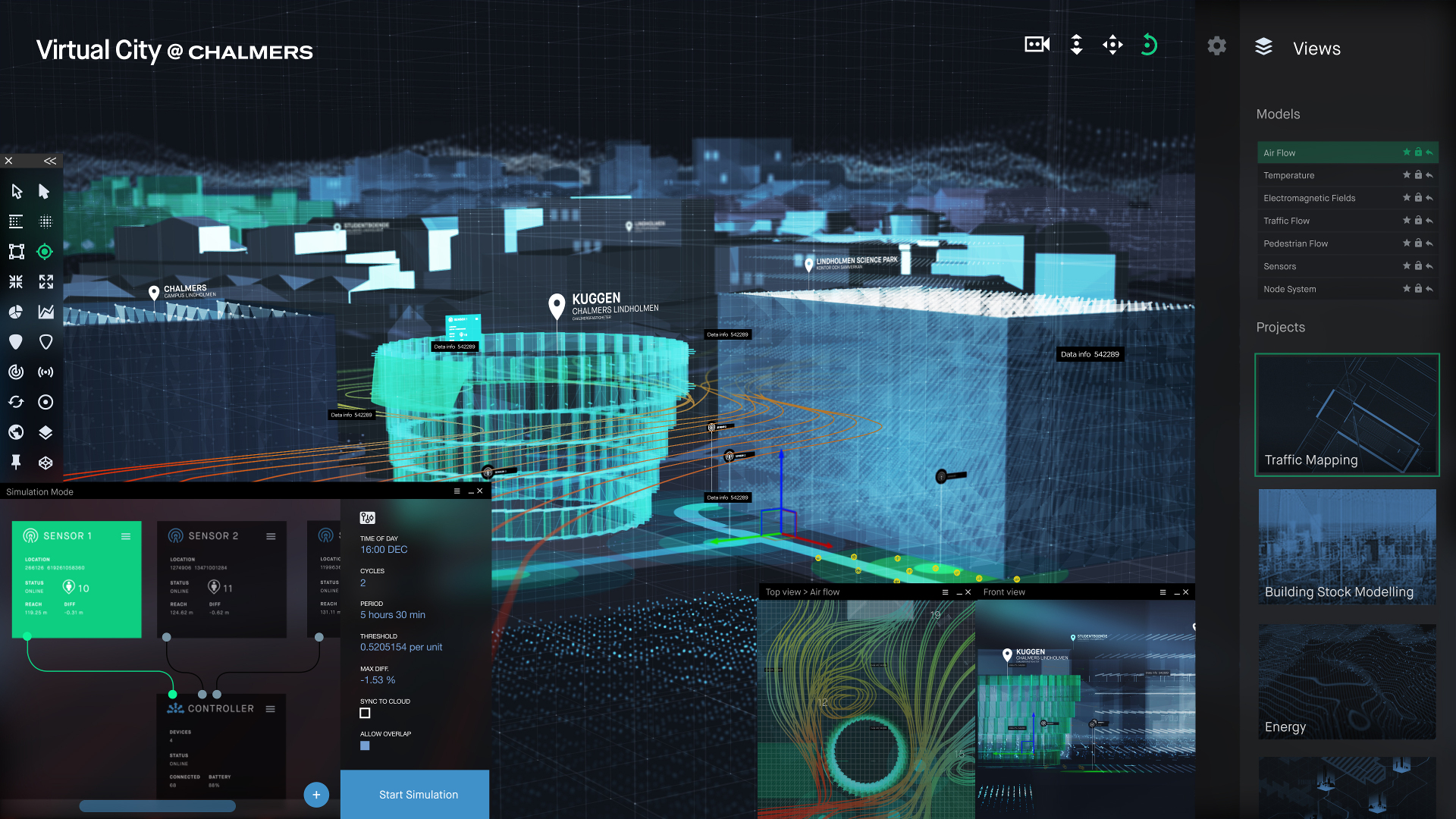
Anders Logg is a Professor of Computational Mathematics at Chalmers University of Technology , Sweden. He serves as Director of the Digital Twin Cities Centre and leads the interdisciplinary VirtualCity@Chalmers project, aiming to build digital twins of urban environments for simulating traffic, wind flow, pollution dispersion, and flooding. Expertise in finite element methods and FEniCS software development Pioneer in mesh generation with tools like mshr Active in scientific computing and domain-specific languages His research team includes experts in mathematical modeling, Unreal Engine development, and building information modeling . Recent work focuses on integrating IoT with digital twins for energy management and developing scalable simulation frameworks for urban planning. Key research trends across publications include: Digital twin technologies for urban environments Mesh generation in complex geometries Multiphysics simulations (fluid dynamics, heat transfer) Automated computing through domain-specific languages Machine learning integration with urban modeling
Beata Stahre Wästberg is an Associate Professor and senior researcher at Chalmers University of Technology in the Interaction Design and Software Engineering department. Her interdisciplinary research focuses on visualization in urban planning , particularly addressing how 3D city models can effectively communicate invisible environmental factors like air quality, noise, and social impacts. Research Evolution: Transitioned from perceptually realistic color and light simulation in virtual environments to environmental data visualization in urban contexts Collaborations: Works with researchers across disciplines and stakeholders from municipalities, government agencies, and businesses Key Projects: Leads initiatives like MiljöVIS , SolVis , and SCENDA funded by organizations including Formas and Energimyndigheten Her visualization work emphasizes cross-disciplinary communication and public dialogue , developing tools that integrate environmental data , cultural values , and infrastructure planning into digital twins and VR urban models . While no specific awards are listed, her research has secured consistent funding for environmental visualization projects.