- Computational Social Science
- Text and network analysis for social media data
- Information theoretic approach to complex systems
- +۷ مورد دیگر
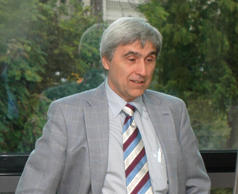
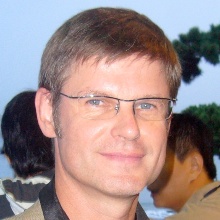
Eckehard Olbrich is a Group Leader and Researcher at the Max Planck Institute for Mathematics in the Sciences (MiS) in Leipzig, Germany. His work bridges mathematics, information theory, and social science with a focus on complex systems analysis. He has coordinated major European research projects including SoMe4Dem (Social Media for Democracy) and ODYCCEUS (Opinion dynamics and cultural Conflict in European Spaces). His educational background includes a PhD in theoretical solid-state physics from the Technical University Dresden (1995), followed by postdoctoral work at the Max Planck Institute for the Physics of Complex Systems in Dresden and research at the University of Zürich. Since 2004, he has been affiliated with the Max Planck Institute for Mathematics in the Sciences. Olbrich's research spans computational social science, information theory, and complex systems. He applies information-theoretic approaches to analyze social media data, complex networks, and human sleep EEG patterns. His work on information decomposition, multi-level systems, and time series analysis has produced significant contributions to understanding complex phenomena across disciplines. He has developed methods for analyzing polarization, opinion dynamics, and network structures in social systems. His publication record shows a strong trend toward interdisciplinary research combining information theory with social and biological systems. Recent work focuses on computational social science applications, particularly analyzing polarization and issue alignment on social media platforms, while maintaining connections to fundamental information theory and complex systems research. Olbrich has collaborated extensively with researchers including Sven Banisch (Karlsruhe Institute for Technology), Peter Achermann (University of Zürich), David Wolpert (Santa Fe Institute), and Jürgen Jost at MiS. His research has been supported by major funding programs including Horizon Europe, Horizon 2020, and the DFG. He has taught courses on Complex Systems Methods and Data Analysis and Modeling at the University of Potsdam, and has contributed to the development of TISEAN, free software for nonlinear time series analysis. His current research continues to explore the intersection of information theory, network science, and computational social science with applications to understanding democratic processes in the digital age.