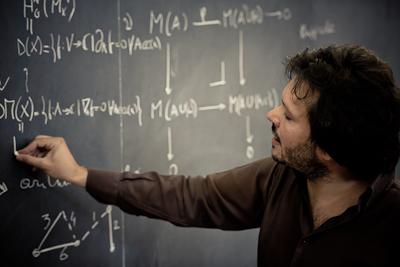
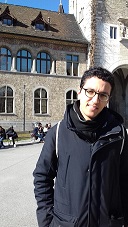
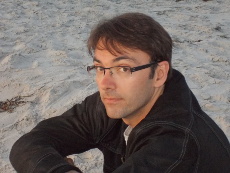
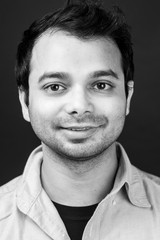
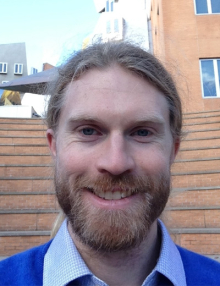
Dr. Gil Kur is a Lecturer in the Department of Mathematics at ETH Zürich. His research focuses on statistical estimation, high-dimensional data analysis, convex regression, machine learning theory, optimization, and probability theory. He has contributed to areas such as nonparametric estimation, convex body approximation, and differential privacy mechanisms. His work bridges theoretical foundations with applications in computational statistics and optimization. Key research themes include analyzing convergence rates of estimators, developing optimal algorithms for convex regression, and studying geometric properties of high-dimensional spaces. His recent articles explore topics like debiased LASSO methods, log-concave maximum likelihood estimation, and the performance of empirical risk minimization under various constraints. Kur’s publications demonstrate a strong focus on rigorous mathematical analysis, often combining tools from probability, functional analysis, and convex geometry. While no specific awards or grants are listed, his active publication record reflects sustained contributions to statistical theory and machine learning fundamentals.
Luca Moci is a Full Professor of Geometry at the University of Bologna's Department of Mathematics. His research focuses on applications of combinatorics to representation theory, commutative algebra, algebraic geometry, and algebraic topology. Notable topics include matroids, Tutte polynomials, hyperplane arrangements, and tropical geometry. He has held positions at TU Berlin, Mittag-Leffler Institute, and Università di Roma 1, and served as a Marie Curie Fellow at INdAM. He taught at Université Paris 7 and organized major research programs like the 'Perspectives in Lie Theory' and 'CoMeTA - Combinatorial Methods in Topology and Algebra' workshops. Education: PhD in Mathematics from Roma Tre University (2010) under Corrado De Concini. Postdoctoral research included stays at prestigious institutions like MSRI and Oxford. Teaching roles span undergraduate and graduate courses in algebra, geometry, and discrete mathematics across multiple universities. Research interests emphasize interdisciplinary approaches, blending combinatorial structures with topological and algebraic methods. Over 50 conference talks and presentations, including at MIT, UC Berkeley, and Princeton. Editorial board member for Springer's 'Combinatorial Methods in Topology and Algebra' and reviewer for leading journals like Advances in Mathematics and Journal of Algebra. Key contributions include foundational work on matroids over rings, arithmetic matroids, and toric arrangements. His articles explore geometric realizations, duality theories, and polynomial invariants in combinatorial and algebraic contexts. Active in academic service, including organizing international research programs and editorial activities.
Dawid Kielak is a Professor of Pure Mathematics at the University of Oxford's Mathematical Institute and a Tutorial Fellow in Pure Mathematics at Hertford College, Oxford. His research bridges Geometric Group Theory and Algebra, with a focus on group rings, cohomology, and ℓ²-invariants. He is a member of the Algebra and Topology research groups and holds an ERC Starting Grant 'Fibring' (2019). His work explores properties like Kazhdan's T, BNSR invariants, and fibring in groups. Education: PhD in Mathematics from the University of Oxford (supervised by Martin Bridson), Habilitation thesis at Bielefeld University on 'Free groups, RAAGs, and their automorphisms'. Research interests include geometric and algebraic aspects of groups, with applications to 3-manifolds, hyperbolic geometry, and representation theory. His recent work addresses conjectures in group theory (e.g., Surface Group Conjectures), expands on ℓ²-Betti numbers, and investigates profinite rigidity. Publications span topics like coboundary expanders, quasi-BNS invariants, and algebraically hyperbolic groups, reflecting a focus on geometric and algebraic interplay. His articles often connect abstract group theory to topological and homological methods. Awards: Whitehead Prize (2022), ERC Consolidator Grant (2024), and multiple DFG/ERC grants. Advising: Supervises DPhil students in geometric group theory and algebra, including Gargi Biswas and Will Thomas. Labs/Teams: Coordinates a research group focusing on group theory and topology, with collaborations on projects involving random groups, RAAGs, and automorphisms.
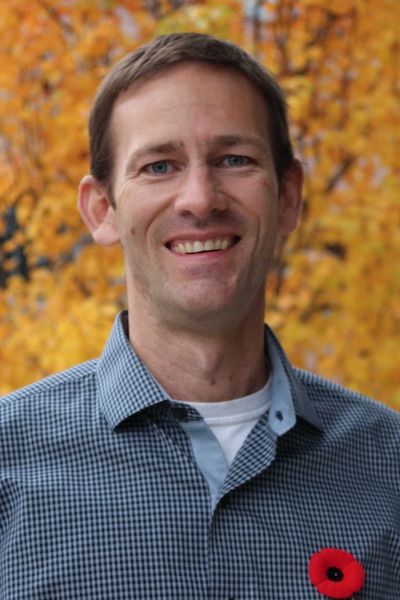
Warren Hare is a Professor and Associate Head of the Graduate Program in the Department of Computer Science, Mathematics, Physics and Statistics at the University of British Columbia Okanagan. He holds a PhD in Mathematical Optimization from Simon Fraser University. His research focuses on structured blackbox optimization, emphasizing algorithm development for applications such as road design and computer simulations. He serves as an Associate Editor for Set Valued and Variational Analysis and the Pacific Journal of Optimization , and co-authored the book Derivative-Free and Blackbox Optimization . Research Interests: Mathematical optimization, nonconvex analysis, derivative-free optimization, bundle methods, and applications in road design. He explores structured blackbox optimization problems where mathematical structures (e.g., max functions) can be leveraged to design efficient algorithms. Advising & Grants: Supervises graduate students in optimization and has secured funding for projects involving road alignment optimization and medical imaging applications. Collaborates on interdisciplinary initiatives combining optimization with civil engineering and medical physics. Labs/Teams: Engaged with UBC Okanagan’s optimization research group and collaborates with industry partners on infrastructure and healthcare optimization challenges.
Robert Tichy is a full Professor at the Institute of Analysis and Number Theory, Technische Universität Graz. His research spans number theory, stochastic analysis, and computational mathematics. He has held significant administrative roles including Department Head (1994-2000), Dean of Mathematical and Physical Sciences (2003-2009), and Vice-Dean (2010-2017). Tichy is a Corresponding Member of the Austrian Academy of Sciences and has served on editorial boards for journals like the Journal of Number Theory and The Ramanujan Journal .
Villó Csiszár is an Assistant Professor at the Department of Probability Theory and Statistics , Faculty of Science , Eötvös Loránd University . Her research focuses on Probability Theory , Statistics , Information Theory , and Markov Chains . Education: PhD in Mathematics (2009, Eötvös Loránd University) MSc in Mathematics (2000, Eötvös Loránd University) Erasmus scholarship at the University of Sheffield (1998-1999) Positions: Assistant Professor (2010-present, ELTE Faculty of Economics) Teaching Assistant (2002-2010, ELTE Faculty of Economics) Visiting Researcher (2007-2008, Rényi Institute of Mathematics) Her work spans random permutations , conditional independence models , hierarchical models , and probabilistic inequalities , with applications in environmental science and interdisciplinary research . Publications include studies on Chebyshev-type inequalities , Markov bases , and statistical inference . She has presented at international conferences such as the 25th EMS European Meeting of Statisticians (Oslo, 2005) , Workshop on Polytopes and Algebraic Statistics (Stockholm, 2008) , and Prague Stochastics (2010) .
Dr. Henna L L Koivusalo is a Senior Lecturer at the School of Mathematics, University of Bristol, specializing in fractal geometry and aperiodic order. Her work intersects dynamical systems, geometric measure theory, and number theory. Research interests include: Dimension theory of self-affine and random fractals Regularity properties of cut and project sets Diophantine approximation in metric spaces Lattice point counting and bounded remainder sets Applications of iterated function systems Recent publications focus on shrinking target problems, mass transference principles, and complexity analysis of quasicrystals, utilizing tools from probability theory and geometric number theory. Collaborations span institutions like Vanderbilt University and Central China Normal University.
Igor Balla is a Strauch Postdoctoral Fellow at the Simons Laufer Mathematical Sciences Institute (SLMath) in Berkeley, where he participates in a research program on extremal combinatorics. He holds a PhD in Mathematics from ETH Zürich, advised by Benny Sudakov, and earned prior degrees from New York University (Master’s) and Carnegie Mellon University (Bachelor’s). He has held postdoctoral positions at Tel Aviv University, the Hebrew University of Jerusalem, and Masaryk University. PhD : Mathematics, ETH Zürich Master’s : New York University Bachelor’s : Carnegie Mellon University His research lies at the intersection of combinatorics and linear algebra, focusing on extremal problems with connections to geometry, theoretical computer science, probability, and quantum physics. Key themes include equiangular lines, orthonormal representations, spectral graph theory, and extremal set systems such as union-closed families. His work often combines algebraic methods with combinatorial reasoning to solve long-standing open problems. The recent articles highlight a strong trend in equiangular lines, spectral extremal combinatorics, and the application of linear algebra to graph theory and coding. His work on extension complexity and the MaxCut problem bridges discrete mathematics and optimization. The recurring use of eigenvalues, matrix projections, and vector representations underscores a unified methodological framework across his publications. Strauch Postdoctoral Fellow Igor Balla has taught as a lecturer in Graph Theory and Advanced Combinatorics at Masaryk University and served as a teaching assistant at ETH Zürich and Carnegie Mellon University across courses in graph theory, algebra, and number theory. He has not been mentioned in connection with any specific grants, but his postdoctoral fellowship indicates competitive research support. His frequent invited talks at institutions like Princeton, MIT, Harvard, and ICERM reflect active engagement in the global combinatorics community. He is affiliated with the research program in extremal combinatorics at SLMath, a leading institute in mathematical sciences. His collaborations span institutions including ETH Zürich, Tel Aviv University, and the Hebrew University, indicating a strong, collaborative research network. His recent work with prominent mathematicians like Benny Sudakov, Po-Shen Loh, and Noga Alon further emphasizes his integration into elite research circles.
Christian Stump is a Professor for Algebraic Combinatorics at the Ruhr-Universität Bochum since 2018 and coordinator of the DFG priority program Combinatorial Synergies . His research focuses on algebraic and geometric combinatorics , particularly in Coxeter groups, cluster algebras, noncrossing partitions, and hyperplane arrangements. He leads the Research Team Stump and collaborates with institutions like Goethe-Universität Frankfurt and Universitat de Barcelona. Research interests: Algebraic Combinatorics, Cluster Algebras, Coxeter Groups, Subword Complexes, Noncrossing Partitions Current projects: Machine learning combinatorial statistics, Combinatorial Polytope Theory His recent work includes studies on non-crossing partitions , Hodge filtrations for reflection groups, and central limit theorems for permutation statistics. He has supervised PhD students in topics ranging from brick polyhedra to matroid complexes and contributed to computational tools like the FindStat database and SageMath . Scientific Awards : DFG Heisenberg Fellowship (2017-2018) Humboldt Research Award (2023) Simons Fellowship (2023) As a principal investigator , he has secured over €1.2 million in DFG grants, including leadership of the project "Combinatorial Polytope Theory" (2024) and coordination of the SPP2458 program. He actively contributes to editorial boards of Electronic Journal of Combinatorics and Combinatorial Theory , and organizes conferences like Formal Power Series and Algebraic Combinatorics (FPSAC) .
Benjamin Dadoun is an Associate Professor in the field of probability theory at Le Mans University, affiliated with the Laboratoire Manceau des Mathématiques (LMM). His research focuses on asymptotic convex geometry, random matrices, high-dimensional phenomena, and growth-fragmentation processes. His research interests include: Asymptotic behavior of random structures in high dimensions Growth-fragmentation processes and their scaling limits Random convex polytopes and their geometric properties Random matrix theory and associated energy functionals Dadoun's recent publications demonstrate a strong focus on the intersection of probability theory, convex geometry, and high-dimensional analysis. His work often involves establishing precise asymptotic behaviors and phase transitions in high-dimensional settings. He has made significant contributions to understanding the properties of Schatten balls, Poisson polytopes, and growth-fragmentation processes, with publications in top journals like Journal of Functional Analysis and Random Matrices: Theory and Applications. His doctoral thesis completed at the University of Zurich under Jean Bertoin established foundational work on growth-fragmentation processes, showing how these continuous processes emerge as scaling limits of discrete Markov branching structures.
Xavier Goaoc is a Professor of Computer Science at Université de Lorraine, affiliated with the Department of Computer Science & Engineering at École des Mines de Nancy and the Gamble research team (joint between LORIA and INRIA). His research focuses on algorithms and discrete mathematics, particularly discrete and computational geometry, including convex hulls, intersection patterns, topological generalizations, and geometric transversal theory. University: Université de Lorraine School: School of Engineering Department: Department of Computer Science & Engineering Research Team: Gamble (LORIA/INRIA) Emails: xavier.goaoc@loria.fr , xavier.goaoc@univ-lorraine.fr His research spans computational geometry, combinatorial convexity, geometric transversal theory, and random geometric structures. Key topics include homological minors, order types of point sets, and geometric optimization. His 15 most recent publications highlight advancements in computational geometry algorithms, structural complexity, and topological constraints. Notably, his work has received Best Paper Awards at SoCG 2020, 2018, 2016, and 2012. Administrative roles include heading the computer science & engineering department at Mines Nancy and co-chairing the computer science department of the IAEM doctoral school. He is also a member of the Université de Lorraine's ‘pôle AM2I’ council. Teaching activities encompass courses in algorithms, computer architecture, blockchains, and geometric models for vision, with publications and grants reflecting his interdisciplinary impact in computer science and mathematics.
Michel Goemans is the RSA Professor and Head of the Department of Mathematics at the Massachusetts Institute of Technology (MIT), with additional affiliations at MIT CSAIL and MIT ORC. Previously, he held the Leighton Family Professorship (2007-2017) and adjunct/visiting positions at the University of Waterloo, University of Louvain, and RIMS Kyoto. His research focuses on combinatorial optimization , discrete algorithms , and approximation methods , with applications spanning network design, stochastic optimization, and algorithmic game theory. His publications consistently explore fundamental problems in mathematical programming and theoretical computer science. Notable awards include: Leroy P. Steele Prize (2022) George B. Dantzig Prize (2021) Farkas Prize (2012) Fellowships: AMS, ACM, SIAM, Guggenheim, Sloan Foundation Doctor Honoris Causa (Université catholique de Louvain) He advises doctoral candidates and postdocs, with prominent former students including David Williamson (Cornell), Jon Kleinberg (Cornell), and Aleksander Madry (MIT). Research is primarily funded by NSF and ONR grants.
Nathan (Nati) Linial is a Professor at the School of Computer Science and Engineering at The Hebrew University of Jerusalem, where he has maintained a distinguished academic career spanning several decades. His research bridges multiple mathematical disciplines with theoretical computer science. Linial's primary research interests encompass Combinatorics, Theory of Algorithms, Geometry, Analysis, and Computational Molecular Biology . His work often explores the deep connections between discrete mathematics and computer science, particularly focusing on high-dimensional combinatorial structures, metric embeddings, and their algorithmic applications. His publication record demonstrates consistent contributions across decades, with recent work focusing on high-dimensional permutations, simplicial complexes, graph theory, and coding theory. Linial has developed significant theoretical frameworks for understanding complex combinatorial structures and their geometric representations. Among his notable achievements is being named an AMS Fellow and receiving the 2008 Conant Prize for the influential survey paper "Expander graphs and their applications" co-authored with S. Hoory and A. Wigderson. His research has shaped multiple areas of theoretical computer science and discrete mathematics. Linial has served on the editorial boards of prestigious journals including Israel Journal of Mathematics (where he was Chief Editor 2013-2017), Random Structures and Algorithms , and Combinatorica . He has supervised numerous students throughout his career and maintains active research collaborations worldwide.
Makrand Sinha is an Assistant Professor in the Siebel School of Computing and Data Science at the University of Illinois Urbana-Champaign (UIUC), part of the Grainger College of Engineering. Previously, he was a Simons-Berkeley postdoctoral fellow at UC Berkeley and a postdoctoral researcher at CWI Amsterdam. He earned his PhD in 2018 from the University of Washington under Anup Rao. His research focuses on theoretical computer science, particularly quantum and classical computation, optimization, and understanding computational advantages and limitations. Key areas include quantum advantage, optimization algorithms, and the intersection of quantum computing with cryptography. Recent publications highlight contributions to quantum algorithms, complexity theory, and optimization, such as exploring quantum-classical separations, pseudorandomness, and mixed-integer programming lower bounds. He has organized workshops on topics like extension complexity and serves on program committees for conferences like ITCS, SODA, and STOC. No formal awards or student advisees are listed, but his work is widely recognized in the theoretical computer science community. Teaching includes courses like Introduction to Quantum Computing and Algorithms.
Michael W. Otte is an Assistant Professor at the University of Maryland, College Park, with a home appointment in the Department of Aerospace Engineering and an affiliate appointment in the Department of Computer Science. He is the Director of the Motion and Teaming Laboratory (Mo-T Lab) and a member of the Maryland Robotics Center. His research focuses on algorithms for autonomous robots and multi-agent systems, including collective cognition in swarms, motion planning, and decentralized coordination under communication constraints. Education: Ph.D. '11 in Computer Science (University of Colorado at Boulder), M.S. '07 in Computer Science, B.S. '05 in Aeronautical Engineering and Computer Science (Clarkson University). Prior appointments include postdoctoral roles at the U.S. Naval Research Laboratory and the Air Force Research Laboratory. Research interests span multi-robot systems, swarm intelligence, motion replanning in dynamic environments, and distributed sensing. His lab develops algorithms for challenges like collective computation in swarms, efficient replanning, and communication-limited collaboration. Notable contributions include the RRT-X replanning algorithm, distributed neural networks across swarms (Group Mind), and the C-FOREST parallel planning framework. Recent awards include the 2023 Best Faculty Advisor Award. Active roles include Program Chair for the 2024 DARS conference and organizing ICRA workshops on multi-robot communication challenges. Students advised include Alexander Mendelsohn, Sharan Nayak, and others. The Mo-T Lab collaborates with institutions like NASA, Northrop Grumman, and DARPA, addressing applications in hazardous environments and autonomous systems.