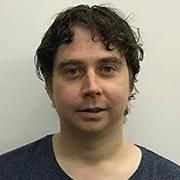
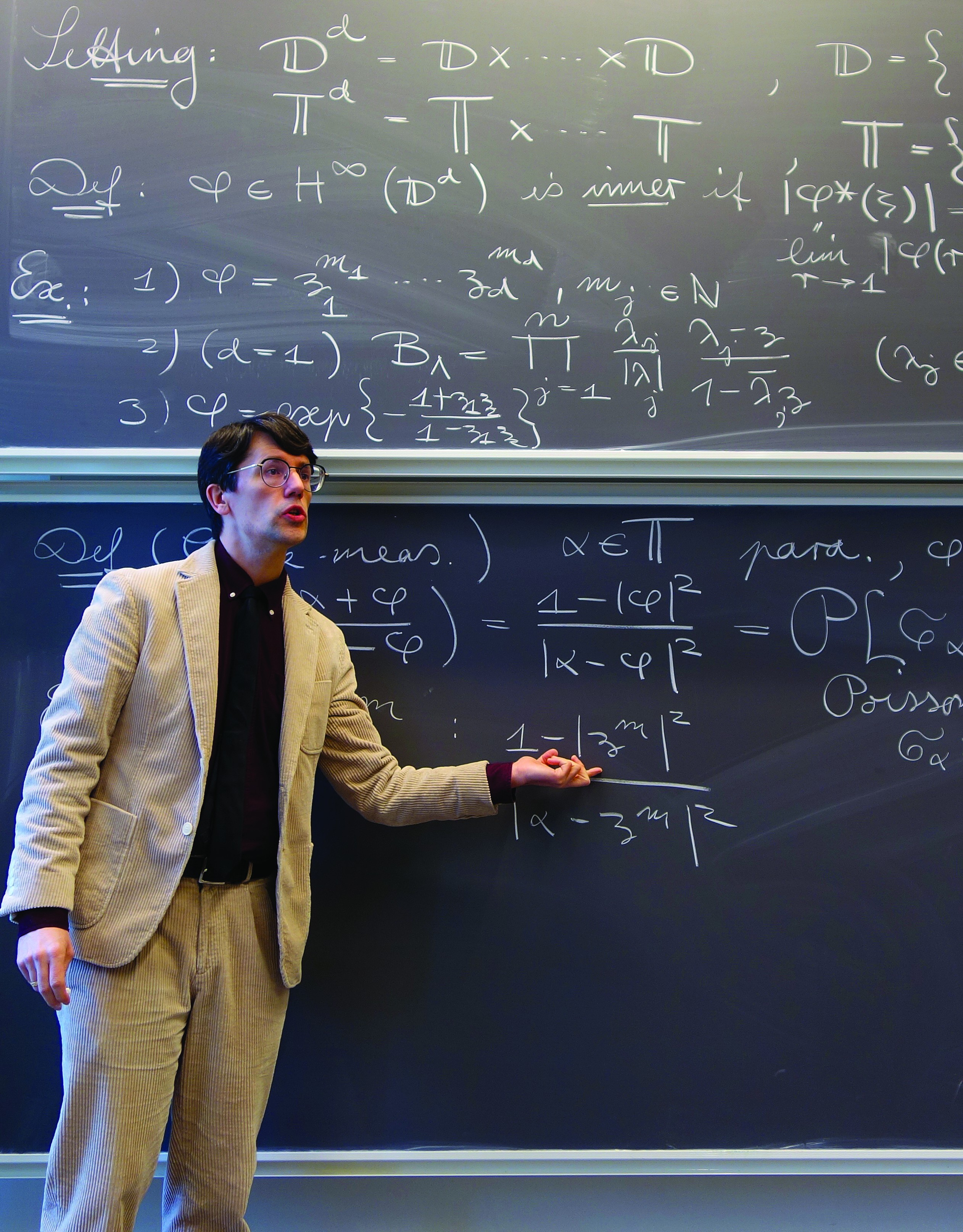
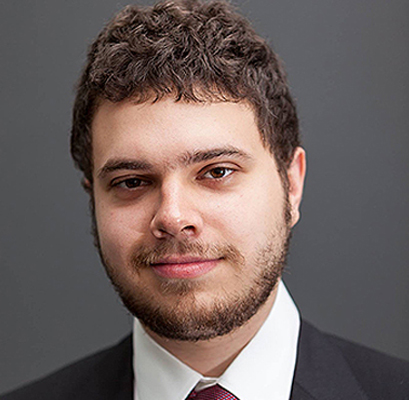
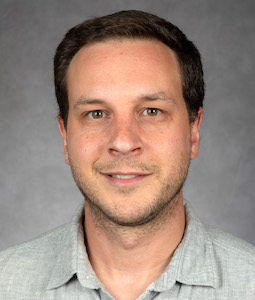
Prof. Oleg Ivrii is a Senior Lecturer in the Department of Theoretical Mathematics at Tel Aviv University's Faculty of Exact Sciences. He earned a B.Sc. in Mathematics from the University of Toronto (2009) and a Ph.D. in Mathematics from Harvard University (2014). Following postdoctoral research positions at the University of Helsinki (2014-2016) and California Institute of Technology (2016-2019), he joined Tel Aviv University in 2019. Research Focus: Complex analysis, conformal geometry, thermodynamic formalism, and geometric function theory. Key Contributions: Studies on analytic mappings of the unit disk, inner functions, quasiconformal homogenization, and Makarov's principle. His work explores critical structures of inner functions, stable convergence, and applications to dynamical systems. He has advised Emanuel Sygal (Master's thesis) and collaborated with Artur Nicolau, Mariusz Urbański, and Vladimir Marković. Ivrii's publications appear in journals like Inventiones Mathematicae , Journal of Differential Geometry , and Analysis & PDE .
David Moens is Full Professor and Chair of the Department of Mechanical Engineering at KU Leuven's Faculty of Engineering Technology. He leads the Mecha(tro)nic System Dynamics (LMSD) research group at De Nayer Campus, where his research focuses on reliability engineering, structural dynamics, and computational mechanics. Moens serves in multiple leadership roles including membership in the university's Research Policy Council and heads Subdivision 10 of the De Nayer Campus. His research integrates computational mechanics with uncertainty quantification methods to address challenges in mechanical system reliability. Primary research domains include: Non-deterministic numerical analysis techniques for structural systems Fatigue and lifetime prediction methodologies Spatial uncertainty quantification in composite materials Physics-informed machine learning for engineering applications Robust design optimization under uncertainty Moens' recent publications demonstrate strong emphasis on computational uncertainty frameworks with applications spanning composite pressure vessels, manufacturing process twins, and neural network uncertainty estimation. Research consistently intersects finite element analysis, experimental validation, and emerging machine learning techniques to solve reliability challenges in mechanical systems. He leads significant research initiatives including RISQ (Random and Interval Spatial Uncertainty Quantification, 2025-2027) and projects on hydrogen storage vessel reliability (2024-2028). As primary supervisor for multiple PhD candidates, Moens actively contributes to academic training through courses including Reliability of Mechanical Systems, Dynamic Behavior of Machines, and Design for Safety and Reliability.
Assistant Professor Aljaž Zalar is affiliated with the University of Ljubljana at the Faculty for Computer and Information Science . His research focuses on Real Algebraic Geometry , Truncated Moment Problems , and Matrix Polynomials , with applications in Operator Theory and Positive Linear Maps . PhD in Mathematics, University of Ljubljana (2017) MSc and BSc in Mathematics, University of Ljubljana (2013, 2011) Zalar's work bridges theoretical mathematics and computational applications, including copositive matrices , positive semidefinite matrix completions , and noncommutative polynomial positivity . His recent projects address truncated moment problems on curves and algebraic structures in optimization . His publications from 2016–2025 span journals like Linear Algebra and its Applications , SIAM Journal on Applied Algebra and Geometry , and Integrable Equations and Operator Theory , emphasizing polynomial operator analysis and matrix inequalities . Zalar supervises postdoctoral and graduate students, including PhD candidate Rajkamal Nailwal and Igor Zobovič, and mentors undergraduate researchers. He leads the ARIS grant project J1-60011 on real algebraic geometry approaches to moment problems.
Dr. Andreas Galanis is an Associate Professor in Computer Science at the University of Oxford, where he serves as a Tutorial Fellow at Hertford College. He earned his PhD from Georgia Tech University in 2015 with a focus on Algorithms, Combinatorics, and Optimization. Research Interests: His work bridges approximate counting/sampling problems in computer science and phase transitions in statistical physics, with a strong emphasis on the computational complexity of partition functions, stochastic processes, and spin systems. Recent Publications: His research spans approximate counting algorithms ( ICALP 2019 , APPROX/RANDOM 2019 ), hardness results in Potts and random-cluster models ( Electronic Journal of Probability 2018 , APPROX/RANDOM 2018 ), and theoretical insights into correlation decay and spatial mixing ( SIAM Journal on Computing 2019 ). Scientific Awards: Best Paper Award, ICALP 2016 Collaborations: He frequently collaborates with researchers like Leslie A. Goldberg and Eric Vigoda on topics involving Markov chains, graph theory, and computational complexity.
Manindra Agrawal is a Professor in the Department of Computer Science and Engineering at the Indian Institute of Technology Kanpur (IIT Kanpur), where he has been a faculty member since 1996. His research focuses on theoretical aspects of computer science with particular emphasis on computational complexity theory and computational number theory. Dr. Agrawal completed his B.Tech in Computer Science from IIT Kanpur in 1986 and his PhD in Computer Science from the same institution in 1991. His doctoral thesis, titled "Towards a Characterization of NP-Complete Sets," was supervised by Professor Somenath Biswas. His research interests span computational complexity theory, computational number theory, algebra, and cryptography. Dr. Agrawal is best known for designing the first efficient and deterministic algorithm for testing if a number is prime, a groundbreaking result published in the Annals of Mathematics in 2004 as "PRIMES is in P." This work has had a profound impact on theoretical computer science and number theory, resolving a long-standing open problem in the field. His publication record shows a consistent focus on fundamental problems in theoretical computer science, particularly in complexity theory and number-theoretic algorithms. His work ranges from theoretical foundations like the isomorphism conjecture for constant depth reductions to practical applications such as designing encryption algorithms for the Indian Navy and Air Force. Padma Shri (2013) Infosys Prize (2008) Godel Prize (2006) Shanti Swarup Bhatnagar Award (2003) Clay Research Award (2002) Fellow of the Indian National Science Academy (FNA) Fellow of The World Academy of Sciences (FTWAS) Fellow of the Indian Academy of Engineering (FNAE) Fellow of the Indian Academy of Sciences (FASc) Dr. Agrawal has advised several notable students, including Nitin Saxena and Satyadev Nandkumar, who have made significant contributions to theoretical computer science. His research group has been instrumental in advancing knowledge in computational complexity and number theory. His work on primality testing has not only theoretical significance but has also influenced practical cryptographic applications.
Professor Nina C Snaith is affiliated with the University of Bristol as a Professor of Mathematical Physics in the School of Mathematics . Her work bridges Random Matrix Theory with Number Theory , focusing on eigenvalue statistics and connections between characteristic polynomials and functions like the Riemann zeta function and L-functions. Research Interests : Snaith investigates how Random Matrix Theory techniques can analyze zeros of number-theoretical functions, particularly elliptic curve L-functions. Her research spans eigenvalue distributions, asymptotics, and combinatorial methods in matrix determinant analysis. Scientific Awards : LMS Whitehead Prize (2008) Supervision & Grants : She has supervised 7 PhD students and led projects such as RANDOM MATRIX THEORY AND NUMBER THEORY: DISTRIBUTION OF PRIMES AND HIGHER ORDER VANISHING OF L-FUNCTIONS (2005-2009) and a fellowship (2004-2010), supported by grants focused on L-functions, elliptic curves, and random matrix ensembles.
Alan Sola is a Lecturer in the Department of Mathematics at Stockholm University's Faculty of Science, where he serves as Head of the Division of Mathematics. His office is located in Room G1359 at Building 1, Albano campus, and he can be reached at sola@math.su.se or by phone at +46 8 16 45 23. Dr. Sola's research program centers on mathematical analysis with particular emphasis on complex analysis, harmonic analysis, operator theory, probability theory, and dynamical systems. His work examines rational inner functions from multiple perspectives including Clark measures, singularities, level curve portraits, and connections to stable polynomials. He has established significant collaborations with researchers like K. Bickel, J.E. Pascoe, and G. Knese, resulting in numerous publications in top mathematical journals. His recent publications (2021-2025) reveal a cohesive research trajectory focused on multivariable complex analysis, particularly examining rational inner functions and their properties across different mathematical contexts. This work bridges pure analysis with applications in operator theory and dynamical systems, demonstrating both theoretical depth and interdisciplinary relevance. Dr. Sola actively supervises graduate students at multiple levels. His current PhD student is Hampus Nyberg (expected graduation 2028). Former PhD students include Eleftherios Theodosiadis (2024) who researched "Geometry of multi-slit Loewner chains and semigroups of finite shift" and Linus Lidman Bergqvist (2023) who investigated "Holomorphic functions in polydiscs and measures on the distinguished boundary." He has also guided Master's students including David Appelgren (2025), Nell P. Jacobsson (2023), and Linus Lidman Bergqvist (2017), several of whom have co-authored publications with him. As an educator, Dr. Sola has taught advanced graduate courses including Quasiconformal maps (fall 2023), Complex Dynamics (fall 2021), and Geometric Function Theory (fall 2020 and spring 2018). His teaching materials and lecture notes demonstrate his commitment to making sophisticated mathematical concepts accessible to students. He has also participated in significant conferences such as the upcoming Operators on analytic function spaces meeting at CIRM (France) in December 2024.
Khanh Duy Trinh is a Professor (non-tenure-track) at Waseda University's Global Center for Science and Engineering, specializing in probability theory and its applications to random matrix theory and stochastic topology. He holds a PhD from Osaka University (2012) and has held academic positions at Tohoku University and Kyushu University. Current affiliation: Waseda University (2025-present) Past roles: Associate Professor at Waseda (2019-2025), Tohoku University, Kyushu University Research areas: Beta ensembles, Random topology, Spectral measures, Stochastic geometry His work demonstrates universal behavior in random matrix models through spectral analysis and topological persistence. Key contributions include central limit theorems for eigenvalue statistics, Poisson approximations in high-temperature regimes, and geometric interpretations of persistence diagrams. His recent papers focus on generalized beta processes and higher-dimensional complex structures. Current projects include: JSPS Grant 2024-2029: Universal approaches in random matrix theory Past JSPS Grant 2019-2023: Multi-aspects of beta ensembles Teaching activities at Waseda include: Introduction to Probability and Statistics Advanced Probability and Statistics Master's Thesis advising in Pure and Applied Mathematics
Professor Martin Gairing is an academic faculty member with a focus on Game Theory , Congestion Games , and Network Design . His research explores the Efficiency and Complexity of equilibria in algorithmic contexts, particularly in transportation and distributed systems. He has secured grants from the Engineering & Physical Sciences Research Council (EPSRC) and Alder Hey Children's NHS Foundation Trust for projects like MRI Image Analysis (MaRIA) and Algorithms for Approximate Nash Equilibria . His recent work includes In Congestion Games, Taxes Achieve Optimal Approximation (2023), which examines taxation strategies for optimizing network efficiency. Other key publications span topics such as Dynamic Traffic Models , Fair Interventions , and Price of Stability in weighted and polynomial congestion games. He has taught modules including Cloud Computing for E-Commerce (COMP315) Computer Forensics (COMP343) Computer Networks (COMP211) Introduction To Programming (COMP101) Robot Perception and Manipulation (COMP341) . Grants and research projects include MRI Image Analysis (MaRIA) (2024-2025) funded by Alder Hey Children's NHS Foundation Trust Algorithms for Finding Approximate Nash Equilibria (2013-2016) funded by EPSRC Efficiency and Complexity in Congestion Games (2013-2014) funded by EPSRC .
Mathieu Hoyrup is a permanent researcher (Chargé de Recherche) at Inria , affiliated with the Mocqua team at the LORIA research center in Nancy, France. His research bridges mathematical logic, computability theory, and dynamical systems through the lens of computable analysis and algorithmic randomness. Research Interests : Recursion theory, computable analysis, algorithmic randomness, ergodic theory, and dynamical systems. Advising : Supervised PhD students Hugo Férée, Djamel Eddine Amir, Alexis Terrassin, and Rémi Pallen. Academic Service : Organized the Computability and Complexity in Analysis conferences (2013–2022) and the Continuity, Computability, Constructivity (CCC 2017). Education : PhD in Mathematics from Université Paris Diderot (2008); Habilitation à diriger des recherches (2021) on topological aspects of representations in computable analysis.
Scott J Aaronson is the David J. Bruton Jr. Centennial Professor of Computer Science at the University of Texas at Austin , where he explores the theoretical foundations of quantum computing and computational complexity theory . A pioneer in the field, he has bridged quantum physics, computer science, and mathematics to clarify the capabilities and limitations of quantum computers. A summa cum laude graduate of Cornell University and holder of a PhD from UC Berkeley , Aaronson has shaped public understanding through his popular blog Shtetl-Optimized , his book Quantum Computing Since Democritus , and TED Talks. His research has established critical insights into: Quantum Supremacy : Theoretical frameworks for experimental validation without full fault tolerance Cryptographic Security : Demonstrating quantum lower bounds for collision problems Classical Complexity : The invention of algebrization as a tool for complexity class analysis Awarded the ACM Prize in Computing (2020) , ACM Fellow (2019) , and the Simons Investigator Award , his work has been recognized as foundational to the digital age. He has also mentored graduate students in quantum complexity theory, with projects advancing topics like Boson Sampling , Forrelation , and Quantum Zero-Knowledge Protocols . Scientific Awards: ACM Prize in Computing (2020) ACM Fellow (2019) Tomassoni-Chisesi Prize in Physics (2018) Simons Investigator Award (2017) Alan T. Waterman Award (2012) Aaronson’s advocacy for Deep Zionism and reflections on AI’s existential implications reflect his broader engagement with ethics and societal impact in technology.
Joseph Kileel is an Assistant Professor in the Department of Mathematics at the University of Texas at Austin, with additional appointments as a Core Faculty Member of the Oden Institute for Computational Engineering and Sciences and as a member of the Machine Learning Laboratory. His academic journey includes a Ph.D. in Mathematics from UC Berkeley (2017) under Bernd Sturmfels and a postdoctoral fellowship at Princeton University (2017-2020) with Amit Singer. Professor Kileel's research spans applied mathematics, mathematical data science, and computational algebra, with particular expertise in inverse problems for imaging science, tensor methods, and non-convex optimization. His work has important applications in cryo-electron microscopy, 3D reconstruction, and mathematical theory for machine learning algorithms. His research program is supported by the NSF, DOE, and Sloan Foundation. His publication record demonstrates consistent high-impact contributions across multiple venues including IEEE Transactions, SIAM journals, Foundations of Computational Mathematics, and NeurIPS. His recent work shows a strong trend toward developing algebraic and geometric methods for data science problems, with increasing focus on tensor decompositions and their applications to molecular imaging. His research bridges theoretical mathematics with practical computational methods. Charles Chui Young Researcher Best Paper Award Bernard Friedman Memorial Prize for Best Thesis in Applied Mathematics Professor Kileel currently advises six doctoral students and postdocs, maintaining an active research group that combines theoretical depth with practical applications. His students work on diverse projects spanning tensor methods, optimization theory, and applications to imaging science. The group benefits from strong connections with the Oden Institute and Machine Learning Laboratory at UT Austin, providing access to interdisciplinary collaborations and resources. His research group focuses on developing mathematical foundations for data science problems, particularly those involving algebraic structure. Current projects include tensor decomposition algorithms, geometric methods for 3D reconstruction, and theoretical analysis of non-convex optimization landscapes. The group maintains active collaborations with researchers at Princeton, Berkeley, and international institutions, reflecting the interdisciplinary nature of his work.
Dr. Alexander Fuchs-Kreiß is a Junior Professor for Statistics at the Institute of Mathematics, Faculty of Mathematics and Computer Science at Leipzig University. He joined the university in April 2022 as a member of the Stochastics research group. He is also a scientific member of the International Max Planck Research School for Mathematics in the Sciences and affiliated with the HKMetrics Network. His research focuses on the statistical analysis of network data, particularly semi- and non-parametric methods for dynamic interaction networks. He has developed methodologies for relational event models using counting processes like Hawkes processes, and has contributed to causal inference, high-dimensional statistics, and quantile regression. His work often bridges multiple statistical areas, creating innovative approaches to complex data structures. His recent publications show a strong trend toward developing statistical methods for network data with applications in economics, epidemiology, and social sciences. His research combines theoretical developments with practical implementations, as evidenced by the R packages accompanying his publications. As an educator, he teaches Mathematical Statistics, Statistical Network Analysis, and Causal Inference at Leipzig University. He supervises PhD students working on network models and advises diploma theses in mathematics and business mathematics. Dr. Fuchs-Kreiß maintains active research collaborations with institutions including Heidelberg University, UC Davis, KU Leuven, and LSE. He co-organizes academic seminars and participates in international conferences on statistical learning and probability.
Soudabeh Shemehsavar serves as a Lecturer in the College of Science, Technology, Engineering and Mathematics at Murdoch University, Australia, where she contributes to statistical and data science education. Her academic foundation includes: Bachelor of Science in Statistics from Shiraz University (1993-1997) Master Degree in Statistics from Amirkabir University of Technology (1998-2000) Doctor of Science in Applied Mathematics from Amirkabir University of Technology (2001-2007) Her research integrates theoretical and applied statistics across diverse domains: Development of stochastic degradation models for mechanical systems to optimize maintenance and reliability Advanced survival analysis techniques including cure models for biomedical lifetime data Random polynomial applications in civil infrastructure design, traffic pattern prediction, and economic modeling Theoretical extensions of Poisson-Dirichlet processes Current focus on ensemble learning methods for high-dimensional classification problems Her work demonstrates strong interdisciplinary connections between statistical theory and practical implementations in engineering, medical research, and economic systems.
Karl Liechty serves as Professor and Associate Chair in the Department of Mathematical Sciences at DePaul University's College of Science and Health. He joined DePaul in 2014 after completing his PhD at Purdue University (2010), a postdoc at the Mathematical Sciences Research Institute, and three years at the University of Michigan. Promoted to Associate Professor with tenure in 2018 and full Professor in 2025, he maintains an active research program in mathematical sciences. His educational background includes: PhD in Mathematical Sciences, Purdue University (2010) Liechty's research centers on random matrix theory with deep connections to probability, statistical physics, and integrable systems. He specializes in asymptotic analysis of orthogonal polynomials and determinantal processes, particularly examining non-intersecting paths, six-vertex models, and Painlevé equations. His work bridges theoretical mathematics with physical applications, focusing on universal behavior in critical systems and phase transitions. Methodologically, he employs Riemann-Hilbert techniques and Fredholm determinant analysis to derive asymptotic expansions for complex systems. His 15 most recent publications (2013-2025) demonstrate consistent focus on asymptotic methods in integrable probability, with increasing emphasis on multi-component systems like the k-tacnode process and boundary statistics in lattice models. Key themes include universality class transitions, singular behavior propagation, and connections between random matrices and statistical mechanical models. Scientific recognition includes: Gabor Szego Prize (SIAM, 2015) for contributions to orthogonal polynomials and special functions Simons Collaboration Grant (2015) supporting collaborative research in mathematics Liechty actively mentors through the Chicago Math Teacher's Circle and Math Circles of Chicago, developing K-12 enrichment programs. His research collaborations span institutions including the University of Michigan, Purdue, and international partners in Belgium and Russia. Current work focuses on boundary effects in integrable systems and finite-temperature fermion models, supported by ongoing Simons Foundation collaboration. He maintains leadership through his Associate Chair role, overseeing curriculum development and faculty coordination in the Mathematical Sciences department while sustaining high-impact publications in top probability and mathematical physics journals.