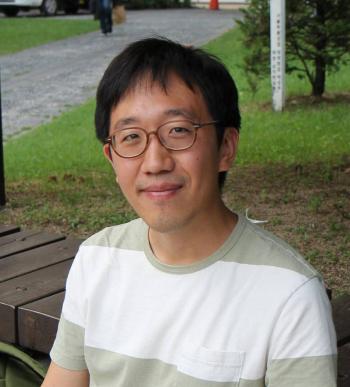
June Huh is a Mathematics Professor at Princeton University's Department of Mathematics. His research focuses on the interplay between algebraic geometry, combinatorics, and matroid theory, with notable contributions to Hodge theory, tropical geometry, and log-concavity phenomena. He is actively involved in collaborative projects such as the FRG initiative on matroids, graphs, and algebraic geometry. Key research interests include matroid polytopes, Chow rings, Lagrangian geometry, and combinatorial applications of Hodge-Riemann relations. His work bridges discrete and continuous mathematics, with implications for enumerative geometry and geometric combinatorics. Recent publications explore topics like volume polynomials, Bergman fans, and singular Hodge theory in combinatorial geometries. He has received funding for interdisciplinary research through grants like the FRG Collaborative Research program. His contributions highlight innovative methods in geometric and algebraic combinatorics.
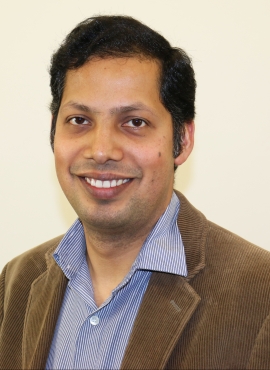
Jonathan Hauenstein is the Robert and Sara Lumpkins Collegiate Professor in the Department of Applied and Computational Mathematics and Statistics at the University of Notre Dame, serving as Department Chair. He holds a Ph.D. from Notre Dame (2009) and M.S. from Miami University (2005). His research focuses on numerical algebraic geometry and computational methods for solving nonlinear equations, implemented in the Bertini software package. Applications span engineering, ecology, sports science, and machine learning. Education: Ph.D., Applied and Computational Mathematics, University of Notre Dame (2009) M.S., Mathematics, Miami University (2005) Research Interests: Development of numerical algorithms for polynomial systems, real algebraic geometry, and scientific computing. Key areas include homotopy continuation methods, parameter space decomposition, and applications in mechanism design, ecological modeling, and sports biomechanics. His work bridges theoretical mathematics with practical computational tools. Awards: Sloan Research Fellowship DARPA Young Faculty Award Army Research Office Young Investigator Award Office of Naval Research Young Investigator Award College of Science Research Award Advising & Grants: Advised numerous undergraduates, graduate students, and postdoctoral researchers. Active in securing grants for computational mathematics projects, including NSF-funded initiatives. His work emphasizes interdisciplinary collaboration between mathematics and engineering. Labs/Teams: Leads computational algebraic geometry research groups at Notre Dame, focusing on software development (e.g., Bertini) and numerical methods innovation.
Noam Berger Steiger is a Professor of Stochastic Processes at the Technical University of Munich (TUM), within the School of Computation, Information and Technology and the Department of Mathematics. His office is located at Parkring 11, Garching bei München, and he can be contacted at noam.berger@tum.de. His research focuses on stochastic processes in random environments, percolation theory, and random walks. Key contributions include asymptotic analysis of preferential attachment graphs, quenched invariance principles for non-elliptic random walks, and slowdown phenomena in ballistic random motion. His work bridges theoretical probability with applications in complex systems. Analysis of his 2012-2014 publications reveals consistent focus on random walk dynamics in disordered media, with significant results on ballisticity conditions, trail detection in random scenery, and distributional limits. His research employs advanced probabilistic techniques published in top-tier journals including Annals of Probability and Probability Theory and Related Fields . Professor Berger has supervised 11 theses: 5 bachelor's theses at TUM covering Brownian motion properties and investment strategies for risk-averse investors, and 6 master's theses (3 at TUM, 3 at Hebrew University) on topics including return times for random walks, mass transport principles, and spin-glass percolation. His current teaching includes Markov Chains, Probability on Graphs, and Brownian Motion seminars. He is an active member of TUM's Probability Theory research group, which participates in the TUM-ICL Mathematical Sciences Hub and Exzellenzcluster MCQST. The group collaborates on quantum science initiatives while maintaining strong foundations in classical probability theory and stochastic analysis.
Mohit Singh is the Coca-Cola Foundation Professor at the H. Milton Stewart School of Industrial and Systems Engineering, Georgia Institute of Technology. He previously held positions at Microsoft Research (2011-2016) and as an Assistant Professor at McGill University (2010-2012). PhD in Algorithms, Combinatorics, and Optimization (ACO) at Carnegie Mellon University His research focuses on discrete optimization , approximation algorithms , and convex optimization , with applications to combinatorial optimization, submodular functions, and network design. He has contributed to topics like Sticky Brownian Rounding, integrality gaps, and online adaptive algorithms. His recent work includes theoretical advancements in matroid constraints, dimensionality reduction, and submodular maximization. He has published extensively in top conferences such as FOCS, SODA, ICML, and NeurIPS. He has been recognized with the Coca-Cola Foundation Professorship and served as Director of the Algorithms and Randomness Center at Georgia Tech (2019-2023). He has also held editorial roles and organized key academic workshops like the Bellairs Workshop on Approximation Algorithms (2011). His teaching includes advanced courses on approximation algorithms, combinatorial optimization, and linear inequalities. He has collaborated with institutions such as Microsoft Research and McGill University.
Nitin Saxena is a Professor in the Department of Computer Science and Engineering at the Indian Institute of Technology Kanpur. He holds a PhD from IIT Kanpur (2006) and a B.Tech from the same institution (2002). His academic career has been centered at IIT Kanpur, where he has made significant contributions to theoretical computer science. His research focuses on Theoretical Computer Science, particularly Computational Complexity Theory, Algebra, and Algebraic Geometry. His work bridges computer science with advanced mathematical concepts, creating innovative approaches to computational problems. His research has established important connections between algebraic geometry and computational complexity, advancing our understanding of fundamental computational limits. Saxena's publication record shows consistent high-impact research from 2004 through 2012, with multiple papers appearing in top theoretical computer science venues including STOC, ICALP, and IEEE Conference on Computational Complexity. His work spans circuit complexity, identity testing, algebraic independence, and primality testing, demonstrating both depth and breadth in theoretical computer science. Best Paper at ICALP Conference 2011 IEEE Conference on Computational Complexity Best Paper Award 2006 IEEE Conference on Computational Complexity Best Student Paper Award 2006 Goedel Prize 2006 Fulkerson Prize 2006 Distinguished Alumnus Award of IIT Kanpur 2003 Global Indus Technovators Awards 2003 Professor Saxena has received prestigious recognition for his work, most notably the Goedel Prize and Fulkerson Prize in 2006 for the groundbreaking 'PRIMES is in P' paper, which resolved a fundamental question in computational number theory. His research has been consistently supported by the academic community through invitations to special journal issues following conference presentations. Based in Room 203 of the Department of Computer Science and Engineering at IIT Kanpur, Professor Saxena continues to contribute to theoretical computer science through research, teaching, and academic service.
Leo Goldmakher is an Associate Professor of Mathematics at Williams College, where he teaches courses in cryptography, topology, Fourier analysis, measure theory, and analytic number theory. He holds a B.A. in Mathematics from Princeton University (2004) and a Ph.D. in Mathematics from the University of Michigan (2009). Research interests Teaching areas Publications His research focuses on number theory, including topics such as Gauss sums, character sums, multiplicative functions, and analytic methods. He has contributed to refinements of classical theorems like Lagrange’s four-square theorem and Artin’s primitive root conjecture. His recent publications explore bounds on character sums, spectral properties of random graphs, and algebraic structures in number theory. The work demonstrates a strong emphasis on analytic and algebraic techniques. Leo has been affiliated with Williams College’s Department of Mathematics and Statistics, which received the 2014 Exemplary Department Award from the American Mathematical Society. He has taught advanced courses such as Cryptography, Topology, and Analytic Number Theory, though these were not offered in the 2025/26 academic year.
Dan Spielman is the Sterling Professor of Computer Science and holds joint appointments as Professor of Statistics and Data Science and Mathematics at Yale University. He is affiliated with the Department of Mathematics within the Faculty of Arts and Sciences. His research focuses on spectral graph theory, algorithms, linear systems, and their applications in computer science, mathematics, and statistics. He has been recognized as an ACM Fellow for his contributions to theoretical computer science and mathematics. Dr. Spielman's work bridges theoretical and applied domains, with notable advancements in graph sparsification, Laplacian solvers, and the resolution of the Kadison-Singer problem. His research also encompasses algorithmic design, optimization, and probabilistic methods. Key grants include NSF funding for projects like 'Generalized Algebraic Graph Theory: Algorithms and Analysis' (2016). His scientific awards include the ACM Fellowship (2011), acknowledging his impactful contributions to algorithms and complexity theory. Spielman’s interdisciplinary approach integrates spectral graph theory with practical applications, addressing fundamental problems in computation and mathematics.
Nicole Wein is an Assistant Professor in the Department of Electrical Engineering and Computer Science at the University of Michigan, where she is a member of the Theory of Computation Lab within the Computer Science and Engineering Division. Her research focuses on theoretical computer science, particularly graph algorithms and lower bounds across various domains including distance-estimation, dynamic, parameterized, distributed, and online algorithms. Education: PhD in Computer Science from MIT, advised by Virginia Vassilevska Williams Master's in Computer Science from Stanford University B.S. in Computer Science/Mathematics from Harvey Mudd College Nicole's research centers on theoretical aspects of graph algorithms and computational complexity. She investigates fundamental questions about how algorithms can efficiently handle changing data, extract information from graphs in linear time, and understand the structure of shortest paths, especially in directed graphs. Her work spans multiple algorithmic paradigms including dynamic algorithms that adapt to changing inputs, parameterized approaches for hard problems, and fine-grained complexity that establishes precise relationships between problem difficulty. Analysis of Nicole's recent publications reveals a strong focus on graph algorithms, particularly shortest path problems, spanners, and hardness results. Her work often bridges theoretical insights with practical implications, developing novel techniques for distance estimation, dynamic graph processing, and approximation algorithms. A significant portion of her research examines the structural properties of graphs that enable or constrain efficient computation, with applications across computer science. Nicole actively mentors students at various levels. She currently advises PhD student Jubayer Nirjhor and has worked with undergraduate researchers including Sam Hiken (now a pre-doc at MIT), Michael Wang, and Tony Zhang. Her teaching includes foundational courses like EECS 376: Foundations of Computer Science and specialized courses such as EECS 598: Graph Algorithms. Nicole contributes to the academic community through service as a program committee member for major conferences including SOSA 2025, FOCS 2025, SODA 2025, and others. She co-organized the June 2023 DIMACS workshop on Modern Techniques in Graph Algorithms and previously organized Algorithms Office Hours at MIT to improve communication between theory and applications of algorithms.
Sean O'Rourke is an Associate Professor in the Department of Mathematics at the University of Colorado Boulder. His research focuses on probability, random matrix theory, and random polynomials. He has organized multiple workshops and minisymposia, including events at the Canadian Discrete and Algorithmic Mathematics Conference (CanaDAM) and ICERM, demonstrating his active role in academic community engagement. His research spans spectral properties of random matrices (e.g., singular values, elliptic matrices, Laplacian matrices), probabilistic behavior of polynomial roots under operations like differentiation and summation, and applications of free probability theory. Recent work includes universal behavior in eigenvalue gaps, non-Hermitian matrix controllability, and asymptotic refinements of classical theorems for random polynomials. Publications highlight collaborations with researchers such as Andrew Campbell, Kyle Luh, David Renfrew, and Van Vu. His work appears in leading journals like Annals of Probability , Electronic Journal of Probability , and Transactions of the American Mathematical Society , covering topics from Gaussian fluctuations to low-rank perturbations and noncommutative harmonic analysis.
Nicola Nicolici is a Professor in the Department of Electrical and Computer Engineering at McMaster University. His research focuses on methods and algorithms for the design of digital integrated circuits and systems, with significant contributions in manufacturing test, post-silicon validation and debug. His work has expanded to include embedded systems, low-energy computing, and custom hardware-accelerated computing systems. Professor Nicolici's research interests span multiple areas of digital system design and validation. His early work focused on manufacturing test methodologies and power-aware testing strategies for integrated circuits. More recently, he has made significant contributions to post-silicon validation techniques, including constrained-random stimuli generation, trace signal selection, and bit-flip detection. His research has evolved to address emerging challenges in embedded computing systems, low-energy design, and specialized hardware acceleration for various applications including deep neural networks and signal processing. His recent publications reveal a strong trend toward hardware acceleration for specialized computing tasks. The research spans matrix multiplication algorithms (Strassen and Karatsuba), memory system optimization (DDR5 calibration), FPGA-based radar processing, and neural network acceleration. His work consistently bridges theoretical algorithm development with practical hardware implementation considerations, particularly focusing on precision analysis, fault tolerance, and energy efficiency. The research demonstrates a clear progression from traditional digital circuit testing to more complex system-level validation and acceleration techniques. Professor Nicolici has been actively involved in teaching courses related to system-on-chip design and test, digital systems, and embedded systems. His teaching portfolio includes advanced courses such as System-on-Chip (SOC) Design and Test and Digital Systems Design , reflecting his expertise in the field. While specific grant information isn't detailed in the provided text, his extensive publication record suggests ongoing research funding support. His research has contributed significantly to the fields of digital circuit testing, post-silicon validation, and hardware acceleration. The work has practical applications in semiconductor manufacturing, embedded systems design, and specialized computing architectures. His recent focus on neural network acceleration and memory system optimization reflects the evolving landscape of computer architecture research.
Mehmet Koyutürk serves as the Andrew R. Jennings Professor in the Department of Computer and Data Sciences at Case Western Reserve University's Case School of Engineering, with additional affiliation as a Member of the Cancer Genomics and Epigenomics Program at the Case Comprehensive Cancer Center. His computational research bridges algorithm development with biological applications, focusing on network-structured data analysis to address complex biomedical challenges. Dr. Koyutürk earned his Ph.D. in Computer Science from Purdue University following B.S. and M.S. degrees in Electrical Engineering and Computer Engineering from Bilkent University. His primary research domains include high-throughput biological data analysis, systems/network biology methodologies, data mining algorithms, and scientific computing optimization, with particular emphasis on phosphorylation networks, genomic interactions, and multi-omics integration. Recent publication trends reveal expanding applications of his network science expertise into Alzheimer's disease phosphoproteomics, bipolar disorder biomarker discovery, and intimate partner violence analysis, while maintaining core contributions to graph neural networks and biological link prediction. His group actively develops open-source analytical tools like RokaiXplorer for phospho-proteomic data accessibility. Scientific Recognition Andrew R. Jennings Professorship Dr. Koyutürk leads multiple NIH-funded initiatives including R01-LM012980 for phosphoproteomics analysis, U01-CA198941 (BD2K program) for big network integration, and R01-LM011247 for GWAS enhancement, complemented by NSF CAREER Award CCF-0953195. He serves on the steering committee for CWRU's Systems Biology and Bioinformatics graduate programs and as Associate Editor for IEEE/ACM Transactions on Computational Biology and Bioinformatics (TCBB), with extensive collaboration through Mark Chance's Center for Proteomics and Bioinformatics. His laboratory specializes in developing scalable algorithms for biological network analysis, currently advancing projects on kinase-substrate association prediction, co-phosphorylation network characterization in cancer, and network-based approaches to intimate partner violence data mining, with strong emphasis on translating computational methods into biomedical insights through open-source software dissemination.
John van de Wetering is an Assistant Professor at the Theoretical Computer Science group of the Informatics Institute, University of Amsterdam, working with the QuSoft research center. He co-authored the open-access book Picturing Quantum Software and developed the PyZX quantum compiler. His research spans quantum computation and quantum foundations, focusing on diagrammatic methods like the ZX-calculus and ZH-calculus. Quantum circuit optimization and verification Quantum foundations via algebraic/compositional methods Co-creator of PyZX His recent publications explore multi-qutrit systems, completeness of graphical calculi, and quantum state representations. Supervises students in quantum computing, including Lia Yeh and Sarah Li. Directs the new Master's program in Quantum Computer Science at UvA. Actively contributes to open-source projects and international conferences. Notable collaborations include Aleks Kissinger, Neil J. Ross, and QuSoft researchers. Uses GitHub for DiZX development (qudit extension of PyZX). No explicit scientific awards mentioned.
Professor Igor Wigman is a Professor of Number Theory at King's College London, affiliated with the Department of Mathematics within the Faculty of Natural, Mathematical & Engineering Sciences. He completed his PhD in Number Theory at Tel-Aviv University under Zeev Rudnick, followed by postdoctoral roles at CRM Montreal and KTH Stockholm. He joined King's in 2012 as a Lecturer, becoming a Reader in 2014 and Professor in 2018. His research focuses on analytic number theory, probability, and mathematical physics, with emphasis on nodal lines, random fields, and quantum chaos. Notable contributions include studies on the Gauss circle problem, eigenvalue clusters, and nodal volume distributions of random functions. Wigman co-organized the 2016 'Random Waves in London' workshop and delivered an inaugural lecture in 2023 on the interplay of number theory, random functions, and music geometry. His work bridges pure mathematics with applications in spectral geometry and stochastic processes.
Daniel Dadush is a part-time Professor at Utrecht University and a senior researcher at Centrum Wiskunde & Informatica (CWI) , where he leads the Networks & Optimization group. His research spans lattice algorithms, integer programming, convex optimization, and discrepancy theory, with a focus on theoretical and algorithmic advancements. PhD in Algorithms, Combinatorics, and Optimization (ACO) from Georgia Tech (2012) Simons Postdoctoral Fellow at Courant Institute, NYU (2012-2014) His work bridges discrete and continuous optimization, exemplified by breakthroughs like Strongly Polynomial Algorithms for Linear Programming (STOC 2024) and Interior Point Methods Are Not Worse Than Simplex (FOCS 2022). Recent publications emphasize randomized algorithms, integrality gaps, and high-dimensional geometry. Scientific Awards : ERC Starting Grant (2019-2024) NWO Veni Grant (2015-2018) Van Dantzig Prize (2020) A.W. Tucker Prize for Best Thesis (2015) INFORMS Optimization Society Student Paper Prize (2011) He mentors PhD students and postdocs, including Ben Bals , Samarth Tiwari , and Sophie Huiberts , and co-organizes major conferences like ISMP 2027 and Dutch Day on Optimization . His teaching includes courses on Interior Point Methods and Learning-Augmented Algorithms.
Tim Browning is a Professor of Number Theory at the Institute of Science and Technology Austria (IST Austria). He leads the Browning Group, focusing on analytic number theory and its interfaces with algebraic geometry. His research addresses Diophantine equations, rational points on algebraic varieties, and the distribution of arithmetic objects. He organizes the Algebraic Geometry & Number Theory Seminar and the Women in Math Day. Previously, he held roles at the University of Bristol and University of Oxford. He has authored over 100 publications and received accolades including the Ferran Sunyer i Balaguer Prize and an ERC Starting Grant. His group includes PhD students and postdocs working on topics like rational points, sieve methods, and arithmetic statistics. Education: PhD in Mathematics, University of Oxford (2002) Postdoctoral Fellowships at University of Oxford and Université de Paris-Sud Research Interests: Analytic and arithmetic methods in number theory, Diophantine geometry, rational points on varieties, circle method, sieve theory, and arithmetic statistics. His work often combines geometric and analytic techniques, such as the circle method and algebraic geometry to solve problems like Manin's conjecture and the distribution of solutions to polynomial equations. Grants & Leadership: ERC Starting Grant (2012) Serves on editorial boards of journals like Compositio Mathematica and Commentarii Mathematici Helvetici Organizes international conferences and workshops Labs/Teams: Leads the Browning Group at IST Austria, which includes postdocs and PhD students working on number theory and algebraic geometry. Collaborates with researchers globally on topics like the arithmetic of Fano varieties and rational curves.