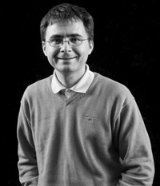
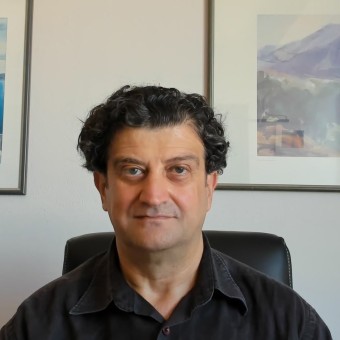
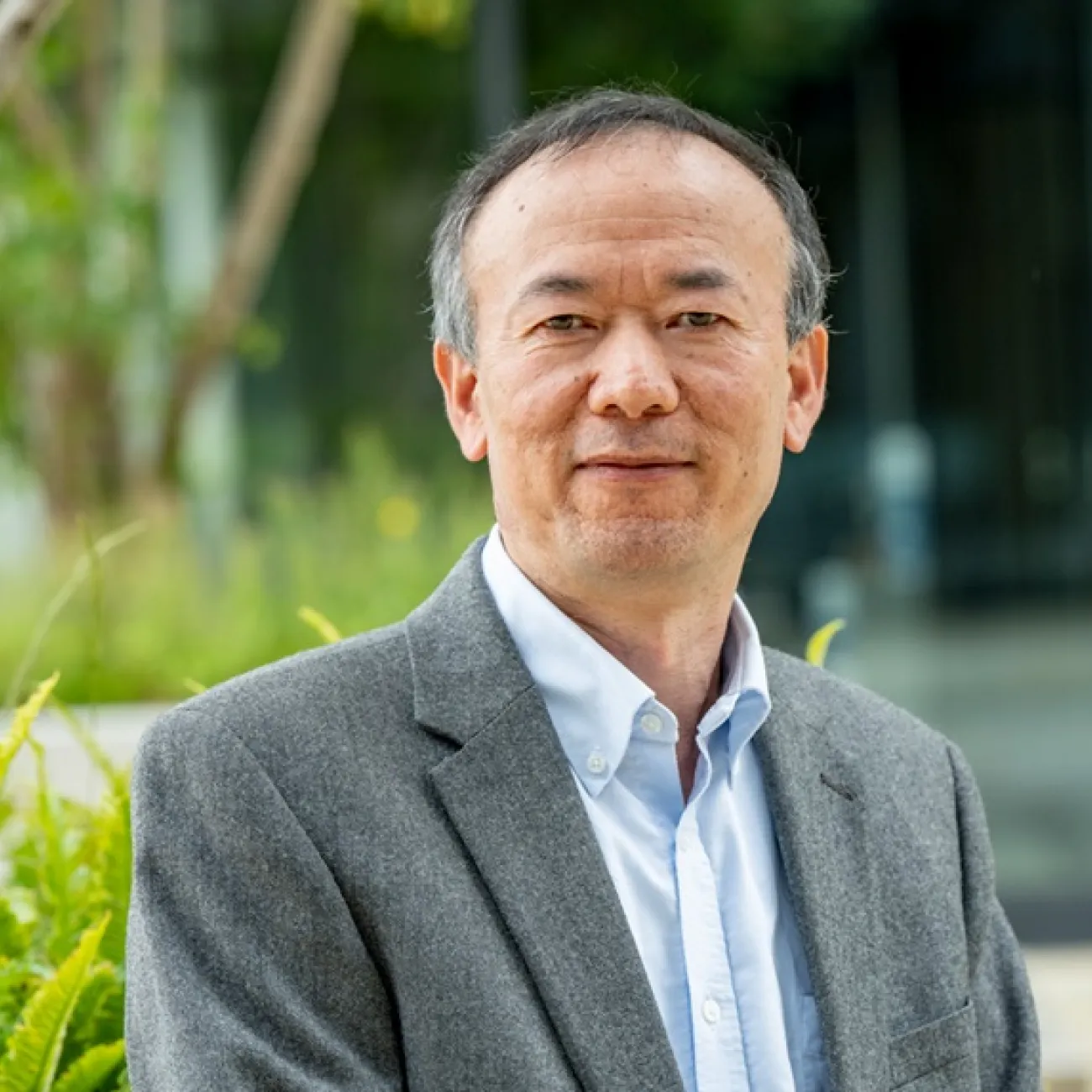
Ben Green is the Waynflete Professor of Pure Mathematics at the University of Oxford and a Fellow of Magdalen College. His work spans additive combinatorics, analytic number theory, harmonic analysis, ergodic theory, discrete geometry, and group theory, with a focus on interdisciplinary approaches. Research Interests: Additive combinatorics and its applications to primes Analytic number theory (prime distribution, L-functions) Harmonic analysis (Fourier methods, spectral theory) Ergodic theory and its combinatorial applications Discrete geometry (ordinary lines, convex structures) Group theory (approximate groups, expansion) Article Trends: His recent work emphasizes multiplicative functions, Ramsey-type problems in number theory, expansion in finite groups, and extremal set theory. Themes include prime gaps, arithmetic progressions, and interactions between analysis and algebra. Scientific Awards: Clay Research Award (2004) Ostrowski Prize (2005) Whitehead Prize (2005) Leverhulme Prize (2007) European Mathematical Society Prize (2008) Royal Society Fellow (2010) Sylvester Medal (2014) Senior Whitehead Prize (2019) Advising: Ben has supervised numerous D.Phil students across additive combinatorics, analytic number theory, and related fields. Past students hold postdoctoral and academic positions globally.
Nathan Kaplan is a Professor in the Department of Mathematics at the University of California, Irvine, where he conducts research in number theory, algebraic geometry, and combinatorics. His work spans rational points on varieties over finite fields, arithmetic statistics, coding theory, and the study of numerical semigroups. He is actively involved in the mathematical community, organizing seminars and conferences including the UC Irvine Number Theory Seminar and the Southern California Number Theory Day. Dr. Kaplan received his PhD from Harvard University in 2013 under the direction of Noam Elkies. Following his doctorate, he was a postdoctoral researcher at Yale University from 2013-2015 before joining the faculty at UC Irvine. His research interests focus on the intersection of number theory and algebraic geometry, with particular attention to problems involving rational points on varieties over finite fields, arithmetic statistics, and coding theory. He has made significant contributions to the study of numerical semigroups, cokernels of random p-adic and integer matrices, and quadratic forms and lattices. His work often bridges theoretical mathematics with applications in coding theory and cryptography. Analysis of his recent publications shows a strong trend toward combinatorial aspects of number theory, particularly in the study of numerical semigroups and their properties. He frequently collaborates with researchers across institutions, with recent work spanning algebraic geometry, combinatorics, and coding theory. His publications demonstrate expertise in both theoretical developments and computational aspects of number theory. Dr. Kaplan is deeply committed to undergraduate research and mentoring. He has experience as a mentor for undergraduate research projects through programs including SUMRY (a research program for Yale undergraduates), the University of Minnesota-Duluth REU program, and the Trinity University REU program. He actively encourages undergraduates to apply for summer research opportunities and has organized numerous outreach activities. He is an organizer of the UC Irvine Number Theory Seminar and the Southern California Number Theory Day conference series. In 2018, he co-organized the Conference on Open Questions in Cryptography and Number Theory in honor of Alice Silverberg's 60th Birthday. Dr. Kaplan has given numerous talks at mathematical venues including the Museum of Mathematics' Math Encounters series, where he presented "Error-Correcting Codes: The Mathematics of Communication" in July 2022. He has also spoken at the Yale Undergraduate Math Society, the UCI Math Circle, and various other outreach events.
Paul Horn is a Professor and Associate Chair of Graduate Studies in the Department of Mathematics at the University of Denver, within the College of Natural Sciences and Mathematics. He earned his Ph.D. in Mathematics from the University of California, San Diego (2009), under the supervision of Fan Chung. Prior to joining DU in 2013, he held postdoctoral positions at Emory University and Harvard University. His research focuses on combinatorics, graph theory, and probability, with a particular emphasis on applying probabilistic, algebraic, and geometric methods to analyze networks and graphs. Dr. Horn co-organizes the Rocky Mountains-Great Plains Graduate Research Workshop in Combinatorics (GRWC) and contributes to the graph theory section of the Masamu Advanced Studies Institute in southern Africa. He also serves as the graduate coordinator in the Mathematics Department, overseeing graduate student advising and program administration. His work spans theoretical contributions to graph structure, stochastic processes on networks, and applications in multi-agent systems and sensor networks. Publications highlight his expertise in graph curvature, network robustness, and combinatorial optimization, reflecting his interdisciplinary approach to discrete mathematics and its real-world applications. His research bridges pure and applied mathematics, addressing challenges in algorithm design, network dynamics, and geometric graph theory. Horn’s advising and mentorship activities include guiding graduate and undergraduate students in mathematics, emphasizing hands-on research experiences through workshops and collaborative projects. His contributions to academic leadership and research dissemination are evident through editorial roles and conference organization in combinatorics and graph theory.
Lutz Warnke is a Professor of Mathematics at the University of California, San Diego, with prior affiliations at Georgia Institute of Technology (where he received tenure in 2021) and Peterhouse, Cambridge University (Junior Research Fellow until 2016). His research focuses on probabilistic combinatorics, random graphs, phase transitions, and combinatorial probability, with applications to extremal combinatorics and Ramsey theory. Education : Ph.D. in Mathematics from the University of Oxford (2012), supervised by Oliver Riordan. Dr. Warnke's research explores the structure and evolution of random graphs and processes, including Achlioptas processes, Ramsey numbers, and extremal problems. His work often bridges probabilistic methods with algorithmic applications and theoretical computer science. His publications from 2022–2025 reveal trends in random graph isomorphisms, clique coloring thresholds, extremal subgraph counts, and hardness of online algorithms. Key subfields include percolation, phase transitions, and probabilistic methods applied to combinatorial structures. Scientific Awards : Dénes König Prize (2016), Alfred P. Sloan Research Fellowship (2018), NSF CAREER Award (2020), Richard Rado Prize (2014). Dr. Warnke actively supervises PhD students and postdocs, including Matthew Cho (PhD ongoing), Erlang Surya (PhD 2025), Emily Zhu (PhD 2025), and He Guo (PhD 2021). He has received teaching accolades at Georgia Tech and contributes to graduate courses in probabilistic combinatorics, random graph theory, and stochastic processes.
Cynthia Yan is a Visiting Professor in the Physics Department at Stanford University, affiliated with the School of Humanities and Sciences. Her academic appointment was noted for the 2019 academic year. Her research focuses on theoretical physics with an emphasis on quantum gravity, string theory, supersymmetry, and black hole physics. She explores topics such as BPS black hole microstates, entanglement in quantum systems, and holographic dualities. Her work bridges advanced mathematical techniques with foundational questions in high-energy physics, including studies on wormholes, topological quantum field theories, and the interplay between QCD effects and particle physics observables like the Z boson forward-backward asymmetry. While specific grants or awards are not listed, her publications reflect engagement with cutting-edge theoretical frameworks and interdisciplinary methods. Though no student advisees are explicitly documented here, her contributions to areas like matrix theory and emergent spacetime suggest involvement in graduate-level research training. Contact information specific to her role is not provided in the available data.
Qi Chen is a Professor in the Department of Geography at the University of Hawaii at Mānoa, specializing in remote sensing and geospatial technologies. His office is located in Saunders Hall, and he teaches undergraduate and graduate courses including GEO 370 (UAV and Aerial Photography), GEO 388 (Introduction to GIS), GEO 470 (Remote Sensing), GEO 489 (Applied GIS), and GEO 762 (Research Seminar: Remote Sensing. His research focuses on transforming earth observation data into actionable knowledge for environmental monitoring. Primary interests include: LiDAR applications for vegetation analysis and biomass estimation Climate change impacts on land cover and coastal systems Machine learning integration with geospatial data High-resolution mapping of agricultural and forest ecosystems Drone and satellite-based environmental assessment Chen's recent publications (2020-2025) demonstrate a strong focus on advancing remote sensing methodologies, particularly through: AI-driven approaches (GANs for vegetation indices, deep learning for marine debris) Multi-sensor fusion (LiDAR with camera systems, hyperspectral-multispectral integration) Novel applications in precision agriculture and infrastructure monitoring Hawaii-specific environmental studies incorporating indigenous knowledge systems He leads the Smart Remote Sensing Lab (smartremotesensing.org) where he mentors graduate students in developing cutting-edge geospatial solutions for ecological and societal challenges.
Richard Kenyon is the Erastus L. DeForest Professor of Mathematics at Yale University, serving as Director of Undergraduate Studies. His research focuses on statistical mechanics, probability, and discrete geometry, with notable contributions to dimer models, random tilings, and integrable systems. He has explored topics such as limit shapes, phase transitions, and combinatorial configurations. His work intersects algebraic geometry, combinatorics, and mathematical physics, often involving the analysis of lattice models and their applications. His research includes open problems such as tiling optimization, geometric spanning surfaces, number theory questions, and rigidity of tilings. Kenyon's gallery showcases visualizations of mathematical concepts, including random triangulations, Vinnikov curves, and conformal mappings. His academic contributions span over three decades, with recent articles addressing dimers, webs, and eigenvalue properties. He actively collaborates on projects like the six-vertex model, multiwebs, and renormalizable dynamical systems. Kenyon’s academic service includes directing undergraduate studies at Yale and contributing to initiatives in discrete differential geometry. His work highlights the interplay between pure mathematics and applied probability, with applications in physics and combinatorial optimization.
Prof. Mihai Nica is an Assistant Professor in the Department of Mathematics and Statistics at the University of Guelph, affiliated with the CARE-AI institute and Vector Institute. His research focuses on probability theory, stochastic processes, and their applications to machine learning, particularly deep neural networks (DNNs). He explores scaling limits of DNNs, numerical methods using neural networks, and phase transitions in high-dimensional learning problems. Education: B.Math in Pure & Applied Math with Physics Option, University of Waterloo PhD in Mathematics, Courant Institute of Mathematical Sciences, New York University Postdoctoral Fellow at University of Toronto (supervised by Jeremy Quastel) Research Interests: His work bridges mathematical theory and practical AI applications, emphasizing topics like the neural tangent kernel, KPZ universality class, and stochastic processes in machine learning. Notable contributions include studies on neural network dynamics, random matrices, and directed polymers. Publications: Over 15 peer-reviewed articles in journals like Communications in Pure and Applied Mathematics and Electronic Journal of Probability , with a focus on theoretical foundations of AI and stochastic systems. Recent work explores infinite-width limits of neural networks and their connections to differential equations. Labs/Teams: Affiliated with CARE-AI (bridging mathematics, engineering, and philosophy) and the Vector Institute, fostering interdisciplinary collaborations.
Jayadev S. Athreya is an Associate Professor in the Department of Mathematics at the University of Washington, where he also serves as Director of the Washington Experimental Mathematics Lab. His primary affiliation is with the College of Liberal Arts & Sciences. He holds dual roles as a Professor of Mathematics and Professor of the Comparative History of Ideas. Athreya co-directs the Pacific Institute for the Mathematical Sciences and is a founder of the Washington Experimental Mathematics Lab, emphasizing interdisciplinary experimental mathematics. His research interests span dynamical systems, geometric topology, number theory, and algebraic geometry. He focuses on translation surfaces, billiards dynamics, geometric flows, and probabilistic methods in geometry. His work often intersects with problems in ergodic theory, Teichmüller theory, and moduli spaces. Athreya has an extensive publication record, with recent work exploring billiard complexity in regular polygons, linear flows on translation prisms, and spectral properties of marked tori. His papers frequently address counting problems, asymptotic distribution of geometric objects, and connections between number theory and dynamical systems. He has taught advanced courses such as Quasiconformal Maps and Teichmüller Theory, Complex Analysis, and Elementary Number Theory. His pedagogical approach emphasizes hands-on exploration through the Washington Experimental Mathematics Lab, fostering collaborative research projects with undergraduates. Athreya is committed to accessible mathematics education, reflecting his alignment with Federico Ardila-Mantilla's axioms on equity and inclusivity in mathematical experiences. His work bridges theoretical research with educational outreach, advocating for mathematics as a universal, adaptable tool.
Professor Silvio Franz is affiliated with the Department of Mathematics and Physics 'Ennio De Giorgi' at the University of Salento (Italy). His research career spans over 30 years with 110+ publications, focusing on the statistical mechanics of disordered systems and their interdisciplinary applications. Key contributions include the development of the Franz-Parisi potential for studying glass transitions and rigorous mathematical frameworks for spin glasses. PhD in Theoretical Physics Full Professor at University of Salento Research Interests center on spin glasses and glassy systems , with applications to: Theoretical Neuroscience Machine Learning Population Genetics Constraint Satisfaction Problems Random Matrix Theory Theoretical Computer Science His work connects statistical physics to: Information Theory Optimization Algorithms Neural Network Modeling Evolutionary Biology Complex Systems Theory Key Publications demonstrate: Landau theory for glasses Universality in jamming transitions Stochastic stability analysis Effective temperature formulations Replica symmetry breaking Applications to error-correcting codes
Erik Carlsson is a Professor in the Mathematics department at the University of California, Davis. His research spans multiple areas of pure and applied mathematics, connecting deep theoretical concepts with practical computational applications. He received his Ph.D. from Princeton University under Professor Andrei Okounkov in 2008, and a B.S. in Mathematics with honors and a minor in Computer Science from Stanford University in 2003. Carlsson's research focuses on representation theory, algebraic geometry, algebraic combinatorics, computational topology, and connections with nonconvex optimization. He is particularly interested in connections between Goresky-Kottwitz-Macpherson (GKM) spaces and applications to Macdonald theory and combinatorics. His work also includes computational topology, especially persistent homology, which he develops in collaboration with John Carlsson. One of his recent developments is a method for constructing the alpha complex in high dimension using the powerful duality principle in mathematical optimization. His recent publications show a clear trend toward bridging theoretical mathematics with computational applications. His work spans from proving deep conjectures in algebraic combinatorics (like the shuffle conjecture) to developing practical algorithms for topological data analysis. The interdisciplinary nature of his work connects pure mathematical theory with applications in data science, computer vision, and optimization problems. Carlsson has made significant contributions to multiple fields of mathematics through his collaborations and independent work. His research has implications for both theoretical mathematics and practical computational problems, with recent publications as of 2024 demonstrating his continued active research program.
Rainer Dietmann serves as Professor in the Department of Mathematics at Royal Holloway, University of London, specializing in Number Theory and its intersections with algebraic geometry and arithmetic. His institutional affiliation places him within the university's mathematical sciences division where he maintains active research and teaching responsibilities. His research program centers on deep problems in Number Theory, particularly focusing on Arithmetic Geometry, Diophantine Approximation, Galois Theory, and Quadratic Forms. Dietmann investigates structural properties of polynomial equations, discriminants of number fields, and geometric configurations of rational points on algebraic varieties. His work combines analytic, algebraic, and combinatorial approaches to address fundamental questions about polynomial behavior and Diophantine structures. Analysis of his recent publications reveals consistent engagement with high-impact problems in arithmetic geometry, including van der Waerden's conjecture, discriminant distributions, and rational curves on hypersurfaces. His research demonstrates increasing international collaboration, particularly with leading number theorists across Europe and Asia, while maintaining methodological rigor in both theoretical proofs and computational aspects of number theory. Professor Dietmann has supervised 3 research students and secured significant funding through two major projects: an EPSRC grant for "Forms in many variables" (2011-2012) and a Royal Society grant supporting the "Joint meeting of the Korean and American Mathematical Society" (2009-2010). These projects reflect his leadership in advancing collaborative research in number theory and polynomial arithmetic.
Nikolaos Samaras is a Full Professor at the Department of Applied Informatics, School of Information Sciences, University of Macedonia in Thessaloniki, Greece. He has been serving as director of the Computational Methodologies & Operations Research (CMOR) Laboratory since April 2016. His academic career includes positions as Assistant Professor (2007-2012) and Lecturer (2003-2007) at the same institution, and earlier as an adjacent Lecturer at the Technological Institute of Western Macedonia (1998-2000). Dr. Samaras earned his Diploma in Applied Informatics from the University of Macedonia in 1996 and his Ph.D. in Applied Informatics from the same university in 2001. His educational background forms the foundation for his extensive research in computational optimization and operations research. Professor Samaras's research focuses on the interface between computer science and operations research, with particular expertise in linear and nonlinear optimization, network optimization, integer optimization, and scientific computing including HPC and GPU programming. His work has resulted in the development of new algorithmic families for optimization problems, efficient GPU implementations of the revised simplex algorithm, and novel algorithms and software for operations research. His research spans theoretical algorithm development, practical implementation, and real-world applications across various engineering and scientific domains. His extensive publication record includes over 35 journal papers in prestigious venues such as Computers and Operations Research, European Journal of Operational Research, and Journal of Artificial Intelligence Research, more than 85 conference papers, and four textbooks (two in English and two in Greek). His work has been recognized through citations and the Thomson ISI/ASIS&T Citation Analysis Research Grant in 2005. ACM Senior Member (2016) Thomson ISI/ASIS&T Citation Analysis Research Grant (2005) Editorial board member of Operations Research: An International Journal Reviewer for numerous top journals including Mathematical Programming Computation and European Journal of Operational Research Professor Samaras has supervised four current Ph.D. students working on hybrid simplex algorithms, large-scale optimization using Apache Hadoop, algorithmic procedures in matrix theory, and smoothed complexity analysis. He has successfully guided five Ph.D. students to completion, including Nikolaos Ploskas who won the 2014 HELORS Doctoral Dissertation Award. Additionally, he has supervised 45 master's theses and 84 bachelor's theses. His research group has secured funding from diverse sources including the European Union, Greek Secretariat of Research and Technology, and industry partners like Veltio Greece LTD. The Computational Methodologies & Operations Research (CMOR) Laboratory, which he directs, focuses on developing and implementing optimization algorithms with applications in transportation, energy systems, and business process design. The lab has produced notable software tools including Euclides and Visual LinProg, which have educational applications in linear programming.
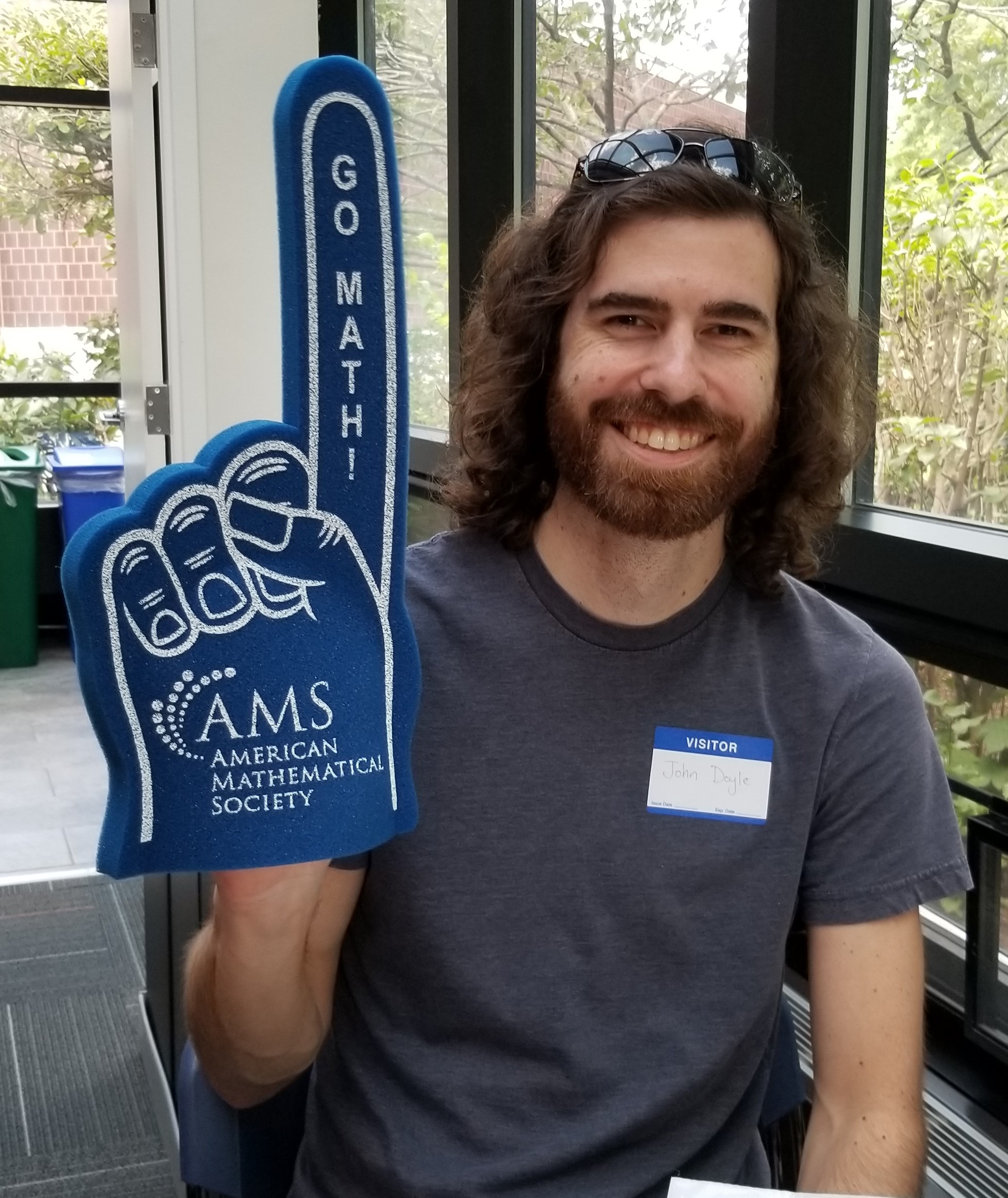
John R. Doyle serves as Associate Professor in the Department of Mathematics at Oklahoma State University, specializing in arithmetic dynamics with complementary work in arithmetic geometry and algebraic number theory. His research investigates rational functions over fields of arithmetic interest including rational numbers, number fields, p -adic fields, and function fields, with particular focus on dynamical moduli spaces and their applications to the dynamical uniform boundedness conjecture of Morton and Silverman. Dr. Doyle earned his bachelor's, master's, and doctoral degrees in mathematics from the University of Georgia, the first state-chartered university in the United States. Following graduate studies, he completed a three-year postdoctoral appointment at the University of Rochester before joining Louisiana Tech University as an assistant professor in 2017. His academic journey reflects progression through major research institutions with increasing responsibility in both teaching and research. His research program centers on the intersection of dynamical systems and number theory, examining preperiodic structures in polynomial dynamics. Doyle's work frequently involves constructing and analyzing dynamical moduli spaces that parametrize rational maps with specified preperiodic behavior. This research contributes significantly to addressing fundamental questions about uniform boundedness of preperiodic points across number fields, connecting Galois theory with dynamical systems in innovative ways. Dr. Doyle maintains an active publication record with numerous articles in top-tier mathematics journals including Transactions of the American Mathematical Society , Compositio Mathematica , and Mathematische Annalen . His recent publications demonstrate consistent advancement in understanding preperiodic points, dynamical modular curves, and Galois-theoretic aspects of arithmetic dynamics, with several 2024-2025 publications indicating ongoing productive research. As an educator, Doyle teaches across the mathematics curriculum at Oklahoma State University, from foundational calculus courses to advanced graduate seminars in algebraic curves and arithmetic dynamics. His teaching portfolio reflects deep expertise in algebra and number theory, with current Spring 2025 offerings including Abstract Algebra II and specialized graduate coursework. His pedagogical approach connects advanced research topics with undergraduate and graduate instruction, enriching the mathematical education experience for students at all levels.
Professor Zheng-Tong Xie is a Professor at the University of Southampton's Department of Engineering and Environment. His research focuses on Aerodynamics, Computational Fluid Dynamics (CFD), Turbulence, and Urban Wind Engineering. He leads modules in Applications of CFD, Race Car Design GDP, and Computational Aerodynamics. Active in professional roles, he serves as a Fellow of the Royal Meteorological Society (since 2009), Chair of the Urban Fluid Mechanics Special Interest Group (since 2017), and Council Member of the UK Wind Engineering Society (since 2014). His work spans urban dispersion modeling, tall building aerodynamics, and CFD methodology development. Current research includes the FUTURE project on urban tall-building clusters and the DIPLOS project on localized urban dispersion. Advises PhD students Keertan Kumar Maskey and Donnchadh Eoghan MacGarry. Collaborates on EPSRC and industry-funded projects, with a focus on wind engineering, turbulence, and fluid dynamics applications. Key research interests include urban airflow dynamics, pollutant dispersion, and CFD validation against sensor data. He contributes to large-eddy simulation (LES) advancements for urban environments, addressing challenges like tall building clusters and street network dispersion. His external roles reflect leadership in both academic and professional wind engineering communities. Research outcomes bridge theoretical CFD models with practical urban design and environmental monitoring needs.