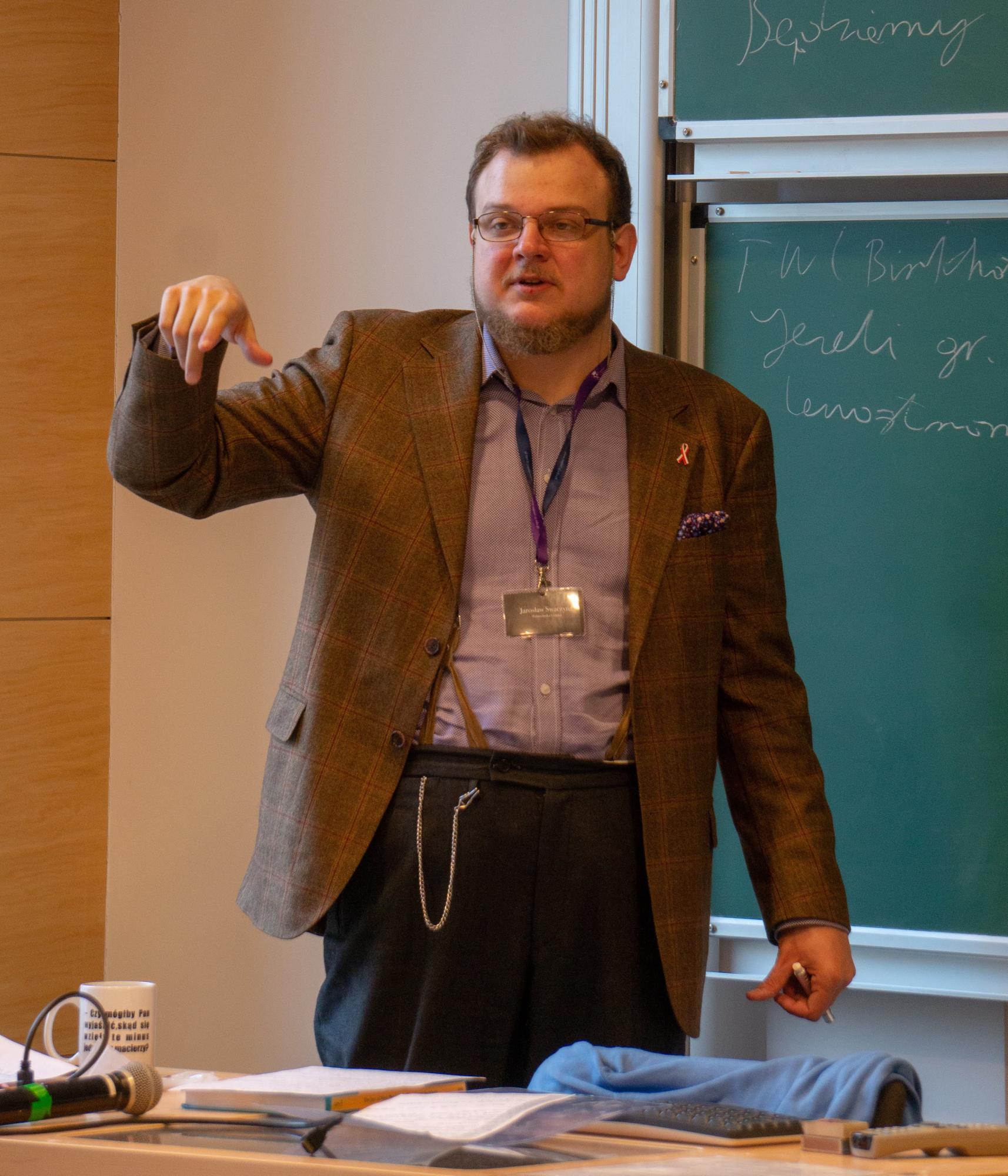
Jarosław Swaczyna is an Assistant Professor at the Division of Applications of Contemporary Mathematical Analysis , Lodz University of Technology. His research spans functional analysis, set theory, fractal geometry, and mathematical logic. Research Interests: His work focuses on the intersection of infinite-dimensional spaces, probabilistic combinatorics, and topological properties of Polish groups. He investigates generalized iterated function systems, density ideals, and continuity of functionals in Banach spaces. Publications Trends: Recent contributions include probabilistic models for random graphs, structural properties of Hamel bases, and topological dynamics of fractal attractors. Earlier works explore density ideals, Cantor sets, and generalized IFSs. Contact: Email: jaroslaw.swaczyna@p.lodz.pl Phone: (+48) 42 631-38-51 Room: 154
Dr. hab. Przemysław Matuła serves as a Professor in the Department of Applied Mathematics within the Faculty of Mathematics, Physics and Computer Science at Maria Curie-Skłodowska University (UMCS) in Lublin, Poland. His academic profile shows active teaching responsibilities including Mathematical Statistics courses for Mathematics and Mathematics in Finance programs, Master's Seminars, and Time Series in Finance instruction. His research concentrates on Probability Theory and Mathematical Statistics with specialization in limit theorems for independent and dependent random variables, various dependence concepts, and Pareto-type distributions. His scholarly work demonstrates consistent theoretical advancements in laws of large numbers, convergence theorems, and extreme value theory with applications to ratio statistics and depopulation modeling. Analysis of his recent publications reveals a strong thematic focus on exact and weak laws of large numbers across diverse dependence structures, particularly examining Pareto distributions and their applications. His work bridges theoretical probability with practical statistical applications, as evidenced by his 2024 study on identifying villages at risk of depopulation in Poland. Professor Matuła maintains regular office hours Monday and Tuesday 10:00-12:00, with departmental availability Monday-Friday during standard business hours. His teaching schedule for the 2024/2025 summer semester includes Mathematical Statistics courses for multiple degree programs.
Dr. Eng. Grzegorz Pędrak is a Lecturer at the Department of Automation and Computer Science within the Faculty of Electrical and Computer Engineering at Cracow University of Technology . His research focuses on pseudorandom number generation, signal processing, analog-to-digital conversion, and stochastic systems. He has actively contributed to publications in these areas since the early 2000s. Keywords: Pseudorandom Number Generation, Signal Processing, Analog-to-Digital Conversion, Stochastic Systems, Monte Carlo Methods Recent work includes wireless monitoring systems and automated control solutions for agricultural applications. While formal scientific awards aren't listed, his publications demonstrate expertise in converting analog signals, RNG algorithms, and stochastic converter design. His research often involves interdisciplinary methods like Monte Carlo simulations and hardware implementation of random number generators.
Maciej Huk is an Assistant Professor at Wroclaw University of Science and Technology, working in the Department of Applied Informatics within the Faculty of Information and Communication Technology. He has been affiliated with the university since 2007, previously working in the Department of Artificial Intelligence and Department of Security of Computer Systems before moving to his current department in 2016. His academic credentials include Ph.D. and D.Sc. degrees in Computer Science from Wroclaw University of Technology (2007, magna cum laude) and an M.Sc. Eng. degree in Computer Science (magna cum laude). Dr. Huk's research spans multiple areas of artificial intelligence and computer science, with particular emphasis on contextual systems, artificial neural networks, and machine learning. His work explores contextual neural networks, selective attention mechanisms, genetic algorithms, and ensembles of classifiers. He has developed several research software systems including H2O Snowflake for distributed training of contextual neural networks, CxNNS, GACS for context-sensitive text mining, and DYDO for educational applications. His research bridges theoretical computer science with practical applications in IoT, embedded systems, and robotics. His publication record shows consistent productivity with research spanning from 2006 to the present (2025), demonstrating evolving focus from foundational neural network research to more applied contextual systems. The publication trends indicate a strong specialization in contextual neural networks, with recent work expanding into biomedical applications (CRISPR-Cas9 analysis), educational technology (attendance systems), and energy optimization. His work consistently addresses the challenge of context representation and utilization in machine learning systems. Dr. Huk serves as an Academic Editor for PLOS ONE Journal and Evolving Systems Journal, and has reviewed over 130 papers since 2016 for journals registered in ISI Web of Science. He has been actively involved in the academic community as a program and organization committee member for numerous conferences including ACIIDS (2016-2021), ICCCI (2016-2020), and others. He has chaired special sessions on Intelligent and Contextual Systems at IEEE conferences. His professional activities extend beyond pure academia, including serving as Software Architect/Data Analyses Architect at Gigaset Communications since 2008, and organizing clinical research including the Phase 3 randomized multicenter clinical study NCT04952519 on amantadine treatment for COVID-19 patients. He is certified to organize clinical trials with human subjects through NIH NIAID Good Clinical Practices 2.0.
Dr. Magdalena Łysakowska is a researcher at the University of Zielona Góra, affiliated with the Department of Computer Science Applications. She teaches courses in linear algebra, logic and set theory, combinatorial analysis, differential geometry, and general algebra. Research focuses on combinatorial geometry (cube partitions, Keller's hypothesis) Nonlinear analysis (Lipschitz maps, fixed point theorems) Stochastic inclusions and multivalued equations Iterative algorithms (Gaussian and Archimedes-Borchardt) Applications of computer science to secure data transmission and software development She participates in Erasmus teaching collaborations, delivering courses at the University of Debrecen (Hungary) and Ilmenau University of Technology (Germany). Her work spans theoretical and applied mathematics, emphasizing geometric structures, functional equations, and computational methods.
Professor Mieczysław Jessa is a distinguished faculty member at Poznań University of Technology, serving in the Faculty of Information Technology and Telecommunications within the Institute of Multimedia Telecommunications. With a scientific discipline focused 100% on Information and Communication Technology, he has established himself as a leading researcher in random number generation, signal synchronization systems, and spectrum sensing techniques. His research interests center around hardware-based random number generators for cryptographic applications, precise synchronization of oscillators using GNSS signals, and advanced spectrum sensing methodologies. Professor Jessa's work bridges theoretical foundations with practical implementations, particularly in telecommunications security and precision timing systems. His recent publications demonstrate continued innovation in applying machine learning to spectrum sensing and developing low-complexity random number generation solutions for FPGAs. Professor Jessa maintains an active publication record with multiple articles in 2024-2025, reflecting his ongoing research contributions. His work spans both theoretical aspects of stochastic processes and practical implementations in measurement systems and secure communications. As an academic supervisor, Professor Jessa has guided doctoral research in areas including FPGA-based random sequence generation and spectrum sensing techniques, with documented supervision of three doctoral students through 2019. His technical contributions include the development of synchronization systems like the DST-16 clock distributors and SP-4000 measurement systems, demonstrating the practical application of his research in real-world telecommunications infrastructure.