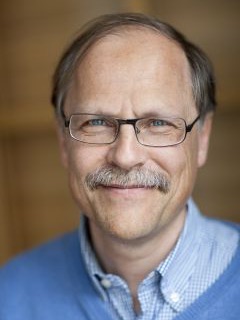
Kurt Johansson is a Full Professor of Mathematics at KTH Royal Institute of Technology, Sweden. His academic journey includes roles as Associate Professor at KTH (1993-2001) and Uppsala University (1988-1993), alongside research funded by the Swedish Natural Science Research Council (1998-2003). His primary affiliations are within the Department of Probability, Mathematical Physics & Statistics at KTH, where he also coordinates courses on Differential Equations and Fourier Analysis. Education: BSc in Physics (1982) and PhD in Mathematics (1988), both from Uppsala University. Research interests focus on Probability Theory , Mathematical Physics , and Random Matrix Theory , with contributions to stochastic models, determinantal processes, and universality in statistical mechanics. Key Awards: Wallenberg Prize (1995), Rollo Davidson Prize (2000), Göran Gustafsson Prize (2002), Fellow of the American Mathematical Society (2012), and multiple Wallenberg Scholar grants (2011-2023). Grants: Major funding from the Swedish Research Council (VR), K&A Wallenberg Foundation, and others. His research group explores Random Matrices, Stochastic Models, and Analysis , with notable work on the Arctic Circle Theorem and KPZ universality class. Recent publications analyze Brownian directed percolation and domino tilings of the Aztec diamond, reflecting his focus on interdisciplinary applications of probability and mathematical physics.
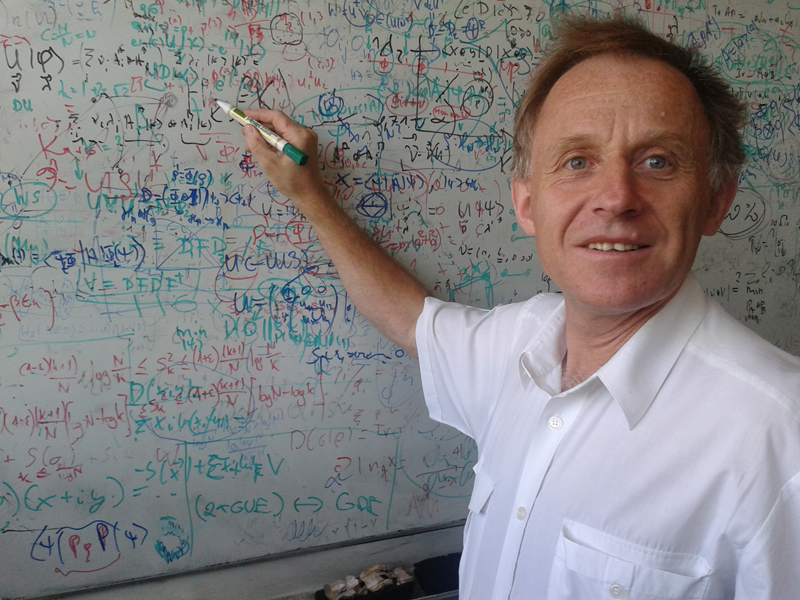
Rafał Latała is a distinguished Professor at the Institute of Mathematics, Faculty of Mathematics, Informatics and Mechanics, University of Warsaw, where he has held a full professorship since 2013. He is also a Corresponding Member of the Polish Academy of Sciences since 2016 and an AMS Fellow since 2013. His academic career spans over 25 years at the University of Warsaw, progressing from Instructor (1994-1997) to Assistant Professor (1997-2003), Associate Professor (2003-2012), and finally to his current position as Professor. Additionally, he held a part-time professorship at the Institute of Mathematics of the Polish Academy of Sciences from 2009-2012. His educational background includes a PhD in Mathematics from the University of Warsaw (1997) with a dissertation on estimation of moments of sums of independent random variables under the supervision of Professor Stanisław Kwapien, a Habilitation degree in Mathematics (2002), and the title of Professor awarded by the President of Poland (2009). He completed his MSc in Mathematics at the University of Warsaw in 1994. Latała's research focuses on the intersection of probability theory and geometric analysis, with particular expertise in convex geometry, functional analysis, asymptotic geometric analysis, and the theory of log-concave measures. His work bridges theoretical mathematics with applications in high-dimensional statistics and random matrix theory. He has made significant contributions to understanding moment inequalities, concentration phenomena, and the geometric structure of high-dimensional random objects. His recent work demonstrates increasing sophistication in handling complex relationships between different norms of random vectors and matrices. His publication record shows a consistent focus on probabilistic methods in geometric settings, with recent articles demonstrating advanced techniques for analyzing random matrices, log-concave measures, and canonical processes. The research trajectory reveals increasingly sophisticated methods for bounding norms and moments in high-dimensional spaces, with applications spanning theoretical mathematics to statistical learning theory. Kolmogorov Lecture 2024 Prize of the Foundation for Polish Science in mathematics, physics, and engineering sciences 2023 Orlicz Lecture 2023 Institute of Mathematics of the Polish Academy of Sciences Prize 2014 AMS Fellow since 2013 Foundation for Polish Science Grant Mistrz 2007-2011 Prime Minister Award for Habilitation Thesis 2003 Invited Speaker at International Congress of Mathematicians 2002 Latała has supervised five PhD students to completion (Rafal Meller, Marta Strzelecka, Jakub Wojtaszczyk, Radoslaw Adamczak, and Rafal Lochowski) and four MSc students (Maciej Bartczak, Dariusz Matlak, Tomasz Tkocz, and Marcin Lis). His editorial service includes positions at Probability Surveys (2024-26), The Annals of Probability (2015-20), and Studia Mathematica (2006-present). He has organized numerous international conferences including the High Dimensional Probability X conference in 2023 and served on various professional committees including the Central Commission for Academic Degrees and Titles.
Karol Życzkowski is a Professor of Physics at the Smoluchowski Institute of Physics, Jagiellonian University, Cracow, Poland, and also holds a position at the Center for Theoretical Physics, Polish Academy of Sciences, Warsaw. He has held visiting positions at the Perimeter Institute for Theoretical Physics (2004/05) and previously served as Director of the Quantum Information Center in Gdańsk (2019-2023). Since January 2023, he has been President of the Cracow Branch of the Polish Academy of Sciences. Education Ph.D. in Theoretical Physics (1987, Jagiellonian University) Habilitation in Physical Sciences (1994, Jagiellonian University) Życzkowski’s research spans Quantum Information Theory , with a focus on quantum entanglement, geometry of quantum states, random matrices, and operator theory. His work bridges theoretical physics, mathematics, and interdisciplinary applications, including voting systems (e.g., Jagiellonian Compromise) and scientometrics. He has authored or co-authored over 150 papers and the influential monograph Geometry of Quantum States (Cambridge University Press, 2006, second edition 2017). His recent publications emphasize quantum thermodynamics (e.g., Jarzynski equality for stochastic maps), entanglement detection via uncertainty relations, and mathematical structures in quantum theory. Collaborations span 134 scientists from 19 countries, and his work has been cited over 6500 times (Google Scholar) with an H-index of 40. Scientific Awards Award of Rector of Jagiellonian University (2013) for work on quantum information foundations Award of Rector of Jagiellonian University (2007) for the monograph Geometry of Quantum States Prime Minister Award (1995) for habilitation thesis Humboldt Fellowship (1989), Fulbright Fellowship (1997/98) Życzkowski has supervised 5 Ph.D. and 16 Master’s theses, with 3 Ph.D. students currently in progress. He coordinated 9 research grants, participated in 10 others, and led the Polish node of a German SFB-Transregio project. He serves on editorial boards for journals including Open Systems & Information Dynamics and Journal of Physics A . He co-organized workshops (including Oberwolfach and Marseille) and founded research networks like the European Research Network Krzyżowa Initiative for Quantum Information. His Jagiellonian Quantum Information Team (JQIT) and involvement in the Mark Kac Complex Systems Research Centre highlight his collaborative leadership.
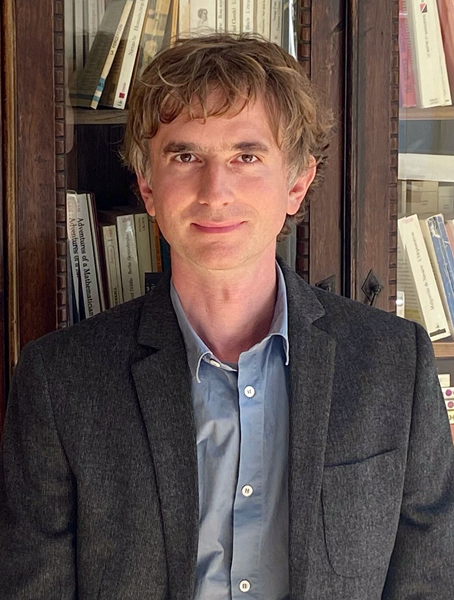
Emmanuel Breuillard is a Professor of Pure Mathematics at the University of Oxford. Previously, he held positions as Sadleirian Professor at the University of Cambridge (2017-2021), Professor at Université Paris-Sud (2008-2017), and Associate Hadamard Professor at École Polytechnique (2006-2008). His academic journey includes a PhD from Université Paris-Sud and Yale University, supervised by Frédéric Paulin and Gregory Margulis, and a Master in Mathematics from Cambridge. PhD: Université Paris-Sud (2004), supervised by Frédéric Paulin; Yale University, supervised by Gregory Margulis Master: University of Cambridge (2000) Ecole Normale Superieure (1997-1999) His research spans Combinatorics , Geometric Group Theory , Ergodic Theory , and Number Theory , focusing on approximate groups, expansion in finite simple groups, and Diophantine geometry. His recent work analyzes Elekes-Szabo problems in projective geometries. He has authored 50+ publications in prestigious journals, addressing topics like random polynomials, C*-simplicity, and uniform independence in linear groups. Fellow of the Royal Society (2024) ERC Consolidator Grant (2014-2019) Prix Charles-Louis de Freycinet (2013) European Mathematical Society Prize (2012) ERC Starting Grant (2008-2013) Cours Péccot, Collège de France (2006)
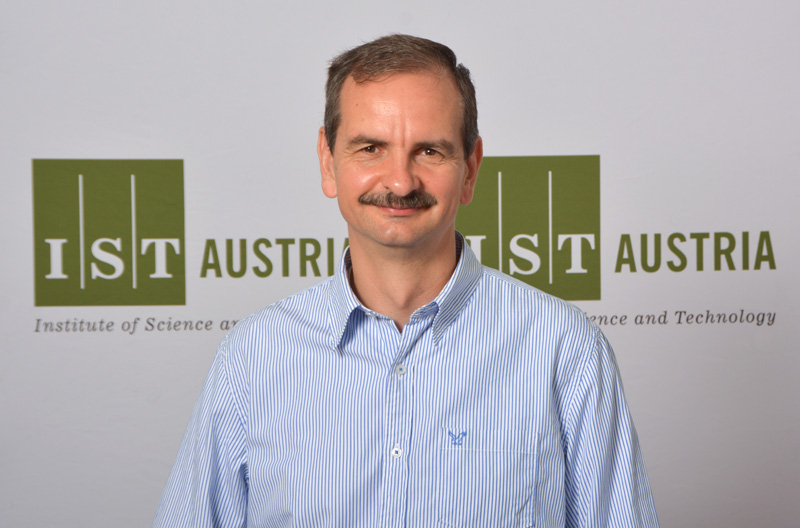
László Erdős is a Professor of Mathematics at the Institute of Science and Technology Austria (IST Austria) since 2013. He previously held positions as C4/W3 Professor at LMU Munich (2003-2013), Associate Professor and Assistant Professor at Georgia Institute of Technology, and was a Member at the Institute for Advanced Study in Princeton (2013-2014). He is an elected Corresponding Member of the Austrian Academy of Sciences (2015). Erdős earned his Diploma in Mathematics from Lorand Eotvos University, Budapest (1990), followed by a PhD in Mathematics from Princeton University (1994) under advisor Elliott H. Lieb. He completed his Habilitation at the University of Vienna (2001). His research focuses on Mathematical Physics, particularly in the areas of Random Matrix Theory, Spectral Analysis of Quantum Systems, and Many-Body Quantum Dynamics. Erdős has made significant contributions to understanding universality in random matrices, quantum dynamics of Bose-Einstein condensates, and spectral properties of disordered quantum systems. His work bridges rigorous mathematical analysis with fundamental questions in theoretical physics. Analysis of Erdős's recent publications reveals a strong focus on spectral statistics of random matrices and their applications to quantum physics. His research demonstrates how universal patterns emerge in complex quantum systems, connecting stochastic processes with spectral theory. The work spans from foundational mathematical results to applications in condensed matter physics and quantum information. His scientific achievements have been recognized with numerous honors including: ERC Advanced Grant (2013) ICM Invited Speaker (2014) SPA Plenary Speaker (2014) QMATH 12 Plenary talk (2013) Aisenstadt Chair, Montreal (2012) ICMP Plenary speaker (2009) ECM Invited Speaker (2008) ICMP Invited Speaker (2000) Elected Corresponding Member of Austrian Academy of Sciences (2015) Geza Grunwald Prize (1995) Annales Henri Poincare Distinguished Paper Award (twice) Erdős has secured significant research funding throughout his career, including an ERC Advanced Grant (2014-2019) worth 1.755M Euro, multiple NSF grants, and participation in major collaborative projects like the Elite Graduate Program TMP and SFB TR12 "Symmetries and Universality." His research group at IST Austria continues to advance the mathematical understanding of quantum systems and random matrices.
Dr. Regino Criado is Full Professor of Applied Mathematics at Rey Juan Carlos University (URJC), where he has held academic positions since June 2000. He currently serves as Academic Director of the Data, Complex Networks and Cybersecurity Sciences Institute (since March 2017) and was elected to the Academia Europaea in May 2023. His career spans European research projects (ESPRIT II/III) and interdisciplinary collaborations at the intersection of mathematics, computer science, and cybersecurity. His research focuses on Complex Networks , including hyper-networks, multiplex networks, and mesoscale structures, with applications to cybersecurity, intentional risk management, and synchronization phenomena. Key innovations include: A game theory-based intentional risk model integrating accessibility, anonymity, and value metrics Hybrid network mining algorithms for credit card fraud detection PageRank extensions to multiplex networks Framework for discrete resilience analysis in technological systems His work on the 2014 Physics Reports monograph The structure and dynamics of multilayer networks (3,500+ citations) established foundational concepts in multilayer network theory. Current research explores linguistic pattern analysis through multilayer hypergraphs for automatic text summarization. Member of Academia Europaea (2023) Chaos Journal Best Paper Award (2011) Academic Entrepeneurs Prize (2002) EUROPA-1992 Prize (1992) As director of the DCNC Institute (2017-present) and BBVA-URJC Chair (2017-2018), he has led major academic-industry collaborations. His 180+ publications (6,500+ citations) demonstrate sustained impact across network science, applied mathematics, and cybersecurity.
Keith Martin Ball is a leading mathematician specializing in functional analysis, convex geometry, and information theory. He holds the Professorship at the University of Warwick since 2010 and previously held prominent positions at University College London, Texas A&M University, and the International Centre for Mathematical Sciences (ICMS) in Edinburgh. Alma Mater: Trinity College, Cambridge (PhD 1987 under Béla Bollobás) Key Contributions: Extension theorems for Lipschitz functions, reverse isoperimetric inequalities, Banach-Steinhaus Theorem advancements, and entropy-driven central limit theorem proofs. His research spans high-dimensional geometry, discrete geometry, and applications to information theory. He has authored the popular mathematics book Strange Curves, Counting Rabbits, & Other Mathematical Explorations . Recent Publications focus on zeta function irrationality, entropy inequalities, and geometric functional analysis, reflecting his interdisciplinary approach combining pure mathematics with probabilistic and information-theoretic methods. Scientific Honours Fellow of the Royal Society (FRS) (2013) Fellow of the American Mathematical Society (AMS Fellow) (2013) Shephard Prize (2015) Whitehead Prize (1992) Leverhulme Fellow (2003-2004) Member of Academia Europaea (2023)
Joscha Henheik is a Postdoctoral Researcher at the Institute of Science and Technology Austria (IST Austria), transitioning to the University of Geneva in September 2025 under Antti Knowles. He completed his M.Sc. (Physics, 2020) and B.Sc. (Mathematics/Physics, 2019) at the University of Tübingen, followed by a Ph.D. in Mathematics at IST Austria (2025). He co-organizes the MIX Colloquium at IST Austria. His research focuses on mathematical physics, emphasizing random matrices, quantum many-body systems, and BCS theory. Key contributions include studies on the Loschmidt echo, universality in BCS models, and adiabatic theory for quantum spin systems. His work bridges theoretical physics and rigorous mathematical analysis, addressing topics like prethermalization, eigenvector decorrelation, and integrable systems. Publications span random matrix theory, superconductivity, and adiabatic processes, with methods rooted in statistical mechanics and quantum dynamics. His collaborations include László Erdős, Giorgio Cipolloni, and Antti Knowles. Future work will explore quantum lattice systems and low-dimensional BCS phenomena at Geneva.
Werner Schachinger is an Associate Professor in the Department of Statistics and Operations Research at the Faculty of Business, Economics and Statistics. His research focuses on optimization theory, mathematical analysis, and game theory, with particular emphasis on completely positive matrices, quadratic optimization, and evolutionary dynamics. He has authored over 18 publications since 2007, exploring topics such as CP-rank bounds, combinatorial asymptotics, and algorithmic methods in optimization. Education background not explicitly stated but inferred through research focus and academic rank. His research interests span operations research, mathematical optimization, probability theory, and combinatorics. Notable contributions include studies on the complexity of optimization models, equilibrium analysis in game theory, and the application of copositive programming techniques. Publications highlight trends in optimization theory, with recent works addressing geometric distribution analysis (2023) and Plancherel averages (2023). Earlier contributions include work on moral play equilibrate (2021) and cp-rank lower bounds (2015–2020). No scientific awards explicitly mentioned in the texts. Advising and grants details are not provided in the text. However, activities include organizing the 2018 Workshop on Optimization, Game Theory, and Data Analysis, and contributing to talks on copositive optimization and duality in conic programming. Labs or research teams are not explicitly mentioned, though collaborations with researchers like Immanuel Bomze and Jörgen Weibull suggest active participation in interdisciplinary projects.
Christian Krattenthaler is a retired Professor at the University of Vienna's Faculty of Mathematics, specializing in combinatorics and algebraic combinatorics. He is a member of the combinatorics group and co-leads the Arbeitsgemeinschaft für Diskrete Mathematik. His research focuses on enumerative combinatorics, hypergeometric series, and number theory, with notable contributions to lattice path enumeration, determinants, and tilings. He has developed Mathematica packages like HYP, HYPQ, and RATE for hypergeometric series manipulation and sequence guessing. Krattenthaler is an editor for journals such as the Séminaire Lotharingien de Combinatoire, Electronic Journal of Combinatorics, and Annales de l’Institut Henri Poincaré D. His work includes advancements in Pfaffian rings, Schubert varieties multiplicities, and combinatorial identities. Collaborations span across institutions like TU Wien and TU Graz within the Special Research Programme (SFB) on Discrete Random Structures. He has advised numerous students, though specific advisee names are not listed here.
Markus Fulmek is an Associate Professor at the Faculty of Mathematics, University of Vienna , with a focus on combinatorial mathematics and discrete structures. He has contributed extensively to enumerative combinatorics, lattice path enumeration, and algebraic combinatorics through his research. His work centers on combinatorics , particularly in lattice path enumeration , permutation patterns , and determinant identities . He has explored tiling problems for symmetric hexagons, nonintersecting lattice paths, and bijective proofs for Schur function identities, often linking these to broader areas like graph theory and discrete geometry . Recent publications (2021–2023) emphasize tiling configurations for damaged or dented hexagons, permutation matrices, and determinant-based combinatorial identities. His methodology frequently relies on nonintersecting lattice paths and bijective combinatorics .
Michael Schlosser is an Associate Professor at the Faculty of Mathematics and Department of Mathematics . His research focuses on combinatorics, number theory, and special functions, with a strong emphasis on q-series and hypergeometric series. Research Interests Combinatorics (ascent sequences, lattice paths, rook theory) Number Theory (supercongruences, cyclotomic polynomials, modular forms) Special Functions (theta functions, hypergeometric functions, orthogonal polynomials) Algebra (noncommutative hypergeometric series, matrix inversions) Recent Article Trends (2012-2025) span q-supercongruences, determinant evaluations, asymptotics of Fishburn matrices, lattice path combinatorics, and elliptic hypergeometric series. His work often intersects classical analysis with computational mathematics. Collaborators include prominent researchers like Victor J. W. Guo, Yujun Jin, Ae Ja Yee, Christian Krattenthaler, and Hwang-Fu Zhou.
Souvik Roy is a Professor at the Applied Statistics Unit of the Indian Statistical Institute, Kolkata . His research spans multiple disciplines including Game Theory, Mechanism Design, Social Choice Theory, and Probability Theory with applications in diffusion processes, percolation, and random matrices. Education: PhD (2010) from the University of Maastricht; M.Stat (2006) from the Indian Statistical Institute, Delhi. Research Interests: Game Theory (Bayesian learning, supermodular games), Mechanism Design (randomized rules, constrained domains), Social Choice (ordinal Bayesian IC, hybrid domains), Probability Theory (diffusion, percolation). His recent work focuses on Bayesian best response dynamics , probabilistic cellular automata in percolation games , and incentive-compatible voting systems . Articles appear in journals like Games and Economic Behavior , SIAM Journal on Control and Optimization , and Social Choice and Welfare , reflecting interdisciplinary applications in economics, computer science, and statistical physics. Scientific Awards: Mahalanobis Memorial Medal (2024), Social Choice and Welfare Award (2024), Professor M.J. Manohar Rao Award (2016). Students: Mentored over 15 Master’s students (M.Stat, M.Math, MSQE) and PhD advisees, including Madhuparna Karmokar and Ujjwal Kumar, with projects on strategy-proofness, mechanism design, and graph-based voting.
Christian Böhm is an Associate Professor at the Faculty of Computer Science, leading the Research Group Data Mining and Machine Learning. His work focuses on clustering algorithms, density-based analysis, and graph construction. He has been active in interdisciplinary projects, including computational modeling for biomedical applications and algorithm benchmarking. Notable contributions include ADOD (Adaptive Density Outlier Detection) and DynoGraph (Dynamic Graph Construction for Nonlinear Dimensionality Reduction). His research bridges theoretical data science with practical applications in healthcare and engineering. Research Group: Data Mining and Machine Learning Key Areas: Clustering, Density Analysis, Graph Algorithms, Medical Data Analytics Collaborations: Biohybrid heart valves, computational biomechanics, and algorithmic benchmarking Recent work emphasizes deep learning integration in clustering, medical outcome prediction, and scalable graph classification. His publications span conferences like IEEE ICDM and interdisciplinary journals.
Hannes Leeb is a full-time Professor at the University of Vienna , leading the Department of Statistics and Operations Research within the Faculty of Business, Economics, and Statistics . He is also affiliated with the Research Network Data Science and co-organizes the ISOR Colloquium . Research Interests : Inference Post Model Selection, Shrinkage-Type Estimators, High-Dimensional Data Analysis, Machine Learning, Random Matrices, Asymptotic Statistics, Linear/Non-Linear Time Series. Recent Research Trends : His 15 most recent articles focus on valid statistical inference in high-dimensional settings, including F-statistics , conformal prediction , and adaptive methods for deep learning. Key subfields include post-model selection uncertainty , conditional coverage , and shrinkage estimator properties . Teaching & Leadership : He teaches core courses like 'Basic Principles of Statistics' and 'Probability Theory', and supervises PhD research privatissimum in econometrics/statistics. As department head, he emphasizes data science integration and methodological rigor .