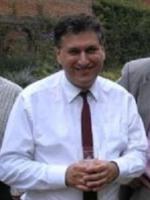
Professor Imre Leader is a distinguished mathematician at the University of Cambridge, where he serves as Professor of Pure Mathematics in the Department of Pure Mathematics and Mathematical Statistics (DPMMS), which is part of the Faculty of Mathematics. His office is located in room C2.02 at the DPMMS building. Professor Leader's research primarily focuses on Extremal Combinatorics and Ramsey Theory , two fundamental areas of discrete mathematics. His work explores deep connections between combinatorial structures, set theory, and algebraic properties. He has made significant contributions to understanding partition regularity, monochromatic structures, extremal set theory, and combinatorial geometry. His research often bridges the gap between pure combinatorics and applications in computer science and theoretical mathematics. Over his prolific career, Professor Leader has published numerous influential papers in top mathematical journals, collaborating with leading mathematicians worldwide. His work spans various aspects of combinatorics including hypergraph theory, geometric combinatorics, additive number theory, and combinatorial game theory. He has been particularly active in advancing our understanding of Ramsey-type phenomena in infinite structures and developing new techniques in extremal combinatorics. Research Group: Combinatorics Email: I.Leader@dpmms.cam.ac.uk Telephone: 01223 765902 Personal homepage: https://www.dpmms.cam.ac.uk/~ibl10
Ben Green is the Waynflete Professor of Pure Mathematics at the University of Oxford and a Fellow of Magdalen College. His work spans additive combinatorics, analytic number theory, harmonic analysis, ergodic theory, discrete geometry, and group theory, with a focus on interdisciplinary approaches. Research Interests: Additive combinatorics and its applications to primes Analytic number theory (prime distribution, L-functions) Harmonic analysis (Fourier methods, spectral theory) Ergodic theory and its combinatorial applications Discrete geometry (ordinary lines, convex structures) Group theory (approximate groups, expansion) Article Trends: His recent work emphasizes multiplicative functions, Ramsey-type problems in number theory, expansion in finite groups, and extremal set theory. Themes include prime gaps, arithmetic progressions, and interactions between analysis and algebra. Scientific Awards: Clay Research Award (2004) Ostrowski Prize (2005) Whitehead Prize (2005) Leverhulme Prize (2007) European Mathematical Society Prize (2008) Royal Society Fellow (2010) Sylvester Medal (2014) Senior Whitehead Prize (2019) Advising: Ben has supervised numerous D.Phil students across additive combinatorics, analytic number theory, and related fields. Past students hold postdoctoral and academic positions globally.
Matthew Jenssen is a Reader in Probability at King's College London and a UKRI Future Leaders Fellow. He holds a BA and MMath from the University of Cambridge (2012–2013) and a PhD from the London School of Economics (supervised by Jozef Skokan and Julia Boettcher). His research focuses on the intersection of combinatorics, statistical physics, and theoretical computer science, particularly on large-scale structure formation in systems with local interactions. Notable contributions include advancements in sphere packing, Ramsey numbers, and random matrix theory. Jenssen has held postdoctoral positions at the University of Oxford and the University of Birmingham before joining King’s in 2023. His research group at King’s explores discrete probability, extremal combinatorics, and algorithms, with applications to statistical physics and high-dimensional geometry. Key achievements include a groundbreaking improvement on sphere packing lower bounds and resolving extremal questions in graph theory. Jenssen’s work often bridges combinatorial theory with computational methods, yielding impactful results in probabilistic combinatorics. Scientific awards include the UKRI Future Leaders Fellowship (2020). His grants include a 2023–2026 project on statistical physics methods in combinatorics and geometry. Jenssen collaborates widely, with notable co-authors including Will Perkins, Jozef Skokan, and Felix Joos. He is actively involved in the Probability Group at King’s and contributes to international conferences and arXiv publications.
Chris Monico is an Associate Professor in the Department of Mathematics & Statistics at Texas Tech University . He has been a faculty member there since 2003, following post-doctoral research at the University of Notre Dame. Education B.S. in Mathematics – Monmouth University M.S. in Mathematics – University of Notre Dame Ph.D. in Mathematics – University of Notre Dame Research Focus Monico’s scholarship centers on the intersection of cryptology , computational algebra , and number theory . A significant recent thrust has been the application of machine-learning techniques to mathematical finance , evidenced by work on random-forest models for option pricing and high-frequency trading risk metrics. Parallel lines of inquiry include post-quantum cryptographic schemes built on tropical algebra and semigroup actions, as well as classical problems in Ramsey theory and combinatorial semigroups . Publication Trends Between 2015 and 2025 Monico has published prolifically, with a clear shift around 2020 toward mathematical finance and machine-learning applications , alongside continued output in algebraic cryptanalysis and combinatorics . His 2024–2025 articles emphasize data-driven models in trading, whereas 2020–2021 works concentrate on cryptanalyses of tropical and group-based key-exchange systems. Earlier contributions focus on computational number theory and semigroup-based cryptography. Contact Information Email: c.monico@ttu.edu Phone: 806-834-4144 Office: Department of Mathematics & Statistics, Texas Tech University, 1108 Memorial Circle, Lubbock, TX 79409-1042 Advising & Grants No specific doctoral or master’s students, funded grants, or named awards are detailed in the provided text. Laboratory or Research Group The text does not mention any dedicated laboratory or research group.
Dr. Julian Sahasrabudhe is a researcher at the Department of Pure Mathematics and Mathematical Statistics (DPMMS) , University of Cambridge, affiliated with the School of Mathematics . His work focuses on combinatorics, number theory, and graph theory, with a emphasis on extremal problems and probabilistic methods. His recent research explores Erdős covering systems, Littlewood polynomials, and monochromatic subgraphs. Publications from 2018–2024 highlight applications of probability generating functions, arithmetic progressions, and density analysis in combinatorial structures. Contact details: jdrs2@cam.ac.uk , Room C2.08, Tel: 01223 337974. Personal homepage .
Ross J. Kang is a Canadian mathematician currently serving as an Associate Professor at the Korteweg–de Vries Institute for Mathematics within the Faculty of Science at the University of Amsterdam since 2022. He is an active member of the Discrete Mathematics and Quantum Information group and the NETWORKS consortium. Previously, he held positions as Assistant/Associate Professor at Radboud University Nijmegen (2014-2022), Assistant Professor at Utrecht University (2013), and Researcher at Centrum Wiskunde & Informatica (2012-2013). His academic journey includes postdoctoral positions at Durham University (2010-2012) and McGill University (2008-2010), where he was advised by Bruce Reed and Louigi Addario-Berry. DPhil in Mathematics, University of Oxford (2008) - Thesis: 'Improper colourings of graphs', advised by Colin McDiarmid BSc (Hons) in Mathematics and Computer Science, University of Victoria (2003) - Governor General's Silver Academic Medal recipient Ross J. Kang's research focuses on probabilistic and extremal combinatorics, random discrete structures, graph coloring, geometric graphs, and algorithms. His work bridges theoretical mathematics with practical applications, exploring fundamental questions in discrete mathematics. He has made significant contributions to understanding graph coloring problems, particularly in the contexts of list coloring, distance coloring, and strong coloring. His research often employs probabilistic methods to establish bounds and structural properties in graph theory. Kang's work on the hard-core model, local occupancy method, and triangle-free graphs has advanced our understanding of the interplay between local constraints and global structure in discrete systems. Analysis of his recent publications reveals a strong emphasis on graph coloring problems, particularly list coloring variants and their extensions. His work frequently explores the relationship between graph structure (such as degree constraints, girth, or forbidden subgraphs) and coloring properties. A notable trend is his development and application of the local occupancy method to establish improved bounds for chromatic numbers in various graph classes. His research also demonstrates a consistent interest in extremal problems, seeking optimal configurations under specific constraints, particularly in the context of triangle-free graphs and geometric representations. NWO Open Competition M-1 grant entitled 'Asymptotic triangle-free structure (3Free)', 2022-2026 NWO Vidi grant entitled 'On the edge: theory and techniques at the frontiers of edge-colouring', 2017-2023 NWO Veni grant entitled 'Generalised colouring for random graph models', 2012-2015 Van Gogh travel grants (2020-2021 with Marthe Bonamy; 2016-2017 with Louis Esperet) Governor General's Silver Academic Medal (2003) Ross J. Kang has successfully supervised multiple PhD students including Eoin Hurley (defending May 2025), Stijn Cambie (defended April 2022), and François Pirot (winner of 2020 prix Charles Delorme). His research is supported by significant grants from the Netherlands Organisation for Scientific Research (NWO), including the prestigious Open Competition M-1 grant. Kang is actively involved in the academic community through his editorial role at Combinatorial Theory, co-organization of conferences like the Dutch Days of Combinatorics, and leadership in initiatives such as Innovations in Graph Theory, a diamond open access journal he helped launch in August 2023. As a member of the Discrete Mathematics and Quantum Information group at the University of Amsterdam and the NETWORKS consortium, Kang collaborates with researchers across various institutions. He has established strong international connections through his Van Gogh travel grants and participation in collaborative projects like the Sparse (Graphs) Coalition sessions. His research group focuses on theoretical aspects of discrete mathematics with connections to quantum information science, and he maintains active collaborations with researchers across Europe and North America.
Amit Kuber is an Associate Professor in the Department of Mathematics & Statistics at Indian Institute of Technology Kanpur . He specializes in representation theory of associative algebras, order theory, and K-theory of model-theoretic structures, with a growing portfolio of high-impact publications and teaching accolades. Education PhD (2011-14) – University of Manchester, UK (Thesis: "K-theory of theories of modules and algebraic varieties"; Supervisor: Prof. Mike Prest) Master of Advanced Studies/Part III of Mathematical Tripos (2010-11) – University of Cambridge, UK M.Sc. (2008-10) – University of Pune B.Sc. (2006-08) – Garware College, Pune Research Interests & Focus Kuber's work lies at the intersection of algebra, model theory, and combinatorics. He explores combinatorial aspects of the representation theory of bound quivers , arithmetic properties of linear orders, and Grothendieck rings arising from model-theoretic structures. His research often bridges abstract categorical frameworks with concrete combinatorial problems, yielding insights into both tame and wild representation types. Scientific Awards & Honors Gopal Das Bhandari Memorial Distinguished Teacher Award (2023) Excellence-in-Teaching Award (2022) Sushila and Kantilal Mehta Award (2019) Eduard Čech Institute Post-doctoral Fellowship (2016) University of Manchester Overseas Students Scholarship (2011-14) Cambridge Commonwealth Trust Scholarship (2010-11) NBHM M.Sc. Scholarship (2008-10) Lt. Padmabhushan A. Garware & Lt. R.G. Kunte Memorial Awards for First Rank in B.Sc. Mathematics (Pune University) Professional Experience & Grants After completing his PhD, Kuber held post-doctoral positions at Masaryk University, Brno (2014-15) and the Second University of Naples, Caserta (2016). While explicit grant details are not provided, his continuous appointment at IIT Kanpur and multiple teaching awards indicate sustained institutional support for his research and pedagogical initiatives. Extracurricular Interests Beyond academia, Kuber engages in Indian classical and light music (vocal, harmonium, tabla) and poem writing .
Asger Dag Törnquist is an Associate Professor at the Department of Mathematical Sciences, University of Copenhagen . His research focuses on Descriptive Set Theory , Infinite Combinatorics , and Forcing , with applications to Operator Algebra and Ergodic Theory . He received his Ph.D. in Mathematics from the University of California at Los Angeles in 2005. Research Highlights: His work explores the Borel complexity of orbit equivalence and von Neumann equivalence, with recent contributions to the interplay between set theory and cognitive psychology models. Key topics include projective witnesses , maximal almost disjoint families , and unitarizability in Polish groups. Publications: Törnquist has published extensively in top-tier journals such as the Annals of Pure and Applied Logic , Journal of Mathematical Logic , and Proceedings of the National Academy of Sciences , often addressing foundational questions in set theory and its applications.
Maria Axenovich is a Professor at the Department of Mathematics , Karlsruhe Institute of Technology (KIT). Her research focuses on graph theory and combinatorics , emphasizing unavoidable structures in graphs, Ramsey-type problems, Turán densities, and extremal graph theory. Education : Undergraduate in Novosibirsk, Russia; Ph.D. at the University of Illinois at Urbana-Champaign under Zoltan Füredi. Positions : Previously at Iowa State University; since 2012 at KIT. Editorial Roles : Editor-in-Chief of the Electronic Journal of Combinatorics (2020–present); Associate Editor of Order (2016–present). Recent Research Trends : Her 2023–2025 publications address hypercubes , poset Ramsey numbers , interval colorings , extremal subgraphs , and canonical Ramsey theorems . Collaborations span institutions in the US, UK, Hungary, and Germany. Students and Collaborations : Supervises Ph.D., Master’s, and Bachelor students. Current advisees include Dingyuan Liu , Christian Winter , and Lea Weber . Former students like Jonathan Rollin and Torsten Ueckerdt have contributed to extremal graph theory and hypergraphs. Courses : Teaches Linear Algebra , Combinatorics , and Graph Theory at KIT. Leads seminars on Extremal Set Theory and Discrete Mathematics .
Peter Nelson is an Associate Professor in the Department of Combinatorics and Optimization at the University of Waterloo, Canada. He currently serves as the Associate Chair for Undergraduate Studies, coordinating academic advising and managing departmental operations. His research focuses on structural and extremal matroid theory, graph theory, and their connections to coding theory, additive combinatorics, and finite geometry. He holds an NSERC Discovery Grant and has contributed to foundational work on matroid minors, binary matroid classification, and combinatorial enumeration. His recent interests include formalizing proofs in the LEAN theorem prover. Education: Ph.D. in Mathematics (University of Waterloo, 2008) with a thesis titled *Exponentially dense matroids*. His academic journey includes postdoctoral research and teaching roles prior to his current position. Research Interests: Structural matroid theory (e.g., minor-closed classes, forbidden configurations) Binary matroid extremal problems Applications to coding theory and additive combinatorics Formal proof systems like LEAN Advising & Grants: As Associate Chair, he oversees undergraduate academic advising via coundergrad.officer@uwaterloo.ca . His NSERC grant supports investigations into matroid density and extremal configurations. He has collaborated extensively with institutions globally, including co-authoring over 40 peer-reviewed publications. Labs/Teams: Active member of the Combinatorics and Optimization research group at Waterloo, contributing to collaborative projects on matroid theory and discrete mathematics.
Andrew Suk is a Professor in the Department of Mathematics at the University of California, San Diego (UCSD). He holds an NSF CAREER Award and an Alfred P. Sloan Research Fellowship. His research focuses on Combinatorics, Discrete Geometry, Ramsey Theory, and Extremal Combinatorics, supported by grants such as NSF FRG Collaborative Research (DMS-1952786) and NSF (DMS-2246847). He completed his Ph.D. at New York University's Courant Institute in 2011, followed by an NSF Postdoctoral Fellowship at MIT under Jacob Fox. Education: Ph.D., Mathematics, New York University, 2011 Research Interests: Suk's work spans Geometric Combinatorics, Ramsey Theory, and extremal problems in discrete structures. Notable contributions include resolving the Erdős-Szekeres convex polygon problem asymptotically and advancing Ramsey-type results for semi-algebraic relations. His research bridges combinatorial geometry with graph theory and hypergraphs. Recent Contributions: His articles explore topics like cliques in point-line arrangements, semi-algebraic Ramsey numbers, and geometric Ramsey problems. Key themes include extremal configurations, topological graphs, and applications of VC-dimension. Awards: NSF CAREER Award Alfred P. Sloan Research Fellowship Service & Mentorship: Suk advises Ph.D. students and serves as an editor for SIAM Journal on Discrete Mathematics and Studia Scientiarum Mathematicarum Hungarica . He organizes workshops and chairs program committees for conferences like SoCG and GD. Teaching: Recent courses include Calculus for Science and Engineering at UCSD.
Associate Professor Alexander Fish is affiliated with the School of Mathematics and Statistics at the University of Sydney , where he works in Ergodic Theory and Additive Combinatorics . His research emphasizes connections between ergodic theory, Ramsey theory, and wireless communication systems. He is supported by Australian Research Council (ARC) Discovery Projects DP210100162 and DP240100472. Education : PhD from Hebrew University of Jerusalem (2007), supervised by Hillel Furstenberg. Positions : Zassenhaus Assistant Professor at Ohio State University; Van Vleck Assistant Professor at UW-Madison; Lecturer (2012), Senior Lecturer (2016), and Associate Professor (2021) at Sydney. Research Interests : Fish explores intersections of Ergodic Theory with Additive Combinatorics , focusing on density problems in discrete groups, recurrence, and geometric patterns. His work spans theoretical mathematics and applications in Wireless Communication (e.g., delay-Doppler channel estimation). Publications : Recent articles highlight advancements in ergodic Zd-actions , approximate lattices , and twisted patterns in density subsets. Topics include Ramsey-type theorems, Plünnecke inequalities, and applications to communication technologies .
Artem Chernikov is a Professor and the Michael Brin Endowed Chair in Mathematics at the University of Maryland, College Park. Previously, he held positions at UCLA from 2015-2023, including roles as Assistant Professor (2015-2018), Associate Professor (2018-2022), and Professor (2022-2023). His research focuses on model theory, particularly Shelah's classification theory (stability, simplicity, NIP/NTP2 properties) and its applications to algebra, geometry, combinatorics, and computer science. He has supervised numerous graduate students and postdoctoral researchers, including notable advisees like Alex Mennen and Chuyin Jiang. Education includes a Ph.D. in Mathematical Logic from Université Claude Bernard Lyon 1 (2012), advised by Itaï Ben Yaacov, and a M.Sc. from Humboldt University Berlin (2009). He also held postdoctoral fellowships at the Hebrew University of Jerusalem, MSRI Berkeley, and Université Paris Diderot. Key awards include the 2023 NSF Research Grant, 2020 Simons Fellowship, 2017 NSF CAREER Award, and the 2013 Sacks Prize for best doctoral dissertation in mathematical logic. His work bridges model theory with combinatorics, topological dynamics, and valuation theory, yielding results in hypergraph regularity, invariant measures, and algebraic structures. Teaching includes advanced courses on model theory, stability, and combinatorics. He co-organized major conferences like the 2025 Model Theory and Applications conference in Warwick and the 2023 EMS Summer School in Leeds. His research outputs include over 30 peer-reviewed papers and invited talks globally, reflecting interdisciplinary impact.
Oleg Pikhurko is a Professor of Mathematics at the University of Warwick, affiliated with both the Mathematics Institute and DIMAP (the Centre for Discrete Mathematics and its Applications). His office is located in room B2.12 at the University of Warwick in Coventry, UK. Pikhurko has established himself as a prominent researcher in combinatorics with significant contributions to extremal combinatorics, graph theory, and related fields. His research interests span a wide range of topics in discrete mathematics including extremal combinatorics and graph theory, descriptive combinatorics, graph limits, random structures, and algebraic, analytic and probabilistic methods in discrete mathematics. Pikhurko's work bridges theoretical foundations with practical applications, often employing sophisticated mathematical techniques to solve challenging problems in combinatorial structures. The analysis of Pikhurko's recent publications reveals a consistent focus on extremal combinatorics, particularly Turan-type problems, hypergraph theory, and graph limits. His work demonstrates increasing sophistication in handling complex combinatorial structures, with recent papers exploring connections to measure theory, geometry, and coding theory. Notably, his research shows a progression from classical combinatorial problems toward more abstract and interdisciplinary approaches, including measurable versions of combinatorial theorems and applications to high-dimensional spaces. ERC Advanced Grant 'Finite and Descriptive Combinatorics' (2022-2026) Pikhurko has successfully supervised numerous PhD students including Teresa Sousa (2006), David Offner (2009), Zelealem Yilma (2011), Matthew Fitch (2019), and Matteo Mazzamurro (2023). He currently co-advises Irene Gil Fernández and Zhuo Wu, both expected to complete their PhDs in 2025. His research group focuses on 'Finite and Descriptive Combinatorics,' reflecting his dual interest in finite combinatorial structures and their descriptive (measurable) counterparts. The ERC Advanced Grant awarded in 2022 has provided significant funding to support this research program through 2026. Beyond traditional research, Pikhurko founded the Hedgehog Fund, which encourages innovative proofs of mathematical results presented in his lectures. He also maintains an Erdos Lap Number of 2, having sat on the lap of Barbie Freidin (Erdos Lap Number 1) who herself sat on Paul Erdos's lap.
Donald Vestal is an Associate Professor and Coordinator in the Department of Mathematics and Statistics at the University of South Dakota. He specializes in Ramsey Theory and Operations Research, with teaching responsibilities in courses like Operations Research (MATH 475/575/675) and Abstract Algebra (MATH 413). His research focuses on Ramsey Theory on the Integers and Operations Research applications. Education: Ph.D. in Mathematics, University of Colorado, Boulder (1998) M.S. in Mathematics, Colorado State University (1992) B.S. in Mathematics, Colorado State University (1990) Research Interests: Dr. Vestal's work explores Ramsey numbers, additive number theory, and combinatorial problems. His studies often bridge pure mathematics with applied operations research methodologies. Publications Trends: His articles span nonlinear Ramsey theory, Diophantine equations, and eta functions, reflecting a focus on both theoretical foundations and applied mathematical problem-solving. Awards: 2013 Engineering Academic Advisor of the Year 2003 Jesse Lee Myers Excellence in Teaching Award Grants & Advising: Secured a $294,200 NSF grant (2003) for Computer Science and Mathematics scholarships. Actively coordinates graduate programs and advises students in mathematics and operations research.