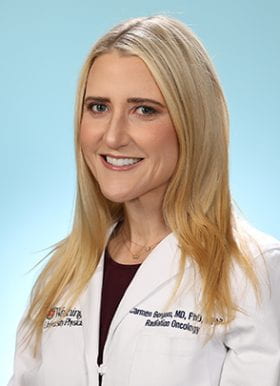
Carmen Bergom, MD, PhD, is an Associate Professor of Radiation Oncology at Washington University School of Medicine (WashU Medicine), where she joined the faculty in 2020. She holds secondary appointments in the Division of Cancer Biology and the Siteman Cancer Center. Her research focuses on leveraging genetic models to improve radiation therapy efficacy while mitigating radiation-induced cardiotoxicity , particularly in breast cancer patients. Key areas include radiation biology , tumor microenvironment , and cardio-oncology . Recent publications highlight her work in genetic mapping of radiation sensitivity (e.g., rat chromosome 3 variants), innovative imaging techniques (e.g., integrin-targeted PET), and clinical trial design for cardiovascular risk stratification. Her laboratory has pioneered the first genetic studies of radiation-induced cardiac dysfunction. Scientific awards include the Michael Fry Research Award (2021) and recognition as a Top Doctor in America (2018, 2019). She serves as Chair of the ASTRO Science Council Scientific Review Panel and co-chair of the Clinical and Experimental Research in Radiation Oncology meeting at ESTRO. Dr. Bergom treats breast cancer patients clinically and mentors students across all levels (undergraduate to postdoctoral). Her work bridges basic research with clinical applications , aiming to develop biomarkers and therapeutic targets for radiation oncology.
Rhenish Friedrich Wilhelm University of BonnGermany
Prof. Waldemar Kolanus leads the Molecular Immunology and Cell Biology department at the University of Bonn's Life & Medical Sciences Institute (LIMES) . His research bridges immunoregulation , stem cell dynamics , and metabolic stress responses in immune cells. Unit 2 member at LIMES Principal investigator in SFB 704 and ImmunoSensation Cluster Leads a multidisciplinary lab with postdocs, PhD students, and technical staff His work focuses on intracellular signaling pathways connecting immune activation to tissue homeostasis, particularly through: Cytohesin proteins in integrin-mediated adhesion and migration TRIM71 in stem cell regulation and congenital hydrocephalus High-salt environments affecting macrophage function Publication trends show expertise in immune cell migration , genetic models , and chemical inhibition , with frequent use of mice and zebrafish for in vivo studies. Key articles explore: TRIM71's dual role in auditory development and germ cell maintenance Cytohesin family's Golgi regulation and insulin signaling Ruxolitinib's off-target migration inhibition of dendritic cells Contact details: Address: LIMES Institute, Carl-Troll-Straße 31, Bonn Email: kolanus.sekretariat@uni-bonn.de Phone: +49 228 73-62788
John Ford is an Associate Professor in the Department of Nuclear Engineering at Texas A&M University. His research focuses on radiobiology, radiation carcinogenesis, and medical applications of radiation. He holds academic appointments within the College of Engineering and contributes to the Health Physics, Radiation Biology & Medical Physics research group. Education includes a B.S. and M.S. in Nuclear Engineering from Mississippi State University (1982, 1986), a Ph.D. in Biomedical Sciences from the University of Tennessee (1992), and postdoctoral training at Oak Ridge National Laboratory (1992–1993). His work emphasizes understanding radiation effects on biological systems, with notable contributions to radiation dosimetry, bystander signaling mechanisms, and dietary modulation of radiation damage. Recent studies explore space radiation monitoring technologies and therapeutic applications of radiation. Awards include the BP Award for Teaching Excellence (2007) and ARRO Educator of the Year (2013–2014). Research spans interdisciplinary areas such as radiation-induced cancer mechanisms, nutritional interventions to mitigate radiation effects, and advanced radiation detection instrumentation. He has advised numerous projects in radiation safety curriculum development and collaborated on NASA-funded studies modeling radiation impacts on astronauts.
Edward Ashworth is a Postdoctoral Research Associate at the Sydney School of Health Sciences, University of Sydney. He is affiliated with the Thermal Ergonomics Laboratory and the Heat and Health Research Incubator. His research focuses on human adaptations to extreme environments, including heat, altitude, hyperbaric conditions, and space-related stressors. Key projects include improving sleep quality in hot environments and enhancing physical work capacity for outdoor workers. Edward's research interests span environmental physiology, with a focus on thermal tolerance, radiation injury mitigation, and the physiological effects of extreme conditions. He has contributed to studies involving nitrogen kinetics tracking using PET imaging, hyperbaric oxygen therapy, and robotic surgery applications. Awards: Young Investigator Award (2023), Art of Science Contest 1st Prize (2024), Australia Space Biology Summit 1st Place (2022), and Sporting Blue (Auckland University of Technology). Associations: The Physiological Society and American Physiological Society. His work integrates clinical trials, statistical research design, and translational approaches to address challenges in environmental health, cardiovascular disease, and healthy ageing. Current projects aim to optimize thermal tolerance strategies for military and occupational settings.
Jos Ruytinx is a faculty member in the Department of Bio-engineering Sciences at Vrije Universiteit Brussel (VUB), Belgium. His research focuses on plant-fungal interactions, particularly ectomycorrhizal symbiosis and metal homeostasis mechanisms. He actively supervises graduate students and serves on PhD committees, contributing significantly to the academic community at VUB. Dr. Ruytinx's research interests span several interconnected fields: Mycorrhizal symbiosis between plants and fungi Zinc and heavy metal homeostasis in ectomycorrhizal systems Molecular mechanisms of fungal adaptation to metal stress Transport physiology in plant-fungal symbiotic relationships Evolutionary aspects of ectomycorrhizal fungi Responses to ionizing radiation in plant-microbe systems His recent publications demonstrate a strong focus on understanding how ectomycorrhizal fungi like Laccaria bicolor and Suillus luteus interact with their plant hosts under metal stress conditions, particularly zinc. Through comparative transcriptomics and functional characterization of transporters, his work reveals genetic determinants of symbiotic compatibility and mechanisms of metal tolerance. This research has implications for phytoremediation and sustainable agriculture in contaminated soils. Dr. Ruytinx has received recognition for his work with an h-index of 17 and over 2151 citations. His research is supported by multiple grants including: FWOAL1080: Zinc homeostasis in ectomycorrhizal symbiosis: nutrition and beyond (2023-2026) FWOTM1079: Reactive oxygen species in ectomycorrhizal fungi: damage, signaling or both? (2021-2025) OZR4191: Bilateral cooperation for joint PhD VUB-UHasselt (2023-2027) HERC66: 3D-CELLMAP project (2024-2028) As an academic advisor, Dr. Ruytinx has supervised 7 students through their theses, including Master's and Doctoral candidates. His laboratory focuses on fungal genetics and plant-microbe interactions, with particular expertise in zinc transport mechanisms in ectomycorrhizal systems. He actively participates in public engagement activities, including field samplings and expert commentary on fungi as biofertilizers.
Joe Pitt-Francis is Associate Professor of Computer Science and Tutorial Fellow in Computer Science at St Edmund Hall, University of Oxford . Since 1999 he has tutored Oxford computer-science students and formally became a Tutorial Fellow of St Edmund Hall in 2024. His research lies at the intersection of computational biology and mathematical biology . Using sophisticated numerical techniques he constructs and analyses models of the heart , cancer and blood flow . A central strand of his work is software development for biological simulation; he is an active contributor to Chaste ( Cancer, Heart and Soft-Tissue Environment ), a large-scale C++ library that supports multiscale computational models in physiology and medicine. Across more than 60 peer-reviewed publications since 1998, his work has progressively advanced from foundational software-engineering papers describing Chaste’s architecture to highly-cited studies on cardiac electrophysiology , tumour-induced angiogenesis , microvascular haemodynamics and cell-cycle dynamics under hypoxia . The 2024-2025 corpus shows strong emphasis on multiscale frameworks , open benchmarking , and radiotherapy-induced vascular remodelling , positioning his group at the forefront of translational in-silico oncology. Contact: Email: Joe.Pitt-Francis@seh.ox.ac.uk
John F Valliant is a Professor in the Department of Chemistry and Chemical Biology at McMaster University. His research focuses on radiopharmaceutical chemistry, molecular imaging, and targeted therapies, particularly in cancer diagnostics and therapeutics. He co-founded Fusion Pharmaceuticals, a company acquired by AstraZeneca for $2.4 billion (US), which specializes in targeted alpha therapy for cancer treatment. His work includes developing radiolabeled imaging agents for prostate cancer (e.g., [18F]DCFPyL), targeted alpha therapies (e.g., FPI-1434), and bioorthogonal chemistry strategies for pretargeted imaging. Valliant has contributed to advancements in photoacoustic imaging, SPECT/PET modalities, and theranostic agents for conditions like bacterial infections and bone diseases. Key projects include the Phase II clinical trial using 18F-DCFPyL PET-MRI for oligometastatic prostate cancer and studies on individualized dosimetry in Lu-177 therapies. He has pioneered platforms for radiolabeled antibody-recruiting molecules and fluorous-phase chemistry for high-specific-activity probes. Valliant’s research bridges disciplines, integrating chemistry, biology, and clinical applications to address unmet medical needs in oncology and diagnostic imaging.
Professor Ananya Choudhury serves as Chair and Honorary Consultant in Clinical Oncology at the University of Manchester, where she is also Co-Group Leader of the Translational Radiobiology Group within the Division of Cancer Sciences. She joined The Christie NHS Foundation Trust in 2008, specializing in urology and sarcoma, and has since focused on radiotherapy-related research in prostate and bladder cancers. Professor Choudhury is clinical lead for advanced radiotherapy, including the groundbreaking MRLinac project, and plays a key role in national radiotherapy research initiatives. Professor Choudhury earned her BA (Hons) in 1993, MB. BChir (Cantab) in 1995, and MA (Cantab) in 1997 from Trinity College, Cambridge. She completed her Clinical Oncology training at the Yorkshire Deanery from 2000-2008, during which she earned her MRCP in 2000 and F.R.C.R in 2004. She completed her PhD in 2008 through the University of Leeds and Princess Margaret Hospital in Toronto, Canada, where she studied the molecular epidemiology of DNA double strand break repair in bladder cancer. Professor Choudhury's research program focuses on optimizing and personalizing radiotherapy using advanced imaging technology to deliver high doses while minimizing side effects. Her work centers on prostate and bladder cancers, with particular interest in predictive biomarkers, hypoxia, and the integration of magnetic resonance imaging to improve treatment precision. She has pioneered research in radiotherapy dose optimization, biomarker development, and the identification of patients who would benefit most from different treatment approaches. Her extensive publication record demonstrates a strong focus on radiation therapy, particularly in genitourinary cancers. Recent work explores MRI-guided radiotherapy, hypoxia biomarkers, and personalized treatment approaches across multiple cancer types. She has made significant contributions to understanding how imaging technology can improve radiotherapy precision and effectiveness while reducing side effects, with several publications appearing in top journals through 2025. Professor Choudhury has received multiple prestigious awards recognizing her contributions to the field: Cancer Research-UK/Royal College of Radiologists Clinical Training Fellowship (2005) Fellowship for the 10th ECCO-AACR-ASCO Workshop on Methods in Clinical Cancer Research (2007) Outstanding Contribution, Greater Manchester Clinical Research Awards (2017) RCR Research Fellowship (2005) Research Fellowship, Princess Margaret Hospital, Toronto (2004) Professor Choudhury has supervised numerous doctoral and master's students across multiple cancer types, with current students expected to complete through 2024. She is Principal Investigator on multiple research grants, including 'Measuring tumour radioresistance to improve radiotherapy outcomes' and the 'MAESTRO Programme' as part of CRUK RadNet. Her research program is supported by significant funding from NIHR Manchester Biomedical Research Centre and other major funding bodies. As Co-Group Leader of the Translational Radiobiology Group, Professor Choudhury collaborates extensively with leading researchers including Peter Hoskin, Catharine West, Corinne Faivre-Finn, and Marcel van Herk. Her team is at the forefront of integrating advanced imaging with radiotherapy to improve cancer treatment outcomes, with active projects spanning from basic radiobiology to clinical implementation of novel radiotherapy techniques.
Dr. Anton Lavrinienko is a Lecturer at the Department of Health Sciences and Technology at ETH Zürich, affiliated with the Biotechnology of Food Systems group. His research focuses on microbiome studies, environmental health, and the impact of pollution and radiation on ecosystems and microbiota. He is based in Zurich, Switzerland, and teaches the course Applied Bioinformatics: Microbiomes (Autumn Semester 2025). His work integrates molecular biology, ecology, and public health to address challenges in food systems and environmental sustainability. Research interests include microbial diversity in polluted environments, radiation effects on wildlife, and the application of genomics to biodiversity conservation. He collaborates on projects such as the European Reference Genome Atlas and studies microbial responses to anthropogenic contamination in urban and natural ecosystems. Dr. Lavrinienko’s studies often involve fieldwork in regions like Chernobyl, investigating how chronic radiation and metal pollution alter microbiota and organismal health. His findings contribute to understanding ecological resilience and human health implications of environmental stressors. He emphasizes open data standards and FAIR principles in microbiome research.
Gerda de Vries is a Professor in the Department of Mathematics & Statistical Sciences at the University of Alberta, Faculty of Science. Her research focuses on mathematical physiology, dynamical systems, and mathematical modeling, particularly in cellular biophysics, pattern formation, and systems biology. She has contributed extensively to understanding complex biological systems through interdisciplinary approaches combining mathematics and biology. Her work spans applications in radiation biology (e.g., cell cycle dynamics and low-dose radiation effects), biophysics (microtubule organization, motor proteins), ecology (predator-prey interactions, forest fire modeling), and education (adapting primary literature for STEM teaching). Recent research highlights include analyzing saddle-node bifurcations, bystander effects in radiation, and collective behavior in animal groups. De Vries has published over 50 peer-reviewed articles since 2000, with a focus on bridging abstract mathematical theory to concrete biological phenomena. Notable contributions include models of pancreatic β-cell dynamics, immune system versatility, and educational frameworks for mathematical biology. Her academic career includes leadership in curriculum development and interdisciplinary research, though no specific grants or awards are explicitly listed in the provided information.
Professor Susan Brooks is a faculty member at Oxford Brookes University in the School of Biological and Medical Sciences . Her research focuses on glycobiology , cancer progression , and the role of extracellular vesicles in metastasis. Professor of Cell Biology Director of Researcher Development Focus on breast and ovarian cancer Specialized in glycosylation mechanisms Research Interests : Dr. Brooks' work explores how aberrant glycosylation of proteins and glycans influences cancer cell behavior, including metastasis and drug resistance . Her recent studies examine extracellular vesicles as diagnostic tools and therapeutic targets. Article Trends : Over 25 years, Dr. Brooks has published 15+ articles on glycosylation patterns in breast and ovarian cancer. Key areas include lectin binding , miRNA regulation , and radiation-induced metastatic changes . Her work bridges cell biology and clinical applications .
Amir Bahadori serves as Professor and Nuclear Engineering Program Director in the Department of Mechanical and Nuclear Engineering at Kansas State University's Carl R. Ice College of Engineering, holding the Hal and Mary Siegele Professorship in Engineering. He directs the Radiological Engineering Analysis Laboratory (REAL) and established the Institute for Radiation Health Studies (IRHS) in 2024, focusing on radiation protection, space radiation environments, and radiation health effects. His educational background includes: Ph.D. in Biomedical Engineering, University of Florida (2012) M.S. in Nuclear Engineering Sciences, University of Florida (2010) B.S. in Mechanical Engineering and Mathematics, Kansas State University (2008) Bahadori's research spans radiation transport modeling, dosimetry, and risk assessment with applications in space exploration, medical physics, and radiation epidemiology. He develops computational frameworks for radiation exposure scenarios and biological response prediction, emphasizing space radiation protection for Artemis missions and chronic exposure studies through the Million Person Study collaboration. Analysis of his recent publications reveals dominant themes in space radiation measurement (Artemis missions), radiation epidemiology (Million Person Study innovations), and advanced detection systems (miniaturized neutron spectrometers). His work increasingly integrates big data approaches for radiation risk assessment and electrostatic shielding concepts for deep-space exploration. His scientific recognition includes: NASA Graduate Student Research Fellowship (2009) Certified Health Physicist designation Big 12 faculty fellowship (2022-2023) NCRP council election (2024) Two USPTO patents Bahadori secures substantial research funding from NASA for space radiation instrumentation, Department of Energy projects via the Kansas City National Security Campus, and collaborative epidemiological studies. He mentors nuclear engineering graduate students while leading interdisciplinary teams developing radiation protection solutions for aerospace and medical applications. His laboratory infrastructure includes the REAL with Beocat high-performance computing resources, radiation detectors, and a 3D printer, plus the IRHS with a Precision X-ray XRad320 irradiator and radon chamber. These facilities support collaborations across K-State colleges and external organizations for radiation health effect studies.
David J. Brenner serves as Higgins Professor of Radiation Biophysics in Radiation Oncology and Environmental Health Sciences at Columbia University Medical Center. He directs both the century-old Center for Radiological Research and the Radiological Research Accelerator Facility (RARAF), leading interdisciplinary teams focused on radiation applications in medicine and safety. BA in Physics from Oxford University (1974) MSc in Radiation Physics from University of London (1976) MA in Physics Philosophy from Oxford University (1979) PhD in Physics from University of Surrey (1980) His research spans dual aspects of radiation: therapeutic applications in cancer treatment and risk assessment across diverse scenarios. Key initiatives include advancing carbon-ion therapy for pancreatic cancer, developing safe far-UVC light for pathogen elimination, and investigating low-dose radiation risks from medical imaging to nuclear terrorism. His team leverages RARAF's unique capabilities for mechanistic studies of radiation effects. Publications reveal dominant themes in radiation biophysics, with significant contributions to biodosimetry (RABiT platform), UV disinfection technology, and cancer risk modeling. Recent work emphasizes translational applications including medical countermeasures for radiation exposure and precision radiation oncology techniques. National Academy of Sciences Nuclear and Radiation Studies Board member National Council on Radiation Protection and Measurements member Radiation Research Society Failla Gold Medal recipient (2011) Oxford University Weldon Prize for mathematical biology (2015) Robert D. Moseley Award for Radiation Protection in Medicine Brenner leads multiple NIH-funded projects including biodosimetry development and UV disinfection research. His mentorship extends through directing Columbia's Radiological Research Accelerator Facility and training programs in radiological sciences. Current lab efforts focus on carbon-ion therapy mechanisms and 222-nm UV applications against drug-resistant pathogens, with active collaborations across oncology, microbiology, and physics disciplines.
University of Texas Southwestern Medical CenterUnited States
Andrew Godley, Ph.D., is the Associate Vice Chair of Clinical Physics Operations and Quality and an Associate Professor of Radiation Oncology at UT Southwestern Medical Center. He is part of the Department of Radiation Oncology’s Division of Medical Physics and Engineering. Dr. Godley holds a Texas Medical Physics License and is board-certified in therapeutic radiologic physics by the American Board of Radiology. Education: Received his Ph.D. in high-energy physics from the University of Sydney as part of the NOMAD experiment at CERN. Completed a postdoctoral fellowship at the University of South Carolina with the MINOS experiment at FermiLab. Transitioned to medical physics at the Medical College of Wisconsin. Research Interests: Focus on advanced radiation therapy techniques including brachytherapy, SBRT, Gamma Knife, MR-linac integration, and adaptive radiotherapy. His work emphasizes improving treatment accuracy, patient-specific quality assurance, and innovative approaches to personalized oncology care. Publications: Over 118 peer-reviewed articles, with recent work emphasizing adaptive radiotherapy strategies, MR-guided therapies, and computational tools for dose verification. Professional Contributions: Active in developing clinical protocols for radiation physics operations, including machine QA/commissioning and program development for new technologies like MR-linac systems.
Christopher J. Lengner is the Harriet Ellison Woodward Professor and Chair of the Department of Biomedical Sciences at the University of Pennsylvania School of Veterinary Medicine. He is a member of the Institute for Regenerative Medicine, NIH P30 Center for Molecular Studies in Digestive and Liver Diseases, and Abramson Cancer Center, with roles in training and research leadership. Education : PhD in Cell and Molecular Biology from the University of Massachusetts Medical School (2004). His research focuses on molecular mechanisms governing stem cell potency and their dysregulation in diseases like cancer and regenerative failure. Using genetic, genomic, and single-cell approaches in murine and human systems, his lab has uncovered novel pathways in intestinal stem cell hierarchy, cancer ontogeny, and therapeutic targeting. Recent publications highlight work in colorectal cancer metastasis (PI3K/AKT, NOTUM inhibition), intestinal regeneration (mTORC1, FLASH radiotherapy), and tumor microenvironment dynamics. Collaborations span human induced pluripotent cells and patient samples. Scientific Awards : Ruth L. Kirschstein Postdoctoral Fellowship He mentors graduate students (Ryan Cedeno, Maryam Yousefi) and leads the Center for Animal Transgenesis. His lab’s integrative studies bridge basic science to translational applications in oncology and regenerative medicine.





.png)