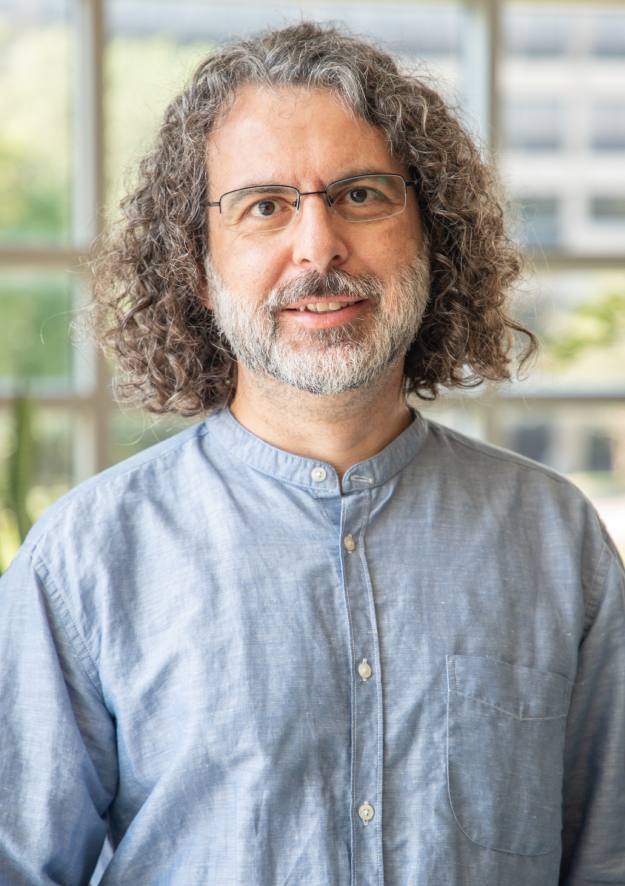
Ram Mohan Narayanan is a Professor in Electrical Engineering, actively contributing to radar systems, ultra-wideband technologies, and microwave engineering. His work spans theoretical and applied research, with a focus on frequency diverse arrays, coherent distributed arrays, and non-destructive testing using noise-based microwave systems. His research interests include Radar systems and waveform diversity Ultra-wideband signal processing Antenna design and optimization Applications in structural diagnostics and materials characterization Recent publications highlight advancements in gradient-based optimization of coherent distributed arrays and the integration of natural language processing in radar systems. He also explores frequency diverse arrays using Sudoku square designs for improved spectral efficiency. Grants from the U.S. Navy support his work on spectral coexistence, cognitive MIMO apertures, and detection of IEDs using ultrawideband waveforms.
Ioannis Konstantinidis is a Lecturer at the University of Houston's Honors College and a Senior Researcher in the Department of Computer Science. He holds a PhD in Mathematics from the University of Maryland and integrates his academic background into his work on data science, focusing on the practical impact of research within policy decision-making frameworks. As part of the Honors College Faculty and the Hewlett Packard Enterprise Data Science Institute, he emphasizes data-centric approaches and mentors students in engaged citizenship. Doctorate in Mathematics, University of Maryland His research spans diverse domains, including signal processing , public health , and STEM education . He has contributed to waveform design for radar systems, data visualization tools for humanities, and educational strategies for planetary science. His work in the Data & Society minor promotes structured methodologies for student researchers. Recent publications highlight his interdisciplinary focus, from 2024 research on multimorbidity in intellectual disability to earlier contributions in digital content management and confocal microscopy denoising . His technical work on CAZAC sequences and phase-coded waveforms has advanced signal processing theory.
Dr. Radwin Askari is an Associate Professor in the Department of Geological and Mining Engineering and Sciences at Michigan Technological University's College of Engineering. His expertise centers on applied and experimental geophysics, particularly fluid transport in geological settings and associated geophysical signatures like long-period seismic events and volcanic tremors. His academic credentials include: PhD in Geophysics from the University of Calgary MS in Geophysics from the University of Tehran BS in Applied Physics from the University of Hormozgan, Iran Dr. Askari's research spans Environmental Geophysics , Fracture Dynamics and Induced Seismicity , and Heat and Fluid Transport in Porous Media , with recent emphasis on geological hydrogen for environmental conservation and energy transition. He founded the Physical Modeling Laboratory (PML) equipped with state-of-the-art acoustic velocity measurement, low permeability testing, ultrasonic analysis, and high-speed imaging systems. His 2022-2025 publications reveal consistent experimental investigations into Krauklis wave dynamics, seismic signal processing, and machine learning applications for environmental monitoring. Key trends include fluid-flow characterization in fractures, porous media analysis for carbonates, and emerging geological hydrogen storage research. Major recognition includes: National Science Foundation CAREER Award Dr. Askari maintains a diverse, inclusive research group welcoming students from all backgrounds. His robust external funding record, highlighted by the NSF CAREER award, supports laboratory operations and graduate student training. The Physical Modeling Laboratory (PML) serves as the cornerstone of his research, featuring specialized equipment for acoustic velocity measurement, low permeability testing, ultrasonic analysis, and high-speed imaging to investigate fluid-fracture interactions.
Shigeru Shimamoto is a Professor at Waseda University's School of Fundamental Science and Engineering, Faculty of Science and Engineering. His research spans wireless communication systems, biomedical sensing technologies, and intelligent transportation solutions. Since 2014, he has led the Communication and Computer Engineering department at Waseda University, previously serving as Director of the Global Information and Telecommunication Institute (2020-2024). 2008: Visiting Professor at Stanford University's Electrical Engineering 2000-2002: Research Assistant at University of Electro-Communications Key research areas include: Wireless Communication: OTFS modulation, NOMA, RIS-aided systems, and microwave-based vital sensing Smart Healthcare: Non-contact blood pressure monitoring, SpO2 estimation using microwave reflection Transportation Optimization: On-street parking analysis, traffic flow modeling, and energy-efficient vehicular networks Awarded the 2024 Commendation for Science and Technology from MEXT, his work demonstrates strong interdisciplinary impact combining communication engineering with medical applications. Recent publications focus on machine learning integration in gesture recognition, vehicular detection, and resource allocation for autonomous systems.
Robin Rajamäki is a Visiting Professor in the Department of Information and Communications Engineering at Aalto University, Finland. He is affiliated with the Visa Koivunen Group and holds an ORCID ID (0000-0002-5028-6022). His academic credentials include a Doctor of Technology (Tekn. toht.) in Electrical Engineering (2021), a Master's in Engineering and Technology (2016), and a Bachelor's in Telecommunications Engineering (2014), all from Aalto University. Research interests focus on Sparse Arrays , Beamforming , ISAC (Integrated Sensing and Communications) , and Array Configuration models. His work explores optimal array geometries, waveform design, and identifiability guarantees in active sensing systems, with applications to MIMO radar, millimeter-wave communications, and future 6G networks. Key methodologies include statistical signal processing, machine learning, and computational optimization. Recent publications highlight advancements in generative deep synthesis , array geometry optimization , and sensor array applications in ISAC. His research spans 2015–2025, including 5 projects (e.g., FUN-ISAC, INSTINCT) and collaborations with institutions like the University of California, San Diego (2019–2020), Technion (2017–2018), and University of Pennsylvania (2016). Scientific Awards: Best Student Paper Award (3rd place, 2019) Projects include fundamental limits in ISAC, joint sensing-communications systems for immersive connectivity, and sparse antenna array processing for 6G and millimeter-wave applications. His work has been cited in Scopus and supported by the Academy of Finland and EU Horizon grants.
Stephanie Bidon is a Professor in the Department of Electronics, Optronics and Signal Processing (DEOS) at ISAE-SUPAERO, University of Toulouse, specializing in statistical signal processing for radar and navigation systems. Her career spans over 15 years of research leadership with significant contributions to adaptive radar techniques and GNSS signal processing. Her educational background includes: Engineer degree from ENSICA, Toulouse (2004) MS degree from ENSICA, Toulouse (2005) PhD from INP Toulouse (2008, with Léopold Escande and Thales prizes) Habilitation à Diriger des Recherches from INP Toulouse (2015) Professor Bidon's research centers on statistical signal processing for extracting signals from noise in radar and navigation contexts. She develops Bayesian estimation frameworks and sparse representation techniques applied to critical challenges including Space-Time Adaptive Processing for detecting moving targets, phase tracking in degraded GNSS environments, and waveform co-design for radar-communications convergence. Her work bridges theoretical advances with practical implementations in aerospace systems. Her scientific recognition includes: Léopold Escande prize (2008) Thales PhD prize (2009) She actively mentors the next generation of engineers through supervision of eight PhD students on cutting-edge topics from GNSS phase tracking to radar-communications integration. As an Associate Editor for IEEE Transactions on Radar Systems (2022-2025) and former Vice Chair of the IEEE AESS Radar Systems Panel, she shapes global research directions while securing collaborative funding through EU and industry partnerships. Her Communication and Information Theory research group provides experimental SDR radar data resources and focuses on robust adaptive antenna systems for aerospace applications. The group maintains strong industry ties with Thales and other defense/aerospace leaders, facilitating technology transfer of advanced signal processing techniques to operational radar and navigation systems.
Loukas F. Kallivokas is a Professor and holder of the Brunswick-Abernathy Regents Professorship in Soil Dynamics and Geotechnical Engineering at The University of Texas at Austin. He serves as Associate Chair of Civil Engineering and is affiliated with multiple research units including the Oden Institute for Computational Engineering and Sciences, Texas Acoustics, and the Texas Consortium for Computational Seismology (TCCS). His educational background includes a Diploma in Civil Engineering from the National Technical University of Athens, and MS (1990) and PhD (1995) degrees in Civil Engineering/Computational Mechanics from Carnegie Mellon University. Prior to joining UT Austin in 1999 as an assistant professor, he held postdoctoral and visiting positions at Carnegie Mellon University, including an NSF CISE postdoctoral fellowship. Professor Kallivokas's research spans computational mechanics with emphasis on wave mechanics and inverse problems. His work focuses on metamaterials design, subsurface imaging, seismic motion modeling, soil-structure interaction, and non-destructive condition assessment. He has made significant contributions to inverse medium problems, inverse scattering, and inverse source problems for wave-driven applications. His research has practical applications in earthquake engineering, geotechnical site characterization, and enhanced oil recovery through wave-based techniques. His recent publications demonstrate consistent output in top journals, with research trends showing increasing focus on metamaterial design, advanced wave focusing techniques, and sophisticated inverse problem solutions for subsurface characterization. The work often involves collaboration with postdocs and students, particularly Heedong Goh who appears as co-author on many recent papers. Allen Newell Medal (1998) for research excellence in large-scale modeling of seismic motion National Science Foundation CAREER award (2003) for research in subsurface imaging Fellow of the Engineering Mechanics Institute (F. EMI) Professional Engineer (PE) license Professor Kallivokas has advised numerous PhD and MS students who have gone on to successful careers in academia and industry, including positions at Seoul National University, Vanderbilt University, ExxonMobil, and major engineering firms. His research has been supported by significant grants including the NSF CAREER award and other NSF funding. He serves as Associate Editor for ASCE's Journal of Engineering Mechanics and previously chaired the Computational Mechanics Committee of ASCE's Engineering Mechanics Institute (2008-2011). His research group operates within the Mechanics, Uncertainty, and Simulation in Engineering (MUSE) laboratory facilities at UT Austin, specifically in ECJ 4.602. The group focuses on computational modeling of wave phenomena and inverse problems, with current projects spanning metamaterial design, subsurface imaging, and coupled-physics imaging approaches.