Emmanuel Dean is a Senior Researcher in the Automation research group at Chalmers University of Technology, School of Electrical Engineering. His work focuses on robotics, human-robot interaction, and assistive technologies. Dean's research interests span multiple areas of robotics and human-computer interaction: Robotics and autonomous navigation systems Human-robot collaboration and interaction Tactile sensing and physical interaction Motion prediction and obstacle avoidance Brain-computer interfaces for robotic control Assistive robotics for physical therapy His recent publications show a strong focus on developing advanced navigation systems for mobile robots that can predict human motion and avoid collisions in dynamic environments. Dean has also made significant contributions to tactile-based interaction methods, particularly for assistive robotics applications in physical therapy contexts. Dean has received research funding for the CRAFT (Collaborative-Robot Assistant for Technicians) project (2021-2023), which focused on developing robotic assistants for industrial technicians. His work demonstrates strong interdisciplinary collaboration, with publications spanning robotics, neuroscience, and rehabilitation engineering.
Deepti Mishra is a Professor at the Department of Computer Technology and Informatics at NTNU, affiliated with the Faculty of Information Technology and Electrical Engineering. She leads the Intelligent Systems and Analytics Research Group and the Educational Technology Laboratory. Previously, she held positions as Associate Professor at Monash University (Malaysia) and Assistant Professor at Atilim University (Turkey). Her research focuses on Empirical Software Engineering, Human-Robot Interaction, and Sustainability. Current projects include collaborative research-based education for wind farms and marine plastic pollution solutions, funded by The Research Council of Norway and DIKU. Her research interests span Human-Computer Interaction, Software Quality, and Requirement Engineering. Recent work emphasizes social robotics applications in healthcare, stress mitigation, and educational environments. She actively contributes to the Excited Centre for Excellent IT Education and the NTNU Active Aging Team. Over 50 peer-reviewed publications demonstrate her expertise in AI-driven robotics, edge computing, and software ecosystem decision-making. Publications highlight innovations in gesture-controlled robotics frameworks, multi-pose action recognition systems, and ROS-based human-like robot actions. Key methodologies include systematic reviews, multi-criteria decision analysis, and deep learning architectures. Ongoing projects aim to bridge technology and societal challenges through interdisciplinary collaboration.
Dr. Dimitar Petrov is an Associate Professor in Computer Science at Ca’ Foscari University of Venice, specializing in static analysis and cybersecurity. He is affiliated with ETH Zürich's Institute of Pharmaceutical Sciences (IPW) as staff under Tit.-Prof. Jörg Scheuermann. His research focuses on applying abstract interpretation-based methods to detect security vulnerabilities in systems ranging from blockchain smart contracts to IoT devices. Education details are not explicitly provided in the text, but his extensive publication history indicates advanced expertise in formal methods. His research interests include software verification, privacy enforcement, and the application of static analysis tools like LiSA across diverse domains such as robotics, microservices, and mobile applications. Key research trends in his articles emphasize blockchain security (smart contract vulnerabilities, consensus protocols), IoT/IoMT security (device interactions, privacy policies), and the integration of machine learning with program analysis. His work bridges academic research with industry challenges, addressing compliance with regulations like GDPR and the EU Data Act. Prior to his current roles, he has contributed to open-source frameworks like LiSA and collaborated on projects involving automated policy extraction, cross-language analysis, and vulnerability detection in automotive systems. His research group at Ca’ Foscari actively engages in both theoretical advancements and practical tool development. Labs/Teams: Part of the Software and System Verification group at Ca’ Foscari, and collaborates with ETH Zürich's Institute of Pharmaceutical Sciences on interdisciplinary projects combining formal methods with healthcare technology.
Fulvio Giovanni Ottavio Risso is a Full Professor in the Department of Control and Computer Engineering (DAUIN) at Politecnico di Torino, where he is a member of the NETGROUP Computer Networks Research Group and leads research in cloud, edge, and software-defined networking. He is the Scientific Advisor of the European EIT Digital Partnership and serves as a representative for Politecnico di Torino in EIT Digital. He teaches core courses in Computer Engineering, including Cloud Computing Technologies, Enterprise Network Technologies, and Software Networking, and supervises several PhD students in advanced distributed systems. His research focuses on cloud computing, edge computing, network functions virtualization (NFV), software-defined networking (SDN), and high-speed packet processing. He has pioneered work in eBPF-based network functions through the Polycube framework and in computing continuum orchestration via the Liqo project. His interests extend to Kubernetes networking, real-time data plane optimization, and privacy-preserving infrastructure. He has led numerous EU, national, and industry-funded projects, including FLUIDOS (PNRR), NEWTON, RESTART, TOSHI, ASTRID, and NFV@EDGE. His recent work emphasizes liquid computing, borderless data spaces, and secure, scalable network services for 5G/6G. The recent publications reflect a strong trend in edge-to-cloud orchestration, secure and efficient data plane processing, and real-time performance optimization. Key themes include the use of reinforcement learning for scheduling in the computing continuum, Kubernetes-based edge orchestration, eBPF for in-kernel networking, and energy-aware task distribution. Projects like Liqo and Polycube are central to his vision of a programmable, fluid infrastructure. The integration of machine learning, real-time monitoring, and open-source frameworks underscores a commitment to practical, scalable solutions in modern distributed systems. Scientific Awards and Recognitions: No explicit awards listed in the provided text. Advising and Grants: Fulvio Risso supervises multiple PhD students including Attilio Oliva, Daniele Cacciabue, Davide Miola, Jacopo Marino, Stefano Galantino, Carlos Mateo Risma Carletti, and Federico Parola, whose research spans cloud-edge continuum, vehicular micro-clouds, and Kubernetes networking. He has led over 30 competitive and commercial research projects, including EU-funded initiatives (H2020, EIT), national PRIN projects, PNRR missions, and industry contracts with Rakuten Mobile. These grants focus on network programmability, edge computing, 5G/6G observability, anomaly detection, and secure orchestration, reflecting strong industry-academia collaboration. Labs and Research Groups: He is a key member of the NETGROUP - Computer Networks Group (DAUIN) and leads research activities in LAB 9 - Research Laboratory (DAUIN). He is also associated with the Interdepartmental Center PIC4SeR - PoliTO Interdepartmental Center for Service Robotics. His work is deeply integrated with open-source development, particularly through Liqo and Polycube, which are actively used in both research and industrial deployments.
Luca Negrini is a Researcher at the Department of Environmental Sciences, Computer Science and Statistics of Ca' Foscari University of Venice. He is affiliated with the Research Institute for Complexity. His work focuses on static analysis techniques applied to blockchain smart contracts, formal methods, and software verification. He contributes to projects like the LiSA framework for multilanguage static analysis and has published extensively on topics such as Hyperledger Fabric security, Tezos smart contracts, and ROS2 security policies extraction. Research interests include blockchain technology, static analysis methodologies, formal verification, and concurrency issues in distributed systems. Recent work emphasizes detecting vulnerabilities in smart contracts (e.g., read-write issues, phantom reads) and developing tools for automated policy extraction in robotics and microservices. He collaborates closely with academic and industry partners, as evidenced by numerous co-authored articles in venues like IEEE Access and ACM conferences. Publications reflect a trend toward addressing security and correctness in distributed systems, with a focus on practical applications of formal methods. His contributions bridge theoretical computer science with real-world challenges in blockchain and software engineering. No scientific awards are explicitly mentioned in the provided texts.
Peter FERRARA is an Associate Professor in Computer Science at Ca' Foscari University of Venice, Italy. He joined the university in November 2019 as a tenure-track assistant professor and transitioned to his current rank. His primary affiliation is with the Department of Environmental Sciences, Computer Science and Statistics (D.A.I.S.) and the Research Institute for Complexity. He is part of the Software and System Verification group and maintains an active role in the Temporary Center Innovation Ecosystem Project. Education: Holds a PhD in Computer Science (2009) from École Polytechnique (Paris) and Ca' Foscari University of Venice, advised by Radhia Cousot and Agostino Cortesi. Completed his MA (2005) and BA (2003) in Computer Science from Ca' Foscari. Defended his thesis at École Normale Supérieure in May 2009. His research experience spans 15 years, with 50+ publications and 20 patents, focusing on static analysis for software reliability and security. Research Interests: Specializes in applying abstract interpretation theories to enhance software security, reliability, and performance. Recent work emphasizes static analysis of mobile and .NET systems, blockchain smart contracts, IIoT vulnerabilities, and automated policy enforcement. He bridges formal methods with practical software development, addressing challenges in precision-efficiency tradeoffs and industrial tool adoption. Industry Experience: From 2013-2019, worked in industry as Head of R&D at JuliaSoft SRL (2016–2019) and IBM Research (2013–2015). Developed commercial static analysis tools, managed research projects, and delivered technical presentations to clients. His work focused on transitioning research into deployable solutions. Teaching: Instructs courses in Object-Oriented Programming, Software Architectures, and Coding/Data Management. Engages students through practical LiSA framework experiences. Has taught at ETH Zurich (2009–2013) and supervised over a dozen students across PhD, Master's, and Bachelor's levels. Awards: No specific scientific awards listed, but recognized through extensive patent portfolio and impactful industry-academia collaborations. Holds 20 patents, including innovations in permissions extraction, privacy enforcement, and malware detection. Grants & Projects: Involved in multiple research projects from proposal to execution, including EU Data Act analysis, IoT security frameworks, and blockchain verification initiatives. Collaborates with institutions like IBM, Microsoft Research, and the University of Verona's JuliaSoft spin-off. Labs/Teams: Active in the Software and System Verification group at Ca' Foscari. Co-developed the LiSA static analysis framework. Engages in interdisciplinary projects combining robotics, IoT, and blockchain domains.
Prof. Michael Reke is a Professor at the Institute for Mobile Autonomous Systems and Cognitive Robotics (MASKOR) within Aachen University of Applied Sciences' Department of Electrical Engineering and Information Technology. He chairs the Audit Committee and teaches courses on vehicle software, digital technology fundamentals, and functional safety (ISO 26262). His research focuses on autonomous driving, mining automation, V2X communication, and sensor systems, with a strong emphasis on practical applications through projects like the modified KIA Niro autonomous vehicle. His work bridges academic research with industry needs, addressing challenges in safety, embedded systems, and real-world implementation. Research interests include autonomous vehicle navigation, fleet management in unstructured environments (e.g., mining), and the integration of advanced sensor technologies like LiDAR. He collaborates with industry partners such as ETAS GmbH and APIS Informationstechnologien to develop tools and methodologies for automotive software development. His teaching modules emphasize hands-on laboratory work, including model-based design, microcontroller programming, and functional safety protocols. Key publications from 2020-2024 explore topics like operational design domains, teleoperation systems, and lifelong mapping approaches for autonomous systems. His work addresses both technical and legal challenges in deploying autonomous vehicles, emphasizing practical solutions for industry adoption. No scientific awards are explicitly mentioned, though his contributions to automotive engineering education and research are highlighted through ongoing projects and curriculum development.
Santosh Pitla is a Professor and Associate Head for Research & Innovation in the Department of Biological Systems Engineering at the University of Nebraska-Lincoln. His work focuses on Digital Agricultural Systems , with expertise in agricultural robotics, embedded control systems, and unmanned vehicles. Ph.D. , Biosystems and Agricultural Engineering, University of Kentucky M.S. , Biosystems and Agricultural Engineering & Mechanical Engineering, University of Kentucky B.S. , Mechanical Engineering, Osmania University Pitla's research spans Agricultural Robotics , Embedded Control Systems , Sensor Integration , and Cybersecurity in Precision Agriculture . His recent publications highlight advancements in edge computing for weed detection, UAV cooperative localization, and robotic planter design. Professional Memberships: American Society of Agricultural and Biological Engineers (ASABE), Institute of Electrical and Electronics Engineers (IEEE) Labs: BSE-PIE Group (Programming, Instrumentation, and Electronics)
Marjan Sirjani is a Professor at Mälardalen University's School of Innovation, Design and Engineering (IDT), located in Västerås, Sweden. She leads the Cyber-Physical Systems Analysis research group and has held academic leadership roles, including founding the Formal Methods Laboratory at the University of Tehran and co-founding the Icelandic Center for Research on Software Engineering at Reykjavik University. Her professional background includes over a decade as Managing Director of Behin System Company before transitioning to full-time academia. Her research focuses on applying formal methods to software engineering, with specialization in modeling and verification of concurrent, distributed, and real-time systems using actor-based approaches. Key contributions include the Rebeca modeling language and its extensions for analyzing network applications and autonomous systems. Current work emphasizes safety, security, and performance evaluation of cyber-physical systems (CPS). Marjan has led major research initiatives such as the SACSys project (2019-2023), Serendipity (2018-2023), and MACMa (2016-), all addressing critical challenges in CPS and autonomous systems. She pioneered the use of timed actors for system analysis and developed the Afra model checking tool, which remains central to her work. Notably, she co-authored foundational papers on Constraint Automata semantics for coordination languages like Reo. Professional Roles: Steering Committee Chair of FSEN conference series Former Editor of Science of Computer Programming journal Expert panel member on Engineering and Physical Sciences at RANNÍS (Iceland) Recent Projects: SACSys: Safe & Secure Adaptive Collaborative Systems Serendipity: Safe and Reliable Platforms for Autonomy MACMa: Modeling and Analyzing Cyber-Physical Systems Her publications consistently explore actor model advancements, CPS security, and model-driven development. Recent work highlights integration of AI (e.g., LLM and ChatGPT) with formal verification techniques, as well as ROS2 system analysis. She has delivered keynote speeches and invited talks on topics like autonomous systems trustworthiness and real-time distributed system analysis across international venues including MIT and UC Berkeley. Awards: 2016: Distinguished Alumni Award from Sharif University of Technology Marjan's academic service includes chairing multiple conferences (SEFM, iFM, COORDINATION) and serving on program committees for major events like DATE and FSEN. Her teaching spans institutions including Reykjavik University (Software Engineering II, Advanced Software Engineering) and University of Tehran (Modeling & Verification of Concurrent Systems).
Tristan Schwörer is a Research Fellow at Aalborg University's Department of Materials and Production within The Faculty of Engineering and Science. His work focuses on robotics, automation, and pharmaceutical manufacturing innovation. His research spans Robotics , Automation , and Pharmaceutical Manufacturing , with specific expertise in mobile robot navigation, production systems, and front-end innovation. Key research areas include: Context-aware navigation systems for industrial robots Aseptic production in pharmaceutical manufacturing Radical innovation frameworks for manufacturing industries Human-robot interaction in production environments His publication trends reveal a dual focus: advancing robotics navigation (2023) and developing manufacturing innovation principles for pharmaceutical contexts (2025). Both works emphasize practical implementation in production systems. Currently active in the AP2030: BRD Aseptic Factory 2030 project (2023-2027), Schwörer collaborates with researchers including Madsen, Schou, and Chrysostomou on biotechnology applications for small-scale pharmaceutical production.
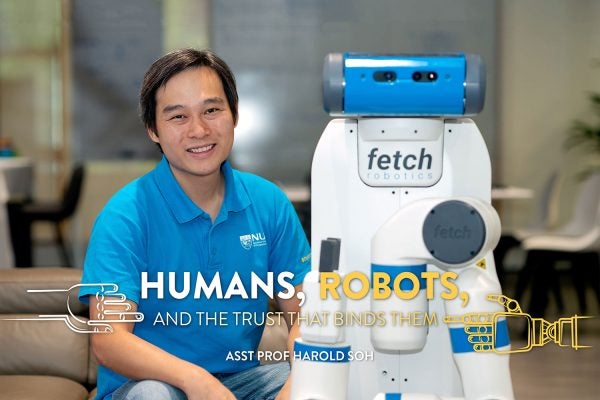
Harold SOH Soon Hong is an Associate Professor in the Department of Computer Science at the National University of Singapore (NUS), School of Computing. He serves as Associate Director of the NUS AI Lab and directs the Collaborative, Learning, and Adaptive Robots (CLeAR) Lab. His research focuses on developing trustworthy collaborative robots through advances in machine learning and human-robot interaction. Education: Ph.D. in Artificial Intelligence & Robotics, Imperial College London, UK (2014) M.S. in Software Engineering, University of Melbourne, Australia (2005) B.ASc. in Computer Science and Economics, University of California, Davis (2004) Professor Soh's research centers on machine learning and decision-making for trustworthy collaborative robots. His work spans cognitive modeling (particularly human trust) to physical systems (including novel e-skins for tactile perception). He has made significant contributions to human-robot interaction, especially in developing robots that can learn from and collaborate effectively with humans. His research integrates theoretical foundations with practical implementations in real-world robotic systems. His recent publications demonstrate a strong trend toward diffusion models, tactile sensing technologies, and trustworthy AI systems. The research spans fundamental machine learning advances to practical robotic applications, with particular emphasis on social navigation, human-robot handovers, and out-of-distribution detection. His work increasingly integrates large language models with physical robotic systems, creating new pathways for embodied AI. Scientific Awards: Best Paper Award at IROS 2021 for Extended Tactile Perception Best of IEEE Transactions on Affective Computing Award (2021) RSS Best Paper Award Finalist (2018) HRI Best Paper Award Finalist (2018) RSS Early Career Spotlight Award (2023) Multiple NUS Annual Teaching Excellence Awards Professor Soh actively supervises PhD students and mentors undergraduate research projects through FYP and UROP programs. He has developed and taught courses including CS3264 Foundations of Machine Learning and CS5340 Uncertainty Modelling in AI. His teaching philosophy emphasizes developing independent thinkers with strong analytical skills, fundamental computer science knowledge, and clear communication abilities. His students have won multiple Research Achievement Awards and the NUS Outstanding Undergraduate Researcher Prize. The CLeAR Lab, which he directs, focuses on developing physical and social intelligence for trustworthy robots. Current projects include Octopi (tactile-language models), Arena platform for social navigation, and GRaCE for robotic grasping. The lab has consistently produced high-impact publications at top venues including RSS, ICRA, and NeurIPS.
Prof. Manfred Hauswirth is the Managing Director of Fraunhofer Institute for Open Communication Systems (FOKUS) and holds the Chair for Open Distributed Systems at Technical University of Berlin. His research focuses on distributed systems, IoT, stream processing, quantum computing, and blockchain. He has held roles including Vice Director at Digital Enterprise Research Institute (DERI) and professor at National University of Ireland, Galway. He leads multiple strategic initiatives, including the Fraunhofer Quantum Technologies Research Field and the Weizenbaum Institute. His work bridges academia and industry, emphasizing digitalization, quantum computing, and IoT. Education: Dipl.-Ing. (1993), Dr. techn. (1999) in Computer Science from Vienna University of Technology. Postdoctoral work at École Polytechnique Fédérale de Lausanne (EPFL). Research Interests: Prof. Hauswirth’s work spans distributed systems, semantic web technologies, quantum algorithms, and IoT edge computing. He emphasizes real-world applications like smart cities, autonomous driving, and secure data management. Recent trends in his publications include quantum programming frameworks (e.g., Qrisp), scalable graph distillation, and edge-based AI systems. Awards: Not explicitly listed, but his work has been recognized through leadership roles in IEEE, ACM, and Fraunhofer committees. Advising & Grants: Active in funding initiatives like the Berlin Institute for Learning and Data (BIFOLD) and Einstein Center Digital Future (ECDF). Leads projects on quantum benchmarking, energy flexibility markets, and semantic stream processing. Labs/Teams: Directs the Fraunhofer High Performance Center for Digital Networking and chairs the Quantum Computing Competence Network, integrating interdisciplinary teams across quantum computing, IoT, and AI domains.
Prof. Dr. Olaf Just serves as Professor and Head of both the Master's program in Mechanical Engineering (Lightweight Construction and Robotics) and the Bachelor's program in Robotics and Automation at Westphalian University of Applied Sciences' Department of Mechanical Engineering in Bocholt. His research expertise spans: Embedded Robotics using ROS2, Universal Robots, and MoveIt! Industrial Control Systems (SPS) with TIA-Portal and Step7 Microcontroller-based hardware/software development in C/C++ Autonomous navigation and Computer Vision via the Ruhr TurtleBot Competition ROS-Navigation Stack and Gazebo simulation environments Prof. Just teaches core courses including Technical Informatics (TIN), Embedded Robotics (EMR), Microcontroller Technology (MCT), and Robot Programming with ROS2/Python (ROP). He actively organizes the Ruhr TurtleBot Competition to advance student capabilities in robotics, emphasizing practical integration of mechatronic systems and industrial automation technologies through hands-on project work.
Harun Teper is a Researcher in the Department of Computer Science at Technische Universität Dortmund, affiliated with the Chair of Design Automation for Embedded Systems. His office is located in Room E08 at Otto-Hahn-Str. 16, 44227 Dortmund. His research focuses on autonomous systems and real-time computing, with expertise spanning: Autonomous driving systems and robotics ROS2 framework development and optimization Real-time embedded systems design 6G network testbeds and digital twins Control systems and simulation frameworks Teper's publications demonstrate consistent focus on timing analysis, system optimization, and validation methodologies for robotic and real-time systems. His recent work shows increasing emphasis on ROS2 architecture improvements and 6G network integration. He has received significant recognition including: Hans-Uhde Award (2022) Best Paper Award at ECRTS (2023) Best Paper Award at EMSOFT (2024) Teper actively contributes to academic peer review, serving on program committees for IROS, ECRTS, RTAS, RTSS, and journals including Journal of Systems Architecture and Transactions on Computers.
Dr. Byung-Cheol Min is an Associate Professor and University Faculty Scholar in the Department of Computer and Information Technology at Purdue University. He serves as the inaugural director of the Applied AI Research Center (AARC) and leads the SMART Lab (www.smart-laboratory.org). His research focuses on human-robot interaction, multi-robot systems, and robotics, with an emphasis on distributed algorithms, learning, and socio-technical collaboration. Dr. Min holds a Ph.D. from Purdue University (2014), an M.S. from Kyung Hee University (2010), and a B.S. from Kyung Hee University (2008). He has received prestigious awards including the NSF CAREER Award (2019), Purdue University Faculty Scholar (2021), and multiple recognition for research excellence and mentorship. His work spans robotics applications in precision agriculture, construction automation, and assistive technologies. Dr. Min has secured over $10 million in grants and has published over 100 peer-reviewed articles, contributing to advancements in AI, control systems, and human-robot collaboration. Key roles include leadership in the Realizing the Digital Enterprise (RDE) initiative (2022–2024) and interdisciplinary affiliations with the Robotics Accelerator, ICON, and ISF institutes. His labs develop innovative systems such as the ROS2-based SMARTmBOT platform and multimodal datasets for cognitive workload assessment.