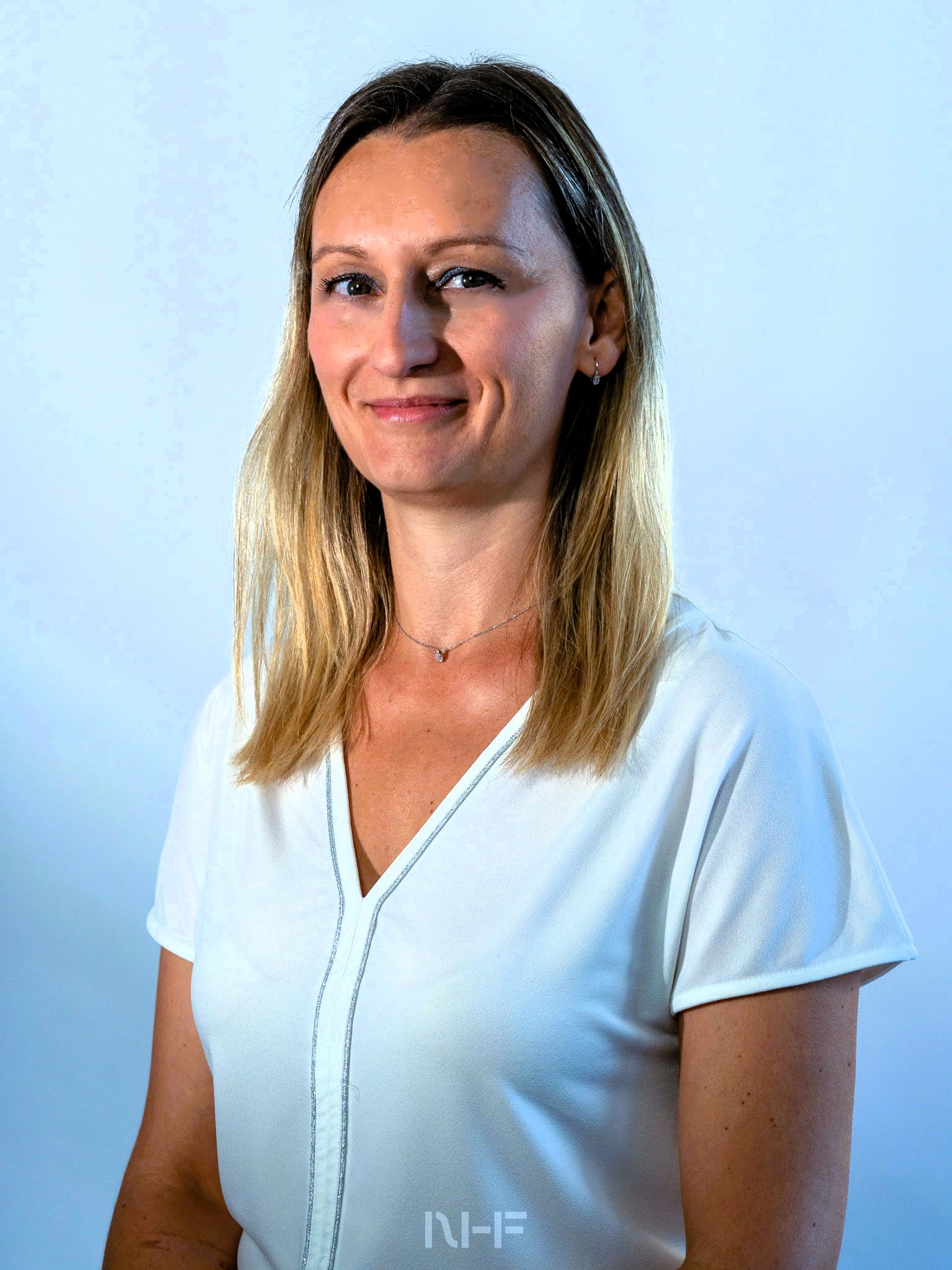
Ing. Adriana Lukáčiková, PhD., is an Assistant Professor and Deputy Head of the Department of Operations Research and Econometrics at the Faculty of Economic Informatics, University of Economics in Bratislava. She has been employed since 1996 and focuses on econometric modeling, macroeconomic analysis, and spatial econometrics. Doctorate in Econometrics and Operations Research (2004), University of Economics in Bratislava Masters in Mathematical Methods in Economics (1993), University of Economics in Bratislava Her research spans asymmetric price reactions in energy markets, spatial spillover effects in EU regional development, Bayesian econometric methods , and macroeconomic impacts of pandemics . She collaborates on VEGA and KEGA grants related to green economy transitions and structural parameter estimation. Current grant projects include: VEGA 1/0052/24: Estimating structural parameters in macroeconomic models KEGA 026EU-4/2024: Interactive web-based quantitative economic analysis textbook VEGA 1/0047/23: Spatial spillovers in EU green economy initiatives Lukáčiková contributes to scientific societies as a member of the Slovak Society for Economic Informatics and the Academic Senate of the Faculty of Economic Informatics. Her teaching includes econometrics and management science courses at bachelor and master levels.
Prof. Martin Lukáčik, PhD, is a Professor at the Department of Operations Research and Econometrics, Faculty of Economic Informatics, University of Economics in Bratislava. His academic career spans over two decades, focusing on econometric modeling, macroeconomic analysis, and operations research applications. Education: 2005: PhD in Econometrics and Operations Research, University of Economics in Bratislava 1998: Master's in Operations Research and Econometrics, University of Economics in Bratislava His research interests include econometrics, operations research, spatial spillover effects, and fuel price asymmetry. Recent projects analyze pandemic impacts on EU economies, asymmetric fuel pricing, and spatial economic dynamics. He has supervised doctoral students such as Ádám Csápai (2021–2024), Martin Benkovič (2013–2018), and Patrik Kupkovič (2013–2016). Grants include VEGA 1/0052/24 (structural parameter estimation) and KEGA 026EU-4/2024 (interactive economics books). Prof. Lukáčik is actively involved in international collaborations, including ERASMUS+ mobilities in Prague, Ostrava, and Split. He serves on scientific councils and editorial boards for journals like Equilibrium .
Sergej Chodarev is an Assistant Professor at the Technical University of Košice in the Department of Computer and Information Systems. His office is located in Building Letná 9, Room B513 (B529 by the old numbering), and consultation hours can be scheduled via Calendly at https://calendly.com/sergej-chodarev/office-hours. He teaches courses in Metaprogramming, Functional Programming, User Interfaces and User Experience, and Fundamentals of Software Engineering. His primary research areas include: Domain-specific languages Programming languages Metaprogramming User interfaces Dr. Chodarev's publication record from 2011-2016 demonstrates a consistent research trajectory focused on language engineering, particularly in domain-specific languages and metaprogramming. His work bridges theoretical computer science with practical software engineering applications, often addressing challenges in language composition, syntax definition, and user interface patterns. Many publications explore how to make programming languages more adaptable and user-friendly for specific domains. He is actively involved in research projects including: Applying new principles in the education of IT specialists in the field of formal languages and translators (as Deputy Project Manager) Developing architectural knowledge across the edge-cloud continuum (as a Solver) Dr. Chodarev maintains a scholarly presence through multiple identifiers: ORCID (0000-0002-9293-0859), Scopus Author ID (54583293100), and Web of Science ResearcherID (R-3205-2019). His professional online presence includes a personal blog, GitHub, and Instagram accounts.
Marcel Novák is an Assistant Professor and Statutory Deputy of the Dean at the Department of Economics, Faculty of Economics and Finance, Bratislava University of Economics and Business. He also serves as the Vice Dean for Research and Doctoral Studies. His research focuses on Economic Cycles, Foreign Direct Investment, and Monetary Policy, with additional work in Financial Literacy and Macroeconomic Analysis. Novák has conducted extensive research on the determinants of Foreign Direct Investment (FDI) in transition economies and the Visegrad Group countries, analyzing their impact on competitiveness and economic growth. He has also explored the implications of monetary policy tools such as quantitative easing and the dynamics of economic cycles in EU member states. His work on financial literacy in Slovakia bridges behavioral economics and public policy, emphasizing data-driven approaches to socioeconomic challenges. His academic career includes international collaborations, such as a teaching stay at the University of Coimbra (2012) and a research stay at the University of Bath (2013). He has contributed to numerous research projects, including VEGA-funded initiatives on macroeconomic policy effectiveness and the consequences of inflation/deflation. His publications span peer-reviewed journals and international conferences, addressing topics from healthcare policy comparisons to transaction costs and Coasean economics. Novák’s research activities are supported by grants including the Excellence Project ITMS 26240120032 and various VEGA projects. He has also been involved in educational initiatives, such as curriculum development for international economics programs and the establishment of the Bee4R Lab for behavioral and economic research.
Denisa IHNATIŠINOVÁ is an Assistant Professor at the Department of Finance within the Faculty of Economics and Finance at Bratislava University of Economics and Business. She holds roles including Deputy Head of the Department for Educational Activities, Academic Advisor, and coordinator for the Academic Information System (AIS) and social media (Facebook/Instagram) for the department. Her work focuses on tax policy, digitalization in tax administration, and public finance efficiency. She is involved in multiple research projects funded by VEGA and APVV, including studies on tax systems' adaptability, digitalization challenges in taxation, and economic competitiveness. Her research emphasizes EU tax harmonization, digital public services, and the impact of global megatrends on tax administration. Key publications include co-authoring a textbook on taxation (2023) and papers on digital assistants in tax management, tax compliance via digital services, and AI readiness in public sectors. She actively participates in academic conferences and publishes in journals like Balkans Journal of Emerging Trends in Social Sciences and Acta aerarii publici . As a tutor and academic advisor, she supports students in Finance and Taxation programs. She manages departmental websites and collaborates with strategic partners like Bee4R LAB and SecureDataLab.
Emília DUĽOVÁ SPIŠÁKOVÁ is an Associate Professor at the Department of Economics and Management within the Faculty of Business Economics at the University of Economics in Bratislava. Her academic career spans multiple research areas focused on innovation systems, European Union strategies, and economic development. Dr. DUĽOVÁ SPIŠÁKOVÁ's research interests center on innovation management, research and development financing, the Europe 2020 strategy, Agenda 2030, microeconomic issues, innovation performance, EU cohesion policy, regional development, and regional disparities. Her work consistently examines the intersection of policy frameworks and practical implementation in economic development contexts. Her scholarly output shows a clear trend toward analyzing European Union strategies and their implementation across different national contexts, particularly focusing on innovation systems and regional development. The publications demonstrate expertise in comparative analysis of innovation policies across European countries, with particular attention to Slovakia's position within broader European frameworks. Her research bridges theoretical economic concepts with practical policy implementation challenges. Dr. DUĽOVÁ SPIŠÁKOVÁ has served on multiple academic committees including the Scientific Board of EUBA FBE, Subfield Committee of EUBA FBE, Internal Grant Committee of EUBA, and editorial boards of several academic journals including Podniková revue, Acta Oeconomica Cassoviensia, Journal of Innovations and Applied Statistics, and Manažment v teórii a praxi. Her research has been supported through numerous VEGA projects where she has served as both principal investigator and co-investigator. Notable projects include VEGA 1/0338/22 on EU and Europe 2020 Strategy in light of Agenda 2030 priorities, VEGA 1/0582/17 examining economic connections of women's share in managerial positions, and MLADÁ VEDA 2330263/12 on EU 2020 strategy targets for R&D investment at 3% of GDP.
Michal Páleš serves as Associate Professor and Head of the Department of Mathematics and Actuarial Science at the Faculty of Economic Informatics, University of Economics in Bratislava, where he teaches core courses including Probability Theory, Risk Theory in Insurance, and Actuarial Predictive Models using R/Python. His academic credentials include: Bachelor's in Managerial Decision Making and Information Technology (2007) Engineer (Ing.) in Actuarial Science (2009) PhD in Quantitative Methods in Economics (2012) Docent (Associate Professor) qualification (2020) Páleš's research centers on computational actuarial methods, with emphasis on Solvency II compliance frameworks. He develops advanced statistical models for insurance risk dependencies, agricultural systemic risk, and market volatility, consistently integrating programming tools like R and Python into practical risk management solutions. His work bridges theoretical mathematics with industry applications in non-life insurance and financial risk assessment. Analysis of his recent publications reveals a methodological evolution toward machine learning integration in actuarial science, with increasing focus on copula-based dependency modeling (2024) and climate-related risk quantification. His publications consistently address real-world insurance challenges while advancing computational techniques for capital requirement calculations. His scientific recognition encompasses: Seven institutional awards for textbook excellence (2015-2021) Rector's and Dean's Awards for diploma thesis (2009) Slovak Society of Actuaries Award for promoting actuarial careers (2022) As principal investigator for VEGA projects including 1/0431/22 (2022-2024), Páleš leads research on innovative risk modeling approaches for insurance companies. He has supervised numerous theses and developed curricula that integrate programming skills into actuarial education, reflecting his commitment to modernizing the field. Through his leadership of the Department of Mathematics and Actuarial Science and coordination of the Slovak Society of Actuaries' Promotion Working Group (2018-2022), Páleš actively shapes actuarial education standards while fostering industry-academia collaboration in Central Europe.
Vladimír MUCHA serves as an Associate Professor in the Department of Mathematics and Actuarial Science at the Faculty of Economic Informatics, University of Economics in Bratislava. His academic career began in 2001 as an assistant, progressing to odborný asistent (assistant professor) in 2002, and achieving associate professor status in 2015. He teaches core courses including Mathematics for Economists, Probability Theory I/II, Non-Life Insurance, Risk Theory in Insurance I/II, and Software Applications for Actuaries. Education: Master's degree in Teaching of General Education Subjects (Mathematics-Physics), Faculty of Mathematics and Physics, Comenius University in Bratislava (1994-1999) PhD in Statistics, Faculty of Economic Informatics, University of Economics in Bratislava (2002-2007) Habilitation (docent) in Quantitative Methods in Economics, Faculty of Economic Informatics, University of Economics in Bratislava (2015) Research Interests: Professor MUCHA specializes in Actuarial Science with emphases on Risk Theory in Insurance, Stochastic and Simulation Processes in Non-Life Insurance, and Software Applications for Actuaries. His work bridges theoretical modeling with practical computational implementation, particularly in claim distribution analysis, risk quantification (CVaR), and capital requirement calculations. He actively develops tools using Microsoft Excel, VBA, and R for actuarial data visualization and simulation. Publication Trends: His 2012-2016 publications reveal a consistent focus on non-life insurance risk modeling using advanced statistical techniques. Key methodologies include Monte Carlo simulation for solvency assessment, bootstrap methods for risk measurement, extreme value theory for threshold analysis, and dynamic data visualization. His research demonstrates strong industry relevance through applications of quantitative finance principles to real-world insurance portfolio management. Scientific Awards: No specific awards are documented in the available information. Advising and Grants: While no student names or grant details are listed, his departmental research profile indicates active involvement in projects under the "Science and Research" section of the Department of Mathematics and Actuarial Science. His computational focus suggests participation in software-driven research initiatives. Labs and Teams: He operates within the Department of Mathematics and Actuarial Science, which maintains external partnerships with the Slovak Society for Economic Informatics, Slovak Society of Actuaries, Slovak Chamber of Auditors, and Slovak statistical and demographic Society. The department participates in international conferences including the Managing and Modelling of Financial Risks series.
Pavol Sojka is a PhD student at the Department of Applied Informatics , Faculty of Economic Informatics , University of Economics in Bratislava. He teaches courses such as Algoritmy a programovanie 1 , Jazyk R , and Python , focusing on programming and data analysis.