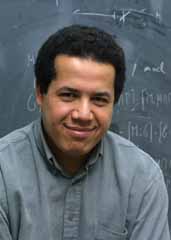
Victor Ginzburg is a Professor in the Department of Mathematics at the University of Chicago. His research focuses on geometric representation theory and noncommutative geometry, with contributions to areas such as Hecke algebras, quantum groups, and mirror symmetry. He currently advises seven graduate students, though their specific projects vary widely. His work intersects with algebraic geometry, string theory, and mathematical physics. Key research themes include the application of algebraic geometry to representation theory, including studies on D-modules, quiver varieties, and symplectic reflection algebras. He has authored influential papers such as Non-commutative Symplectic Geometry (2001) and Symplectic reflection algebras (2002). His interests also extend to Calabi-Yau categories and operads, reflecting a deep engagement with modern geometric and algebraic structures.
James Sparks is a Professor of Mathematical Physics at the Mathematical Institute of the University of Oxford and a Fellow of Oriel College. He works at the intersection of mathematical physics, theoretical physics, and geometry, with a focus on supersymmetric field theories, supergravity, and the AdS/CFT correspondence. His research explores geometric structures in string theory, including special holonomy manifolds, Sasaki-Einstein manifolds, and generalized geometry. Education: MA and PhD from the University of Cambridge Current Role: Head of the Department of Mathematical Physics Contact: Mathematical Institute, University of Oxford, Andrew Wiles Building, Radcliffe Observatory Quarter, Woodstock Road, Oxford, OX2 6GG Sparks' research interests center on the interplay between quantum field theory, supergravity, and differential geometry. He investigates localization techniques in supersymmetric theories, holographic dualities, and geometric constructions relevant to string theory. His work often bridges mathematical rigor with physical insights from the AdS/CFT correspondence. His recent publications highlight advancements in supergravity localization, black hole thermodynamics, and equivariant cohomology in AdS/CFT. Articles span topics like toric gravitational instantons, matrix models from black hole geometries, and geometric duals of extremization principles in holography. These contributions reflect his focus on connecting geometric methods to physical phenomena in high-energy theory. In teaching, Sparks has lectured on quantum theory, electromagnetism, classical mechanics, and dynamics. He maintains an active research profile with collaborations on topics such as spinning spindles, squashed spheres, and brane tilings. His work continues to shape understanding of geometric structures in theoretical physics and their dual gravitational descriptions.
David Nadler is a Professor in the Department of Mathematics at the University of California, Berkeley, appointed in 2012. His research centers on geometric representation theory and symplectic geometry, with significant contributions to the Langlands program, microlocal sheaf theory, and symplectic topology. He maintains an active research group and teaches courses ranging from undergraduate linear algebra to graduate algebraic topology and geometry. Nadler's research explores the interface of algebraic geometry, topology, and representation theory. His work in geometric representation theory focuses on Langlands duality, Springer theory, and Betti geometric Langlands. In symplectic geometry, he investigates microlocal sheaves, Fukaya categories, and Weinstein structures. His recent publications demonstrate a consistent focus on categorical methods in geometric Langlands correspondence and symplectic arborealization. His publications consistently emphasize categorical and geometric approaches to representation theory. Recent works cluster in three areas: (1) extensions of the geometric Langlands program to Betti cohomology settings, (2) microlocal analysis of sheaves on symplectic manifolds, and (3) combinatorial models in symplectic topology. This reflects sustained development of 'Betti geometric Langlands' as a distinct research program bridging topology and automorphic forms. Nadler has advised over a dozen PhD students since 2012, with dissertations spanning geometric representation theory, symplectic geometry, and algebraic topology. Student projects frequently investigate categorical aspects of geometric Langlands, microlocal sheaves, and combinatorial models in symplectic topology.
Sergei Gukov is the John D. MacArthur Professor of Theoretical Physics and Mathematics at the California Institute of Technology (Caltech), where he has been a faculty member since 2005. He serves in the Division of Physics, Mathematics and Astronomy, with primary affiliation in the Department of Mathematics. His research bridges the fields of mathematics and theoretical physics, focusing on deep connections between geometry, topology, and quantum field theory. Gukov received his B.S. from Moscow Institute of Physics and Technology in 1997, followed by an M.S. and Ph.D. from Princeton University in 2001. He joined Caltech as an Associate Professor in 2005, was promoted to Professor in 2007, and was named the John D. MacArthur Professor in 2021. His research spans several interconnected areas at the frontier of mathematics and physics. A central theme is the exploration of quantum topology and its connections to mathematical physics. He has made significant contributions to the geometric Langlands program, gauge theory, and the categorification of knot and 3-manifold invariants. His recent work increasingly incorporates machine learning approaches to mathematical problems, reflecting his interest in the intersection of traditional mathematical research and modern computational techniques. Gukov's work often reveals deep connections between seemingly disparate areas of mathematics and physics, such as the relationship between Rozansky-Witten geometry and Coulomb branches in supersymmetric gauge theories. Gukov's publications demonstrate a consistent focus on the mathematical structures underlying quantum field theories and their topological implications. His recent work shows an increasing emphasis on computational approaches to mathematical problems, particularly through his interest in mathematics and machine learning. The recurring themes across his research include the application of physical insights to solve mathematical problems and the discovery of new mathematical structures through physical reasoning. He serves on the editorial boards of several prestigious journals including the Journal of Knot Theory and Its Ramifications, Communications in Mathematical Physics, and Letters in Mathematical Physics. Gukov is also active in the academic community, having delivered plenary talks at major conferences such as the First International Congress of Basic Science and presenting at String Math 2023 on the potential impact of AI on mathematical research. Gukov teaches Ma 146 ab, Introduction to Knot Theory and Quantum Topology, a course that reflects his research interests. He also runs a seminar on Mathematics and Machine Learning, held Tuesdays from 2-3pm in East Bridge Conference room 114, demonstrating his commitment to fostering interdisciplinary research at the intersection of mathematics and computational methods.
Thomas Lam is a professor of mathematics at the University of Michigan , specializing in algebraic combinatorics, total positivity, and connections to mathematical physics. His work bridges cluster algebras, positive geometry, and integrable systems, with applications to scattering amplitudes in quantum field theory. Lam has collaborated extensively with physicists such as Nima Arkani-Hamed and mathematicians like Pavlo Pylyavskyy and Mark Shimozono. Key research areas: Cluster algebras, total positivity, electrical networks, positroid varieties, and quantum cohomology. Notable contributions: Defining polypositroids, proving regularity theorems for totally nonnegative flag varieties, and establishing cluster structures in braid varieties. Recent work focuses on positive geometries , including the amplituhedron and moduli spaces of points on projective lines, with implications for particle physics. His articles often explore dual graded graphs, K-theoretic Schubert calculus, and the interplay between combinatorics and algebraic structures. Lam's research has been supported by NSF grants, including DMS-0748636 and DMS-1249708 .
Kazushi Ueda is an Associate Professor at the Graduate School of Mathematical Sciences, The University of Tokyo, where he has been since April 2015. His research spans algebraic geometry, symplectic geometry, and mathematical physics, with a focus on homological mirror symmetry and its applications to moduli spaces, Calabi-Yau manifolds, and singularities. He previously held academic positions at Osaka University from 2006 to 2015, including roles as Assistant Professor and Associate Professor. Ueda has also had visiting appointments at institutions such as the University of Oxford, Max Planck Institute for Mathematics, and Korea Institute for Advanced Study. Bachelor of Science, Kyoto University (1997-2001) Master of Science, Kyoto University (2001-2003) Doctor of Science, Kyoto University (2003-2006) Ueda's research explores the deep interplay between complex and symplectic geometry through mirror symmetry, particularly in the context of Calabi-Yau varieties, toric degenerations, and dimer models. His work addresses derived categories, stability conditions, and moduli problems, with recent contributions to noncommutative algebraic geometry and applications in mathematical physics. He has collaborated extensively with researchers like Akira Ishii, Masahiro Futaki, and Shinnosuke Okawa. His publications highlight homological mirror symmetry for K3 surfaces, Grassmannians, and singularities, as well as studies on modular forms, cluster transformations, and the Grothendieck ring. Ueda is a member of the Mathematical Society of Japan and has contributed to educational programs, including graduate lectures on mirror symmetry and symplectic geometry.
Vasu Tewari is an Assistant Professor (CLTA) at the University of Toronto, working across both the Downtown Toronto (St. George) and Mississauga (UTM) campuses. Their office is located at HU1015 (215 Huron), and they can be reached at vasu.tewari@utoronto.ca. As a member of the Department of Mathematics within the Faculty of Arts and Science, Professor Tewari contributes to both teaching and research activities at the university. Professor Tewari's research focuses on advanced topics in algebraic combinatorics, with particular expertise in: Quasisymmetric functions and their geometric interpretations Schubert polynomial theory and related structures Representation theory of symmetric groups and related algebras Combinatorial aspects of algebraic geometry Enumerative combinatorics with connections to symmetric functions Algebraic structures arising from combinatorial objects Analysis of Professor Tewari's recent publications reveals a consistent focus on the interplay between combinatorial structures and algebraic frameworks. Their work often explores generalizations of classical symmetric function theory through the lens of quasisymmetric functions, providing new insights into Schubert calculus, permutation statistics, and geometric combinatorics. A notable trend in their research is the investigation of stability phenomena in combinatorial structures and the development of new algebraic tools for studying these phenomena. Professor Tewari has made significant contributions to understanding the geometry of combinatorial objects through algebraic methods, particularly in the areas of permutahedral varieties, zonotopal algebras, and quiver representations. Their work bridges pure mathematics with potential applications in theoretical physics and computer science.
Magnus Bakke Botnan is an Assistant Professor at the Department of Mathematics, Vrije Universiteit Amsterdam, holding a VIDI career grant (€850,000) since 2018. His research bridges pure and applied mathematics within topological data analysis (TDA), focusing on multiparameter persistence, computational topology, and applications to sciences. PhD in Mathematics, Norwegian University of Science and Technology (NTNU), 2015 Postdoc at TU Munich, 2016-2018 His research group includes postdocs Hannah Rocio Santa Cruz Baur and Rui Dong, and PhD student Enes Devecioğlu. Recent work involves signed barcodes, rank decompositions, and stability of persistence modules. He co-authored the first comprehensive tutorial on multiparameter persistence with Mike Lesnick. Notable contributions include proving the NP-hardness of computing interleaving distance, establishing universality of bottleneck distance for extended persistence diagrams, and developing computational methods for non-branching complexes. Publications span journals like Foundations of Computational Mathematics , Discrete & Computational Geometry , and conferences SoCG, NeurIPS, and ICRA. Scientific Awards: VIDI Career Grant (€850,000) He has taught courses including Complex Analysis, Calculus, Topological Data Analysis, and seminars on analysis and dynamical systems. Actively organizes Applied Topology Days and collaborates on projects integrating TDA with physics, computer science, and statistics.
Nathan Reading is a Professor in the Department of Mathematics at North Carolina State University (NCSU). He holds a Ph.D. in Mathematics from the University of Minnesota (2002) and a B.S. in Physics from Stanford University (1995). His research focuses on algebraic and geometric combinatorics, particularly in Coxeter groups, cluster algebras, and lattice-theoretic approaches. He has been actively involved in organizing the Triangle Lectures in Combinatorics, a biannual research conference. His research interests include noncrossing partitions, cluster scattering diagrams, and the lattice theory of torsion classes. Recent work explores connections between Coxeter groups and combinatorial structures on surfaces. Reading has authored numerous papers on topics such as semidistributive lattices, scattering diagrams, and Cambrian frameworks. He teaches advanced combinatorics courses (e.g., MA 724: Combinatorics II) and has advised graduate students. His work has been supported by grants from the National Science Foundation (NSF), including DMS-1500949. Reading maintains an active presence in the mathematics community through publications, conference organization, and pedagogical contributions.
Benjamin Steinberg is a Professor in the Mathematics Department at the City College of New York (CCNY) and the CUNY Graduate Center. He holds a Ph.D. from the University of California, Berkeley (1998) under John Rhodes and has held positions at the University of Porto (Portugal) and Carleton University (Canada). His research focuses on algebra, including semigroups, geometric group theory, algebraic combinatorics, representation theory, and automata theory, with notable work on etale groupoids, inverse semigroups, and ring theory. He is the author of several books, including *The q-theory of Finite Semigroups* and *Representation Theory of Finite Monoids*. Steinberg serves as Managing Editor of the *International Journal of Algebra and Computation* and has organized conferences such as the International Conference on Semigroups and Groups in Honor of John Rhodes. Research interests include the interplay between algebraic structures and their applications, such as in automata theory and Markov chains. His work bridges pure mathematics with combinatorial and geometric approaches, often involving categorical and topological methods. Recent articles explore topics like Nekrashevych algebras, twisted Steinberg algebras, and Lyndon's identity theorem for monoids. He has contributed to the study of profinite groups and their connections to symbolic dynamics. Steinberg’s editorial roles and conference organization reflect his leadership in the mathematical community. Despite his defunct blog, his academic contributions remain prolific, with ongoing editorial work and research in algebraic combinatorics and representation theory.
David E Speyer is a Professor in the Department of Mathematics at the University of Michigan . His research focuses on algebraic problems with combinatorial flavors , particularly in tropical geometry , cluster algebras , and geometry of Lie groups . He has supervised multiple PhD students, including Shelby Cox, Will Dana, and John Wiltshire-Gordon, and collaborated on projects with undergraduates like Grant Barkley and Benjamin Branman. Education: PhD in Mathematics from UC Berkeley under Bernd Sturmfels; undergraduate at Harvard. Research: Key areas include tropical geometry , cluster algebras , and flag manifolds . His work often bridges combinatorics, algebraic geometry, and representation theory. Publications: Over 40 papers, including breakthroughs in cluster algebras , affine weak order , and braid variety cluster structures . Awards: Clay Research Fellow (2005-2010). Teaching: Coordinates courses like Math 593 (graduate algebra) and Math 214 , with a focus on inquiry-based learning .
Vasily Pestun is a Permanent Professor of theoretical physics at the Institut des Hautes Études Scientifiques (IHÉS) in Bures-sur-Yvette, France, a position he has held since 2014. Previously he was a member at the Institute for Advanced Study (2011–2014) and a Junior Fellow of the Harvard Society of Fellows (2008–2011). Education Ph.D. in Physics, Princeton University (2008). Thesis: Wilson loops in supersymmetric gauge theories under the supervision of Edward Witten. B.S. & M.S. in Physics (summa cum laude), Moscow Institute of Physics and Technology (MIPT) (2003). Research Interests Pestun’s research lies at the intersection of quantum field theory, string theory and integrable systems . He is renowned for developing supersymmetric localization techniques that yield exact results in strongly-coupled supersymmetric gauge theories placed on curved manifolds. His recent work explores deep connections between quiver gauge theories , conformal field theories , quantum algebras and integrable systems , with applications to the geometric Langlands programme . Selected Awards & Honours Hermann Weyl Prize (2016) ERC Starting Grant QUASIFT (2015–2020) Junior Fellow, Harvard Society of Fellows (2008–2011) Porter Ogden Jacobus Fellowship, Princeton University (2007–2008) Centennial Fellowship, Princeton University (2003–2008) Joseph Henry Merit Prize, Princeton University (2003) Pomeranchuk Fellowship, ITEP (2003) Russian Federation President Fellowship (1997) Gold Medal, 28th International Physics Olympiad (1997) Grants & Funding Principal Investigator, ERC Starting Grant Quantum Algebraic Structures In Field Theories (QUASIFT) – €1.5 million (2015-2020) Professional Service & Outreach Pestun serves as an editor for Letters in Mathematical Physics and regularly referees for leading journals. He has organised several high-profile meetings and schools, including the 2018 month-long programme “Localization Techniques in Quantum Field Theories” at Stony Brook, and the 2019 IHES conference “Higher Structures in Holomorphic and Topological Field Theory”. He has given more than 100 invited lectures and seminar talks world-wide.
Abdellah Sebbar is a Full Professor in the Department of Mathematics and Statistics at the University of Ottawa. He holds a PhD from Stony Brook University (1993-1997) and prior degrees from Rabat and Strasbourg. His research focuses on number theory, algebraic geometry, and modular forms, with specialties in elliptic curves, moonshine theory, and quantum groups. He has authored over 40 publications, including works on Schwarzian equations and equivariant functions. His career includes roles as CRM-ISM Postdoctoral Fellow (1997-1999), CMS Instructor (1999-2001), and Associate Professor (2004-2013) before attaining his current rank. He advises graduate students and collaborates on projects involving modular subgroups and automorphic forms. Education: 1992: BSc in Pure Mathematics, Rabat 1992-1993: DEA (Master's), Strasbourg 1993-1997: PhD in Mathematics, Stony Brook (Fulbright Scholar) Research Interests: Modular forms and functions Elliptic curves and surfaces Discrete groups and moonshine Quantum groups and mathematical physics Schwarzian differential equations Professional Timeline: 2013–Present: Full Professor, UOttawa 2004–2013: Associate Professor, UOttawa 2001–2004: Assistant Professor, UOttawa His recent work emphasizes applications of Schwarzian equations to modular forms and automorphic differential equations. Collaborative efforts with Hicham Saber and others explore equivariant functions and vector-valued modular forms. He has supervised multiple PhD/MSc students, including co-supervision with Damien Roy.
Sira Helena Gratz is an Associate Professor at the Department of Mathematics, Aarhus University. Her research focuses on advanced topics in algebra and category theory, particularly cluster algebras, singularity categories, and tilting theory. She has published extensively in leading journals such as the Journal of the London Mathematical Society and Mathematische Zeitschrift. Her work often involves collaborations with other mathematicians, including G. Stevenson and A. Zvonareva. Her recent publications explore cluster structures for infinite singularities, lattices of t-structures in discrete cluster categories, and homotopy invariants in singularity categories. These works intersect with subfields like representation theory, homological algebra, and noncommutative geometry. Contact: sira@math.au.dk | Phone: +45 87 15 17 98 | Address: Aarhus C, 1530-428
Professor Catharina Stroppel is a distinguished researcher and educator in the Department of Mathematics at the University of Bonn, Germany. She maintains an active research program in representation theory and related fields, with significant contributions to categorification, knot theory, and higher category theory. Her office is located at Endenicher Allee 60, Room 4.007, Bonn, and she is supported by secretary Alev Erisöz-Reinke. Stroppel's research primarily focuses on representation theory of Lie algebras, connections to topology (particularly knot and manifold invariants), categorification, and diagram algebras. Her work bridges abstract algebra with topological applications, exploring combinatorial aspects of representation theory including Schubert calculus, Kazhdan-Lusztig theory, and canonical bases. She has made substantial contributions to understanding Hecke algebras and their representation theory, as well as developing connections between categorification and topological quantum field theories. Her recent publications demonstrate a consistent research trajectory advancing semi-infinite highest weight categories, geometric categorifications, and the interplay between quantum algebra and topology. The work shows increasing sophistication in handling higher categorical structures while maintaining concrete connections to classical representation theory problems. Her research has evolved from foundational work in categorification to more complex structures involving higher categories, quantum groups, and geometric interpretations. Indagationes Mathematicae Best Paper Prize (2022) Honorary Doctorate from Uppsala University Invited Plenary Speaker at the International Congress of Mathematicians (2022) Professor Stroppel has supervised numerous doctoral students, including current PhD candidates Jonas Nehme, Liao Wang, Lukas Bonfert, and Daniel Bermudez Montana. Her former PhD students include Till Wehrhan, Anna Mkrtchyan, Tashi Walde, Tomasz Przezdziecki, Arik Wilbert, Joanna Meinel, Hanno Becker, Antonio Sartori, Hoel Queffelec, Gisa Schaefer, and Sebastian Holzmann. She actively participates in the academic community through the Oberseminar Representation Theory (Darstellungstheorieseminar DAS), which she co-organizes with Johannes Flake, held Fridays 2:15-4pm in Endenicher Allee 60 - SR 1.008. Stroppel leads the Algebra and Representation Theory working group in Bonn and maintains strong connections with the Hausdorff Center for Mathematics, which recently received seven additional years of funding. Her research program continues to expand, with upcoming teaching responsibilities including V4A3 Representation Theory II for the WS25/26 semester.