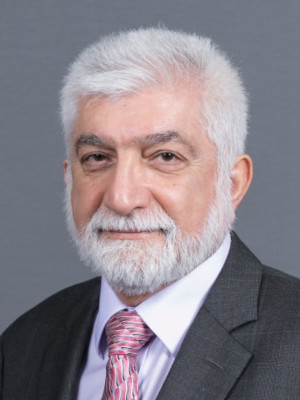
Professor Iadh Ounis is a leading academic in the field of Information Retrieval at the University of Glasgow's School of Computing Science. He heads the 60-strong Information, Data and Analysis (IDA) Section and leads the Terrier Team, known for developing advanced text retrieval techniques. His work focuses on machine learning applications in IR, recommender systems, and big data architectures. Roles: Professor of Information Retrieval, Head of IDA Section, Principal Investigator of Terrier search engine. Education: PhD from University Joseph Fourier (Grenoble, France), MSc from ENSIMAG (Grenoble). Awards: 2022 Tony Kent Strix Award. Research interests include fairness in AI, multi-modal recommendation systems, and large-scale IR architectures. He has published over 200 papers and led major initiatives like TREC Blog/Microblog tracks and NTCIR Math IR task. Active in conference program committees and journal editorial boards. Labs/Teams: Terrier Team, IDA Section. Collaborations include Scottish Informatics & Computer Science Alliance (SICSA) and The Data Lab Innovation Centre.
Theis Erik Jendal is a Researcher at the Department of Computer Science, Aalborg University, affiliated with the Technical Faculty of IT and Design. He specializes in Recommender Systems and Knowledge Graphs, focusing on areas like explainable AI, graph neural networks, and inductive recommendation architectures. He participates in the Poul Due Jensen Professorate in Big Data and Artificial Intelligence (2019–2025), addressing challenges in query processing, knowledge graphs, semantic web, and open data. Key research interests include hypergraph models for explainable recommendation, gated architectures in knowledge graphs, and addressing challenges in knowledge graph embeddings. His work emphasizes interpretability, similarity search, and practical use cases in AI systems. Contributions include 5 peer-reviewed publications since 2020, spanning conferences like ECIR and CIKM, and a dataset contribution to the Yelp Collaborative Knowledge Graph (Zenodo, 2023). His research bridges theory and application, particularly in improving recommendation systems through advanced graph-based methodologies.
Prof. Czesław Jędrzejek is a former faculty member at Poznań University of Technology, affiliated with the Faculty of Electronics and Information Technology. His research focuses on information retrieval, knowledge representation, machine learning, and cybersecurity. He has supervised two doctoral dissertations and contributed to interdisciplinary projects involving medical data analysis and economic crime modeling. Key research interests include ontology reasoning (e.g., OWL 2 RL), collaborative filtering algorithms, and semantic web technologies. His work bridges theoretical foundations with practical applications in healthcare informatics and network security. Prof. Jędrzejek's publications span journals like Database and STUDIA INFORMATICA , addressing topics such as RDF querying methods and adaptive audio stream transmission. He has also reviewed doctoral theses in computer vision and network systems. His advising record includes students focused on knowledge bases for economic crimes and IP audio streaming optimization. Despite being a former employee, his contributions to computational methods and interdisciplinary research remain notable.
Yuchen Li is an Associate Professor at the School of Computing and Information System (SCIS) at Singapore Management University (SMU), where he also holds the Lee Kong Chian Fellowship for Research Excellence. He earned his Ph.D. in Computer Science from the National University of Singapore (NUS) in 2017. His research focuses on social analytics, high-performance graph mining, and fintech applications leveraging large language models (LLMs). He has led significant projects funded by MoE, including 'Next-Gen Competitive Intelligence' and 'CONQUEROR' for concurrent graph query processing. His academic contributions span influential publications in top-tier conferences like SIGMOD, KDD, and ICML, with notable works on graph algorithms, fraud detection, and knowledge graph robustness. He advises Ph.D. students and has supervised over a dozen researchers, including current students Xiao Hanhua, Wang Sha, and Ye Chang. His awards include the Lee Kong Chian Fellowship and the Best Demo Paper Award at CIKM 2021. Li’s research bridges theoretical foundations and practical applications, addressing challenges in graph processing, social media analysis, and fintech. His team develops systems like 'Dupin' for fraud detection and 'ThunderRW' for in-memory graph processing, showcasing expertise in GPU acceleration and scalable algorithms.
Toni Taipalus is an Assistant Professor (tenure track) in Computing Sciences at Tampere University. His research focuses on database systems, cybersecurity, and computer science education. He has published extensively on SQL query formulation, database education, and cognitive security. His work integrates empirical studies, systematic reviews, and usability-focused design. Recent contributions include curriculum recommendations for data systems education and analysis of citizen perceptions during geopolitical shifts. Taipalus collaborates widely, evidenced by his multi-author publications in venues like ITiCSE and ACM Transactions.
Dr. Ali Hurson is a Professor in the Department of Electrical and Computer Engineering at Missouri University of Science and Technology. His research spans high-performance computing, pervasive computing, mobile databases, personalized education, intelligent transportation systems, and cyber-physical systems. PhD, Computer Science, University of Central Florida MS, Computer Science, University of Iowa BS, Physics, University of Tehran Dr. Hurson’s research focuses on mobile data access systems, cybersecurity for critical infrastructure, and educational technologies. His work addresses challenges in data dissemination, power management, and fault propagation in heterogeneous systems. His recent publications emphasize agent-based modeling for cyber attacks, predictive analytics in education, and fault tolerance in cyber-physical systems. Trends include integration of machine learning, security frameworks, and sustainable computing. Editor-in-Chief, Advances in Computers Editor-in-Chief, Journal of Sustainable Computing and Communication Dr. Hurson has secured over $3 million in grants from NSF, DOE, DOT, and industry partners. He has held academic roles at Penn State University and the University of Oklahoma, transitioning to Missouri S&T in 2007.
Youki Kadobayashi is a Professor at NAIST, specializing in cybersecurity and network engineering. He holds a Ph.D. in Computer Science from Osaka University. His research focuses on Internet infrastructure evolution, cybersecurity education, and standards development. He collaborates with industry and academia on projects like creating technologies for failure recovery and infrastructure co-creation. Research interests include: Internet engineering, web security, cybersecurity education standards, and privacy-preserving systems. His work addresses challenges in smart home security, federated learning for fraud detection, and secure edge computing. Publications span topics like differential privacy, federated learning frameworks, and authentication protocols. He contributes to consortia such as WIDE and organizes competitions like CDMC and Hardening Zero. His lab explores advanced cybersecurity tools and datasets.
Dr. Mieczysław Pawłowski is an Assistant Professor at the Department of Information Systems and Logistics within the Faculty of Economics at Maria Curie-Skłodowska University (UMCS). Specializing in e-commerce, omnichannel distribution, and customer experience management, he teaches interactive courses for Erasmus+ students and Economic Analytics majors, focusing on digital business strategies and team-building in fast-growing organizations. Teaches Customer Experience Management in digital era (Erasmus+ program) Coordinates WordPress-based personal branding blogs at cxm.mietwood.pl Develops competencies in SEO, content marketing, and business analytics metrics Designs blockchain-focused curricula covering decentralized communication, digital currencies, and Ethereum His research explores customer analytics, circular economy applications, and machine learning in business contexts. He advocates for CSR/ESG reporting as a tool for environmental-friendly branding and investigates viral marketing strategies. Students engage in hands-on projects analyzing business lifecycle metrics like customer churn and lifetime value. Research Trends : Recent publications emphasize machine learning in customer segmentation, omnichannel integration challenges, and circular economy competitiveness models. His work bridges technical analytics with practical business transformation strategies, particularly in B2B e-commerce environments. Advising Approach : Through interactive seminars, he trains students in market research, business model benchmarking, and digital presence management. Projects include building personal branding blogs, analyzing search behavior in technical wholesale, and developing customer engagement strategies.
Dr. David Brazier is a Lecturer at Edinburgh Napier University's School of Computing, Engineering and the Built Environment , affiliated with the Centre for Interaction Design and Centre for Social Informatics. He holds a PhD in Information Science from Northumbria University, an MSc in Business Information Systems Management (Northumbria), and a BSc (Hons) in Applied Computing (Newcastle College). His research examines interactive information retrieval, digital literacy, and social impacts of digitalization , with focus areas including: E-government accessibility for non-native speakers Digital literacy development in vulnerable populations Public library roles in migrant integration Music recommender system receptivity Cognitive adaptability in workplaces Publication analysis reveals strong emphasis on equality of access, participatory research methods, and cross-cultural information behavior , with recent work exploring AI applications in labor market intelligence and democratic processes. Awards & Recognition: Associate Fellow of Higher Education Academy ACM Professional Member (including SIGIR) Research Leadership: Secured £125,390 in grants including: £64,428 from Skills Development Scotland for AI-enhanced labor market intelligence (2021-2025) £60,962 from ESRC for meta-skills research (2018-2023) Current PhD Supervision: Digital literacy development (Drew Feeney) Trust in digitalization's democratic impact (Natalie Wangler) Natural language interfaces for career decisions (Marianne Wilson) Machine learning for labor intelligence (Aleksander Bielinski)
Anirban Chakraborty is a Lecturer in Computer Science (AI and Data Science) at the University of Wolverhampton's Faculty of Science and Engineering. He leads research initiatives in the Data Science and AI group (DAIREL) at the Digital Innovations and Solution Centre. His academic journey includes a PhD in Computer Science from Trinity College Dublin (2021) and post-doctoral research at the University of Edinburgh's School of Informatics (2022-2024). Current Position: Lecturer (AI/Data Science) at University of Wolverhampton Previous Roles: Post-doctoral Research Associate at University of Edinburgh Education: PhD in Computer Science (Trinity College Dublin, 2021) His research spans personalised information retrieval , contextual recommendation , NLP , and machine learning . Recent work focuses on multi-contextual point-of-interest recommendation and noise handling in OCRed text . Publications demonstrate expertise in relevance modeling, query variants, and co-occurrence analysis. Key contributions include frameworks for contextual recommendation systems and robust retrieval from noisy datasets.
Eirini Ntoutsi is an Associate Professor at the Faculty of Electrical Engineering and Computer Science at Leibniz University Hannover and a member of the L3S Research Center. Her academic journey includes a post-doctoral position at LMU Munich with an Alexander von Humboldt Foundation fellowship, and she earned her PhD from the University of Piraeus, Athens under the supervision of Y. Theodoridis. She holds a diploma and M.Sc. in Computer Engineering & Informatics from the University of Patras, Greece. Her research lies at the intersection of Artificial Intelligence and Machine Learning, focusing on two main pillars: learning over complex data and data streams (covering adaptive learning, change detection, and model stability), and responsible Artificial Intelligence (covering fairness-aware learning, data quality, and proper evaluation of AI/ML methods). Her work addresses critical societal challenges related to bias in algorithmic decision-making systems. Dr. Ntoutsi's recent publications demonstrate a strong focus on drift-aware learning for imbalanced data streams and fairness in AI systems. Her research shows a clear progression from foundational work in pattern management during her PhD to cutting-edge applications addressing real-world challenges in social streams, sensor data, and recommendation systems. Alexander von Humboldt fellowship for postdocs Best-student paper award at ICBK 2018 1st place in the 2006 innovation competition in Greece Dr. Ntoutsi actively mentors PhD and master's students while leading major research initiatives including NoBIAS (EU-funded, as Network coordinator), BIAS (Volkswagen Stiftung-funded), and OSCAR (DFG-funded). Her interdisciplinary approach combines technical AI solutions with philosophical and legal considerations to develop more equitable algorithmic systems.
Mohammad Masudur Rahman is an Associate Professor in the Faculty of Computer Science at Dalhousie University. His research focuses on intelligent automation of software maintenance and evolution , combining Artificial Intelligence (AI) and Software Engineering (SE) to address challenges in bug detection, diagnosis, and reproducibility. He leads the RAISE Lab , which aligns with Dalhousie’s strategic goals in Advanced AI & Digital Innovation , particularly Sustainable Software Innovation and Sustainable AI . Dr. Rahman earned his PhD in Computer Science/Software Engineering from the University of Saskatchewan (2019), advised by Prof. Dr. Chanchal Roy, and completed a postdoc at Polytechnique Montreal under Prof. Dr. Foutse Khomh. He has published 50+ papers in top venues like ICSE , ESEC/FSE , ASE , and TOSEM , with research funded by NSERC Discovery Grant, Mitacs Accelerate International, and Dalhousie Startup Fund. His work investigates the challenges of software bugs, crashes, vulnerabilities, and technical debt , particularly in AI-driven systems like Large Language Models and Deep Learning frameworks. He develops tools to automate bug diagnosis, leveraging code structures and neural machine translation. Recent articles analyze deep learning bug reproducibility , fault diagnosis in attention models , and code smell impacts . Scientific Awards : Governor General's Gold Medal, U of S Doctoral Thesis Award, Dalhousie Belong Research Fellowship, President Gold Medal (Bangladesh). Grants : $475K+ (PI) and $4.3M+ (Co-PI) from NSERC, Mitacs, Climate Action Fund, and Dalhousie.
Claudio SILVESTRI is an Associate Professor at Ca' Foscari University of Venice, affiliated with the Department of Environmental Sciences, Computer Science and Statistics. He specializes in Computer Science (INFO-01/A), with a focus on data mining, privacy in location-based services, and spatio-temporal data analysis. His research integrates computer science with environmental and biomedical applications. Teaching Responsibilities include courses on Advanced Data Management (Computer Science) and Geographic Information Systems (Environmental Sciences) at the Master's level across multiple academic years. Research Interests span: Algorithms for privacy protection in location-based services Spatio-Temporal Data Warehouses and trajectory analysis Parallel computing on GPU and cloud platforms Applications in fisheries monitoring and diabetic kidney disease modeling Funding Projects include EU initiatives like H2020 (e.g., DC-ren for kidney disease research) and regional grants (e.g., ADMIN4D on Industry 4.0). Key collaborations involve researchers like Salvatore ORLANDO and Debora SLANZI. He is affiliated with the European Center for Living Technology (ECLT) and the Research Institute for Social Innovation. Office hours are held Wednesdays 2-4 PM by email appointment.
Jorge Augusto Meira is a Research Scientist at the University of Luxembourg's Interdisciplinary Centre for Security, Reliability and Trust (SnT), specifically within the Services and Data Management research group (SEDAN). He holds a PhD in Computer Science from the University of Luxembourg (2014) and has 15+ years of experience spanning industry and academic research roles including software development, system analysis, data science, project management, and principal investigator positions. His research focuses on machine learning applications in anomaly detection (e.g., anti-money laundering), big data analytics, recommendation systems, and database optimization. Notable areas include cybersecurity for blockchain networks, insurance risk modeling using Hawkes processes, and energy-efficient database architectures. Publications span topics like vehicle routing optimization, natural disaster prediction models, and privacy-preserving data systems. He has contributed to both theoretical advancements and practical implementations in areas like smart grid monitoring and aviation predictive maintenance. His work frequently bridges AI techniques with real-world infrastructure challenges across transportation, finance, and healthcare sectors. Led by Prof. Radu State, the SEDAN group focuses on service-oriented architectures and data management innovations. While no formal awards are listed, his extensive publication record reflects sustained contributions to interdisciplinary tech research.
Bin Ren is an Assistant Professor in the Department of Computer Science at the College of William & Mary, where he has been a faculty member since Fall 2016. He holds a Ph.D. in Computer Science and Engineering from The Ohio State University (2014) and was a postdoctoral research associate at Pacific Northwest National Laboratory from 2014 to 2016. Research Interests: His work centers on high-performance computing, compiler techniques, and machine learning systems, with a focus on enabling real-time and energy-efficient deep neural network execution on mobile and edge devices. He explores compiler optimizations, DNN pruning, neural architecture search, and GPU memory management to improve system performance and efficiency. Publication Trends: His recent publications (2023–2025) reveal a strong focus on compiler-aware deep learning systems, mobile and edge AI, and performance optimization across heterogeneous platforms. Key themes include DNN acceleration, memory efficiency, real-time inference, and hardware-software co-design. His work frequently appears in top-tier venues such as ASPLOS, SC, CVPR, and PLDI. Scientific Awards: NSF CAREER Award, 2021 Best Paper Award, SC 2020 Best Student Paper Nomination, SC 2020 Jeffress Trust Award, 2020 ISLPED Design Contest First Place, 2020 Student Cluster Reproducibility Challenge Paper, SC 2019 Best Paper Award, CGO 2013 SIGPLAN Research Highlights, 2013 Advising and Grants: Bin Ren has advised numerous Ph.D. and master’s students, many of whom have co-authored influential papers. His research has been supported by competitive grants, including the NSF CAREER Award. He actively mentors students in areas of parallel computing, compiler design, and machine learning systems. He has also received funding from the Jeffress Trust Awards and other sources to support interdisciplinary research. Professional Service: He has served in leadership roles such as Program Co-Chair for PPoPP'25 and HIPS'21, Track Co-Chair for ICPP'24 and HiPC'24, and Artifact Evaluation Co-Chair for PPoPP'24 and ALENEX'25. He is a frequent reviewer for top journals and conferences including TPDS, TACO, NeurIPS, and SC. Teaching: He teaches courses such as CS304 (Computer Organization) and CS642 (Compiler Techniques for High Performance Computing), contributing to both undergraduate and graduate education in systems and programming. Lab and Team: His research group focuses on system-software co-design for efficient AI deployment. Collaborators include researchers from institutions like Pacific Northwest National Laboratory and The Ohio State University. His team works on real-world applications in healthcare, autonomous systems, and scientific computing.