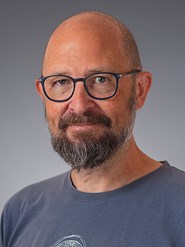
Henrik Björklund is an Associate Professor at the Department of Computer Science, Umeå University. His research focuses on natural language processing , formal languages , and mitigating social bias in large language models . Primary affiliation: Umeå University Department: Computing Science Role: Faculty member Research interests include: Detecting and mitigating gender bias in NLP systems like ChatGPT Foundational studies in formal languages and automata theory Developing language technology for Swedish, particularly nonbinary pronouns like 'hen' Publication trends show: Recent work (2023-2024) on intersectional bias analysis in LLMs 2017-2023 studies on hyperedge replacement grammars and DAG language transduction 2013-2017 contributions to XPath evaluation and tree pattern queries Contact : henrik.bjorklund@umu.se
Daniel Varro is a Professor and Head of Unit at the Department of Computer Science (IDA) of Linköping University, Sweden. He leads the Software and Systems (SAS) department, focusing on AI, software engineering, and cyber-physical systems. His research is supported by major grants like the Vinnova 5.6 million SEK project for AI-generated software quality assurance. Affiliation: Department of Computer Science (IDA), Linköping University Department: Software and Systems (SAS) Research Focus: Model-based systems, large language models for code analysis, reinforcement learning, and cyber-physical safety verification. His recent work includes empirical studies on machine learning notebooks, infrastructure code smells, and data leakage in large language models. He collaborates extensively within the Wallenberg Autonomous Systems Program (WASP) and trains doctoral students in software engineering.
Karl Meinke is a Professor at KTH Royal Institute of Technology, where he serves as Head of the Computer Science Department and Head of the Division of Theoretical Computer Science within the School of Electrical Engineering and Computer Science. His research focuses on applying machine learning techniques to software testing, particularly for safety-critical systems like autonomous vehicles and embedded systems. His research interests span machine learning, software testing, safety critical systems, embedded systems, autonomous driving, digital pathology, and graph neural networks. Meinke has developed innovative approaches like Learning-Based Testing that combine machine learning with formal methods for system validation. His work bridges theoretical computer science with practical applications in automotive systems and medical diagnostics. His recent publications show a strong trend toward applying graph neural networks to diverse domains including program analysis, digital pathology, and autonomous vehicle testing. His research demonstrates a consistent focus on solving the test oracle problem and generating meaningful test cases for complex systems where traditional testing approaches fall short. Meinke actively collaborates with Karolinska Institutet (KI), indicating interdisciplinary work between computer science and medical research. He is responsible for Masters level education in software testing at KTH and serves as examiner for several advanced courses including Degree Projects in Computer Science and Software Reliability. His research group has developed tools like LBTest for learning-based testing of reactive systems, and he has secured funding for projects such as the ITEA3 Testomat Project focused on next-level test automation. His work has significant implications for validating autonomous systems where safety is paramount. Meinke leads research in using machine learning to address fundamental challenges in software testing, particularly for systems where traditional test oracles are unavailable or impractical. His approach of combining active learning with formal specifications has created new pathways for validating complex cyber-physical systems.
Senior Lecturer Fredrik Bengtsson is affiliated with Luleå University of Technology, where he works in the Department of Computer Science, Electrical and Space Engineering. His research focuses on Dependable Communication and Computation Systems within the Computer Science division. His research interests include: Algorithms for aggregate information extraction from sequences Computational theory and data structures Range-sum computation in multidimensional arrays k maximum sum subsequences problem Efficient algorithms for information extraction Dr. Bengtsson's work has applications in several important areas including large databases and DNA sequence segmentation. His research contributes to the development of efficient computational methods for data analysis, with particular emphasis on optimizing query performance and pattern recognition in sequential data. His notable publications include his 2007 doctoral thesis 'Algorithms for aggregate information extraction from sequences' and several related papers on computing maximum-scoring segments and ranking k maximum sums, which demonstrate his expertise in developing theoretically sound and practically applicable algorithmic solutions. As a Senior Lecturer and Recognised University Teacher, Dr. Bengtsson is involved in teaching and mentoring students in computer science and related fields, contributing to both research and education at Luleå University of Technology.