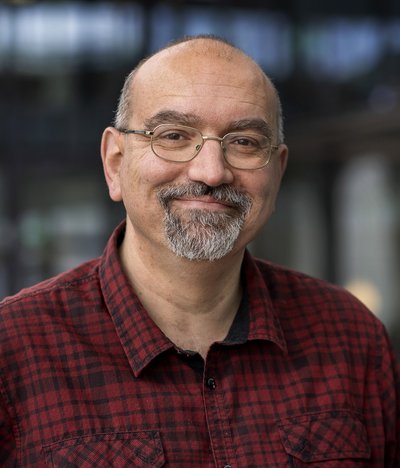
Boris Škorić is an Associate Professor in the Security group at Eindhoven University of Technology (TU/e), affiliated with the Department of Mathematics and Computer Science. His research focuses on security applications leveraging noisy data, quantum physics, and cryptographic techniques. He holds a PhD in Theoretical Physics from the University of Amsterdam and has worked at Philips Research before joining TU/e in 2008. Research interests include secure key storage, anti-counterfeiting, privacy-preserving biometric systems, and quantum security protocols. His work bridges physics, information theory, and cryptography, addressing challenges like collusion-resistant watermarking and quantum-based security solutions. He is part of the Center for Quantum Materials and Technology Eindhoven and teaches courses such as 'Introduction to Quantum Computing and Security.' No ancillary activities are listed, and his contributions are centered within TU/e's academic and research ecosystem.
Prof. Valerio Pruneri is an ICREA Professor and Group Leader at the Institute of Photonic Sciences (ICFO), holding the Corning Inc. Chair in Optoelectronics. He leads a research group focused on quantum optics, nanophotonics, and biomedical imaging. His academic background includes a PhD in Laser Physics from the University of Southampton (UK). Research interests span quantum communication technologies, plasmonic sensors, and nanomaterials for optical applications. Recent advancements include work on quantum key distribution systems, graphene-based devices, and super-sensitive phase imaging techniques. Articles highlight innovations in quantum-enhanced imaging, integrated photonic circuits, and hyperbolic metamaterials. His team collaborates on EU projects like NANO-GLASS ITN and FLIGHT, with a strong emphasis on translational research. Over 50 students and researchers are advised, many funded by national and international grants (e.g., Agencia Estatal de Investigación, CELLEX Foundation). Key lab facilities include state-of-the-art cleanrooms and optical characterization tools.
Dr. Ciara Rafferty is a Senior Lecturer at Queen's University Belfast's School of Electronics, Electrical Engineering and Computer Science, affiliated with the Centre for Secure Information Technologies. She leads research in advanced cryptography, focusing on post-quantum systems, homomorphic encryption, and hardware acceleration. Her work includes quantum-safe cryptography projects like the UK Quantum Communications Hub and AQuASeC (Innovate UK). She co-teaches CSC2056 - Systems Security and Cryptography and actively supervises PhD students. Dr. Rafferty is a Senior Member of IEEE and an EPSRC SPRITE+ Expert Fellow. Research Interests: Homomorphic Encryption Post-Quantum Cryptography Cryptographic Hardware Architectures Privacy-Preserving Technologies Side-Channel Attack Mitigation Key Projects: UK Quantum Communications Hub (Phase 2) SAFEcrypto (H2020 Project) AQuASeC (Toshiba Europe-funded) SEQURED (Rolls Royce-funded) Awards: Senior Member of IEEE EPSRC SPRITE+ Expert Fellow Advising & Grants: PhD Supervision: Shabnam K (Secure Cloud Computation) Funding: EPSRC, Innovate UK, Industry Partners Lab/Teams: Centre for Secure Information Technologies (CSIT), collaborating on hardware-accelerated cryptography and quantum-safe systems.
Chris Monico is an Associate Professor in the Department of Mathematics & Statistics at Texas Tech University . He has been a faculty member there since 2003, following post-doctoral research at the University of Notre Dame. Education B.S. in Mathematics – Monmouth University M.S. in Mathematics – University of Notre Dame Ph.D. in Mathematics – University of Notre Dame Research Focus Monico’s scholarship centers on the intersection of cryptology , computational algebra , and number theory . A significant recent thrust has been the application of machine-learning techniques to mathematical finance , evidenced by work on random-forest models for option pricing and high-frequency trading risk metrics. Parallel lines of inquiry include post-quantum cryptographic schemes built on tropical algebra and semigroup actions, as well as classical problems in Ramsey theory and combinatorial semigroups . Publication Trends Between 2015 and 2025 Monico has published prolifically, with a clear shift around 2020 toward mathematical finance and machine-learning applications , alongside continued output in algebraic cryptanalysis and combinatorics . His 2024–2025 articles emphasize data-driven models in trading, whereas 2020–2021 works concentrate on cryptanalyses of tropical and group-based key-exchange systems. Earlier contributions focus on computational number theory and semigroup-based cryptography. Contact Information Email: c.monico@ttu.edu Phone: 806-834-4144 Office: Department of Mathematics & Statistics, Texas Tech University, 1108 Memorial Circle, Lubbock, TX 79409-1042 Advising & Grants No specific doctoral or master’s students, funded grants, or named awards are detailed in the provided text. Laboratory or Research Group The text does not mention any dedicated laboratory or research group.
Professor Oliver Johnson is a faculty member at the School of Mathematics, University of Bristol, UK, where he serves as Head of School and holds the Professor of Information Theory position. His research bridges information theory, probability, and statistics, focusing on entropy convergence, group testing, and fundamental limits in data analysis. Current PhD students: Kieran Morris, Conor Crilly Ex-PhD students: Matt Aldridge, Leonardo Baldassini, Dan Cowley, Vaia Kalokidou, Tom Kealy, Jennifer Chakravarty, Zichen Gui, Chrys Paschou Ex-postdoc: Erwan Hillion His work includes ORCiD profile and collaborations across information theory, cybersecurity, and ecological modeling.
Thuy T. Le is a Professor of Electrical Engineering at San Jose State University's College of Engineering. With a distinguished career spanning several decades, he teaches graduate and undergraduate courses in digital system design, computer architecture, microprocessor systems, and related fields. His academic journey began with earning B.S., M.S., and Ph.D. degrees from the University of California, Berkeley. Professor Le's research interests encompass a broad spectrum of cutting-edge technological domains. His primary focus areas include System-on-Chip (SoC) and Embedded System Design, Hardware Accelerators for complex algorithms, Quantum Computing, implementation of Probability theory and Monte Carlo simulation, and radiation effects on electronic devices and systems. His work bridges traditional electrical engineering with emerging computational paradigms, demonstrating a consistent ability to adapt to evolving technological landscapes while maintaining strong foundations in core engineering principles. Analysis of Professor Le's publication record reveals a consistent trajectory from nuclear reactor physics and computational methods toward modern hardware acceleration and quantum computing. His early work focused on nuclear reactor simulation and radiation shielding, then evolved to parallel computing and distributed systems, and has recently centered on hardware acceleration for complex algorithms, quantum computing applications, and AI hardware. This progression demonstrates his ability to transition between major technological paradigms while maintaining expertise in computational methods and hardware implementation. Professor Le has demonstrated significant leadership in professional service, having served as keynote speaker, general chair, technical program chair, session chair, reviewer, and committee member for numerous international conferences. His service extends beyond academia through his role as Co-Founder and Advisor of the Vietnamese Strategic Ventures Network and Chairman of the Board of the United States–Vietnam Foundation. In his educational role, Professor Le has made substantial contributions to engineering curriculum development and assessment. He has taught a wide range of courses including EE271 (Advanced Digital System Design), EE210, EE250, and various project/thesis courses. His research advising spans digital system design, ASIC, SOC, and hardware accelerators. He has also collaborated with local companies on projects related to high-performance system architectures, parallel algorithms, digital arithmetic, and System-on-Chip verification.
Dr. Stefano Signorini is a Postdoctoral Researcher and European Commission Fellow at the Institute of Photonic Sciences (ICFO), specializing in quantum photonics and nonlinear optics. His research focuses on developing advanced photonic technologies using silicon-based platforms, particularly in the areas of heralded single-photon sources and mid-infrared quantum applications. He holds a PhD in Physics from the University of Trento (Italy). Education: PhD in Physics, University of Trento, Italy His research interests include silicon photonics, quantum communication, and nonlinear optical phenomena. He has contributed to breakthroughs in integrated quantum photonic devices and mid-infrared spectroscopy. His work emphasizes practical applications of quantum technologies in sensing, cryptography, and telecommunications. Awards: European Commission Fellow Signorini’s research group at ICFO explores optoelectronics and quantum photonics, aiming to bridge fundamental science with technological innovation. His projects involve collaborations on integrated photonics platforms and novel material synthesis for enhanced optical functionalities.
Shachar Lovett is a researcher at the University of California, San Diego (UCSD), specializing in computational complexity, combinatorics, and theoretical computer science. His work spans advanced topics in communication complexity, pseudorandomness, and coding theory, often intersecting with problems in additive combinatorics and Boolean function analysis. Education : Not explicitly detailed in the provided text. Research Interests : Lovett's research focuses on computational complexity, particularly in communication and circuit complexity, combinatorial structures like sunflowers and high-dimensional expanders, and the analysis of Boolean functions through Fourier and Gowers norms. His work explores the limits of deterministic vs. randomized computation, the structure of codes over finite fields, and the interplay between additive combinatorics and theoretical computer science. Article Trends : His recent publications address exact vs. approximate representations of Boolean functions, quasipolynomial bounds in combinatorics, hypercontractivity in high-dimensional expanders, and advancements in the log-rank conjecture. These works emphasize connections between computational complexity, discrete mathematics, and pseudorandomness, often yielding improved bounds or novel frameworks for understanding Boolean function behavior. Scientific Awards : No specific awards or honors were mentioned in the provided text. Advising and Collaborations : Lovett collaborates extensively with researchers like Hamed Hatami, Kaave Hosseini, and Jiapeng Zhang, contributing to fields such as non-malleable codes, matrix multiplication algorithms, and communication complexity. No formal student advising details were provided.
Nadia Heninger is a Professor in the Computer Science and Engineering department at the University of California, San Diego. Previously, she was an assistant professor at the University of Pennsylvania from 2013 to 2018. Her research focuses on mathematical and empirical cryptanalysis of public-key cryptographic systems, with significant contributions to identifying vulnerabilities in widely deployed cryptographic implementations. Her primary research interests include cryptography, cryptanalysis, and security, with particular emphasis on mathematical cryptanalysis aimed at real-world applications. Her work frequently employs lattice techniques, computational number theory, coding theory, and network measurement to uncover weaknesses in cryptographic systems. She has made notable contributions to understanding the security of RSA, Diffie-Hellman, and ECDSA implementations in practice. Heninger's research output shows a consistent focus on practical cryptanalysis, with recent work including the Blast-RADIUS vulnerability discovery, SSH key compromise via lattice techniques, and analyses of cryptographic implementations in blockchain systems like Bitcoin. Her publications span top security and cryptography venues including Crypto, Eurocrypt, Usenix Security, and CCS, often receiving best paper awards. Among her scientific achievements are an NSF CAREER award and multiple best paper awards from premier conferences including Crypto, PKC, CCS, and Usenix Security, as well as test of time awards from Crypto and Usenix Security. These accolades reflect the significant impact of her work on the field of cryptography and security. She advises several PhD students including Miro Haller, Laura Shea, Adam Suhl, and George Sullivan, and has a substantial list of notable alumni who have gone on to successful careers in academia and industry. Her research has been supported by various grants, including an Amazon Research Award for work on 'Bringing Modern Security Guarantees to End-to-End Encrypted Cloud Storage.'
The Atomic Quantum Optics Group at ICFO, Barcelona , led by Morgan W. Mitchell , investigates quantum phenomena at the interface of light and matter. The group develops advanced sensing technologies with applications in biomedicine, space science, and fundamental physics. Research focuses on ultra-cold atoms, high-coherence photons, and entanglement, aiming to understand and utilize atomic coherence for quantum technologies. Their work includes pushing sensitivity limits in magnetic field detection, quantum thermometry, and miniaturized quantum devices. Recent publications highlight advancements in cavity-enhanced spin detection , anomalous noise in SERF magnetometry , and spread-spectrum magnetic sensing . These studies span quantum optics, atomic physics, and applied quantum technologies. Scientific awards include mentoring students like Joanna Zielinska and Carlos Abellan , who won the UPC Thesis Prize. The group actively trains PhD students, postdocs, and visiting researchers in quantum technologies.
Steven DenBaars is a Professor of Materials and Electrical & Computer Engineering at the University of California, Santa Barbara (UCSB), where he holds the Mitsubishi Chemical Chair in Solid State Lighting and Displays. He serves as Director of the Institute for Energy Efficiency and Executive Director of the Solid State Lighting and Energy Electronics Center (SSLEEC). PhD, Electrical Engineering, University of Southern California BS, Materials and Metallurgical Engineering, University of Arizona MS, Materials Science, University of Southern California His research revolves around the growth and application of wide-bandgap (GaN-based) semiconductors for blue LEDs, laser diodes, high-power electronics, and quantum technologies. Key areas include MOCVD of III-V compound materials, strain engineering, and device fabrication. Recent publications highlight advancements in GaN-based microLEDs for quantum random number generation, UV LED efficiency, laser diode design, and strain relaxation techniques. Subfields span tunnel junctions, V-defect engineering, and metasurface light-emitting structures. 2021 ISCS Quantum Devices Award 2010 IEEE Photonics Society Aron Kressel Award 2008 JSAP Outstanding Paper Award 2005 IEEE Fellow 2014 National Academy of Inventors Fellow 2021 Central Coast Innovation Award Member, U.S. National Academy of Engineering He has co-founded four compound semiconductor companies (Nitres, Soraa, SLD Laser, Akoustis) and holds over 150 U.S. patents. His research group at UCSB includes 11 graduate students and postdocs focusing on III-nitride materials for optoelectronics and quantum applications. DenBaars leads the SSLEEC, a multidisciplinary lab advancing solid-state lighting and energy-efficient electronics through semiconductor innovation.
Pascal Sasdrich is a Researcher at Ruhr University Bochum, Germany, affiliated with the Faculty of Computer Science and the Security Engineering department. He holds a PhD in IT-Security/Information Technology from the same university (2018), following M.Sc. (2015) and B.Sc. (2012) degrees in the same field. His research focuses on Hardware Security, Secure Processor Design, Computer-Aided Security, and Security by Design. He has extensive experience in cryptographic hardware implementations, including countermeasures against side-channel and fault attacks. Teaching includes courses on Processor Security and Implementation of Cryptographic Schemes. His work bridges theoretical security models with practical hardware implementations, emphasizing automated tools and formal verification for secure embedded systems. Key projects include contributions to Project HEP (open-source hardware security chip design) and development of methodologies like EASIMASK for automated masking in hardware. Publications span cryptographic hardware implementations, fault and side-channel countermeasures, and formal security verification. Notable works include combined threshold implementations, secure processor extensions, and automated generation of masked hardware circuits. Current research emphasizes securing embedded systems through holistic design approaches, including ISA extensions and automated EDA tools.
Ghyslain Gagnon is a Professor in the Department of Electrical Engineering at École de technologie supérieure (ÉTS) in Montreal, Canada. He leads research activities within the LACIME – Communications and Microelectronic Integration Laboratory, focusing on cutting-edge developments in microelectronics, sensors, and communication systems. His work bridges theoretical research and practical applications across multiple domains including health technologies, wireless communications, and quantum engineering. Education: B.Ing. from École de technologie supérieure M.Ing. from École de technologie supérieure Ph.D. from Université de Carleton Professor Gagnon's research spans several interconnected domains with emphasis on Radiofrequency circuits and antennas, Microelectronics, Wireless communications, Sensors and monitoring systems, Machine learning applications, Health technologies, and Quantum engineering. His work demonstrates a strong commitment to translating theoretical concepts into practical solutions with real-world impact, particularly in the areas of health monitoring systems and advanced communication technologies. His recent publications reveal a clear trajectory toward increasingly interdisciplinary research, combining traditional electrical engineering with machine learning, health monitoring, and quantum technologies. The trend shows growing emphasis on practical applications in automotive safety systems, wireless communications for next-generation networks, and health monitoring technologies that leverage flexible electronics and novel sensor designs. Professor Gagnon has successfully supervised numerous graduate students through their doctoral and master's research, with recent theses focusing on smart hearing protection devices, machine learning applications, energy monitoring systems, and flexible sensor technologies. His supervision record demonstrates consistent productivity and relevance to contemporary engineering challenges. He is an active member of the LACIME research laboratory, which focuses on six key areas: Functional materials, Micro- and nanofabrication processes, Conception and design of integrated circuits, Design and fabrication of hybrid components, Photonic and electronic microsystems, and Signal processing and communication. This environment provides students with access to cutting-edge tools and fosters innovation through interdisciplinary collaboration.
Tanvir Arafin serves as an Assistant Professor in the Department of Cyber Security Engineering at George Mason University, where his research focuses on hardware security and trust mechanisms for emerging computing platforms. With publications in premier venues including IEEE Transactions on Very Large Scale Integration Systems, IEEE Transactions on Computers, and ACM International Conference on Computer-Aided Design, he addresses critical security challenges in next-generation systems through rigorous hardware-software co-design approaches. His research portfolio spans Hardware Security, Trusted Computing, and IoT Security, with specialized expertise in Side-Channel Attacks and Secure Hardware Design. Dr. Arafin investigates electromagnetic side-channel vulnerabilities in O-RAN networks, develops countermeasures for autonomous vehicle cybersecurity, and pioneers RRAM-based security solutions for memory-constrained devices. His work bridges theoretical security models with practical implementations, emphasizing real-world applicability in edge computing environments and autonomous navigation systems. Current projects explore machine learning integration for anomaly detection in connected vehicles and secure acceleration of cryptographic operations. Analysis of Dr. Arafin's 2022-2025 publications reveals strategic focus areas: electromagnetic fingerprinting for radio units in O-RAN (2025), spatial acceleration of Kolmogorov-Arnold Networks (2025), and NTT-based cryptography accelerators (2024). His research demonstrates consistent innovation in securing autonomous navigation systems and edge devices, with emerging work on in-memory computing architectures using resistive memory technologies. Key trends include hardware-centric defense against model inversion attacks, voltage overscaling for lightweight authentication, and robust multi-robot coordination in dynamic environments. Scientific Awards: No scientific awards, fellowships, or medals were documented in the source materials. Dr. Arafin leads significant collaborative research, including the NSF CISE-MSI grant (DP: CNS) for edge-based robust multi-robot systems. His educational initiatives feature Capture-the-Flag competitions targeting underrepresented students in cybersecurity. Current grant activities emphasize practical security solutions for autonomous navigation, multi-robot coordination, and IoT edge devices, with demonstrated focus on translating research into deployable countermeasures for real-world threats in dynamic operational environments.
Sjoerd van der Heide is a University Researcher at Eindhoven University of Technology, affiliated with the Electrical Engineering department and the Electro-Optical Communication group. His work focuses on advanced optical communication systems, with expertise in quantum key distribution, digital signal processing, and space-division multiplexing. Education: MSc in Optical Communication Systems (2017), thesis titled Low-complexity pre-compensation and advanced modulation techniques for high capacity intensity-modulated direct detection systems , supervised by Prof. C.M. Okonkwo. Research interests include: Quantum cryptography over free-space and fiber links GPU-accelerated real-time optical receivers Mode-division multiplexing techniques Holography-based fiber device characterization Atmospheric turbulence compensation Statistical modeling of mode-dependent loss Recent publications demonstrate trends in Continuous-variable QKD integration Co-propagation of classical and quantum signals Neural network applications for transmission High-capacity SDM systems Real-time GPU-based signal processing Off-axis digital holography techniques Scientific awards include: ECOC 2018 Student Paper Award Optica Student Paper Award (2022) OECC 2019 Best Paper Award Active in experimental validation of transmission systems, with collaborations on multi-core fiber implementations, turbulence generators, and software-defined optical receivers. Currently involved in the Zwaartekracht ECO project for integrated nanophotonics research.