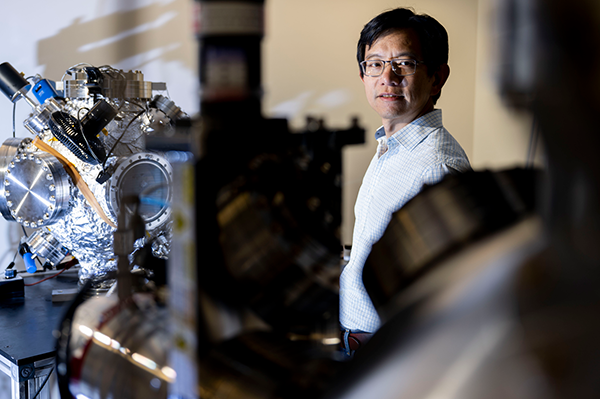
Judy Z. Wu is a University Distinguished Professor in the Department of Physics and Astronomy at the University of Kansas. Her research spans condensed matter physics and astronomy, focusing on thin films, nanostructures, and their applications. Education: PhD in Physics, University of Houston (1993) BS in Physics, University of Science and Technology of China (1986) Her work explores atomic-scale materials engineering for devices like Josephson tunnel junctions, memristors, and photodetectors. Recent publications highlight innovations in superconducting nanocomposites, quantum dot arrays, and 2D material heterostructures. Scientific Awards: KU Women of Distinction (2014-2015) Higuchi Olin Petefish Award (2012) Kemper Fellow (2006) Judy Wu serves as an SPS Advisor and is affiliated with the American Physical Society, American Ceramic Society, and Applied Superconductivity Conference Board. Her lab develops advanced materials aligned with Moore’s Law scaling challenges.
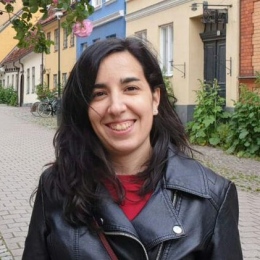
Dr. Laia Gines is a Postdoctoral Researcher at the Department of Physics , Stockholm University , Sweden (2018–Present). Previously, she held postdoctoral positions at Cardiff University (2014–2018) and research roles at institutions in Spain. Education: PhD in Physics, Cardiff University (2018) MSc in Nanoelectronics, Universidad Complutense de Madrid (2012) BSc in Physics, Universidad Complutense de Madrid (2010) Her research focuses on quantum photonics and semiconductor device physics , particularly for generating quantum light states applicable to communication, simulation, and sensing . Key subfields include quantum entanglement , nonlinear optical processes , and nanostructured light sources . She combines experimental quantum optics with computational techniques like deep learning for entanglement analysis from incomplete data. Recent publications highlight her work on nanodiamond coupling to plasmonic antennas (2025), quantum dot entanglement (2023), and broadband micropillar cavities for photon pair extraction (2022). Her team investigates quantum state manipulation and spin coherence in nanomaterials for real-world applications.
Professor Manus Hayne is a leading figure in semiconductor physics at Lancaster University 's Department of Physics , with a focus on low-dimensional semiconductor nanostructures (quantum wells, wires, and dots) and their applications in novel electronic and photonic devices. He collaborates extensively with UK and European institutions, including KU Leuven and University of Exeter . Developed ULTRARAM™ , a patented compound semiconductor memory combining DRAM speed with flash non-volatility Explored GaSb quantum rings for telecom-wavelength single-photon LEDs and VCSELs Career Path : University of Southampton (BSc) University of Exeter (PhD, Postdoc) Research in Paris and KU Leuven (10 years, high magnetic field studies) Joined Lancaster University Physics Department in 2006 Research Trends from 15+ years of publications show expertise in: Quantum dot/wire/ring physics High-magnetic-field semiconductor studies III-V compound semiconductor devices Optoelectronic and memory device development Advanced nanofabrication techniques Photoelectrochemical applications Supervision : Currently advising 6 postgraduate students including Gizem Acar , Kacper Burczyk , and George Seager . Projects focus on III-V memory devices and eye-safe VCSELs . Labs & Collaborations : Active in Quantum Technology Centre and Energy Lancaster , with industry partnerships through spinout Quinas and participation in International Semiconductor Researchers Forum .
Martin Koch is a Professor in the Department of Physics at Philipps-Universität Marburg . He leads the Semiconductor Photonics Group and contributes to teaching and doctoral supervision in physics. Research Focus : Terahertz spectroscopy, quantum well dynamics, materials characterization, and applications in pharmaceuticals and cultural heritage conservation. Key Article Trends : Recent work explores THz for microplastic detection, 3D-printed photonic components, and excitonic behavior in 2D heterostructures. Teaching Roles : Lecturer for Optics and Quantum Phenomena and Functional Materials seminars.
Professor Wolfram Heimbrodt is a distinguished physicist at Philipps University of Marburg, where he leads the Semiconductor Spectroscopy Group (also known as Gerhard's Group) within the Physics Department. His research focuses on advanced optical spectroscopy techniques applied to semiconductor materials, particularly examining the fundamental properties of semiconductors through various spectroscopic methods. Prof. Heimbrodt's research interests span multiple areas of semiconductor physics, with particular emphasis on time-resolved spectroscopy , magnetic spectroscopy , excitation-dependent spectroscopy , and Raman spectroscopy . His work investigates the optical properties of semiconductor heterostructures, quantum dots, and 2D materials, with applications in photovoltaics, optoelectronics, and quantum technologies. The research group explores fundamental questions about charge transfer mechanisms, exciton dynamics, and spin-valley coupling in novel semiconductor systems. Analysis of Prof. Heimbrodt's recent publications reveals a strong focus on 2D materials (particularly transition metal dichalcogenides like WS 2 and WSe 2 ), semiconductor heterostructures, and quantum dot systems. His work spans fundamental physics investigations of spin-valley phenomena in 2D materials to applied research on dye-sensitized solar cells and semiconductor interfaces. The consistent thread through these diverse topics is the application of sophisticated optical spectroscopy techniques to understand material properties at the nanoscale. Prof. Heimbrodt actively mentors students and researchers, with several documented advisees including Johannes Röder, Luise Rost, Nico Hofeditz, and Mikko Wilhelm. His group encourages both Marburg students and external candidates to pursue bachelor's and master's theses on topics related to practical physics challenges in semiconductor research. Current projects involve investigating organic-inorganic semiconductor interfaces, functionalization of semiconductors for IR laser development, and time-resolved photoluminescence studies of quantum dot systems. The Heimbrodt Research Group maintains specialized laboratories for time-resolved, modulated, magnetic, excitation-dependent, and Raman spectroscopy, enabling comprehensive characterization of semiconductor materials. Their work contributes significantly to understanding the fundamental physics of semiconductor materials while exploring applications in energy conversion and quantum technologies.
Benjamin T. King is the Reynold Clayton Fuson Endowed Professor in Chemistry at the University of Nevada, Reno, affiliated with the College of Science and Department of Chemistry. His research focuses on synthetic organic chemistry, organometallic methodology, and theoretical studies of carbon-based materials. Education Postdoctoral Research Associate (2000-2002) at University of California, Berkeley with Robert G. Bergman Ph.D. (2000) from University of Colorado with Josef Michl B.S. (1992) from Northeastern University Research Focus Professor King leads investigations into: (1) Mechanistic studies of the Scholl reaction for polycyclic aromatic hydrocarbon (PAH) synthesis using computational and experimental approaches; (2) Development of zirconium-mediated biphenylation methodologies for strained PAH structures; (3) Electronic structure analysis of carbon nanotubes through valence-bond theory; and (4) Synthesis of novel nanocarbon architectures including quadrannulene and extended triptycenes with potential applications in molecular machinery. Recent Publication Trends King's recent articles (2024-2025) demonstrate interdisciplinary collaboration across quantum electrodynamics, particle physics, materials science, and biomedical research. Dominant themes include strong-field QED experiments, advanced semiconductor laser design, COVID-19 clinical trials, and novel sensor development, reflecting broad applications of chemical principles to physics and engineering challenges. Awards and Honors Reynold Clayton Fuson Endowed Professorship in Chemistry (awarded 1984) Research Infrastructure He directs the King Group, specializing in synthetic organic chemistry and organometallic methodologies. The group maintains expertise in computational chemistry, X-ray crystallography, and advanced synthesis techniques for developing novel carbon nanostructures.
Rui Emanuel Ferreira da Silva is a Researcher at the Max Born Institute for Nonlinear Optics and Short Pulse Spectroscopy, Berlin, Germany. He is affiliated with the Attosecond Theory Group (T1), focusing on ultrafast phenomena and quantum control in condensed matter systems. His work integrates theoretical and computational approaches to understand light-matter interactions, particularly in 2D materials and solid-state systems. Research interests include high-harmonic generation, ultrafast spectroscopy, quantum materials, and nonlinear optics. His studies explore valleytronics, exciton dynamics, and real-space dynamics in solids under strong laser fields. Recent contributions address topics such as polarization-tailored light control, dephasing mechanisms in high-harmonic generation, and optical manipulation of quantum properties in 2D materials. Publications highlight advancements in solid-state HHG, twisted bilayer graphene characterization, and ultrafast phase transitions. Collaborations involve international teams in experimental and theoretical physics. No scientific awards are explicitly listed, but his research is widely published in top journals like Nature , Science Advances , and Physical Review Letters . While no advising or grant details are provided, his contributions to the Attosecond Theory Group reflect active participation in cutting-edge research programs. His lab/team work emphasizes interdisciplinary approaches to advancing ultrafast and quantum optical technologies.
Dr. Felipe Morales Moreno is a Researcher at the Max Born Institute for Nonlinear Optics and Short Pulse Spectroscopy in Berlin. He holds a PhD in Theoretical Chemistry (2009, Universidad Autónoma de Madrid) and an MSc in Computer Science (2004, Universidad Politécnica de Madrid). He has been a Postdoctoral Fellow in Prof. O. Smirnova's group since 2010 and has been a permanent Scientist at the institute since 2012. His research focuses on strong-field phenomena, attosecond science, and numerical methods, with particular emphasis on high-harmonic spectroscopy and laser-matter interactions. He leads Project 2.2 (Strong-field Few-body Physics) and contributes to Projects 1.1 (Fundamentals of Extreme Photonics) and 2.3 (Time-resolved XUV Science). His work bridges theoretical and experimental advances, including attosecond pulse generation, spin-polarized electron beams, and chiral light fields. Notable contributions include ultrafast electron dynamics studies and attoclock techniques for imaging tunneling processes. His research has been supported by fellowships from the Spanish Ministry of Education and features collaborations with leading institutions globally. Education: MSc Computer Science (2004), PhD Theoretical Chemistry (2009) Awards: FPI Fellowship (MEC, 2005–2009) Labs: Strongfield Theory Group (T2)
Lorenzo Orsini is a Postdoctoral Researcher at ICFO, specializing in Quantum Nano-Optoelectronics. His work focuses on photonic systems, polaritons, and 2D materials for nanoscale optical applications. PhD in Photonics, Universitat Politècnica de Catalunya (Spain) Research interests include quantum optoelectronics, hyperbolic materials, and nanophotonic device engineering. His recent publications investigate topological edge states, phonon polaritons, and graphene-based modulators integrated with dielectrics. Lorenzo's scholarly contributions highlight advancements in hyperbolic polaritons, hexagonal boron nitride systems, and 2D-3D material integration. His work spans theoretical modeling and experimental validation in nanophotonics. He can be contacted via email at lorenzo.orsini@icfo.eu and is affiliated with ICFO's Quantum Nano-Optoelectronics group.
Dr. Karuppasamy Soundarapandian is a Postdoctoral Researcher at ICFO (Institute of Photonic Sciences) within the Quantum Nano-Optoelectronics research group. He holds a PhD in Photonics from Universitat Politècnica de Catalunya (Spain). His work focuses on advanced materials and nanostructured systems for optoelectronic applications, with emphasis on graphene-based devices, quantum phenomena in 2D materials, and terahertz communication technologies. Dr. Soundarapandian's research spans from fundamental studies of exciton dynamics and carrier behavior to applied developments in high-speed data transmission and wearable sensors. His technical expertise includes fabrication and characterization of photonic devices, spectroscopic analysis, and integration of nanomaterials into functional systems. Recent projects involve exploring graphene's potential for 6G wireless communications, investigating topological edge states in hyperbolic media, and developing corrosion-resistant materials using natural inhibitors. Extensive experimental capabilities include ultrafast spectroscopy, terahertz time-domain spectroscopy, and advanced electron microscopy techniques. His contributions bridge nanotechnology, quantum physics, and applied photonics, addressing challenges in both fundamental science and next-generation technologies.
Dr. Zoe Velluire-Pellat is a Postdoctoral Researcher at ICFO - The Institute of Photonic Sciences, affiliated with the Quantum Nano-Optoelectronics research group. She holds a PhD in Physics from École Supérieure de Physique et de Chimie Industrielles de la Ville de Paris (Paris, France). Her research focuses on advancing quantum technologies through interdisciplinary exploration of nano-optoelectronic systems. Education: PhD in Physics, École Supérieure de Physique et de Chimie Industrielles de la Ville de Paris (20XX) Research interests include the development of quantum devices, nanoscale photonics integration, and optoelectronic material characterization. Her work bridges fundamental quantum phenomena with practical applications in next-generation photonic systems. Awards and grants: None explicitly listed in available text. Labs/Teams: Active member of the Quantum Nano-Optoelectronics group at ICFO, collaborating on cutting-edge photonics research.
Yoeri B. van de Burgt is an Associate Professor in the Department of Mechanical Engineering at Eindhoven University of Technology (TU/e). He holds affiliations with the Institute of Complex Molecular Studies (ICMS), Eindhoven Hendrik Casimir Institute (EHCI), and Eindhoven Artificial Intelligence Systems Institute (EAISI). His expertise spans materials science, organic electronics, neuromorphic engineering, and cell-material interfaces. He leads the Neuromorphic Engineering group , which focuses on optimizing organic neuromorphic devices for smart biosensors, robotics, and adaptive biointerfaces. PhD in Mechanical Engineering from TU/e (2014) Postdoctoral Fellowship at Stanford University (2014–2016) Visiting Professorships at the University of Cambridge (2017) and Georgia Tech (2022) Research interests include neuromorphic computing, biohybrid systems, and low-energy electronic materials. His work contributes to the UN Sustainable Development Goals related to innovation and sustainable technology. Key awards include the ERC Starting Grant (2018), ERC Consolidator Grant (2024), and TU/e Ground-breaking Researcher Award (2023). He serves on editorial boards for Neuromorphic Computing and Engineering and Frontiers in Neuroscience . His publications emphasize neuromorphic hardware, biosensors, and organic electronic materials, with over 4365 citations. He advises on grants like the 4TU Visiting Research Grant and chairs the Eindhoven Young Academy.
Kin Chung Fong is an Associate Professor in the Department of Electrical and Computer Engineering and holds a joint appointment in Physics at Northeastern University. As a Core Faculty Member of the Quantum Materials and Sensing Institute, he leads research focused on quantum technologies including quantum sensing, quantum networks, and quantum computation using low-dimensional quantum materials. His interdisciplinary work bridges fundamental physics and engineering to develop innovative quantum devices. Fong's research explores electron hydrodynamics, unconventional superconductivity, and novel quantum phenomena in materials like graphene, topological insulators, and Weyl semimetals. His group designs and characterizes quantum devices including single-photon detectors, quantum noise amplifiers, and superconducting qubit systems. Recent publications demonstrate a strong focus on quantum materials characterization and device engineering, with recurring themes in graphene-based detectors, superconducting circuits, and topological materials. Research consistently addresses fundamental limits of quantum measurement while developing practical applications for quantum sensing and computing. Awards & Recognitions: Principal Investigator for DARPA-funded WIdeband graphene-based aXion dARk matter quantum Detector (WIXARD) Fong leads the Quantum Wave-Matter Lab at Northeastern, which develops ultrahigh-sensitivity techniques for investigating quantum phenomena and pioneers technological innovations based on novel physics discoveries.
María Mercedes Velázquez Salicio is a full professor in the Department of Chemical Physics at the University of Salamanca since 2011. Her research focuses on colloid and interface chemistry, nanoparticle films, and advanced materials like graphene. She has led projects on self-assembled surfactant/polymer systems and participated in industry collaborations (e.g., Grupo Antolín) for graphene-based technologies. Education: PhD in Chemistry from the University of Salamanca (postdoc at the Centre for Structural Chemistry, Lisbon, 1987–1990). Prior roles include Associate Professor (1991–2011) and visiting positions at Universidad Complutense de Madrid. Key research areas include Langmuir-Blodgett film fabrication, CO₂ capture using graphene-based hybrids, and photoluminescence properties of nanomaterials. Her work bridges fundamental colloid science with applied nanotechnology for electronics and environmental applications. Recent projects involve synthesizing chemical graphene from nanofibers (GRAnPHTEC) and developing graphene-silver hybrids for automotive devices (DINNAMIC project). Publications emphasize structural characterization (Raman spectroscopy, neutron reflectivity) and functionalization of 2D materials. No scientific awards explicitly mentioned, but her sustained contributions reflect significant academic impact.
David López Díaz is a Researcher in the Physical Chemistry Department at the University of Salamanca. He completed his PhD studies on surface properties of Langmuir and Gibbs monolayers formed by surfactant-polymer mixtures. From 2008 to 2010, he was a postdoctoral researcher at the National Autonomous University of Mexico (UNAM), studying rheological properties of surfactant mixtures and synthesizing Janus particles. His research focuses on nanomaterials, graphene oxide, colloids, and surface chemistry, with applications in energy storage, CO₂ capture, and antibacterial agents. Key techniques include Langmuir-Blodgett deposition and advanced spectroscopic methods like Raman and neutron reflectivity. His work bridges fundamental material science with environmental and biomedical applications. Research interests include: nanocomposite design, interfacial phenomena, optoelectronic properties of nanoparticles, and CO₂ adsorption mechanisms. His work emphasizes understanding chemical composition effects on material behavior, particularly in 2D materials and surface-functionalized systems. Notable contributions include studies on graphene oxide film stability at air-water interfaces and the antibacterial potential of N-doped carbon nanoparticles. He has published extensively in journals like Coatings , Journal of Colloid and Interface Science , and ACS Applied Materials and Interfaces . Advising/Grants: No formal advisees listed, though contributions to collaborative research projects are evident. No grants explicitly mentioned in text.