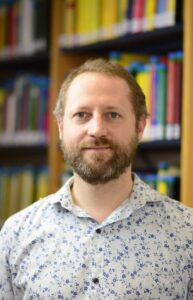
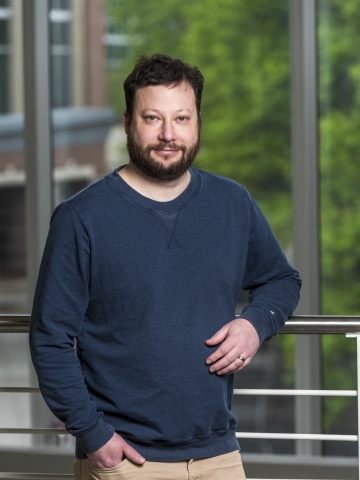
Prof. Herwig Ott leads the research group Ultrakalte Quantengase und Quantenatomoptik at the Department of Physics, RPTU Kaiserslautern-Landau. His research focuses on quantum properties of ultracold matter, particularly ultracold quantum gases and Rydberg atoms. He oversees five state-of-the-art quantum optics laboratories: Rydberg Laboratory, Tweezer Laboratory, BEC Laboratory, ReMi Laboratory, and Rymax (quantum computing). Prof. Ott's research spans from fundamental quantum physics to quantum computing applications. His team investigates phenomena such as Rydberg blockade, ultralong-range Rydberg molecules including trilobite molecules, and quantum many-body systems. The group employs innovative laser, vacuum, and imaging techniques to study atomic interactions at temperatures near absolute zero. Their work has significant implications for quantum simulation, quantum computing, and understanding fundamental quantum phenomena. Analysis of recent publications reveals a strong focus on Rydberg physics with particular emphasis on molecular structures formed by Rydberg atoms, state-changing collisions, and quantum simulation platforms. The research demonstrates increasing sophistication in controlling and measuring quantum systems, with applications moving toward practical quantum computing implementations. The group consistently publishes in high-impact journals including Nature Communications and Physical Review A. Prof. Ott actively mentors students at all levels, offering bachelor's, master's, and doctoral research opportunities. His group comprises numerous researchers working across multiple specialized laboratories. The team investigates topics ranging from technical developments in laser systems and optics to fundamental quantum phenomena. Current projects include developing laser systems for Rydberg excitation, building quantum computers based on neutral atoms, and studying quantum dynamics in ultracold systems. The research group operates five specialized laboratories: the Rydberg Laboratory studies interactions between Rydberg atoms; the Tweezer Laboratory traps individual atoms in optical tweezers; the BEC Laboratory examines ultracold quantum gases under electron microscopy; the ReMi Laboratory observes atomic collisions with full 3D momentum resolution; and Rymax focuses on building quantum computers using neutral atoms.