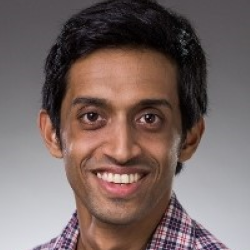
Prakash Murali is an Associate Professor in the Department of Computer Science at Cambridge University, specializing in quantum computing, quantum architecture, and resource estimation. He previously worked as a quantum architect at Microsoft, where he contributed to the Azure Quantum Resource Estimator. He earned his Ph.D. in Computer Science from Princeton University in 2021, with a dissertation recognized by the ACM SIGARCH/IEEE CS TCCA Outstanding Dissertation Award. His research focuses on bridging the gap between quantum algorithms and hardware through compiler and architecture innovations. His awards include the ACM SIGARCH/IEEE CS TCCA Outstanding Dissertation Award (2022), Communications of ACM Research Highlights (2022), and the IBM PhD Fellowship (2021). He leads a research group comprising PhD students (e.g., Sanaa Sharma and Dmitry Filippov), MPhil candidates, and undergraduate researchers. Key contributions include the TriQ compiler framework for quantum systems and the TimeStitch technique for decoherence mitigation. His work has been adopted in industry compilers and has influenced quantum benchmarking practices.
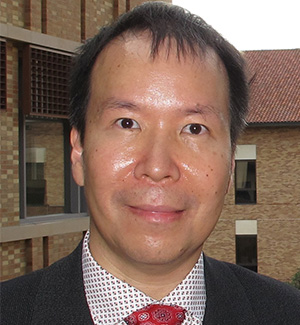
Venkatesan Guruswami is a Chancellor's Professor in the Department of EECS and a Senior Scientist at the Simons Institute for the Theory of Computing at UC Berkeley . He also holds a Professor position in the Department of Mathematics . His academic journey began with a B.Tech in Computer Science from the Indian Institute of Technology, Madras (1997) , followed by a Ph.D. in Computer Science from the Massachusetts Institute of Technology (2001) . After a Miller Research Fellowship at UC Berkeley (2001–02), he held faculty roles at the University of Washington and Carnegie Mellon University before returning to UC Berkeley in January 2022. Education : B.Tech, IIT Madras (1997) Ph.D., MIT (2001) Professional Affiliations : Chancellor's Professor, UC Berkeley (EECS) Senior Scientist & Interim Director, Simons Institute Professor, UC Berkeley (Mathematics) Guruswami's research spans multiple domains within Theoretical Computer Science , focusing on Error-Correcting Codes , Approximation Algorithms , Randomness in Computing , Probabilistically Checkable Proofs , and Computational Complexity . His groundbreaking work in List Decoding has enabled codes with minimal redundancy for correcting worst-case errors, while recent advancements include Polar Codes , Deletion-Correcting Codes , and Constraint Satisfaction Problems . He has also contributed to Quantum Coding Theory , Locally Recoverable Codes , and Approximation Hardness in various computational contexts. His publications reflect a deep engagement with interdisciplinary topics. Key trends include: Quantum Information Theory : Quantum LDPC codes, transversal gates, and quantum storage. Algebraic Coding : Reed-Solomon codes, AG codes, and polynomial-based constructions. Computational Complexity : Hardness of approximation, CSPs, and parameterized intractability. Data Transmission : Polar codes, deletion channels, and feedback mechanisms. Algorithmic Techniques : Spectral methods, semirandom models, and Lasserre hierarchy applications. Guruswami has received numerous accolades, including the Simons Investigator Award , Presburger Award , Packard Fellowship , Sloan Research Fellowship , ACM Doctoral Dissertation Award , and the IEEE Information Theory Society Paper Award . He is an ACM Fellow (2017) and IEEE Fellow (2019) , with recent honors like the Guggenheim Fellowship (2023) and AMS Fellow (2023) . As an advisor, he has mentored over 25 PhD and postdoctoral researchers , including Atri Rudra , Prasad Raghavendra , and Peter Manohar , whose work has won awards like the Edmund M. Clarke Doctoral Dissertation Award and CRA Outstanding Undergraduate Researcher Award . His research is supported by grants from the National Science Foundation , Packard Foundation , and Sloan Foundation . He also serves as Editor-in-Chief of the Journal of the ACM and holds leadership roles in IEEE and arXiv moderation. Guruswami is actively involved in Simons Institute programs and co-organized workshops on Coded Computation and Information Theory . His work bridges theoretical advancements with practical applications in Cloud Storage , Quantum Computing , and Group Testing , including pandemic-era contributions like AC-DC: Amplification Curve Diagnostics for SARS-CoV-2 .
Bryan K. Clark is an Associate Professor in the Department of Physics at the University of Illinois, with his office located in the Engineering Sciences Building. He leads the Clark Research Group, which works at the intersection of quantum information, condensed matter physics, machine learning, and computing. Clark's research spans four main areas: Quantum Computing , where his group develops quantum algorithms and collaborates with experimentalists on superconducting qubit systems; Quantum Many-Body Physics , where he applies computational methods to understand emergent behavior in strongly correlated systems; Algorithms for the Quantum Many-Body Problem , where his group has pioneered techniques like Neural Network Backflow (NNBF) that represent state-of-the-art accuracy for simulating fermions and frustrated magnetism; and Machine Learning for Experiment , where his group develops techniques to analyze experimental data like scanning transmission electron microscopy images. His publication record demonstrates consistent innovation in bridging theoretical quantum information science with practical applications. Recent work focuses on neural network approaches to quantum simulation, quantum error correction/mitigation, and novel qubit architectures like the Floquet Fluxonium Molecule. His research shows a clear trajectory from fundamental questions about the quantum-classical boundary to practical implementations in quantum hardware. Clark actively mentors graduate students, with recent thesis defenses by Faisal Alam, Matt Thibodeau, Chad Germany, James Allen, and Abid. His group has secured significant funding from the NSF and IBM's IIDAI institute to support research in quantum computing and machine learning applications for nano-photonics manufacturing and error mitigation. The Clark Research Group maintains strong connections with experimental teams, particularly in superconducting qubit development and materials characterization. They've developed computational tools like QOSY (Quantum Operators from SYmmetry) that are publicly available on GitHub and have gained recognition in the quantum information community.
Raouf Boutaba is a Professor at the University of Waterloo , serving as Director of the David R. Cheriton School of Computer Science since July 2020. He holds prestigious fellowships including FRSC , FIEEE , FIEC , and FCAE . 2024: Inaugural Rogers Chair in Network Automation 2024: Ontario Research Fund–Research Excellence (ORF–RE) $2M grant for next-gen mobile networks 2021: University Professor title, University of Waterloo Research Interests span network automation, resource management in wired/wireless networks, network function virtualization (NFV), software-defined networking (SDN), cloud computing, blockchain, future Internet architecture, and cybersecurity. His work focuses on zero-touch networks, 5G/B5G slicing, and AI-driven orchestration. Scientific Contributions include 15+ recent publications on topics like reinforcement learning for RAN slicing, encrypted traffic classification, quantum network optimization, and self-driving infrastructure. His projects 5G LEAP and 5G ELITE explore network isolation and Open RAN principles. 2024: IFIP/IEEE CNOM Test of Time Paper Award 2024: Graduate Supervision Excellence Award 2021: Kenneth C. Sevcik Outstanding Student Paper Award (advisor) Teaching includes co-developing the NSERC CREATE Network Softwarization program, offering courses like Network Softwarization: Principles and Foundations (Winter 2024) and Technologies and Enablers since 2018. He emphasizes hands-on training in SDN, NFV, Open RAN, and 5G. Students and Collaborations : Supervised PhD students such as Shihabur R. Chowdhury (2021), Nashid Shahriar (2020), and undergrad Leni Aniva (2022 Gov. Gen. Silver Medal ). His team includes researchers working on 5G, blockchain, and AI-driven network management. Professional Leadership : Organized Rogers TEP Workshops (2024-2025), delivered keynotes at IEEE Globecom, ColCom, and BalkanCom, and served on expert panels for AI orchestration and 5G cybersecurity at major symposia.
Pascal BOUVRY is a full Professor of parallel computing and optimization techniques at the University of Luxembourg's Department of Computer Science , within the Faculty of Science, Technology and Medicine (FSTM) . He currently serves as the Dean of the FSTM and leads the Parallel Computing and Optimisation group . Additionally, he oversees the University's High Performance Computing (HPC) infrastructure. His research focuses on parallel computing, optimization algorithms, distributed systems, and their applications in bioinformatics and distributed environments. Prof. BOUVRY holds a Ph.D. in Computer Science from the University of Grenoble (France) and has extensive industry experience, including roles as CEO/CTO of tech firms and leadership in telecom and financial services sectors. He has pioneered initiatives like the Master in High-Performance Computing and Technopreneurship programs at the University of Luxembourg. His research interests span GPU programming paradigms , federated learning , distributed optimization , and trustworthy AI . Recent work includes advancements in HPC education frameworks, federated learning frameworks (e.g., FedPref), and quantum circuit optimization. He contributes to editorial boards of journals like IEEE Transactions on Sustainable Computing and IEEE Cloud Computing Magazine. Prof. BOUVRY has held international leadership roles, including as Honorary Chair of conferences and active participation in technical committees. His educational efforts emphasize bridging academic research with industrial applications, particularly in HPC and AI.
Antonio Lioy is a Full Professor in the Department of Control and Computer Science (DAUIN) at the Polytechnic University of Turin. He serves as the Cyber Security Representative for the university in national and European government collaborations, is a member of the SmartData@PoliTO interdepartmental center, and acts as Scientific Advisor for the DRIVESEC partnership. His research is deeply rooted in cybersecurity, electronic identity, network and web security, and quantum-resistant systems. His research interests focus on cybersecurity , electronic identity , network security , web security , and quantum cryptography . He leads the TORSEC Security Group and conducts research in LAB 7, with a strong emphasis on trusted computing, post-quantum cryptography, IoT security, and secure network infrastructures. His work aligns with ERC sectors in computer systems and cryptology, and supports UN SDGs on innovation and sustainable cities. His recent publications show a strong trend toward post-quantum cryptography , remote attestation , trusted execution environments , and secure network virtualization . These works appear in top venues such as IEEE, ACM, and IFIP conferences, with a focus on securing future digital infrastructures against emerging threats. Themes include integrity management in softwarized networks, standard-based attestation, and quantum-resistant PKI strategies. He has supervised numerous PhD students, including Davide Colaiacomo, Francesco Vaccaro, Flavio Ciravegna, Grazia D'Onghia, Lorenzo Ferro, Francesco Settanni, Enrico Bravi, Silvia Sisinni, Luca Mannella, and Ignazio Pedone, whose research spans cybersecurity, quantum computing, and IoT. He leads multiple high-profile research projects such as Q-FENCE, QUBIP, SERICS, and FISHY, funded by Horizon Europe and national programs, demonstrating significant grant acquisition and leadership. He is actively involved in research labs and teams, primarily the TORSEC - Security Group (DAUIN) and LAB 7 - Research Laboratory (DAUIN) , which focus on applied cybersecurity research. His projects often involve collaboration with industry and government bodies, emphasizing real-world impact in secure digital identity, critical infrastructure protection, and quantum-safe transitions.
Professor Albert Cheng is a faculty member in the Department of Computer Science at the University of Houston. His research focuses on real-time systems, cyber-physical systems, smart cities, and embedded systems with societal impacts. He has authored over 270 publications and a textbook on real-time systems. Cheng holds roles as an Associate Editor for the IEEE Transactions on Knowledge and Data Engineering and ACM Computing Surveys. His research interests span real-time scheduling, machine learning applications, and systems optimization. Recent work includes vehicular traffic modeling for epidemiological risk reduction, quantum computing response time analysis, and satellite mission planning. Awards include Fulbright Specialist, Distinguished ACM membership, and IEEE Senior Member status. Cheng’s articles demonstrate expertise in real-time scheduling algorithms, cyber-physical systems development, and smart city infrastructure. His contributions bridge theoretical computer science with practical implementations in transportation, healthcare, and aerospace domains. Ongoing efforts include fault-tolerant systems, energy-efficient scheduling, and CPS education initiatives. Awards: Fulbright Specialist, ACM Distinguished Member, IEEE Senior Member, Institute of Physics Fellow Labs/Teams: Hewlett Packard Enterprise Data Science Institute (HPE DSI), Research Computing Data Core (RCDC)
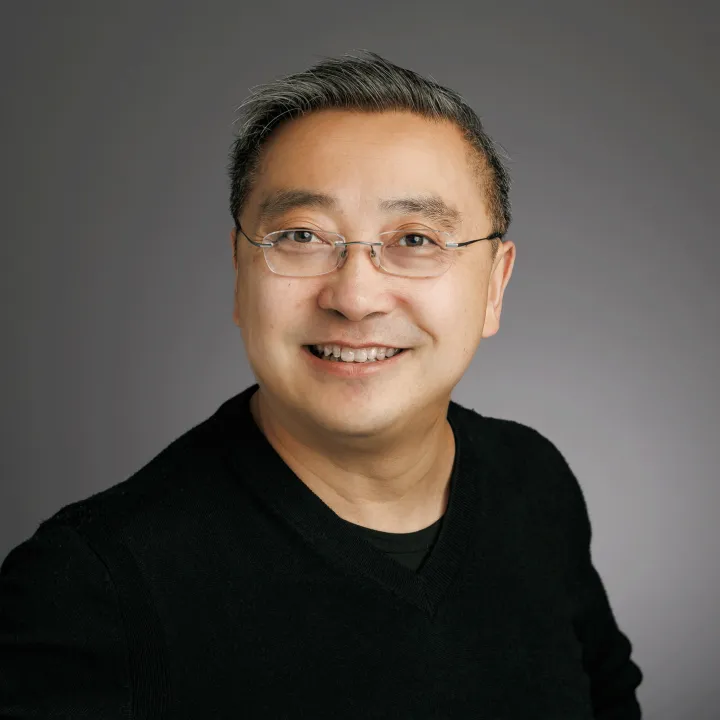
Lin Zhong is the Joseph C. Tsai Professor of Computer Science at Yale University, leading the Efficient Computing Lab. He holds a Ph.D. from Princeton University and M.S./B.S. degrees from Tsinghua University. Previously, he served at Rice University from 2005 to 2019. His research focuses on optimizing computing efficiency, quantum error correction, operating systems, and mobile systems. Education: Ph.D., Princeton University M.S., Tsinghua University B.S., Tsinghua University Research Interests: His work spans quantum computing (e.g., decoding algorithms for surface codes), operating systems (safety, correctness, and lightweight kernels), and mobile/networking systems (massive MIMO, energy-efficient designs). Recent trends include integrating large language models (LLMs) into robotics and securing cloud-based AI workflows. Awards: NSF CAREER Award ACM SIGMOBILE RockStar (2014) and Test of Time (2022) Fellowships from IEEE and ACM Best Paper Awards at ACM MobileHCI, IEEE PerCom, ACM MobiSys, and more Lab & Teams: His Efficient Computing Lab explores systems for quantum error correction (e.g., FPGA-based decoders), secure embedded systems, and LLM-driven robotics. Projects include TimelyLLM (real-time LLM serving) and Blindfold (confidential memory management).
Assoc Prof Wu Hongjun is an Associate Professor at the Division of Mathematical Sciences, School of Physical & Mathematical Sciences, Nanyang Technological University (NTU). His research focuses on cryptography and information security, with notable contributions to lightweight authenticated encryption algorithms like TinyJAMBU and ACORN, as well as cryptanalysis of stream ciphers (e.g., ZUC, HC-128) and hash functions (e.g., JH, SHA-3 candidates). His academic career includes over 15 years of contributions to cryptographic standards, IoT security frameworks, and secure cloud data management. Key areas of expertise encompass symmetric-key cryptography, algorithm design for resource-constrained devices, and vulnerability analysis of cryptographic primitives. Prof Wu has authored influential papers on authenticated encryption modes (AEGIS, MORUS), lightweight cipher optimizations (ACORN), and cryptanalysis techniques applied to Feistel networks and stream ciphers. His work bridges theoretical cryptography with practical implementations across telecommunications, IoT, and cloud computing domains.
Dimitris Mitropoulos is an Assistant Professor at the National and Kapodistrian University of Athens (NKUA) in the Department of Business Administration, where he teaches courses on Distributed Ledger Technologies, Data Security and Privacy, Algorithms and Business Analytics, and Introduction to Programming. He also serves as Head of the Reliability Engineering Directorate at the National Infrastructures for Research and Technology (GRNET), Greece's national research and education network organization. Previously, he was a Postdoctoral Researcher in the Computer Science Department at Columbia University. Dr. Mitropoulos received his Ph.D. degree in Secure Software Development Technologies from the Athens University of Economics and Business (AUEB) in 2014. His doctoral research was supported by the Heracleitus II Scholarship, co-financed by the European Union and Greek national funds. He is a member of prestigious professional organizations including ACM, IEEE, and USENIX. Dr. Mitropoulos conducts pioneering research at the intersection of software engineering and cybersecurity, with particular expertise in secure software development, vulnerability analysis, and blockchain security. His work spans multiple dimensions of software security including code injection attacks, infrastructure as code security, smart contract analysis, and dependency management in software ecosystems. His research methodology combines static and dynamic analysis techniques with empirical studies of real-world software systems, particularly focusing on Java, Python, and Solidity ecosystems. His recent work has made significant contributions to understanding security vulnerabilities in modern software development practices and infrastructure management. Dr. Mitropoulos has received numerous prestigious awards for his research contributions, including the Research Excellence Award from NKUA (2025), Distinguished Paper and Artifact Awards at PLDI '22, Best Data Showcase Award at MSR 2018, and multiple postdoctoral research funding scholarships. His work on "Finding typing compiler bugs" was recognized with both Distinguished Paper and Artifact Awards at PLDI '22, highlighting the significance and reproducibility of his research. He has also received recognition for his service to the academic community, including a Certificate of Appreciation from ESEC/FSE '21 for his contributions to conference organization. Dr. Mitropoulos has been actively involved in securing research funding and leading significant research projects. He currently serves as Principal Investigator for the SecOPERA project (2023-Today), funded by the European Commission under Horizon Europe. Previously, he contributed to several major EU and US-funded projects including eSSIF-Lab (2019-2022), FASTEN (2019-2022), PRIViLEDGE (2018-2021), CERTCOOP (2017-2020), PANORAMIX (2016-2019), and TREDISEC (2016-2018). His research has been supported by diverse funding sources including the European Commission's Horizon 2020 program, the National Science Foundation, and the Defense Advanced Research Projects Agency (DARPA). Dr. Mitropoulos plays an active role in the international research community through various leadership positions. He serves on program committees for top-tier conferences including OOPSLA (2026), ICSE (2026), ESEC/FSE (2025), and ISSTA (2025). He has previously served as Workshop Co-Chair for ISSTA 2025 and Student Volunteer Chair for ESEC/FSE 2021. His contributions to mentoring the next generation of researchers include serving as a mentor for the ICSE Student Mentoring Workshop (2022) and supervising Google Summer of Code projects (2017).
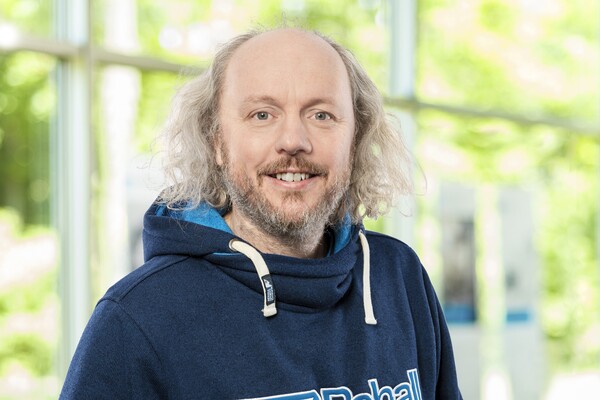
Frank Fitzek serves as Full Professor holding the Deutsche Telekom Chair of Communication Networks at Dresden University of Technology, where he directs the Centre for Tactile Internet (CeTI) Cluster of Excellence and maintains association with the Faculty of Computer Sciences. His work is institutionally anchored within the School of Engineering Sciences and actively engages with 5G Lab Germany and 6G-life Hub initiatives, positioning him at the forefront of next-generation communication research. Fitzek's research spans communication networks, tactile internet systems, 5G/6G mobile technologies, network coding, quantum networking, virtual twinning, and haptic feedback systems. His recent publications demonstrate emphasis on resilient network architectures through quantum security protocols, cloud-native 5G implementations, theoretical communications frameworks, and human-computer interaction in mixed reality environments. This work consistently bridges theoretical innovation with practical testbed validations across multiple emerging technology domains. As Director of CeTI, Fitzek leads a major interdisciplinary research cluster focused on ultra-low latency networks enabling remote physical interaction. His affiliations with 5G Lab Germany and 6G-life Hub facilitate industry-academic collaboration on standardization and deployment of future communication infrastructures, with particular emphasis on network coding techniques and tactile internet applications that transform industrial automation and teleoperation scenarios.
Sri AravindaKrishnan Thyagarajan is a Lecturer at The University of Sydney's School of Computer Science, specializing in cryptography. He focuses on enhancing security and fairness in distributed systems, blockchains, and multi-party computations with applications in post-quantum cryptography. His work spans top-tier conferences like ACM CCS and IEEE SP. Education: B.Tech, Computer Science & Engineering, National Institute of Technology Trichy, India (2011–2015) M.Sc., Computer Science, Saarland University, Germany (2015–2016) Ph.D., Applied Cryptography, Friedrich Alexander Universität Erlangen-Nürnberg, Germany (2016–2021) Research Interests: Cryptography (classical and post-quantum), blockchain security, cryptocurrencies, fairness in multi-party computations, privacy-preserving protocols, and decentralized systems. Recent Articles: Focus on cryptographic protocols for blockchains, threshold cryptography, verifiable randomness, and secure atomic swaps. Recent work includes advancements in post-quantum signatures, distributed randomness generation, and privacy-preserving payment systems. Awards: Nominated for GI Dissertationspreis 2021 Advising & Grants: Advising Ankit Kapoor. Active in program committees for CCS, IEEE SP, and FC. Currently Program Chair for Crypto Valley Conference 2025. Labs/Teams: Part of the Sydney Blockchain Centre and cybersecurity cluster at the University of Sydney. Collaborates globally with institutions like NTT Research, Carnegie Mellon University, and Bocconi University.
Sanjeev Baskiyar is a Professor in the Department of Computer Science and Software Engineering at Auburn University's College of Engineering. He has been actively involved in research, teaching, and academic leadership, with a strong focus on computer systems, real-time and embedded computing, scheduling, cloud and fog computing, and energy-aware architectures. Education: Ph.D., Electrical and Computer Engineering, University of Minnesota M.S., Electrical and Computer Engineering, University of Minnesota B.S., Electronics and Communications, Indian Institute of Science, Bangalore B.S., Physics (with honors), and distinction in Mathematics Dr. Baskiyar’s research interests span scheduling, real-time and embedded systems, computer architecture, fog/cloud computing, thermal/energy-aware computing, and STEM education. His recent work explores machine learning applications in scheduling and quantum computing for fake news detection. He has supervised over 25 graduate students, many of whom now hold academic and industry positions. His recent publications emphasize fog computing simulation, service placement, quantum-inspired fake news detection, and adaptive scheduling using machine learning. These works reflect a trend towards intelligent, scalable, and energy-efficient computing systems, particularly in distributed and edge environments. Scientific Awards and Honors: Walker Teaching Excellence Award, Auburn University, 2020 Summer Faculty Fellow, Air Force Research Labs, 2020 Nominated Best Teaching Assistant, University of Minnesota, 1992 Multiples Merit and State-merit Scholarships Honors in Physics and Distinction in Mathematics Dr. Baskiyar has successfully advised numerous MS and PhD students and secured over $2 million in research funding as Principal Investigator from the National Science Foundation, DARPA, NASA, and industry partners like Wind River Systems and Mentor Graphics. His grants focus on parallel computing education, real-time micro-architectures, and embedded systems. He has also served on editorial boards, program committees, and as a reviewer for NSF and IEEE journals. He has held leadership roles including Senator in the University Faculty Senate and Chair of the E-day Committee. Labs and Research Groups: While not explicitly named, Dr. Baskiyar leads a research group focused on computer systems, scheduling, and embedded computing, as evidenced by his long list of graduate student supervision and funded projects in fog, cloud, and real-time systems.
Dr. Krishnendu Guha is an Assistant Professor and CONNECT Funded Investigator at the School of Computer Science and Information Technology, University College Cork. His research bridges embedded systems, cybersecurity, and quantum-safe hardware design with AI and bio-inspired strategies. PhD: University of Calcutta (Department of Science and Technology, Government of India) Postdoctoral: University of Florida Past Roles: Research Fellow at Intel India, Visiting Scientist at Indian Statistical Institute, Temporary Assistant Professor at NIT Jamshedpur His research focuses on embedded systems security , real-time security mechanisms , and quantum-safe hardware . He integrates AI (e.g., neural networks) and bio-inspired strategies (e.g., gecko crypsis behavior) into security frameworks for FPGAs and edge platforms. Recent publications highlight trends in blockchain for supply chains , quantum machine learning , secure FPGA architectures , and distributed AI systems . His work addresses energy efficiency, fault detection, and decentralized security in hardware. As a CONNECT Centre member, Dr. Guha contributes to advanced research in reconfigurable systems and cybersecurity. Grants and collaborations span quantum-safe design, cloud FPGA security, and hardware trojan mitigation.
Prof. Zheshen Zhang is a Professor in the Department of Electrical and Computer Engineering at the University of Michigan College of Engineering . He leads the Quantum Engineering Lab , focusing on harnessing quantum mechanical resources like entanglement to advance sensing, communication, and computing systems. Academic Rank: Professor Institution: University of Michigan School: College of Engineering Department: Electrical and Computer Engineering Research Interests: His work spans quantum engineering, emphasizing: Quantum computing architectures using continuous-variable cluster states Quantum communication via entanglement-assisted protocols Quantum sensing for precision metrology and dark matter detection Hybrid photonic circuits with Scandium Aluminum Nitride and Silicon Nitride Application of machine learning to quantum information processing Publications Trends: Recent articles highlight: Advances in integrated photonics for scalable quantum devices Development of entanglement-enhanced sensors for covert and precision applications Exploration of exceptional points in optical cavities for metrology Quantum network prototypes enabling open-access quantum computing Machine learning integration with quantum data acquisition